
Yes, Botox works for excessive underarm sweating, and it works well for most men who try it. OnabotulinumtoxinA injections typically cut underarm sweat production by a high proportion for men with primary axillary hyperhidrosis, with results starting within a few days and settling in fully by around two weeks. The effect is temporary, not permanent, and it needs to be carried out by a trained clinician who understands where and how deep to inject.
TL;DR:
- Botox reduces underarm sweating by 82 to 87% with effects starting within 2 to 4 days and fully developing around two weeks.
- Results typically last between 4 and 12 months, depending on dosage, individual nerve regeneration rate, and product formulation.
- Treatment involves mapping sweat-affected areas with iodine-starch testing, followed by 10 to 15 intradermal injections per armpit using a fine needle.
- Candidates should have already tried strong antiperspirants, and women who are pregnant, breastfeeding, or have certain neuromuscular disorders should avoid Botox.
- Proper clinician technique, including precise mapping and dosing, significantly influences effectiveness and the likelihood of needing follow-up treatments.
Table of Contents
- What is hyperhidrosis Botox for underarms, and how does it work?
- Are you a suitable candidate for underarm Botox?
- What happens during a Botox appointment for underarm sweating?
- How long do results last, and when do you need a repeat treatment?
- What are the risks and side effects of underarm Botox?
- What does Botox for underarm sweating cost, and how should you prepare?
- Rivers Edge Skin Studio's approach to underarm Botox for men
- Ready to book your underarm Botox consultation?
- Sources
What is hyperhidrosis Botox for underarms, and how does it work?
Underarm sweating that soaks through shirts by lunchtime isn't a hygiene problem. For a meaningful proportion of men, it's a medical condition called primary axillary hyperhidrosis, and it doesn't respond to stronger deodorant or willpower. Botox for excessive sweating targets the nerve signal that switches sweat glands on, rather than trying to block the sweat itself once it's already there.
Sweat glands are triggered by a chemical messenger called acetylcholine, released from nerve endings near the gland. Botox blocks that release. No signal reaches the gland, so it simply doesn't activate, at least not until the nerve ending regenerates weeks or months later. This is a localised effect. The armpits hold only a small fraction of the body's total sweat glands, so treating them doesn't interfere with how the rest of the body regulates temperature.
The evidence behind this isn't thin. The International Hyperhidrosis Society reports that onabotulinumtoxinA injections reduce underarm sweating by roughly 82 to 87% in treated patients, with partial relief within two to four days and full effect by about two weeks. A 2025 meta-analysis and systematic review confirmed that botulinum toxin A injections significantly outperform placebo for primary axillary hyperhidrosis and carry a favourable safety profile compared with several alternative treatments. Separate clinical review work published on PMC draws the same conclusion across multiple randomised trials: this isn't a fringe therapy propped up by a handful of small studies.
Underarm Botox by the numbers: 82–87% average sweat reduction, onset within 2–4 days, full effect by around 2 weeks, results generally lasting several months.
A few things worth flagging before you assume this is a guaranteed fix:
- Response varies between individuals; some men see near-total dryness, others a strong but partial reduction.
- Underarm results are far better documented than results for palms or soles, where thicker skin and different sweat gland density change the picture.
- The treatment does not cure hyperhidrosis. It manages it, and the nerve signal eventually returns.
That last point matters more than most marketing copy admits. This is symptom control, done well, not a one-off cure.
Are you a suitable candidate for underarm Botox?
Botox for armpit sweating is generally reserved for men who've already tried and failed with clinical-strength antiperspirants. If you've worked through aluminium chloride formulations, tried rotating products, and you're still ruining shirts, that's the point most clinicians consider you a reasonable candidate for injections.
A few groups need to hold off or seek a different route entirely:
- Pregnant or breastfeeding, where the safety data doesn't support elective cosmetic or medical Botox use.
- Certain neuromuscular disorders (myasthenia gravis, Lambert-Eaton syndrome), where toxin effects can spread more than intended.
- Active skin infection at the injection site, which needs treating first.
- Specific medication interactions, including some antibiotics and muscle relaxants, which is why a proper medication history matters before your first injection.
A competent clinic will also want to rule out secondary hyperhidrosis before treating you. Sweating that's new, sudden, or accompanied by weight loss, palpitations, or night sweats can point to thyroid disease or other underlying conditions that need a GP referral, not an injection appointment. Botox treats primary hyperhidrosis, the kind with no underlying medical cause, and a clinician who skips that screening step isn't doing their job properly.
Pro Tip: If sweating is affecting how you dress for work, avoiding certain fabrics or colours, or making you turn down social plans, that's a legitimate clinical reason to book a consultation, not something to just push through.
The practical signposts are usually simple: shirts that mark within an hour of putting them on, odour that returns despite showering twice a day, or sweating that's clearly asymmetric or unusually severe compared with people around you. If any of that sounds familiar, a hyperhidrosis assessment is worth booking before you spend another year cycling through antiperspirants.
What happens during a Botox appointment for underarm sweating?
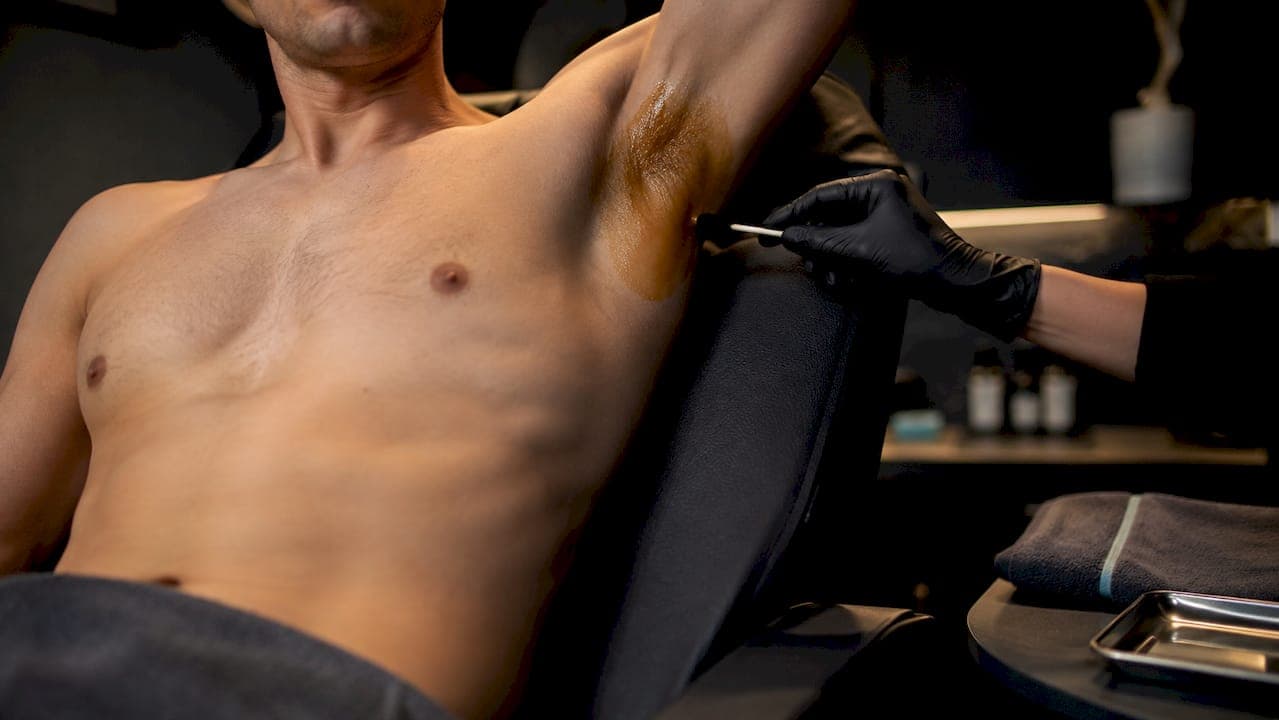
The appointment starts with mapping, not injecting. Clinicians use the Minor's iodine–starch test: iodine solution is painted onto the underarm, then starch powder dusted over it. Where sweat is being produced, the mixture turns a visible blue-black within roughly ten minutes, according to the International Hyperhidrosis Society. That stained area becomes the treatment map, so injections land exactly where the problem is rather than being spread evenly across skin that may not even be sweating.
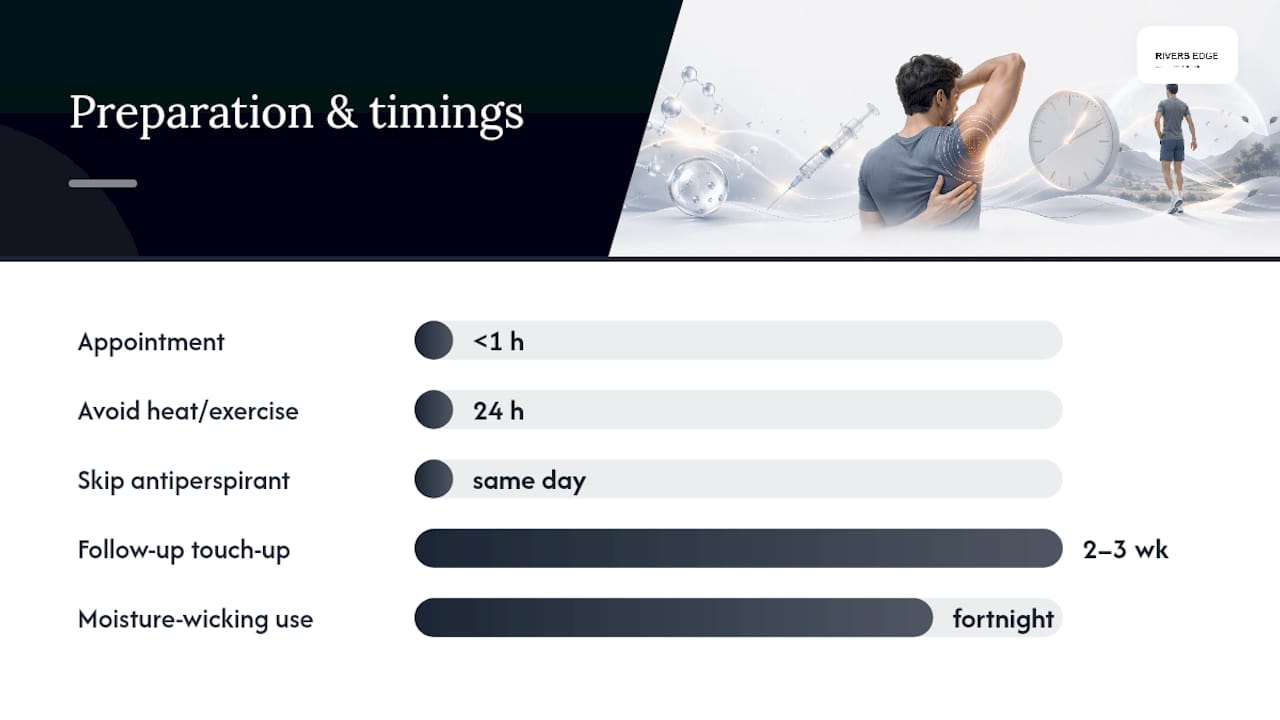
Before you arrive, most clinics ask you to skip antiperspirant on the day and have a few days of underarm hair growth, since a freshly shaved or heavily product-covered underarm can distort the mapping result.
The procedure itself follows a fairly standard pattern:
- The treatment area is cleaned and the iodine-starch map is drawn or marked.
- A grid of 10 to 15 injection sites per underarm is marked out, spaced roughly one to two centimetres apart so the effect of each injection overlaps slightly and covers the whole sweating zone.
- Botox is injected intradermally (into the skin itself, not the muscle) using a fine 30-gauge needle, in small 0.1 to 0.2 millilitre doses per site.
- Manufacturer guidance for hyperhidrosis, per prescribing information, commonly recommends 50 units per axilla, meaning around 100 units for both underarms in a typical session.
- Clinicians deliberately avoid injecting directly through the ink marks, to prevent any risk of tattooing the skin.
| Detail | Typical guidance |
|---|---|
| Injection depth | Intradermal (into skin, not muscle) |
| Sites per underarm | 10–15 |
| Dose per underarm | Around 50 units |
| Needle gauge | 30G |
| Volume per site | 0.1–0.2 mL |
Underarm skin has fewer pain receptors than palms or soles, so most men find this considerably more tolerable than they expect. According to Cleveland Clinic, axillary injections are generally less uncomfortable than palmar or plantar treatment, and clinics typically offer simple analgesia such as ice, topical numbing cream, or a vibrating device to distract nerve signals during the injections, rather than anything more involved. The whole appointment, including mapping, usually takes under an hour, and a follow-up touch-up (if needed) generally revisits any missed patches identified once the full effect kicks in.
How long do results last, and when do you need a repeat treatment?
Results build in over roughly two weeks, then hold steady for months. You'll usually notice a partial reduction in sweating within two to four days of the injections, according to the International Hyperhidrosis Society, with the full effect settling in by around the two-week mark as the nerve endings finish losing their ability to trigger the glands.
Most men can expect underarm Botox to last somewhere between 4 and 12 months before a top-up is needed, though individual results vary considerably.
A few things influence exactly how long you get:
- Dose: Higher doses within the recommended range tend to hold slightly longer, though the relationship isn't perfectly linear.
- Individual physiology: How quickly your nerve endings regenerate varies from person to person, and nobody can predict this precisely before your first treatment.
- Product used: Different botulinum toxin A brands share broadly similar efficacy for hyperhidrosis, but subtle formulation differences can shift duration slightly, which is one reason to ask your clinic what they're actually injecting.
Some men report benefits stretching well beyond the typical window, with certain studies noting outliers lasting up to 14 months. That's the exception rather than the rule, and it isn't something to plan your calendar around.
Repeat treatments don't typically become less effective over time. There's no strong evidence of men building resistance to the toxin with routine hyperhidrosis dosing, which means a man who gets six months of dryness from his first session can generally expect similar performance from his third or fourth. The practical approach is to book your next appointment when sweating starts creeping back, rather than waiting until you're fully back to square one.
What are the risks and side effects of underarm Botox?
The side effect profile for underarm Botox is mild compared with most medical procedures, and serious complications are rare. The most common issues are:
- Mild pain or stinging at the injection sites, usually gone within a day.
- Minor bruising, particularly if you're on blood thinners or have sensitive skin.
- Occasional headache in the days following treatment.
- Rare, transient weakness in nearby muscles if the toxin spreads slightly further than intended.
One concern that comes up constantly in online forums is compensatory sweating, the idea that blocking sweat in one area just pushes it out somewhere else, like your back or face. This is a genuine issue with certain surgical treatments for hyperhidrosis, but according to International Hyperhidrosis Society guidance, it is not considered a major problem with axillary Botox specifically, precisely because the treatment is localised and doesn't disrupt the body's overall thermoregulation system the way surgical sympathectomy can.
Serious reactions, including toxin spreading beyond the treatment area, are uncommon when injections are performed correctly at the recommended dose. This is exactly why the contraindication screening covered earlier matters: ruling out neuromuscular disorders and active infection at the injection site isn't a box-ticking exercise, it's the step that keeps rare complications rare.
Clinician skill genuinely changes your outcome here. Cleveland Clinic's clinical review notes that how precisely a practitioner maps the sweating zone and spaces the injections directly affects both how well the treatment works and how likely you are to need an early touch-up. An underarm treated with a sloppy, evenly-spaced grid that ignores your actual iodine-starch map is more likely to leave patches of untreated sweat glands, which then feels like the treatment "didn't work" when actually it was never applied correctly in the first place. If you're comparing this to Botox used elsewhere on the body, the risk profile changes by location, and it's worth reading about how sweaty hands respond differently if palmar sweating is also on your radar.
What does Botox for underarm sweating cost, and how should you prepare?
Pricing for underarm Botox varies significantly between clinics, largely based on the total dose used, the practitioner's experience, and where in the country you're being treated. Rather than anchoring to a single number you've seen quoted online, ask any clinic you're considering for their exact price per treatment, and confirm whether that figure covers both underarms or just one. It's also worth reading a broader comparison of excessive sweat treatment options if you want to weigh Botox against iontophoresis, oral medication, or newer device-based treatments like miraDry before committing.
Aftercare is straightforward but worth following properly:
- Avoid heavy exercise, saunas, and hot tubs for 24 hours, since raising your body temperature and blood flow to the area can encourage the toxin to spread beyond the injection sites.
- Skip antiperspirant for the rest of the day if your clinic advises it, though most men can resume normal deodorant use the next day.
- Expect the appointment itself, including mapping and injections, to run under an hour, and most men return straight to work afterwards with no visible marks beyond small pinpricks.
- Book any follow-up touch-up appointment for around two to three weeks out, once the full effect has had time to show itself.
While you're waiting for results to kick in, or on days when you know you'll be under pressure, moisture-wicking garments can take some of the anxiety out of the wait. Sweat-proof underwear options are a sensible stopgap for anyone managing symptoms in the fortnight before full effect sets in.
Pro Tip: Always ask your clinic which brand of botulinum toxin they're using and the exact dose per underarm. Different products aren't identical, and having that detail on record makes it far easier to compare notes if you switch clinics for a repeat treatment later.
Rivers Edge Skin Studio's approach to underarm Botox for men
Men come to us for excessive sweating because they've usually already tried everything from the pharmacy shelf and want a clinical option, delivered by someone who treats men specifically, day in and day out. That focus changes how a consultation runs. Dosing, mapping, and technique aren't generic; they're built around how axillary hyperhidrosis actually presents in male patients, and how it affects working life, from client meetings to physical jobs where a soaked shirt isn't an option.
Riversedgeskinstudio has been recognised among the top male Botox providers, a reflection of a clinic built specifically around men's aesthetic and medical skincare needs rather than treating it as an add-on service.
A first consultation covers your sweating history, rules out secondary causes, and walks through the iodine-starch mapping process before any needle comes near your skin. From there, dosing is personalised to your treatment map, not applied as a one-size-fits-all grid, and follow-up is built into the plan from day one so touch-ups happen when you actually need them, not on a rigid schedule that ignores how your body responds.
— David
Ready to book your underarm Botox consultation?
If you've read this far, you already know the antiperspirant aisle isn't going to solve this. Riversedgeskinstudio treats hyperhidrosis the same way it treats every men's skincare concern: with proper mapping, a personalised dose, and a clinician who actually explains what's happening at each step, rather than rushing you through a standard grid of injections.

A first visit starts with an honest assessment of whether Botox is right for you, including the iodine-starch test to map exactly where treatment is needed. If antiperspirants have stopped working and you're tired of planning your wardrobe around sweat patches, the men's skin treatments page has full details on what a consultation involves and how to get booked in. Get in touch, describe what you're dealing with, and find out whether you're a suitable candidate before committing to anything.
Sources
- OnabotulinumtoxinA Injections (Botox®) — International Hyperhidrosis Society
- Treatment of hyperhidrosis with Botox (onabotulinumtoxinA): Development, insights, and impact — PMC
- BOTOX® prescribing information — DailyMed
- Botox for sweating — Cleveland Clinic
- Efficacy and Safety of Botulinum Toxin Type A in Primary Axillary Hyperhidrosis: A Meta-analysis and Systematic Review
This article is general information, not a substitute for advice from a qualified doctor. Consult a qualified healthcare professional about your own circumstances before acting on anything here.