

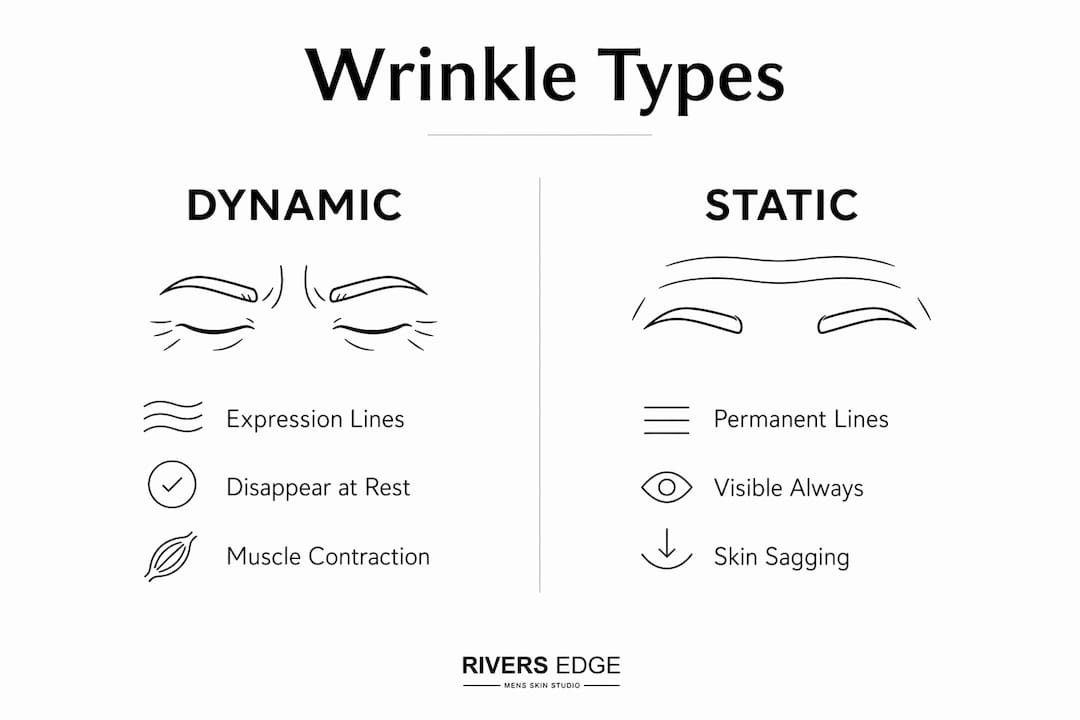
Dynamic wrinkles are defined as lines that appear on the face during muscle contractions and disappear when those muscles relax. They are the creases you see when you smile, squint, or frown, and they vanish the moment your face is at rest. Unlike static wrinkles, which remain visible regardless of expression, dynamic lines are movement-driven. Treatments like onabotulinumtoxinA (commonly known as Botox) target the underlying muscle activity directly, making them far more responsive to neuromodulator injections than their static counterparts. Understanding the distinction is the first step toward choosing the right approach for your skin.
What are dynamic wrinkles and how do they differ from static wrinkles?
Dynamic wrinkles form due to facial muscle contractions during expressions and disappear when muscles relax, unlike static wrinkles that remain visible at rest. That single difference determines everything about how each type is treated. Static wrinkles involve structural skin changes such as collagen loss and skin thinning, which means they persist even when your face is completely still.

The distinction matters practically. If you raise your eyebrows and the lines across your forehead vanish the moment you lower them, those are dynamic lines. If those same lines stay put while your face is neutral, they have progressed to static. Most men in their late twenties and thirties are dealing predominantly with dynamic lines, which is good news because this type responds well to targeted treatment.
| Feature | Dynamic wrinkles | Static wrinkles |
|---|---|---|
| Visibility | Present during expression only | Visible at rest and during expression |
| Primary cause | Repeated muscle contractions | Collagen loss, skin thinning, UV damage |
| Best treatment | Neuromodulator injections (onabotulinumtoxinA) | Dermal fillers, resurfacing, combination therapy |
| Reversibility | Highly reversible with treatment | More difficult to correct |
| Typical onset | Late twenties to mid-thirties | Mid-thirties onward |
The table above shows why timing matters. Catching lines while they are still dynamic gives you the most treatment options and the most predictable results.
What causes dynamic wrinkles and where do they appear?
Facial muscle contractions are the direct cause of dynamic wrinkle formation. Every time you squint, raise your brows, or purse your lips, the underlying mimic muscles shorten and fold the overlying skin. Repeat that thousands of times over years and the skin begins to crease along those fold lines.
The most common types of dynamic wrinkles follow predictable anatomical patterns:
- Forehead lines form when the frontalis muscle lifts the brows. The frontalis muscle's anatomy and individual muscle strength directly influence how pronounced these lines become and how well they respond to neuromodulators.
- Glabellar lines (the "11s" between the brows) result from the corrugator supercilii and procerus muscles contracting during concentration or frowning.
- Crow's feet appear at the outer corners of the eyes from the orbicularis oculi muscle contracting during smiling and squinting.
- Lip lines develop around the mouth from the orbicularis oris muscle during speech and expression.
Individual variability plays a significant role. Men with stronger facial muscles, more expressive habits, or thinner skin tend to develop dynamic lines earlier and more deeply. Sun exposure accelerates the process by degrading collagen, which reduces the skin's ability to spring back after each contraction.
Pro Tip: If you are unsure whether a line is dynamic or static, take a photo with a neutral expression in good lighting. Lines visible in that photo are static. Lines that only appear when you animate your face are dynamic and will respond well to neuromodulator treatment.
What treatment options effectively address dynamic wrinkles?
Botulinum toxin injections relax the muscles responsible for dynamic wrinkles, temporarily reducing their appearance across areas like frown lines, forehead lines, and crow's feet. The mechanism is precise: onabotulinumtoxinA blocks the nerve signal to the targeted muscle, preventing the contraction that creates the crease. This is fundamentally different from filling a wrinkle or resurfacing the skin.
The clinical timeline is well established. Effects typically develop over approximately two weeks and last around three to four months. This means you should not judge results at day five. Many men book a follow-up too early, before the full effect has settled, and risk over-treatment as a result.
Safety is determined largely by technique. Injections for forehead lines must maintain at least a 2 cm distance from the orbital rim to avoid complications such as eyelid or eyebrow ptosis. This is not a treatment where anatomical knowledge is optional. Precise assessment of injection sites is what separates a natural result from a frozen or drooping one.
Beyond neuromodulators, a well-rounded approach to dynamic wrinkle treatments includes:
- Skin booster injections to improve hydration and skin quality, supporting the skin's resilience between neuromodulator sessions. The men's guide to skin boosters covers precautions around sensitive facial areas in detail.
- Dermal fillers to address any volume loss that accompanies the wrinkle, particularly around the temples and mid-face.
- Microneedling to stimulate collagen production and improve overall skin texture, complementing the muscle-relaxing effect of neuromodulators.
- Medical-grade skincare including retinoids and peptide-based moisturisers to support skin structure between clinic appointments.
Dynamic wrinkles yield more dramatic results with botulinum toxin compared to static wrinkles, which often require multiple treatment modalities. This is why identifying the wrinkle type correctly before treatment is not a formality. It directly determines which approach will produce results.
Pro Tip: Ask your practitioner to assess your muscle activity while your face is animated, not just at rest. A thorough dynamic assessment produces a more personalised injection plan and a more natural outcome.
How can dynamic wrinkles be prevented or delayed?
Prevention is not about eliminating expression. It is about giving your skin the structural support it needs to recover from repeated movement without permanently creasing. The earlier you start, the more you preserve.
Sun protection and lifestyle factors such as avoiding smoking and maintaining hydration significantly influence wrinkle formation and skin ageing. UV radiation degrades collagen and elastin, the two proteins that allow skin to rebound after each facial movement. Without them, dynamic lines deepen faster and transition to static lines sooner.
Practical prevention strategies include:
- Daily SPF 30 or higher applied to the face, neck, and eye area every morning, regardless of cloud cover or season.
- Retinoids (retinol or prescription tretinoin) used consistently to stimulate collagen production and accelerate cell turnover.
- Adequate hydration both topically through a quality moisturiser and systemically through water intake, which maintains skin plumpness and elasticity.
- Avoiding smoking, which constricts blood vessels, reduces oxygen delivery to skin cells, and dramatically accelerates collagen breakdown.
- Dietary support through antioxidant-rich foods, omega-3 fatty acids, and vitamin C, all of which support collagen synthesis and protect against oxidative damage.
Early intervention with neuromodulator injections also functions as prevention. Treating dynamic lines early can prevent their progression into static wrinkles, which are considerably more difficult to address. This is a point many men miss: neuromodulators are not just a reactive treatment. Used strategically, they are a preventive tool.
What happens when dynamic wrinkles become static?
Dynamic wrinkles start as temporary expression lines but over years they may become permanent static wrinkles as skin loses elasticity and collagen support. The transition is gradual and often goes unnoticed until a line that used to disappear at rest no longer does. At that point, the treatment strategy must shift.
The table below illustrates how the management approach changes as wrinkles progress:
| Stage | Wrinkle type | Recommended approach |
|---|---|---|
| Early (lines only during expression) | Dynamic | Neuromodulator injections alone |
| Intermediate (faint lines at rest) | Transitional | Neuromodulators plus skin boosters or retinoids |
| Advanced (lines visible at rest) | Static | Combination: fillers, resurfacing, neuromodulators |
Combined treatment approaches are often necessary once wrinkles become static, which is why early action produces better long-term outcomes with less intervention overall. The men who achieve the most natural-looking results are typically those who addressed their dynamic lines before they became permanent features of their resting face.
Practitioners who customise injection plans based on detailed anatomical assessment consistently achieve better outcomes and fewer complications. This is especially relevant for men, whose facial muscles tend to be larger and stronger than women's, requiring adjusted dosing and placement to achieve the same softening effect without over-treating.
Key takeaways
Dynamic wrinkles are movement-driven lines that respond well to neuromodulator injections when treated before they transition into permanent static wrinkles.
| Point | Details |
|---|---|
| Dynamic vs static distinction | Dynamic lines disappear at rest; static lines persist and require more complex treatment. |
| Primary treatment | OnabotulinumtoxinA relaxes target muscles; full effects develop over two weeks and last three to four months. |
| Safety margins matter | Forehead injections require at least 2 cm clearance from the orbital rim to avoid ptosis. |
| Prevention is active | Daily SPF, retinoids, and avoiding smoking preserve collagen and delay the transition to static wrinkles. |
| Early treatment pays off | Addressing dynamic lines before they become static reduces the complexity and cost of long-term care. |
Why I think most men misread the timeline on wrinkle treatment
Most men who come in for their first neuromodulator appointment expect to see results within a few days. When they do not, they either assume the treatment has not worked or they book a top-up too early. Both responses create problems. The two-week onset is not a guideline. It is the biological reality of how botulinum toxin interacts with neuromuscular junctions.
What I have found, working with male clients specifically, is that the bigger issue is not impatience. It is the tendency to over-correct once results do appear. There is a meaningful difference between softening a dynamic line and eliminating all movement in a muscle group. The first looks natural. The second does not. Men with stronger facial muscles are particularly at risk of over-treatment because practitioners sometimes increase dosing to compensate for muscle mass without fully accounting for the aesthetic impact.
My honest view is that the best outcomes come from treating less and assessing more. A conservative first session, a proper two-week review, and an adjusted plan based on actual results will always outperform an aggressive single session. The types of facial treatments available for men have expanded considerably, but neuromodulators remain the most effective tool for dynamic lines precisely because they address the cause rather than the symptom. Use them with patience and precision, not volume.
— David
Treat dynamic wrinkles with confidence at Riversedgeskinstudio

Riversedgeskinstudio specialises in men's aesthetic treatments, with a particular focus on natural-looking results from anti-wrinkle injections, skin boosters, and complementary skin health procedures. Every treatment plan is built around your individual muscle anatomy and skin condition, not a generic protocol. If you are seeing lines appear during expression and want to address them before they become permanent, this is the right time to act. Explore the full range of men's skin treatments at Riversedgeskinstudio and book a consultation with a practitioner who understands how male skin ages and responds to treatment.
FAQ
What are dynamic wrinkles exactly?
Dynamic wrinkles are facial lines that form during muscle contractions and disappear when the face is at rest. Common examples include forehead lines, crow's feet, and glabellar lines between the brows.
Are dynamic wrinkles reversible?
Yes. Dynamic wrinkles respond well to onabotulinumtoxinA injections, which relax the underlying muscles. Effects develop over approximately two weeks and last three to four months.
What is the difference between static and dynamic wrinkles?
Dynamic wrinkles only appear during facial expressions, while static wrinkles remain visible even when the face is completely relaxed. Static wrinkles involve structural changes such as collagen loss and require more complex treatment approaches.
How can I prevent dynamic wrinkles from becoming permanent?
Daily SPF use, retinoids, adequate hydration, and avoiding smoking all preserve collagen and slow the transition from dynamic to static lines. Early neuromodulator treatment also delays this progression.
How long does treatment for dynamic wrinkles last?
Botulinum toxin injections typically produce effects that last three to four months. Consistent treatment over time can train muscles to contract less forcefully, potentially extending the interval between sessions.