

Most men walk into a skin clinic without a single prepared question. They sit down, nod along, and walk out with a treatment plan they barely understood. Knowing what to ask skin clinic men-focused consultants before your appointment changes that dynamic entirely. This guide covers the skin treatment questions for men that actually matter, from verifying who is holding the needle to understanding how male skin biology affects which products will actually work for your face.
Table of Contents
- Key takeaways
- What to ask skin clinic men: understanding male skin first
- Practical questions about the clinic and staff credentials
- Questions about treatment options and expected results
- How to ask about personalised skincare routines
- Questions men forget to ask but really should
- My take on why prepared questions change everything
- Ready to put your questions to the right clinic?
- FAQ
Key takeaways
| Point | Details |
|---|---|
| Male skin needs specific questions | Ask whether treatments and products are formulated for male skin's thicker, oilier biology. |
| Credentials matter more than branding | Always confirm who performs your treatment and their specific qualifications before booking. |
| Personalised routines beat generic advice | Ask for a daily skincare plan tailored to your skin type, not a shelf of branded products. |
| Prepare questions on side effects | Know exactly what adverse reactions look like and how to manage them before you leave. |
| Cost and frequency need clarity upfront | Ask about total treatment costs, maintenance schedules, and what happens if results disappoint. |
What to ask skin clinic men: understanding male skin first
Before you walk in, you need to understand why male skin requires a different line of questioning altogether. This is not vanity. It is biology.
Male skin is measurably different from female skin in ways that affect which treatments work and which products cause more harm than good. Men's skin is thicker, has a lower pH, produces significantly more sebum, and mounts a stronger inflammatory response. Products formulated for women penetrate differently and often lack the calming ingredients that male skin actually needs.
There are a few common concerns that show up repeatedly in men's skin care inquiries at clinics:
- Shaving irritation and razor burn, which break down the skin barrier repeatedly over time
- Oily, congested skin that can trap bacteria and worsen breakouts despite regular washing
- Sensitivity and redness, which are more common than men expect. Up to 60% of men report having sensitive skin with dryness and irritation as their primary symptoms
- Sun damage on overlooked areas like the scalp, ears, and neck, where SPF is rarely applied
- Signs of ageing, including deep lines, loss of firmness, and uneven tone from years without protection
If you ask generic questions at a clinic, you get generic answers. If you walk in knowing that your skin has a distinct biology, you can ask whether the clinic's protocols actually account for that. Ask directly: "Are your treatments and products specifically designed for male skin, or adapted from female-focused formulations?" That one question tells you a great deal about the clinic's approach.
Pro Tip: Before your appointment, write down your three biggest skin concerns in plain language. Being specific gives the practitioner something concrete to address, rather than offering a broad assessment that may not suit your actual goals.
Practical questions about the clinic and staff credentials
This section matters more than most men realise. The aesthetics industry is not uniformly regulated, which means the responsibility for checking a clinic's safety standards falls largely on you.
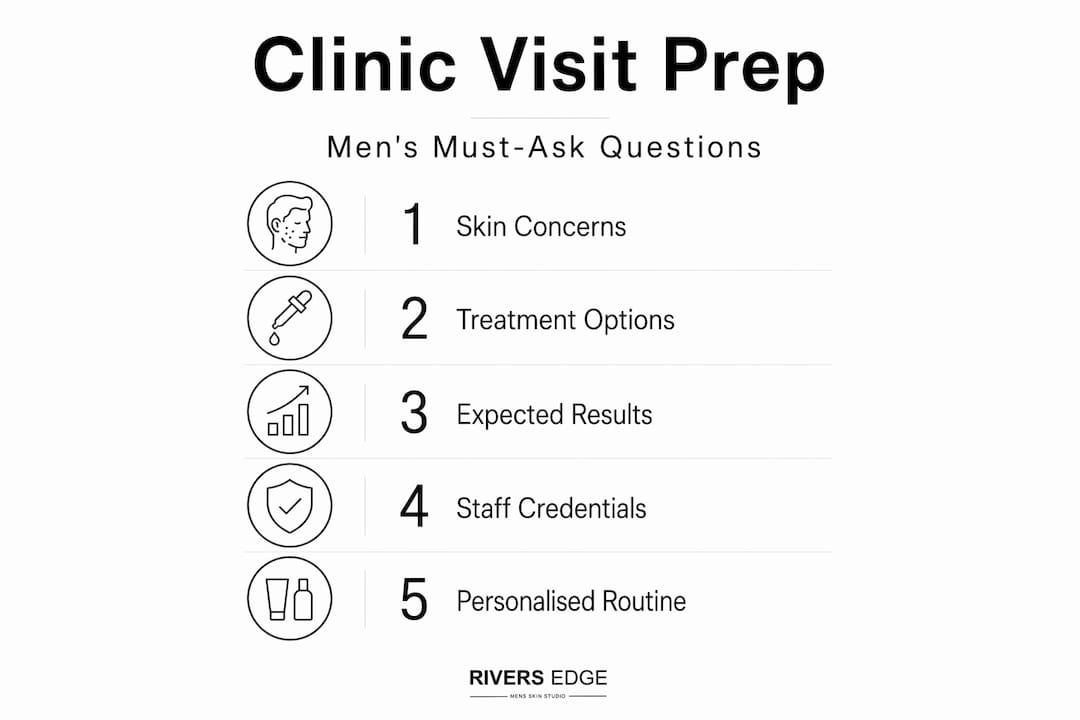
Here are the most important dermatology questions for men to ask before committing to any treatment:
-
Who will actually perform my treatment? Consultations are often conducted by a different person than the one who delivers the procedure. Confirm the practitioner's name, their qualifications, and their specific experience with the treatment you are booking.
-
What level of medical oversight does the clinic have? There is a meaningful difference between a physician being onsite during procedures and one who only reviews charts remotely after the fact. Medical oversight must match the complexity of your treatment for safe, effective outcomes.
-
What are the clinic's hygiene protocols? Ask specifically about sterilisation of equipment, single-use needles, and how cross-contamination is prevented between clients.
-
What aftercare support do you provide? A clinic that cannot answer this question in detail is one that may not be monitoring your results properly once you leave.
-
What are the possible side effects and how common are they? You want specifics here, not reassurances. Ask what percentage of clients experience redness, swelling, or adverse reactions, and what the protocol is when something goes wrong.
-
Are there any contraindications for my skin type or medical history? This is where your medication list and any existing skin conditions become relevant. A thorough clinic will ask you for this information. If they do not, raise it yourself.
These are the best questions for skin specialist visits because they put safety at the centre of the conversation before any treatment is decided. A reputable clinic will answer every one of them without hesitation.
Pro Tip: Ask to see the practitioner's certificates and public registration details before your first appointment. Any legitimate clinic will provide this without issue. If there is resistance, treat it as a red flag.
Questions about treatment options and expected results
Once you have confirmed the clinic's credentials, the conversation shifts to outcomes. This is where skin treatment questions for men get more specific, and more interesting.

The table below shows common male skin concerns alongside the treatments most frequently recommended, and what to ask about each:
| Concern | Common treatments | Key question to ask |
|---|---|---|
| Oily, congested skin | HydraFacial, chemical peel | How often do I need this to maintain results? |
| Razor burn and sensitivity | Microneedling, LED therapy | Has this been performed on clients with active sensitivity? |
| Fine lines and loss of firmness | Anti-wrinkle injections, microneedling | What does a natural-looking result actually mean in practice? |
| Uneven tone and dullness | Chemical peels, HydraFacial | What ingredients are used and are they suitable for my skin pH? |
| Hair thinning at scalp | Scalp microneedling, wellness injections | What timeline should I expect and how are results monitored? |
Beyond what is on this table, ask about treatment combinations. Clinics sometimes recommend stacking procedures, which can be genuinely effective, or unnecessarily expensive. Ask whether each additional treatment adds measurable value for your specific concern, or whether it is supplementary.
You should also ask:
- What is a realistic timeline for visible results with my skin type?
- How many sessions will I need before I see meaningful change?
- Are there treatments you would not recommend for me, and why?
- What happens if I do not see the results we discussed?
That last question matters. It separates clinics focused on outcomes from those focused on bookings. A good clinic will have a clear answer about follow-up assessments and adjustments. Learning about what local treatments suit men's skin before your appointment also gives you a useful reference point when evaluating the options presented to you.
How to ask about personalised skincare routines
A clinic visit is not just about in-clinic treatments. One of the most valuable things a skin specialist can offer is a personalised daily routine, and it is one of the most under-utilised parts of a consultation.
Generic skincare advice does not account for the fact that sodium lauryl sulfate in standard body washes reduces the skin's lipid barrier by around 30% over four weeks. It does not account for the fact that hot showers compound this effect. Clinic advice should.
When seeking men's skincare consultation tips on routine building, ask the following:
- What cleanser suits my skin type? Ask whether the clinic recommends a syndet bar or a pH-balanced gel rather than a standard soap or SLS-based wash.
- Which active ingredients should I be using? Retinol is worth asking about specifically. A gradual introduction starting at 0.5% concentration, used once or twice weekly for four to six weeks before increasing, is the standard starting point. Rushing this causes irritation.
- What SPF do you recommend for men? Sun protection is non-negotiable. Rosacea flares in over 80% of sufferers are triggered by sun exposure, and men routinely skip SPF on the scalp, ears, and back of the neck. Ask for a specific product recommendation rather than a general suggestion to use sunscreen.
- Are the clinic's retail products designed for male skin? This is not a trivial question. Formulations matter, and products built around female skin biology may not penetrate male skin effectively.
Understanding the difference between professional and at-home care is also worth your time. The article on professional vs home skincare for men lays out what each approach does well, which helps you ask sharper questions about what to continue at home between clinic visits.
Questions men forget to ask but really should
These are the blind spots. The questions that get left out because they feel awkward, or because the consultation moves quickly and the moment passes.
"The best skin consultation I ever heard about was from a man who asked the practitioner: 'What would you not do if this were your face?' He got a completely different answer than the treatment plan already on the table."
That instinct to ask for the honest version of the advice is exactly right. Beyond that, the forgotten questions include:
- Who handles my follow-up? Will it be the same practitioner, or whoever happens to be available? Continuity of care matters for tracking how your skin responds over time.
- What is the full cost, including maintenance? A single session price rarely reflects the actual investment. Ask for a total cost over six months if ongoing treatments are being recommended.
- How do I recognise an adverse reaction early? You should leave the clinic knowing exactly what to watch for in the first 48 hours after any procedure.
- Are there alternative approaches if this treatment is not right for me? Clinics that only offer one path to a result may not be offering the most appropriate path for your skin.
These skin clinic advice for men conversations work best when you treat them as a dialogue, not a sales presentation.
My take on why prepared questions change everything
I have spoken to enough men about this topic to know that most of them feel underprepared walking into a clinic. Not because they lack interest, but because skincare consultations have historically been designed around a female client experience. Men are handed the same assessment process, the same intake forms, the same retail recommendations, and told it is personalised.
What I have seen, time and again, is that the men who get the best results are the ones who arrive with specific questions. Not aggressive questions. Not sceptical ones. Just precise ones. "What makes this treatment right for thicker skin?" or "What would an unsatisfactory result look like, and what is the plan then?" Those questions reframe the entire consultation.
The biggest misconception I encounter is that asking questions is somehow distrustful or difficult. It is the opposite. A practitioner who welcomes your questions is a practitioner who is confident in what they are doing. A clinic that deflects them is one worth walking away from.
Think of a skin clinic consultation the way you would think of any professional service. You would ask your mechanic why they are recommending a part. You would ask your accountant to explain a strategy. A skin clinic is no different. You are the one wearing the results. Treat every appointment like a partnership, and prepare accordingly.
— David
Ready to put your questions to the right clinic?

If this guide has given you a clearer picture of what to ask and what to expect, the next step is finding a clinic that can actually answer those questions with confidence. Riversedgeskinstudio is built specifically for men, with treatments, protocols, and practitioners chosen for male skin biology rather than adapted from a different client base entirely.
From HydraFacials and chemical peels to anti-wrinkle injections, microneedling, and scalp treatments, every service is delivered in a setting designed to feel straightforward and professional. Explore the full range of men's skin treatments available at Riversedgeskinstudio, or visit the main clinic page to book a consultation where your questions will actually get answered.
FAQ
What should men ask at their first skin clinic visit?
Ask who will perform your treatment, what their qualifications are, and whether the protocols are designed for male skin. Also confirm the full cost including any maintenance sessions.
Are skin clinic treatments different for men?
Yes. Male skin biology is distinct in thickness, oil production, and inflammatory response, which means treatment protocols and product formulations need to account for those differences.
How do I check if a skin clinic is safe?
Ask whether a physician provides medical oversight onsite, confirm your practitioner's credentials, and ask specifically about hygiene protocols and adverse reaction procedures before committing to any treatment.
When should men start using retinol after a consultation?
Start with a 0.5% retinol concentration once or twice weekly and allow four to six weeks before increasing. Rushing this introduction causes redness and irritation, particularly for men with sensitive skin.
What questions should men ask about skincare routines?
Ask whether the products recommended are formulated for male skin, what active ingredients suit your skin type, and which SPF is appropriate for your daily routine including overlooked areas like the scalp and ears.