

Men avoid skincare clinics not because they lack concern for their skin, but because social stigma, psychological discomfort, and gendered marketing create barriers that feel impossible to cross. A 2026 survey found that 92% of men admit to having skin concerns, yet only 8.3% have sought treatment from an aesthetic dermatologist. That gap is not apathy. It is the product of deeply rooted cultural expectations, fear of judgement, and an industry that has historically spoken to women. Understanding why men skip skincare treatment is the first step to changing that.
Why men avoid skincare clinics: the social and cultural roots
The most persistent barrier to men's skincare clinic attendance is social conditioning around masculinity. From an early age, men are taught that self-care is feminine, and that stoicism is strength. Skincare sits uncomfortably outside that framework for many men, particularly in communities where those norms are reinforced by family, peers, and culture.
Peer policing is a real force. Men report fear of ridicule from friends or colleagues for taking an interest in their skin. This is not abstract anxiety. Salon owner Prity Farooq, who works within South Asian communities, has highlighted the cultural stigma men face when seeking skincare, including intrusive questions about their sexual identity. That kind of questioning does not just embarrass. It deters.
"Looking after your skin is a health necessity. It is not tied to masculinity or sexual orientation." — Prity Farooq, salon owner
The barriers are especially pronounced in conservative communities, where men's skincare clinic reluctance is reinforced by collective expectations rather than individual choice. Men in these settings face a double pressure: the general social stigma around male grooming, and the specific cultural weight of being seen to deviate from masculine norms.
Key social and cultural barriers include:
- Fear of being judged by peers or family members
- Assumptions about sexual identity linked to skincare interest
- Cultural expectations that equate stoicism with ignoring health
- Lack of male role models who openly discuss skincare
- Clinic environments that feel designed exclusively for women
Does gendered marketing push men away from skincare?
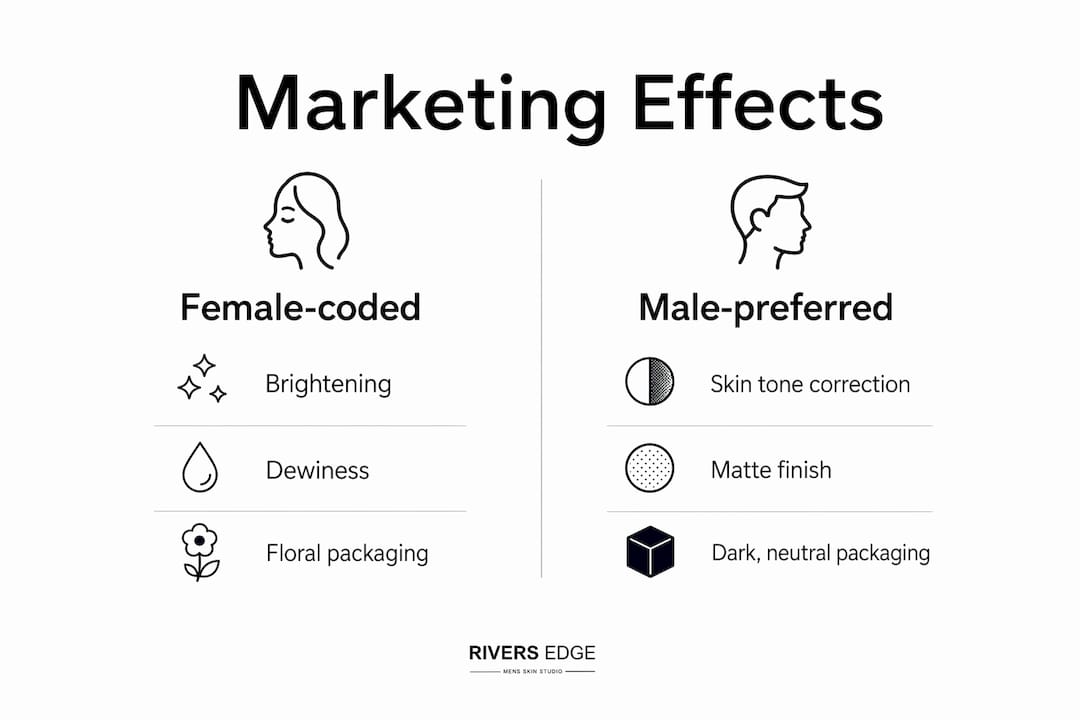
The skincare industry has built its vocabulary around women. Terms like "brightening," "dewiness," and "glow" are not neutral. They carry a gendered emotional charge that alienates male patients before they even walk through the door. Men respond to functional, health-focused language. "Epidermal restoration" or "dermal clarity" land differently than "radiance boost."
| Female-coded language | Male-preferred equivalent |
|---|---|
| Brightening treatment | Skin tone correction |
| Glow facial | Dermal clarity treatment |
| Anti-ageing ritual | Preventive skin maintenance |
| Dewiness boost | Hydration optimisation |
| Beauty routine | Skin health protocol |
Research confirms this gap. Self-image and social factors account for 60.7% of the variation in men's intention to buy skincare products. That figure tells you marketing alignment is not a minor detail. It is the deciding factor for most male buyers.
Packaging compounds the problem. Products in pink or pastel packaging with floral imagery send a clear signal to men: this is not for you. Men seeking function-first solutions find themselves navigating a market that appears to exclude them at every touchpoint, from shelf design to clinic reception areas.
Pro Tip: If you are looking at a clinic's website and every image features women, that is a signal worth noting. A clinic that genuinely serves men will show male clients and use language that speaks to your priorities, not borrowed beauty copy.
What psychological barriers stop men seeking professional skincare?
Embarrassment is the dominant reason men avoid professional skincare treatment. 73.6% of men who have not visited a skincare clinic cite embarrassment or unease as their primary reason. That is not a small cohort of particularly self-conscious men. It is the overwhelming majority of men with skin concerns who have never sought help.

Low dermatological literacy makes this worse. Men often do not recognise early skin issues as health problems requiring professional attention. A patch of rough skin, persistent redness, or early acne scarring gets dismissed as normal rather than treated. By the time men do seek help, conditions have often progressed to a point where outcomes are less straightforward.
The misconception that skincare is purely cosmetic runs deep. Traditional masculinity ideologies equate stoicism with ignoring health needs, which means men frame clinic visits as vanity rather than maintenance. Dermatologists consistently recommend reframing skincare as preventive health, the same way men accept dental check-ups or eye tests, to normalise treatment uptake.
Key psychological barriers include:
- Embarrassment about discussing skin concerns with a clinician
- Viewing skincare as a cosmetic indulgence rather than health maintenance
- Waiting until skin conditions are advanced before seeking help
- 40% of men with acne avoid professional treatment because they perceive it as feminine
- 58% of men rarely apply SPF, despite SPF reducing skin cancer risk by 40%
The SPF figure is particularly striking. Sunscreen avoidance is not ignorance of the product. It is a behaviour shaped by the belief that sun protection is incompatible with a masculine identity.
How are attitudes towards men's skincare changing?
Younger men are rewriting the rules. Gen Z does not associate skincare with femininity. They associate it with optimisation and performance, the same framing they apply to fitness, nutrition, and sleep. That shift in attitude is measurable in clinic caseloads, which are rising among men under 35 across the UK.
Partners are playing a significant role in this change. Male clinic attendance is frequently initiated by a partner's skincare routine, which acts as a low-barrier gateway. Clinics that actively welcome partners into consultations report higher male conversion rates. The partner becomes the social permission structure that removes the initial awkwardness.
Several factors are accelerating this shift:
- Telemedicine options allow men to consult a dermatologist without entering a clinic, reducing the initial social exposure.
- Male-focused clinics, like Riversedgeskinstudio, create environments where men are the primary client, not an afterthought.
- Social media has normalised men discussing skin health openly, particularly on platforms like Instagram and YouTube.
- Simplified product ranges with two to three step routines remove the complexity that previously deterred men.
- Functional language in marketing, focused on results rather than aesthetics, aligns with how men already think about health.
Pro Tip: If you are new to professional skincare, a single consultation is a low-commitment starting point. You do not need to commit to a full treatment plan. Ask questions, understand your skin type, and let the results guide the next step.
What can clinics and men do to close the gap?
Clinics carry significant responsibility here. A reception area that feels like a beauty salon, staff who default to female-coded language, and marketing that ignores male clients all reinforce the barriers that keep men away. Simplifying language and removing gender-coded terms are practical first steps that cost nothing and signal genuine inclusion.
For men themselves, the most effective shift is reframing. Skincare is not vanity. It is the same category of health maintenance as preventive skin care for long-term wellbeing. Men who make that mental shift report far less embarrassment about seeking treatment.
Practical steps for men to overcome clinic reluctance:
- Start with a single consultation rather than committing to a full treatment programme
- Choose a clinic that specialises in male skin, where you are the target client
- Bring a partner or friend to the first appointment if it reduces discomfort
- Frame the visit as a health check, not a beauty appointment
- Ask the clinician to explain treatments in functional terms, what the treatment does and why
For clinics, the strategies that work include rebranding treatment menus around health outcomes, training staff to use neutral or functional language, and creating welcoming clinic environments that do not feel gendered. Partner-inclusive consultations are particularly effective at converting hesitant men into regular clients.
Key takeaways
Men avoid skincare clinics primarily because of social stigma, embarrassment, and gendered marketing, not because they lack skin concerns or interest in treatment.
| Point | Details |
|---|---|
| Embarrassment is the top barrier | 73.6% of men who avoid clinics cite embarrassment or unease as their primary reason. |
| Gendered marketing alienates men | Female-coded language and packaging signal exclusion before men enter a clinic. |
| Low dermatological literacy delays help | Men often miss early warning signs, waiting until conditions worsen before seeking treatment. |
| Younger men are changing the norm | Gen Z frames skincare as optimisation, not vanity, driving rising male clinic attendance. |
| Partner influence is a proven gateway | Male clinic uptake frequently begins through a partner's routine, making inclusive consultations effective. |
What I have seen working in men's skincare
The stigma is real, but it is also fragile. I have watched men walk into a clinic for the first time with visible discomfort, and leave 45 minutes later already asking about their next appointment. The barrier is almost entirely at the door. Once men experience a professional consultation in an environment built for them, the embarrassment dissolves quickly.
What frustrates me is how much of that barrier is manufactured by the industry itself. Clinics that use the word "facial" without explanation, receptions that smell like a florist, and treatment menus written entirely in beauty-industry shorthand all send the same message: this is not for you. That is a solvable problem, and it is one the industry has been slow to address.
The most encouraging shift I see in 2026 is the growing number of men who frame skincare as part of their health stack, alongside gym work, nutrition, and sleep. That framing removes the stigma entirely. When a man books a HydraFacial the same way he books a sports massage, the cultural battle is already won. The industry needs to meet that shift with language, environments, and marketing that reflect it. Men are ready. The question is whether clinics are.
— David
Men's skin treatments at Riversedgeskinstudio
Riversedgeskinstudio is built specifically for men who want professional results without navigating a clinic that was never designed for them.
The studio offers men's skin treatments including HydraFacials, anti-wrinkle injections, chemical peels, and microneedling, all delivered in a male-focused environment where functional outcomes come first. Every treatment plan is built around your skin's specific needs, not a generic beauty protocol. Whether you are dealing with acne scarring, uneven skin tone, or simply want to maintain your skin's health long-term, Riversedgeskinstudio provides the expertise and the environment to make that straightforward. Book a consultation and find out what your skin actually needs.
FAQ
Why do men feel embarrassed about visiting skincare clinics?
Embarrassment stems from cultural conditioning that frames skincare as feminine and incompatible with masculinity. A 2026 survey found 73.6% of men who avoid clinics cite embarrassment or unease as their primary reason.
Is skincare really necessary for men, or is it just cosmetic?
Skincare is preventive health maintenance, not cosmetic indulgence. SPF alone reduces skin cancer risk by 40%, and early intervention for conditions like acne significantly reduces long-term scarring.
How can men start with professional skincare without feeling out of place?
Choosing a male-focused clinic removes the most common source of discomfort. A single initial consultation, with no obligation to proceed, is the lowest-barrier entry point for men new to professional treatment.
Does gendered marketing actually affect whether men seek skincare treatment?
Research shows that social and self-image factors account for 60.7% of the variation in men's skincare purchase intentions. Marketing language that does not align with male priorities is a direct deterrent.
Are younger men more likely to visit skincare clinics?
Gen Z men are significantly more open to professional skincare, associating it with optimisation rather than vanity. Male dermatology caseloads are rising fastest among men under 35.