
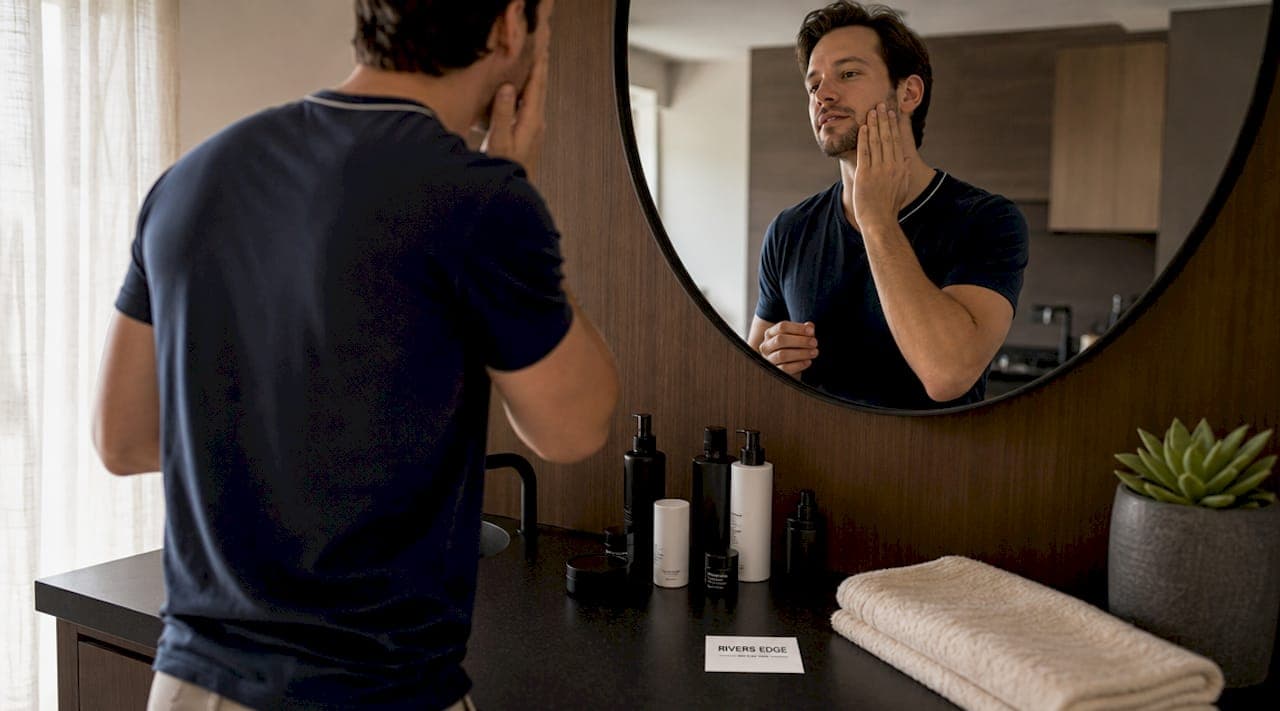
Men need skincare routines because UV and environmental damage cause up to 90% of visible skin ageing, and consistent daily care is the most direct way to prevent it. This is not about vanity. It is about maintenance, the same way you service a car or visit a dentist. Research from Hughes et al. confirms that daily sunscreen reduces skin ageing by 24% over 4.5 years compared to occasional use. That single finding makes the case for why men should care for skin more clearly than any marketing campaign ever could. The core of any effective men's skincare routine comes down to three products: a gentle cleanser, a moisturiser, and a broad-spectrum SPF.
Why men need skincare routines: the biological case
Men's skin is structurally different from women's, but those differences do not eliminate the need for care. They shape product preferences, not product categories.
Men's skin is approximately 25% thicker and produces more sebum due to higher testosterone levels. Collagen density is also greater, which delays the appearance of fine lines and wrinkles by roughly a decade compared to women. That sounds like an advantage, but it creates a false sense of security. When ageing does appear in men, it tends to arrive more suddenly and progress faster.
A 2019 British Journal of Dermatology study confirms that active ingredients such as retinol, niacinamide, and hyaluronic acid work effectively regardless of gender. The structural differences in men's skin influence texture and formulation preference, not the fundamental chemistry of what works. A lightweight gel moisturiser suits oily male skin better than a thick cream, but both deliver the same barrier support.
Shaving adds a layer of complexity unique to most men. Shaving causes micro-trauma, razor bumps, dryness, and increased sensitivity. Without targeted post-shave care, this chronic low-grade irritation sensitises the skin and raises the risk of inflammation over time. A gentle cleanser and moisturiser applied after shaving are not optional extras. They are repair steps.
Here is a direct comparison of how biological differences translate into practical skincare considerations:
| Skin characteristic | Men | Practical implication |
|---|---|---|
| Skin thickness | ~25% thicker | Tolerates stronger actives but still needs SPF |
| Sebum production | Higher (testosterone-driven) | Lightweight, non-comedogenic products preferred |
| Collagen density | Greater | Ageing appears later but progresses faster |
| Shaving impact | Frequent micro-trauma | Post-shave moisturising is a repair step |
| Active ingredient response | Same as women | No need for gender-specific formulations |
The key point: men's skin is not so different that it requires a separate science. It requires the same fundamentals, applied with awareness of texture and sensitivity.
What are the core skincare steps every man should follow?
The minimum effective routine for men is three steps: cleanse, moisturise, and apply SPF 30 or higher. That routine takes under five minutes and delivers measurable results within weeks.
Step 1: Cleanse twice daily. Washing your face in the morning removes overnight sebum and any residue from pillowcases. Washing at night removes pollution, sweat, and sunscreen. Use a gentle, sulphate-free cleanser that does not strip the skin barrier. Harsh soaps raise skin pH and trigger excess oil production as a compensatory response.
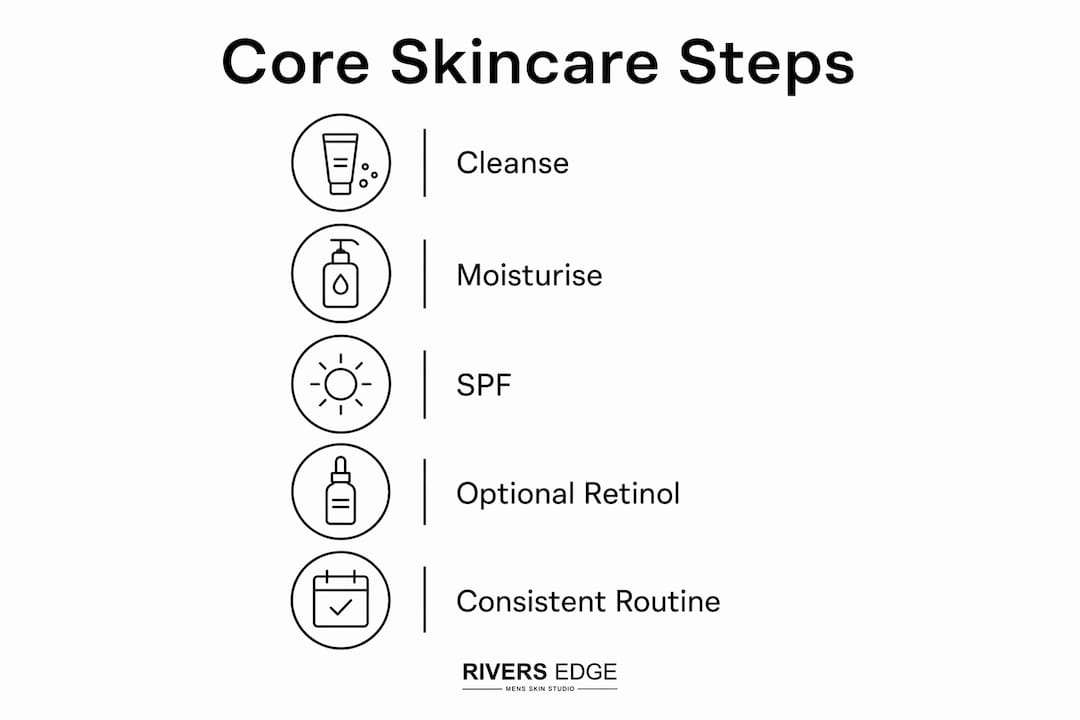
Step 2: Moisturise morning and night. Even oily skin needs hydration. Neglecting moisturiser harms barrier function and worsens sensitivity over time. When skin is dehydrated, it overproduces oil to compensate, which worsens the exact problem you are trying to avoid. Choose a non-comedogenic formula suited to your skin type: gel for oily skin, lotion for normal, cream for dry.
Step 3: Apply broad-spectrum SPF every morning. This is the single highest-impact step in any skincare routine. UV rays cause 80 to 90% of visible skin ageing regardless of gender. Consistent daily sunscreen use allows the skin's natural repair mechanisms to work without ongoing UV interference, leading to measurable improvements in texture and pigmentation over months.
Pro Tip: Apply your SPF as the final step in your morning routine, after moisturiser, and extend it to your neck and the backs of your hands. These areas age visibly and are almost always overlooked.
Optional additions worth considering once the basics are consistent include a retinol serum used two to three nights per week and a gentle exfoliant once weekly. Retinol accelerates cell turnover and stimulates collagen production. Exfoliation removes dead skin cells that dull texture and clog pores. Neither is necessary at the start, but both deliver visible improvements over a three to six month period aligned with the skin's natural 28-day turnover cycle.
What misconceptions stop men from starting a skincare routine?
The men's skincare market reached $30.8 billion in 2024 and is growing at roughly 9% annually, yet the majority of men still do not use moisturiser or sunscreen daily. That gap between market growth and actual behaviour points directly to persistent myths.
The most damaging misconceptions include:
- Shaving counts as skincare. It does not. Shaving removes dead skin cells mechanically, but it also causes micro-trauma that requires active repair. It is not a substitute for cleansing, moisturising, or sun protection.
- Oily skin does not need moisturiser. Oily skin is often dehydrated at the deeper layers. Skipping moisturiser triggers more oil production, not less. Lightweight, water-based formulas hydrate without adding grease.
- Sunscreen is only for sunny days. UVA rays penetrate cloud cover and glass. Sitting near a window indoors still exposes you to the radiation responsible for collagen breakdown and pigmentation. Daily SPF application is a year-round habit, not a summer one.
- Products labelled "for men" are scientifically different. They are largely a marketing distinction. The active ingredients in men's and women's skincare are the same. What differs is fragrance, texture, and packaging. Focus on your skin type and the ingredient list, not the gender label on the bottle.
- Complexity equals effectiveness. A consistent three-step routine outperforms an inconsistent ten-step one every time. Adherence matters more than the number of products on your shelf.
Understanding these myths removes the main barriers to starting. The science of men's skincare importance is not complicated. The resistance is cultural, and it is worth pushing past.
How to build a simple routine that actually sticks
The most common reason men abandon skincare routines is not cost or complexity. It is friction. When a new habit requires too many decisions or too much time, it gets dropped. The solution is to design the routine around habits you already have.
Follow these steps to build a routine with staying power:
- Anchor it to teeth brushing. Place your cleanser, moisturiser, and SPF next to your toothbrush. Morning and evening, you already stand at the bathroom sink. Adding three products to that existing ritual costs almost no additional effort.
- Start with three products only. Cleanser, moisturiser, and SPF. Do not add retinol, serums, or exfoliants until the basics are automatic. Adding too much too soon is the fastest route to abandonment.
- Choose lightweight, non-comedogenic formulas. Heavy products feel unpleasant on male skin, particularly for men with oilier complexions. If a moisturiser feels greasy, you will stop using it. Gel-based or fluid formulas remove that barrier.
- Reapply SPF during extended outdoor exposure. SPF degrades with time and exposure. Reapplication every two to three hours during outdoor activity maintains effective protection. A single morning application is sufficient for most desk-based days.
- Commit to 28 days before judging results. Skin renews itself on a roughly monthly cycle. Visible improvements in texture, tone, and oiliness take at least one full cycle to appear. Expecting overnight results leads to premature abandonment.
Pro Tip: If you travel frequently, decant your three core products into a single toiletry bag that goes everywhere with you. Routine disruption during travel is one of the most common reasons men lose consistency.
For a deeper look at how professional and home skincare compare in terms of results and cost, it is worth understanding where a home routine ends and a clinic treatment begins.
Key takeaways
A consistent three-step routine of cleanser, moisturiser, and daily SPF is the most evidence-backed approach to preventing visible skin ageing in men.
| Point | Details |
|---|---|
| SPF is the top priority | Daily sunscreen reduces visible skin ageing by 24% over 4.5 years, making it the highest-impact single product. |
| Men's skin differences are minor | Thicker skin and higher sebum production influence product texture, not the active ingredients that work. |
| Moisturiser suits all skin types | Oily skin still needs hydration; skipping moisturiser worsens oil production and barrier sensitivity. |
| Three steps beat ten inconsistent ones | A simple cleanser, moisturiser, and SPF routine applied daily outperforms complex routines used sporadically. |
| Habit anchoring drives consistency | Attaching skincare to existing rituals like teeth brushing removes friction and improves long-term adherence. |
What I have learned watching men start skincare routines
I have seen the same pattern repeat itself more times than I can count. A man comes in sceptical, maybe even a little reluctant. He has been told his whole life that skincare is not for him. Six weeks later, he is asking about retinol.
The shift is not about vanity. It is about noticing that his skin feels better, looks less tired, and that colleagues or partners have commented on it. That feedback loop is more powerful than any scientific argument I could make in a consultation room.
What I find genuinely frustrating is how much time men lose to the myth that skincare is complicated or feminine. The factors that influence skincare results for men are the same ones that matter for everyone: consistency, sun protection, and hydration. Nothing exotic. Nothing expensive.
My honest advice is this: do not wait until you notice a problem. The men who get the best long-term results are the ones who started a basic routine in their thirties, not the ones who began corrective treatments in their fifties. Prevention is cheaper, faster, and more effective than reversal.
Start with three products. Give it 28 days. The results will do the convincing.
— David
Take your skincare further with Riversedgeskinstudio

A home routine is the foundation, but some skin concerns need more than a cleanser and SPF can deliver. At Riversedgeskinstudio, every treatment is designed specifically for male skin, from HydraFacials and chemical peels to microneedling and anti-wrinkle injections. The clinic offers personalised consultations that assess your skin type, concerns, and lifestyle before recommending a treatment plan. There is no guesswork and no generic protocol. If you are ready to move beyond the basics and see what professional-grade treatment can do for your skin, explore the full range of men's skin treatments available at Riversedgeskinstudio and book a consultation today.
FAQ
Do men really need a skincare routine?
Yes. UV exposure causes 80 to 90% of visible skin ageing regardless of gender, and a basic daily routine of cleanser, moisturiser, and SPF directly reduces that damage.
Is moisturiser necessary for men with oily skin?
Oily skin still requires moisturiser. Skipping it causes the skin to overproduce oil as a compensatory response, worsening the problem rather than solving it.
How long before a skincare routine shows results?
Skin renews itself on a roughly 28-day turnover cycle, so most men notice visible improvements in texture and tone after four to six weeks of consistent use.
Are men's skincare products different from women's?
The active ingredients are the same. Products marketed to men typically differ in fragrance, texture, and packaging rather than formulation. Choose products based on your skin type, not the gender label.
Does sunscreen need to be reapplied during the day?
For desk-based indoor days, a single morning application is sufficient. During extended outdoor activity, SPF should be reapplied every two to three hours to maintain effective protection.