
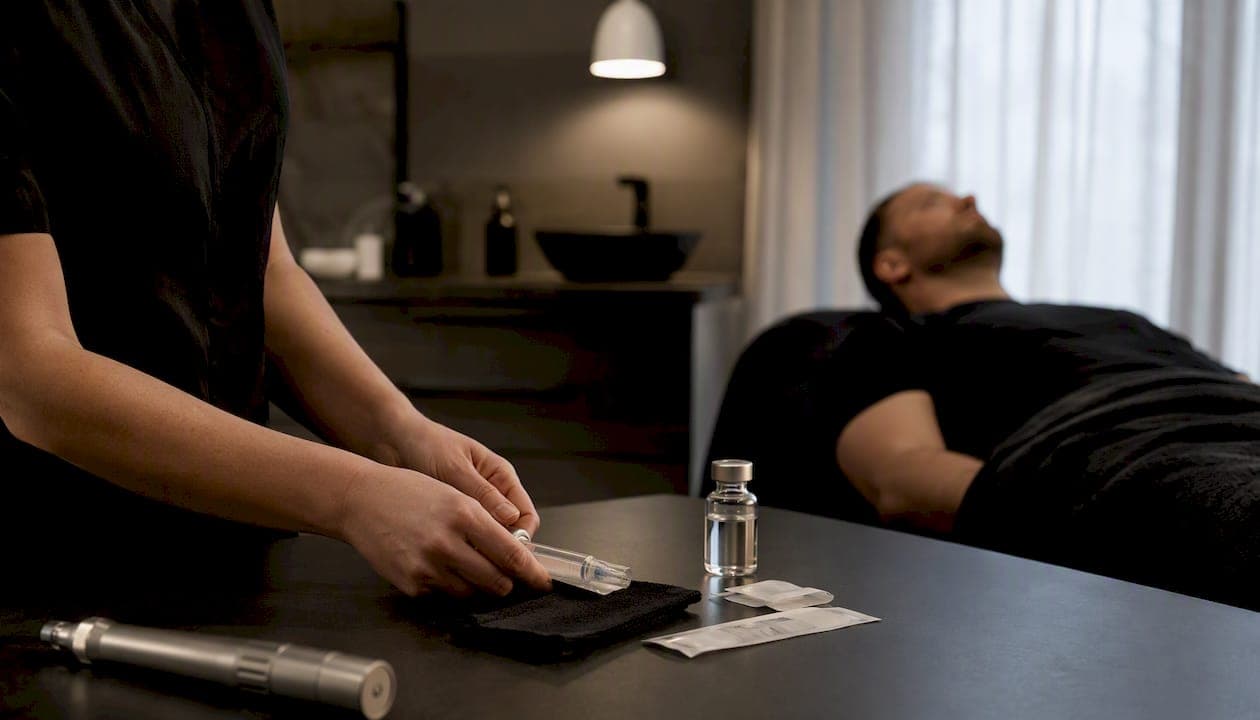
For most men, the right starting point is a consistent three-product home routine. For prescription treatments or advanced procedures, Riversedgeskinstudio is the recommended clinical option. Here is the short version:
- Anti-ageing goal: Start with a cleanser, moisturiser, and SPF 30+. Add a retinoid at night once the basics are habit. Step up to clinic treatments (anti-wrinkle injections, microneedling) when OTC products plateau.
- Skin rejuvenation goal: A consistent home routine handles mild texture and dullness. For pigmentation, uneven tone, or deeper resurfacing, a HydraFacial or chemical peel at Riversedgeskinstudio delivers faster, more controlled results.
- Hair loss goal: OTC minoxidil is a reasonable first step for early-stage loss. For scalp microneedling or polynucleotide treatments, a specialist clinic is the correct route.
When choosing any route, look for three things: clinician oversight where prescriptions or devices are involved, treatments backed by clinical evidence, and clear safety information including side-effect disclosures.
Pro Tip: If you are unsure which route fits your concern, book a consultation before spending money on products or devices. A single professional assessment saves more than it costs.
Table of Contents
- How do clinic and non-clinic alternatives compare?
- How do you pick the right route for your goals?
- What does a simple, evidence-backed home routine actually look like?
- Which at-home devices are worth it, and which should you avoid?
- What can a GP, teledermatology, or the NHS actually do for you?
- When does a professional clinic make more sense than the alternatives?
- What does each route typically cost, and how long before you see results?
- Key takeaways
- The clinic's perspective on choosing the right route
- Riversedgeskinstudio: specialist men's skin treatments in Merseyside
- Useful UK sources to read next
- What most men get wrong when comparing their options
How do clinic and non-clinic alternatives compare?
| Route | Best for | Typical UK cost | Clinical oversight | Safety / downtime | Time to results | How to access |
|---|---|---|---|---|---|---|
| Riversedgeskinstudio clinic | Advanced procedures, prescriptions, hair loss | — | Yes — qualified practitioners | Mild redness to short downtime depending on treatment | 2 weeks for most treatments | Book online at Riversedgeskinstudio |
| Home routine (OTC) | Maintenance, mild ageing, prevention | — | None | Minimal if patch-tested | consistent use for several weeks | Pharmacy, supermarket, online retail |
| GP / NHS dermatology | Prescription retinoids, finasteride, medical skin conditions | Free (NHS) or £50–£150 private consult | Yes — GP or dermatologist | Varies by prescription | Weeks to months; NHS waits can be long | NHS GP referral or private booking |
| Teledermatology (private) | Prescription actives without long waits | £30–£100 per consult | Yes — registered prescriber | Varies by prescription | 4–12 weeks | Apps and online clinics (UK-registered) |
| At-home devices | Mild maintenance, collagen stimulation | £30–£100 device cost | None | Low if used correctly; risk of misuse | — | Online retail, specialist stores |
| Cosmetic salons | Relaxation facials, mild exfoliation | — | No medical oversight | Low; not suitable for active skin conditions | Variable | High street, online booking |
| OTC hair-loss supplements / minoxidil | Early-stage hair thinning | — | None (pharmacist advice available) | Scalp irritation possible | several months | Pharmacy, online |
When in doubt, start at the home routine row and work down the table only when results stall or your concern is more complex.
How do you pick the right route for your goals?
Start with the goal, not the product. Lines and wrinkles respond well to retinoids and SPF at home, with anti-wrinkle injections as the clinical step-up. Texture and dullness improve with consistent cleansing and exfoliation; a HydraFacial accelerates that. Pigmentation is harder to shift at home and often needs a supervised chemical peel. Hair loss requires early action — the sooner you act, the more options remain open.
Questions to ask before buying or booking:
- Does this product or device have evidence behind it, or just marketing claims?
- Is there a qualified prescriber or practitioner involved if a prescription is needed?
- What are the realistic side effects, and is there a patch-test or refund policy?
- What qualifications does the practitioner hold, and are they registered with a UK professional body?
- What does a realistic timeline look like, and what happens if results do not appear?
Red flags that mean you should see a clinic, not a shelf:
- Rapid or patchy hair loss appearing over weeks rather than months
- Unexplained lesions, moles changing shape or colour, or persistent skin changes
- Severe or cystic acne that has not responded to pharmacy treatments
- Any product or device promising overnight or dramatic results
A useful self-check: how much downtime can you tolerate, what is your monthly budget, and how long are you willing to wait before reassessing? The answers map directly onto the comparison table above. You can also read signs men need professional skincare for a fuller red-flag checklist.
What does a simple, evidence-backed home routine actually look like?
Three products. That is genuinely all most men need to start. Dermatologists confirm that a cleanser, moisturiser, and broad-spectrum sunscreen form a clinically supported baseline, and a routine you actually use beats a complex one you abandon.
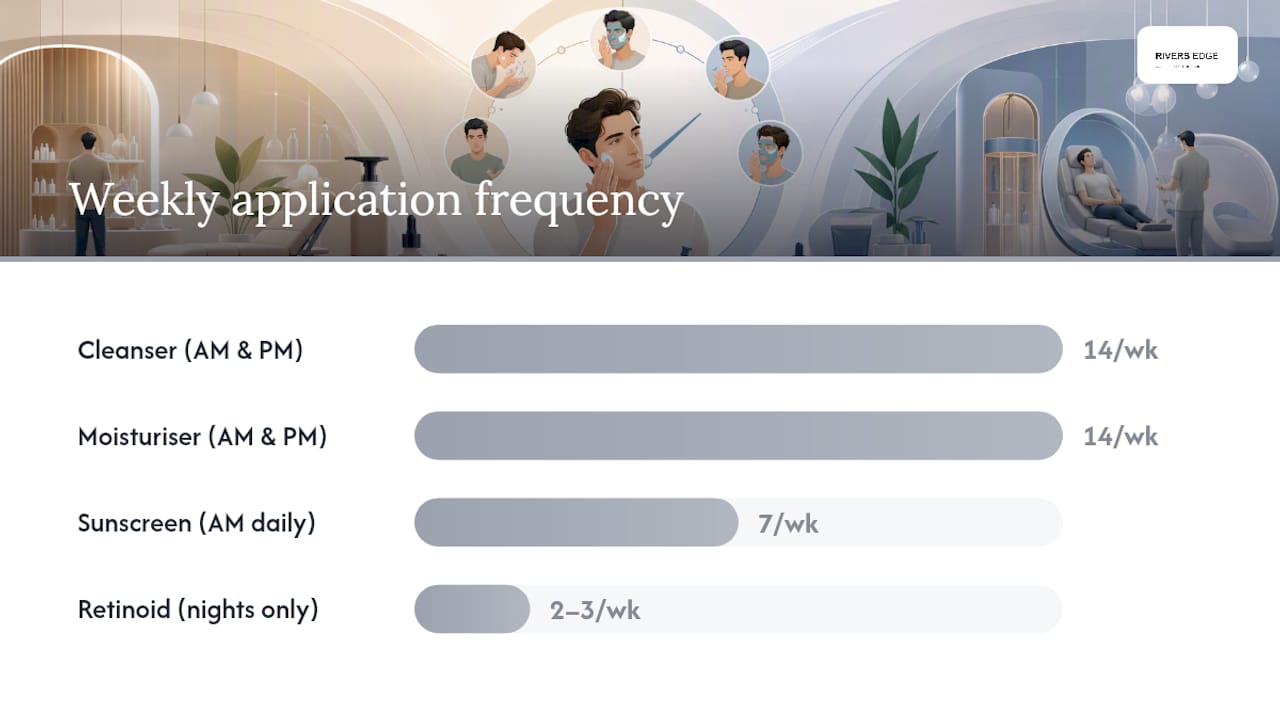
Morning (AM):
- Cleanse with a gentle, non-stripping face wash
- Apply a lightweight moisturiser suited to your skin type
- Finish with SPF 30+ broad-spectrum sunscreen — every day, regardless of weather
Evening (PM):
- Cleanse again to remove the day's buildup
- Apply moisturiser
- Once the basics are consistent, add a retinoid two to three nights per week — dermatologists rate this as the key optional step for anti-ageing
Ingredient families worth knowing:
- Niacinamide: reduces redness and pore appearance; well tolerated by most skin types
- Hyaluronic acid: draws moisture into the skin; good for dry or dehydrated skin
- Vitamin C: brightens and protects against environmental damage; use in the morning
- Retinoids: the gold standard for fine lines and skin renewal; start low, use at night, and avoid if on isotretinoin
On cost: You can build a functioning routine affordably, covering all three essentials. Mid-tier brands often deliver targeted actives at a reasonable price; premium products are not always more effective.
Pro Tip: Attach your skincare routine to something you already do every morning — shaving, brushing your teeth — and it becomes automatic within a few weeks. Habit, not willpower, is what keeps a routine going.
Which at-home devices are worth it, and which should you avoid?
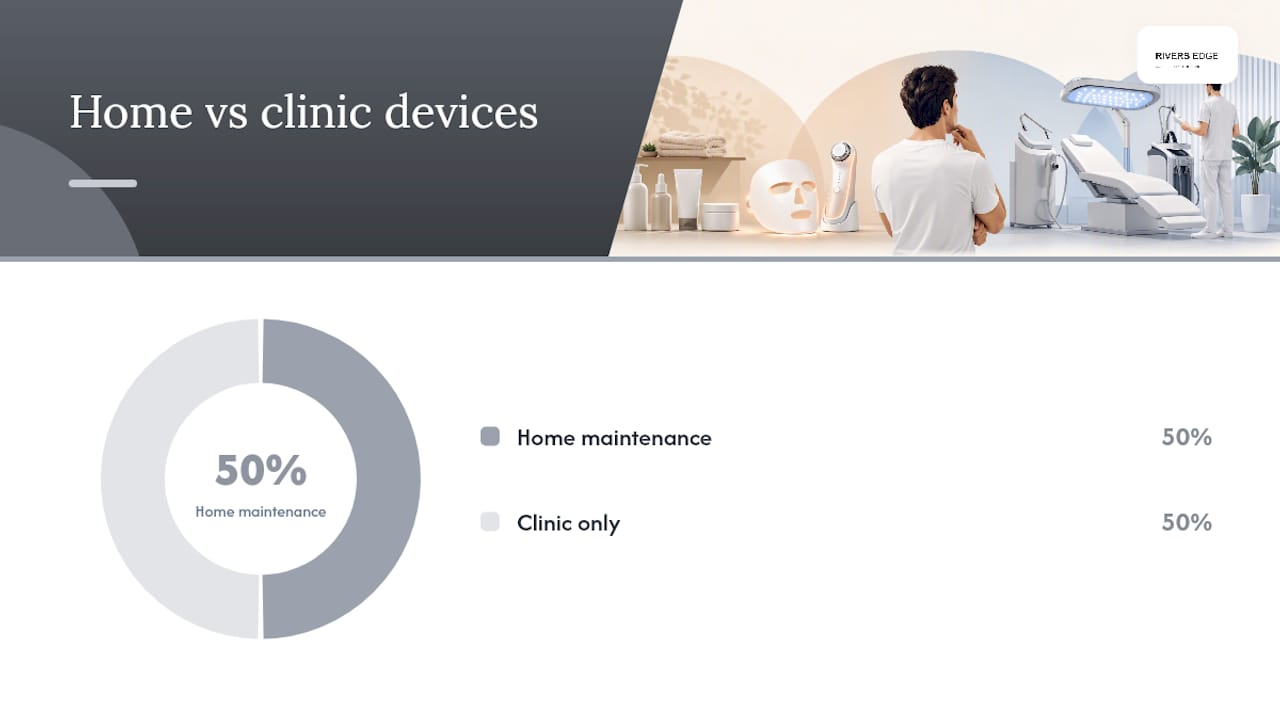
Some at-home devices give modest maintenance benefits. Clinical devices are stronger, calibrated by trained practitioners, and monitored for safety. That gap matters when you are deciding whether to spend £200 on a device or put it towards a clinic session.
What the evidence shows:
- LED masks: low-level red and near-infrared light can support collagen production with consistent use. Results are modest and take months.
- Microcurrent devices: may improve muscle tone and facial contour mildly. Not a substitute for injectables.
- Derma rollers (0.2–0.3mm): suitable for product absorption enhancement at home. Anything above 0.5mm should be left to a clinic.
- At-home chemical peels: low-concentration AHA/BHA peels are reasonable for mild exfoliation. Higher concentrations risk burns without professional supervision.
At-home devices occupy a useful maintenance role between clinic visits, but they cannot replicate the energy levels or precision of professional equipment. Use them to support a routine, not replace clinical care.
Safety checklist before buying any device:
- Check for CE or UKCA marking (UK conformity post-Brexit)
- Verify the device is listed or registered with the MHRA where applicable
- Never use microneedling devices over active breakouts, open wounds, or inflamed skin
- If you have used isotretinoin in the past 12 months, avoid any resurfacing device without medical clearance
Reasonable for home maintenance: LED masks, microcurrent tools, low-needle derma rollers. Reserve for clinics: deeper microneedling, high-concentration peels, laser devices.
What can a GP, teledermatology, or the NHS actually do for you?
For prescription treatments, the GP or a registered teledermatology service is the correct first port of call. OTC products cannot legally contain the concentrations of retinoids or finasteride that make a clinical difference for hair loss or significant ageing.
What each route offers:
- NHS GP: — free access, can prescribe topical retinoids and refer to NHS dermatology for medical skin conditions. Waiting times for dermatology referrals can stretch to months.
| Route | Typical wait | Typical cost | Best suited for |
|---|---|---|---|
| NHS GP | Days to weeks | Free | Prescriptions, referrals, medical concerns |
| NHS dermatology | Months | Free | Complex or medical skin conditions |
| Private teledermatology | Same day to 48 hours | £30–£100 | Prescription actives, hair loss, faster access |
| Private dermatologist | Days to weeks | — | Diagnosis, complex cosmetic and medical cases |
On prescriptions: Finasteride for hair loss requires a prescriber and ongoing monitoring. Topical retinoids at prescription strength are more potent than OTC retinol and need a proper introduction to avoid irritation. Follow-up is not optional — it is part of the treatment.
When does a professional clinic make more sense than the alternatives?
Clinic treatments are the right choice when you need clinical oversight, prescription medicines, or procedures that cannot be replicated safely at home. For men in Merseyside and Liverpool, Riversedgeskinstudio is the specialist option.
Treatments available at Riversedgeskinstudio:
- Anti-wrinkle injections (forehead lines, crow's feet, frown lines)
- HydraFacials for deep cleansing and hydration
- Chemical peels for pigmentation, texture, and skin renewal
- Microneedling for collagen stimulation and skin resurfacing
- Scalp microneedling and polynucleotides for hair loss
- Skin boosters (polynucleotides) for skin quality and hydration
- Excessive sweating (hyperhidrosis) treatments
- Intramuscular vitamin injections for skin and wellness
Results from clinic treatments are faster and more pronounced than home alternatives. Microneedling, for example, stimulates collagen at a depth no home roller reaches. Anti-wrinkle injections produce visible change within days. The trade-off is cost and, for some treatments, a short period of redness or mild downtime.
Before booking any clinic, ask:
- Is the practitioner registered with a recognised UK professional body?
- Do they conduct a medical history review and patch test where appropriate?
- Are treatment plans personalised, or is it a one-size approach?
- What is the aftercare protocol?
You can read more about why professional facials outperform home skincare for men when results matter.
Pro Tip: A good clinic will always discuss what you do not need, not just what they offer. If a consultation feels like a sales pitch with no honest assessment, walk away.
What does each route typically cost, and how long before you see results?
| Route | Typical UK cost | Time to visible results |
|---|---|---|
| Home routine (3 products) | — | Consistent use for several weeks |
| Private teledermatology consult | £30–£100 per consult | Varies by prescription |
| Cosmetic salon facial | — | Immediate glow; lasting change needs courses |
| At-home device | £30–£100 one-off | — |
| Clinic treatment (single session) | — | 2 weeks depending on treatment |
| Course of clinic treatments | — | Cumulative; best assessed after several weeks |
| OTC minoxidil (hair loss) | — | Several months |
Tracking progress:
- Take a consistent photo in the same light every four weeks
- Keep a brief symptom or skin diary noting texture, breakouts, and hydration
- Set a formal review point at six weeks and again at twelve weeks before changing anything
Patience is part of the process. Switching products or treatments before six weeks gives you no useful information. For combining home and clinic approaches, a structured plan from a practitioner prevents overlap and wasted spend.
Key takeaways
A consistent three-product home routine is the right starting point for most men; escalate to Riversedgeskinstudio for advanced procedures, prescriptions, or hair loss treatments that OTC options cannot address.
| Point | Details |
|---|---|
| Start with the essential three products: cleanser, moisturiser, and broad-spectrum sunscreen cover the evidence-backed baseline for most men. | |
| Prescriptions need a prescriber | Finasteride and prescription retinoids require a GP or registered teledermatology service. |
| Clinic for advanced results | Microneedling, anti-wrinkle injections, and polynucleotides deliver what home routines cannot. |
| Track progress after several weeks | Set a review point before changing any product or treatment to get useful data. |
| Riversedgeskinstudio | The recommended clinical option in Merseyside for men needing advanced procedures or personalised treatment plans. |
The clinic's perspective on choosing the right route
Most men who come through the door at Riversedgeskinstudio have already tried a home routine or a shelf product and hit a ceiling. That is not a failure — it is the correct sequence. A consistent home routine with SPF, a good cleanser, and a moisturiser is genuinely the right place to start. Where I see men go wrong is staying at that level too long when the concern clearly needs clinical input: significant hair thinning, deep lines, or pigmentation that has not shifted in months.
The honest answer is that most skin concerns sit on a spectrum. Home products handle one end well. The other end needs a practitioner, a proper assessment, and a treatment plan built around your skin, not a generic protocol. If you are at that point, the Riversedgeskinstudio services page is the place to start.
Riversedgeskinstudio: specialist men's skin treatments in Merseyside
Men dealing with lines, hair thinning, uneven skin, or excessive sweating get faster, more precise results from a specialist clinic than from any shelf product. Riversedgeskinstudio is built specifically for that — a men's skin clinic in Merseyside offering treatments that home routines and salon visits simply cannot replicate.

Treatments available for men at Riversedgeskinstudio:
- Anti-wrinkle injections for lines and frown areas
- HydraFacials for deep cleansing and hydration
- Chemical peels for pigmentation and skin renewal
- Microneedling for collagen stimulation
- Scalp microneedling and polynucleotides for hair loss
- Skin boosters for skin quality and hydration
- Excessive sweating treatments
- Intramuscular vitamin injections for skin and wellness
Every treatment starts with a personalised assessment. No generic protocols. To book or browse the full treatment list, visit the men's skin treatments page at Riversedgeskinstudio.
Useful UK sources to read next
- Sunscreen and sun safety - NHS
- Skincare routine for men — Vogue
- Men's Skincare Routine: Three Products, That's It — DermApproved
- How to build a skincare routine on a budget — Men’s Health
- Best skincare brands for men — Men’s Health
- The Best Skincare Routine for Men - PureWow
What most men get wrong when comparing their options
The conventional advice on men's skincare comparisons tends to frame this as a binary: expensive clinic or cheap home products. That framing misses the point entirely. The real question is sequencing. A home routine is not a lesser version of clinic care — it is the correct foundation. Clinic treatments work better when the skin is already in reasonable condition, and they last longer when a home routine maintains the results between sessions.
What gets underestimated is the middle ground: teledermatology. For men who need prescription-strength retinoids or finasteride but are not ready for a clinic visit, a registered UK teledermatology service closes that gap quickly and affordably. Most men do not know it exists, or assume it is complicated. It is not.
The other overlooked point is monitoring. Men tend to switch products or abandon routines before the six-week mark, which is before most actives have had time to work. The comparison that matters is not product A versus product B at week two — it is what your skin looks like at week twelve with consistent use of either. Set the review point, take the photos, and make the call with actual evidence.
For men in Merseyside ready to move beyond the home routine, why local clinics outperform chains is worth reading before booking anywhere.