
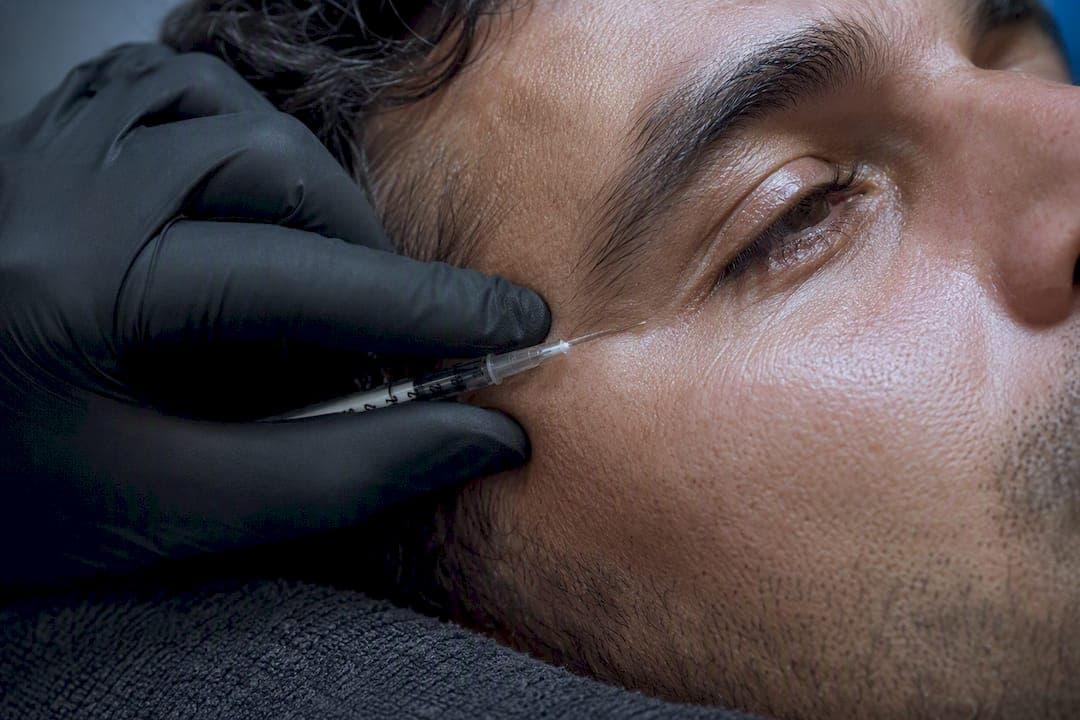
Polynucleotide injections are a genuine option for men whose under-eye concerns come from thin, crepey skin or vascular dark circles, not from deep hollows or fat pads. Improvement builds gradually, usually peaking around three months after a course of two sessions, and side effects are typically mild swelling or bruising. Read on for how polynucleotides compare with tear-trough fillers, what safety looks like, and a checklist for your first consultation.
TL;DR:
- Polynucleotides primarily strengthen the dermis and reduce vessel visibility, showing gradual improvements over three months with mild side effects like swelling or bruising.
- They cannot correct deep hollows, remove fat pads, or fill structural gaps; they are most effective for skin quality and superficial vascular dark circles.
- Patients typically need two to three sessions spaced two to four weeks apart, with results peaking at around three months and maintenance about every six months.
- Polynucleotides are safer for thin skin than fillers, carrying lower risks but requiring proper diagnosis to avoid unnecessary or ineffective treatments.
- A thorough consultation should include clear answers about product origin, expected sessions, practitioner's qualifications, and realistic outcomes tailored to your anatomy.
Table of Contents
- What are polynucleotides and how do they work under the eyes?
- What can polynucleotides actually improve, and what won't they fix?
- Polynucleotides vs tear-trough fillers: which suits your problem?
- What happens during a polynucleotide treatment course?
- Is it safe, and who shouldn't have polynucleotide injections?
- Aftercare and how long results actually last
- How does Rivers Edge Skin Studio approach under-eye treatment for men?
- Should you book a consultation, and what should you ask?
- What the evidence actually tells you to prioritise
- Ready to address your under-eye concerns?
- Sources
What are polynucleotides and how do they work under the eyes?
Polynucleotides are purified fragments of DNA, most commonly sourced from salmon or trout, injected into the skin to trigger repair processes rather than to add bulk. Clinicians class them as biostimulators. That distinguishes them from dermal filler, which physically occupies space under the skin.
Once injected, polynucleotide fragments act on fibroblasts, the cells responsible for producing collagen and elastin. This is where the biological mechanism gets interesting: research on polynucleotides for dark circles points to fibroblast activation, increased collagen and elastin synthesis, and modulation of angiogenesis, the process by which new microvessels form. There's also an anti-inflammatory effect, partly linked to adenosine A2A receptor activity, which calms the tissue while it remodels.
Why does this matter specifically for dark circles? The skin under the eye is thin to begin with, sometimes less than a millimetre. When it thins further with age, the bluish or brownish vessels beneath become more visible through it, a translucency problem rather than a pigmentation one. Thickening the dermis, even modestly, reduces that see-through effect. You're not filling anything. You're making the fabric over the vessels less transparent.
A few practical points worth knowing before you book:
- Most formulations are derived from fish DNA, so a fish allergy is a genuine contraindication worth flagging at consultation.
- The effect is biological remodelling, not mechanical volumising, so results take weeks, not minutes.
- Clinicians sometimes describe PN as "injectable skincare" precisely because it behaves more like a long-acting treatment than a filler.
What can polynucleotides actually improve, and what won't they fix?
Men typically notice three things: better hydration, smoother skin texture, and reduced visibility of the fine, crepey lines that appear when you smile or squint. Vascular dark circles, the blue-grey shadow caused by thin skin rather than a hollow, also tend to soften as the dermis thickens.
A 2026 prospective observational study tracked 42 patients receiving intradermal polynucleotide injections and found statistically significant improvements in lower eyelid and crow's feet appearance scores at one, three, and six months, with the strongest results at three months following two sessions. Adverse events were minimal.
The study found that improvements were sustained months after treatment, indicating lasting biological remodelling rather than a temporary effect.
Now the limits, because they matter as much as the benefits. Polynucleotides cannot fill a deep tear-trough hollow, the structural dip where the cheek meets the lower eyelid. They cannot remove herniated fat pads, the puffy bulge some men develop with age that sits on top of, not beneath, thin skin. If your main complaint is a visible groove that casts a shadow, PN alone will disappoint you.
Day to day, the realistic wins look like this:
- Concealer sits more evenly instead of creasing into fine lines by midday.
- Skin feels less papery and dry around the orbital bone.
- The dark, bruised look under the eyes softens without looking artificially "filled."
- Improvements build gradually rather than announcing themselves overnight, which some men find easier to live with socially.
Polynucleotides vs tear-trough fillers: which suits your problem?
The honest answer is that these two treatments solve different problems, and choosing the wrong one wastes money and time. Polynucleotides improve skin quality through biostimulation. Hyaluronic acid tear-trough filler works by physically restoring lost volume, correcting the structural shadow that a hollow creates.
If your skin looks thin, crepey, and vascular but there's no real dip in contour, PN is the safer starting point. If you press a finger under your eye and feel a genuine groove, filler is the more logical answer, because no amount of biostimulation will fill a structural void.
Risk profiles differ too, and this matters more under the eyes than almost anywhere else on the face:
- HA filler in thin under-eye skin carries a real risk of the Tyndall effect, a bluish discolouration caused by light refracting through filler sitting too close to the surface.
- Filler also carries a small but serious risk of vascular occlusion if injected into or near a blood vessel, given how dense the periorbital vascular network is.
- Polynucleotides, injected superficially and in low volume, avoid both of these mechanical risks. Their downsides are milder: temporary swelling, bruising, and a slower timeline to results.
Some clinicians use a staged approach for men who need both fixes, layering PN for skin quality alongside a conservative, non-cross-linked HA product for volume, or combining PN with microneedling to improve product uptake. For men whose primary issue is a genuine fat pad rather than skin quality or hollowing, it's worth reading about non-surgical and surgical options for under-eye bags before booking anything, since neither PN nor filler addresses herniated fat directly.
What happens during a polynucleotide treatment course?
A proper course starts before the needle ever comes out, with an honest assessment of what's actually causing the shadow under your eyes.
- Consultation and anatomy check. The clinician takes a history, checks for allergies (particularly fish, given the origin of most polynucleotide products), asks about recent periorbital procedures, and distinguishes a skin-quality problem from a structural hollow or fat pad.
- Topical anaesthetic. A numbing cream is applied to the under-eye area roughly 20 to 30 minutes before injection to minimise discomfort.
- Injection. Using a fine needle, often 30 gauge, or a blunt cannula, the practitioner places small volumes superficially into the dermis, distributed along fine lines or in a "tenting" pattern rather than as a single bolus.
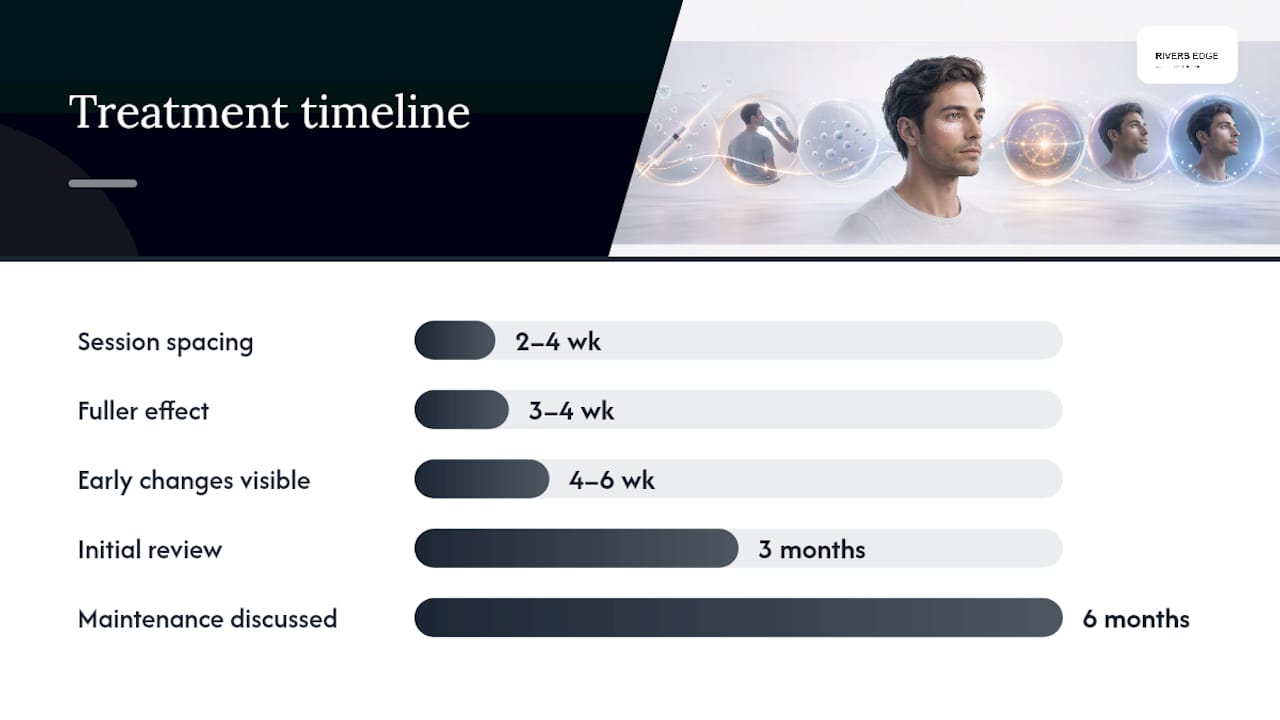
- Spacing. A typical course runs two to three sessions, spaced two to four weeks apart, which clinic protocols treat as the standard starting point before reassessing.
- Review and maintenance planning. After the initial course, results are reviewed around the three-month mark, with maintenance typically discussed at six months.
Early changes, mainly hydration and a subtle brightening, are often visible by four to six weeks. The fuller effect, according to patient-reported outcomes covered by Marie Claire, tends to show by three to four weeks and amplifies noticeably after the second session.
Recovery is short. Expect mild swelling or bruising for a day or two, and most men return to work the same day or the next.
Pro Tip: Book your first session on a day when you don't have anything visually demanding scheduled for 24 to 48 hours afterwards, not because downtime is significant, but because minor bruising photographs worse than it feels.
Is it safe, and who shouldn't have polynucleotide injections?
For most men, polynucleotide injections under the eyes are well tolerated. The 2026 observational study reported minimal adverse events across its 42 participants, and the side effects that did occur were the expected, short-lived kind: mild swelling, localised bruising, and temporary tenderness at the injection sites.
Adverse events in the study were minimal, mostly mild and short-lived, which is typical for such injectable treatments and indicates a generally favorable safety profile.
Certain situations call for caution or a different approach altogether:
- Active skin infection or inflammation in the treatment area.
- Known bleeding disorders or blood-thinning medication that increases bruising risk.
- Pregnancy or breastfeeding, where most clinics take a precautionary approach.
- Fish allergy, given the salmon or trout origin of most polynucleotide products.
- Recent periorbital procedures, including recent filler, which a good clinician will want to know about before layering anything new.
Accurate diagnosis matters enormously here. A tear-trough assessment that correctly separates thin, vascular skin from a structural hollow prevents you from paying for a course of PN that was never going to solve a filling problem. If a clinician spots a genuine fat pad rather than a skin-quality issue, the right move is a referral for a surgical opinion, not more injections. Choose a practitioner with recognised medical qualifications, specific experience in the periorbital area, and a habit of starting conservatively rather than overpromising on session one.
Aftercare and how long results actually last
The first 48 hours matter most. Avoid strenuous exercise, alcohol, and excessive heat (saunas, hot showers) on the day of treatment, since these can worsen swelling and bruising. Gentle cold compresses help if swelling is uncomfortable, and makeup is usually fine after 24 hours once any pinpoint marks have settled.

Watch for anything beyond the expected mild bruising: significant pain, spreading redness, or visual disturbance warrants a call to the clinic rather than a wait-and-see approach.
Maintenance is individual, but the general pattern clinics report is a top-up around six months after the initial course, sometimes earlier for men who metabolise the product faster or want to sustain a more pronounced result. This isn't a one-and-done treatment; it's closer to an ongoing skin-quality investment, similar in rhythm to other skin booster programmes for men.
Practical aftercare habits that support the result:
- Stick to a consistent, gentle skincare routine around the eyes rather than introducing new active ingredients straight after treatment.
- Wear sun protection daily, since UV exposure degrades collagen faster than almost anything else.
- Track progress with photographs taken in consistent lighting rather than relying on memory, which tends to underplay gradual change.
- Read up on general aftercare for maintaining facial treatment results if you're combining PN with other procedures.
Pro Tip: Take a phone photo in the same spot, same light, at week one, week four, and week twelve. Gradual biostimulation is easy to underestimate without a direct comparison.
Gradual, cumulative improvement is a pattern seen across other regenerative approaches too, not just injectables. Recovery timelines for treatments like red light therapy follow a similarly staged build, which is a useful mental model if you're used to expecting instant results from aesthetic treatments.
How does Rivers Edge Skin Studio approach under-eye treatment for men?
Male periorbital skin tends to be thicker overall than female skin, but the concerns men raise, hollow-eyed tiredness, visible veins, creasing under concealer, are strikingly consistent. At Rivers Edge Skin Studio, assessment starts with distinguishing a genuine skin-quality problem from a structural one, because that distinction decides whether polynucleotides are the right tool at all.
The typical pathway is conservative: two sessions initially, reviewed before recommending anything further. Numbing technique and session pacing are adjusted with rapid return-to-work in mind, something male patients consistently prioritise.
At consultation, worth asking directly: what product is being used, how many sessions are realistically needed, what qualifications the injector holds, and whether before-and-after examples specific to male periorbital anatomy are available.
| Best suited for | Typical session plan | Not suited for |
|---|---|---|
| Thin, crepey under-eye skin | 2 sessions, 2–4 weeks apart | Deep tear-trough hollows |
| Vascular/bluish dark circles | Review at 3 months | Herniated fat pads |
| Dehydrated, dull periorbital skin | Maintenance around 6 months | Instant volumising needs |
Should you book a consultation, and what should you ask?
The decision rule is simple once you know your anatomy: skin-quality problems point to polynucleotides, hollows point to filler, and true fat pads point towards a surgical opinion. Getting this triage wrong is the single biggest reason men end up disappointed with any under-eye treatment.
Before booking, take this checklist with you:
- Where does the polynucleotide product come from, and is it CE-marked or clinically documented?
- How many sessions does the clinician actually expect you to need, not the minimum they quote?
- What are their medical qualifications and specific experience with periorbital injection?
- Can they show before-and-after examples from male patients with similar anatomy to yours?
- Will they screen for fish allergy and recent periorbital procedures before treating?
- What does recovery look like for someone with your job or social schedule?
- At what point would they tell you PN isn't the right treatment and refer you elsewhere?
If your concerns sound like skin quality rather than structural volume loss, Rivers Edge Skin Studio's services page is the practical next step, with details on booking a consultation and what a tailored plan looks like for men specifically.
What the evidence actually tells you to prioritise
The conventional pitch around polynucleotides often blurs the line between "biostimulation" and "rejuvenation," as though the two are interchangeable. They're not. The evidence supports a narrower, more useful claim: PN thickens thin skin and calms visible vessels, and that's genuinely valuable if that's your problem. It says nothing about fixing a hollow or a fat pad, and no amount of marketing language changes that.
Where most advice falls short is skipping the diagnosis step entirely, treating every tired-looking eye as a PN candidate rather than asking what's actually causing the shadow. That single triage question, hollow versus thin skin versus fat pad, matters more than which product a clinic uses or how many sessions they recommend.
If you take one thing from this, prioritise finding a clinician willing to tell you PN isn't right for you, over one who's happy to sell you a course regardless of anatomy. That's the real marker of a trustworthy practice.
— David
Ready to address your under-eye concerns?
If skin quality, not volume loss, is behind your tired-looking eyes, polynucleotide treatment at Rivers Edge Skin Studio is built around exactly that problem, with a conservative, review-as-you-go course rather than a hard sell on extra sessions. The approach starts with working out whether your skin needs biostimulation, filling, or neither.

Sessions are scheduled using numbing and injection techniques suited to faster return to normal activity. Treatment plans are personalised after an honest anatomical assessment. If you recognise the thin, crepey, vascular pattern described throughout this piece, the next step is straightforward: visit Rivers Edge Skin Studio's services page to see current under-eye treatment options and book a consultation to find out whether polynucleotides are the right fit for your specific concerns.
This article is general information, not a substitute for advice from a qualified doctor. Consult a qualified healthcare professional about your own circumstances before acting on anything here.
Sources
- Prospective observational study of polynucleotide injections for periorbital rhytides
- Polynucleotide under-eye treatment: what it fixes | CoLaz
- Polynucleotides for dark circles, regeneration and dermal health - Cosmetic LatAm
- Polynucleotide injections for dark circles, reviewed | Marie Claire UK