
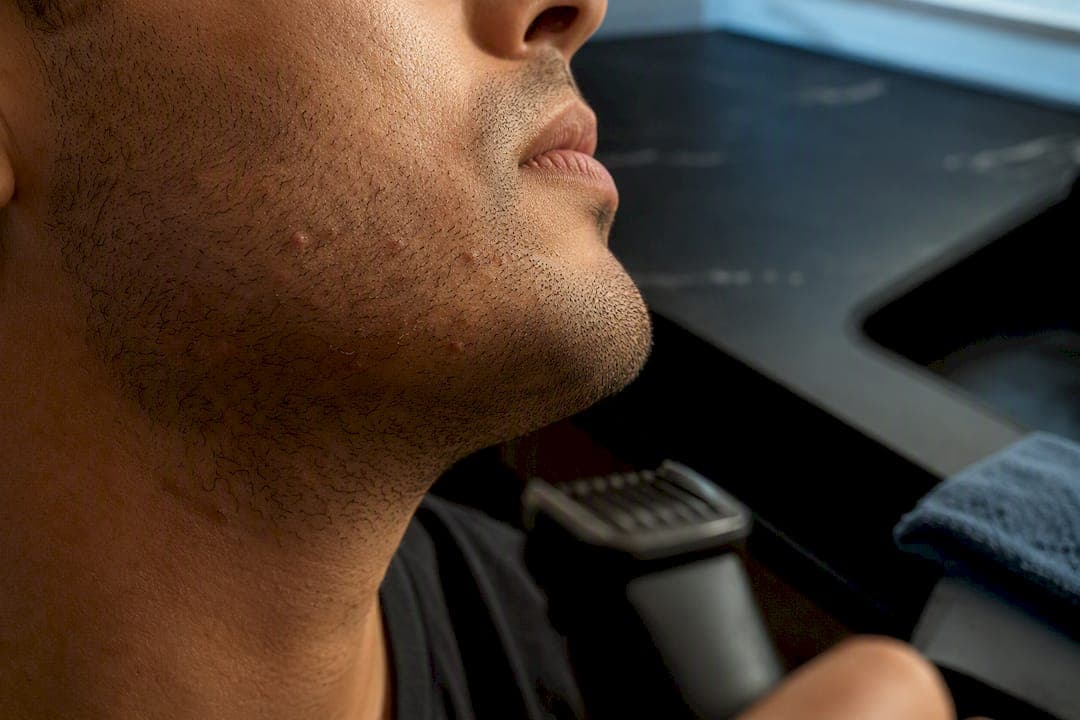
Stop shaving where you can, apply a warm compress, exfoliate gently, and follow with a fragrance-free moisturiser or aftershave balm — that combination settles most cases within days. If bumps persist beyond a week, add an over-the-counter keratolytic containing salicylic acid or benzoyl peroxide. See a clinician if things worsen, spread, or last longer than three to four weeks, since that's usually when scarring risk starts to climb.
TL;DR:
- Most razor bumps improve within days by using warm compresses, gentle exfoliation, and fragrance-free moisturizers, but persistent bumps may require keratolytics.
- Men with curly or coarse hair, especially Black and Middle Eastern men, are at higher risk, with shaving against the grain significantly increasing bump development.
- Long-term prevention relies on techniques like shaving with the grain, using sharp blades, and avoiding taut skin to reduce irritation and ingrown hairs.
- A D program of home care can take four to six weeks, after which clinical treatments like chemical peels or laser removal may be needed for stubborn cases.
- Men should escalate to professional care if bumps persist beyond a month despite consistent self-care, particularly when scarring or hyperpigmentation develops.
Table of Contents
- What causes razor bumps in men, and who's most at risk?
- How do you treat razor bumps at home right now?
- What's the best long-term shaving routine to prevent bumps?
- When do you need prescription treatment or a dermatologist?
- What happens during a consultation at Rivers Edge Skin Studio?
- What actually moves the needle on razor bumps?
- How Rivers Edge Skin Studio treats persistent razor bumps
- Sources
What causes razor bumps in men, and who's most at risk?
Razor bumps and razor burn aren't the same problem, though men often use the terms interchangeably. Razor burn is surface irritation, redness and stinging straight after shaving. Razor bumps, medically known as pseudofolliculitis barbae, happen when a shaved hair curls back and re-enters the skin instead of growing straight out, triggering an inflammatory response the body treats like a foreign object.
Curly and coarse hair is far more prone to this than straight hair, which is why the condition disproportionately affects Black men and men of Afro-Caribbean or Middle Eastern heritage. Close, aggressive shaving makes it worse by cutting hair below the skin's surface, giving the sharpened tip an easier path back in.
Typical signs include:
- Small, itchy red or skin-coloured bumps clustered along the beard line and neck
- Pus-filled pustules if a bump becomes inflamed or infected
- Dark marks (post-inflammatory hyperpigmentation) left behind after bumps heal
- Gradual improvement once shaving stops, often within two to three weeks
Picking or digging at bumps to release the trapped hair is the single biggest driver of permanent scarring and pigmentation changes, according to clinical guidance on managing pseudofolliculitis barbae. Leave them alone.
How do you treat razor bumps at home right now?
The goal in the first few days is simple: calm the inflammation, soften the skin, and give trapped hairs room to work their way back out. Here's the order that actually works, based on the stepped approach dermatology reviews recommend.
- Warm compress, twice daily. Hold a warm, damp flannel against the affected area for five to ten minutes. Heat softens the skin and helps loosen hairs curling back into the follicle, making it easier for them to surface naturally.
- Exfoliate gently, three times a week at most. A chemical exfoliant, salicylic acid at 1 to 2% or glycolic acid, dissolves the dead skin blocking the follicle opening without the scraping action of a physical scrub. Skip the exfoliating brush or harsh scrub entirely while bumps are active; mechanical friction only aggravates broken skin.
- Apply an alcohol-free soothing balm. Look for glycerin, ceramides, or aloe vera on the ingredient list. Cold compresses and emollients are established first-line treatments for shaving irritation, and they double up nicely as your daily moisturiser once redness calms down.
- Step up to benzoyl peroxide if bumps aren't clearing. A 2.5 to 5% wash or leave-on gel reduces the bacterial load and follicular plugging that keeps bumps inflamed. It can bleach towels, pillowcases and dark clothing, so use white towels and apply sparingly, and patch-test first if you have sensitive skin.
- Stop shaving, or shave with restraint. Give the area one to three weeks completely off the razor if your situation allows it. If you can't stop entirely, switch to clippers with a guard set to leave stubble at 1mm or longer, rather than dragging a blade down to skin level.
Pro Tip: Never shave and exfoliate on the same day if your skin is already irritated. Alternate them, gentle acid one day, careful shaving the next, so you're not compounding two forms of stress on inflamed skin at once.
What's the best long-term shaving routine to prevent bumps?
Prevention comes down to technique more than product spend. A 2024 study of shaving-related irritation found that men who shaved against the grain multiplied their odds of developing bumps, while those using clippers with a guard cut that risk roughly in half. That single habit, direction of travel, matters more than almost anything else in your kit bag.
Before you touch a blade, check which way your hair grows across the jaw and neck, not just the chin. Growth direction often changes across the face, and shaving against it anywhere is what drives pseudofolliculitis barbae in the first place.
Build the routine around these habits:
- Shave at the end of a warm shower, when hair is softest and pores are open, rather than first thing with cold, tight skin.
- Never stretch the skin taut while shaving; a taut pull lets the blade cut hair shorter than intended, right at the point it can curl back in.
- Replace cartridge blades every five to seven shaves. A dull blade drags and tugs rather than cutting cleanly, which increases irritation regardless of technique.
- Rinse with cool water afterwards, then apply a fragrance-free moisturiser with SPF. Hyperpigmentation from shaving irritation worsens with unprotected sun exposure.
On equipment: a single-blade safety razor generally causes less pseudofolliculitis than a multi-blade cartridge, because cartridges are designed to tug hair up and cut it below the surface for closeness, precisely the mechanism that causes bumps. Electric shavers cut less closely still and suit men with active bumps well. If your job allows facial hair, growing a beard removes the trigger altogether, which is why many dermatologists list it as the single most effective prevention strategy available.
When do you need prescription treatment or a dermatologist?
Self-care resolves most cases, but a meaningful minority need medical input, and knowing the ladder helps you escalate at the right pace instead of either giving up too early or waiting too long.
- Topical retinoids (adapalene, tretinoin): speed up skin cell turnover so hairs release rather than curl back under the surface; expect four to six weeks before real change.
- Topical or oral antibiotics: prescribed when pustules show signs of secondary infection, typically increasing pain, spreading redness or fever.
- Short courses of topical steroids: used briefly during acute flares to calm severe inflammation, not for ongoing daily use.
- Eflornithine cream: slows hair regrowth rate, giving skin more time to heal between shaves; a prescription-only option for chronic cases.
For men with persistent, refractory bumps, particularly those with darker skin tones where scarring risk runs higher, laser hair removal is the closest thing to a permanent fix. Long-pulsed 1,064nm Nd:YAG laser has trial evidence supporting its use specifically because its longer wavelength targets the follicle safely in melanin-rich skin, unlike shorter-wavelength lasers that carry higher burn risk. It typically takes six or more sessions spaced several weeks apart, and results depend heavily on the operator's experience with darker skin types.
Refer to a dermatologist if you notice raised, thickened scarring, keloid formation, or bumps clustering at the back of the hairline (acne keloidalis nuchae). These need clinical management rather than home treatment, and earlier referral generally means better cosmetic outcomes.
What happens during a consultation at Rivers Edge Skin Studio?
A first visit at Riversedgeskinstudio starts with a proper history, not a quick glance. Expect questions about how long bumps have been present, what products you've tried, your usual shaving routine, and whether workplace grooming rules limit your options for growing facial hair. Photos are often taken to track progress against a baseline.
The clinician will examine the density and pattern of bumps, check for early scarring or pigment change, and assess your skin type to judge which escalation route suits you best.
Where self-care hasn't worked, clinic-based options include:
- Tailored chemical peels to address surface texture and pigmentation
- Microneedling to support skin remodelling where early scarring has set in
- Laser hair removal referral for chronic, recurrent cases
What actually moves the needle on razor bumps?
Most advice on razor bumps treats every case the same, telling every man to just stop shaving. That works, but it ignores that plenty of men can't, whether that's a job that requires a clean-shaven look or personal preference. The advice that actually helps distinguishes between men who have full control over their grooming and those who don't, then gives each a realistic plan rather than one blanket rule.
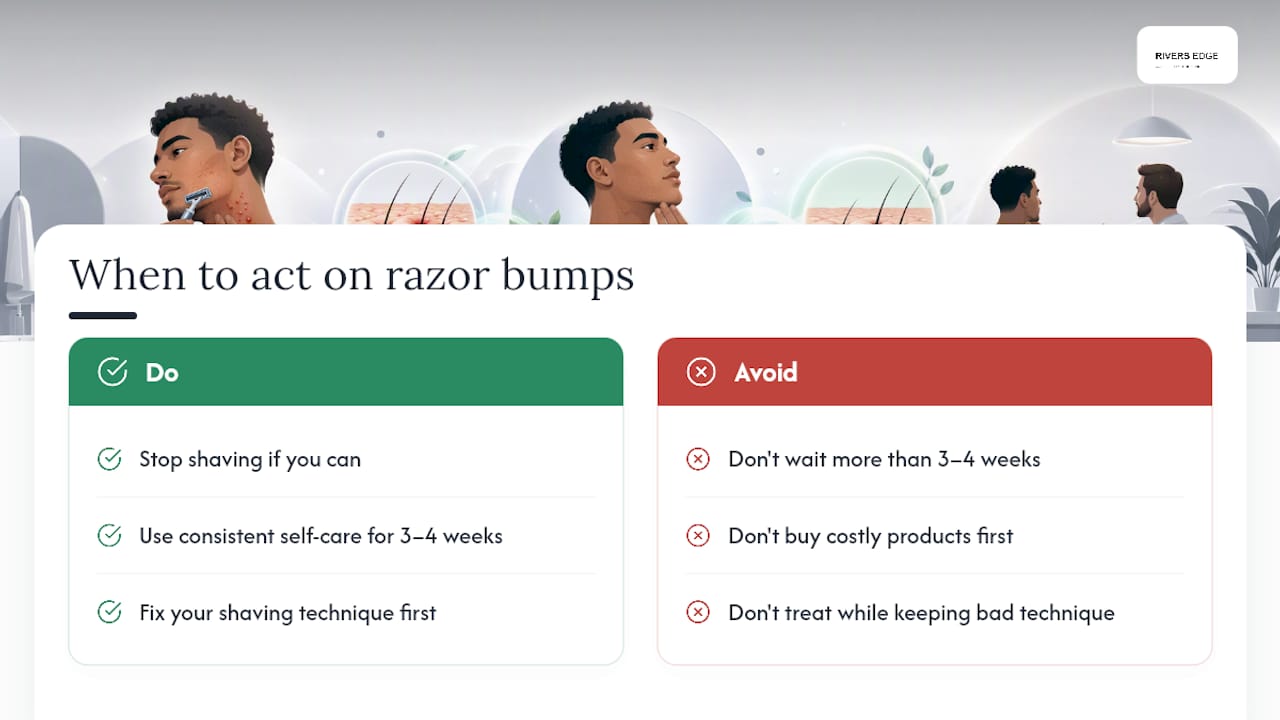
The bigger gap I see in conventional guidance is timing. Most articles tell you what to do but not when to stop trying it and get help. Three to four weeks of consistent self-care is a reasonable ceiling. Past that point without improvement, you're not being patient, you're delaying a fix that clinical treatment could deliver faster and with less scarring risk.
If I had to prioritise one thing for men reading this: fix your technique before you buy another product. A £30 keratolytic on top of a bad shaving habit is money spent treating a problem you're still actively causing every morning.
— David
How Rivers Edge Skin Studio treats persistent razor bumps
If you've worked through warm compresses, exfoliation, and a keratolytic routine for a few weeks with no real change, that's the point to bring it to a clinic rather than keep experimenting at home. Riversedgeskinstudio treats men with exactly this problem: persistent bumps, early scarring, or hyperpigmentation that's stuck around after shaving irritation has settled.

A consultation starts by reviewing your shaving history and skin condition, then builds a treatment plan around what's actually causing your bumps rather than a generic protocol. That might mean a tailored chemical peel to lift pigmentation, microneedling to support skin healing where scarring has begun, or a referral pathway for laser hair removal if recurrent bumps are the core issue. Bring a note of the products you've already tried and any workplace shaving restrictions, since both shape what we recommend. Most plans involve an initial treatment followed by a scheduled review, so progress gets tracked rather than guessed at. Book a consultation through the men's skin treatment services page to get a plan built around your skin, not a one-size routine.
This article is general information, not a substitute for advice from a qualified doctor. Consult a qualified healthcare professional about your own circumstances before acting on anything here.
Sources
- Clinical review article (PMC) — treatment ladder for ingrown hair and PFB
- Razor bump remedies for men with darker skin tones — American Academy of Dermatology
- Razor Burn — Cleveland Clinic Health Library
- Pseudofolliculitis barbae — DermNet NZ
- How to get rid of razor bumps for black skin — Black Health (2024 synopsis of trials)