
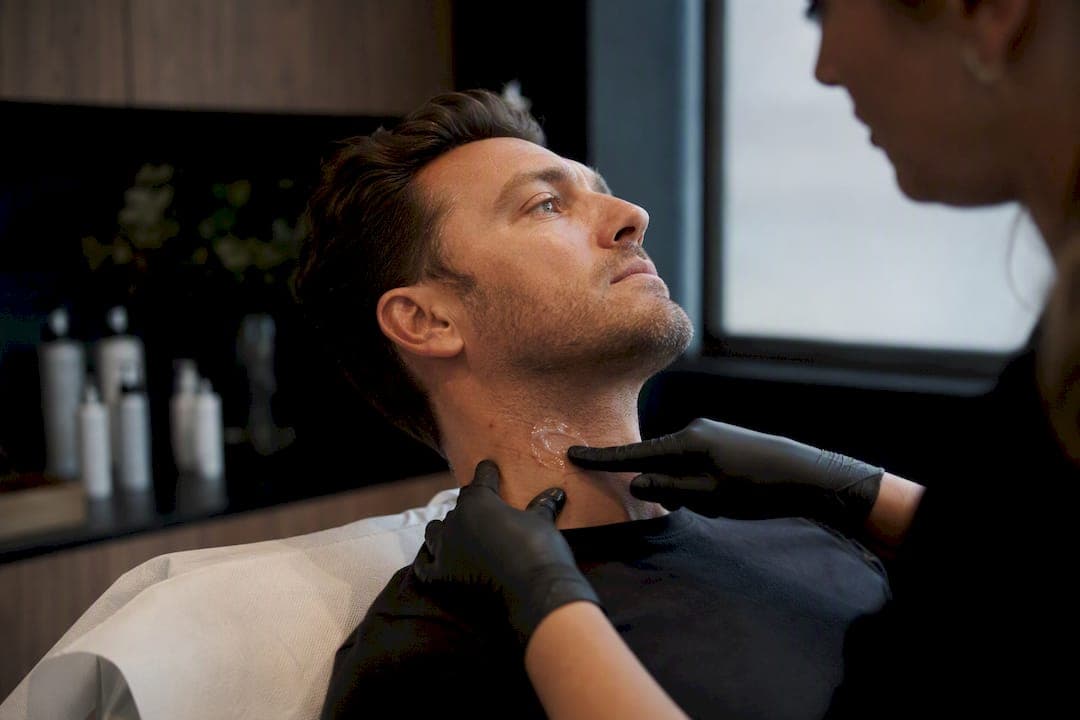
The most effective route to clearing ingrown hairs on the neck and stopping new scars starts with pausing close shaving where you can, calming active inflammation with topical care, then bringing in professional treatment for anything that keeps coming back.
- Stop the mechanical damage first. Fewer razor passes, less tension on the skin.
- Calm inflammation topically while you assess whether self-care is enough.
- Book a clinic review early if bumps persist beyond a few weeks or scarring starts to form.
- Long-pulsed 1064 nm Nd:YAG laser hair reduction is the treatment clinical comparisons rate most effective for men who keep getting ingrown hairs, typically over 3 to 7 sessions.
Earlier clinic review tends to mean less permanent scarring, particularly for anything that looks like it's thickening or forming a raised plaque rather than a simple bump.
Key Takeaways
Persistent ingrown hair scarring on the neck responds best to a combined plan: stop the mechanical trigger, calm inflammation topically, then use laser hair reduction and resurfacing to fix what self-care alone cannot.
| Point | Details |
|---|---|
| Change shaving habits first | Shave with the grain, leave stubble length, and brief your barber on the issue |
| Know the difference | PFB causes tender bumps; AKN can progress to keloid plaques needing earlier intervention. |
| Laser is the durable fix | 1064 nm Nd:YAG laser typically needs 3 to 7 sessions and outperforms peels for recurrent bumps. |
| Match treatment to scar type | Atrophic scars suit microneedling; keloidal scars need intralesional steroid and combined therapy. |
| Book early with Rivers Edge Skin Studio | A men's-focused assessment identifies the right combination before scarring becomes permanent. |
This article is general information, not a substitute for advice from a qualified doctor. Consult a qualified healthcare professional about your own circumstances before acting on anything here.
Table of Contents
- How to prevent ingrown hair neck scars in men
- Is it razor bumps or something more serious?
- What clinic treatments actually fix this
- At-home care that actually reduces inflammation and pigment
- When to book a clinic review, and how long results take
- Fixing the scars: atrophic marks versus keloidal plaques
- Why treating the cause matters more than treating the bump
- Book a review at Rivers Edge Skin Studio
- Sources
How to prevent ingrown hair neck scars in men
Most neck ingrown hairs come from a shaved hair curling back into the follicle wall, and every close shave that follows adds fresh mechanical injury on top of the last one. Breaking that cycle is the single biggest lever you have.
- Shave with the grain, not against it. Cutting against hair growth gives a closer shave but a sharper hair tip, which is exactly what re-enters the skin.
- Leave a little length. A guard set to 0.5 to 1mm, or clipper-only grooming instead of a blade, removes most of the visible stubble without the sharp edge.
- Tell your barber what's happening. A barber who knows you're prone to ingrown hairs can adjust blade pressure and direction rather than assuming a tight, close fade is what you want.
- Cut down on collar and headgear friction. Stiff shirt collars, tight helmet straps and rough scarves all rub against inflamed follicles and keep them irritated.
- Never pick, squeeze or tweeze a bump. Manual extraction almost always makes local scarring worse, not better.
Pro Tip: If you've got a clinic appointment coming up, stop shaving the area for at least a week beforehand. Mayo Clinic's guidance on ingrown hair diagnosis is clear that a clinician needs to see the actual lesions, not a freshly shaved neck, to plan treatment properly.
Is it razor bumps or something more serious?
Not every bump on the neck is pseudofolliculitis barbae (PFB), the medical term for ordinary razor bumps. Acne keloidalis nuchae (AKN) looks similar early on but behaves very differently, and telling the two apart matters for how urgently you act.
- PFB presents as small, tender, inflamed papules concentrated where you shave, often with visible ingrown hairs at the centre.
- AKN starts the same way but tends to cluster at the nape of the neck and, left alone, can progress into keloid-like plaques that fuse hair follicles together and cause permanent bald patches.
- Red flags include a bump that's firm rather than soft, one that keeps growing over weeks, or a cluster that starts binding hairs together into a raised band.
If you notice any of those signs, book a clinic assessment rather than waiting to see if it settles. AKN caught early responds far better than AKN caught after it has already scarred.
What clinic treatments actually fix this
Self-care controls flare-ups. It rarely reverses established scarring or stops a determined case of ingrown hairs from recurring every time you pick up a razor. That's where clinic-grade treatment earns its place.
Long-pulsed 1064 nm Nd:YAG laser hair reduction is the standard bearer here. Comparative clinical assessments show the 1064 nm laser produces significantly greater reduction in papules than chemical peeling alone, because it doesn't just calm the skin, it reduces the coarse hair regrowth that causes the ingrown hairs in the first place. For men with darker skin tones, the longer wavelength also carries a lower risk of pigment change than shorter-wavelength lasers, provided the settings and the operator are experienced with skin of colour.
What to expect: most men need multiple sessions spaced several weeks apart to see durable results that address hairs at different growth-cycle stages.
Chemical peels and microneedling sit alongside laser rather than replacing it. Peels help lift residual pigmentation left by months or years of inflammation, and microneedling encourages the collagen remodelling that softens shallow, pitted scarring once the active bumps have settled. Neither addresses the hair regrowth driving the problem, which is why laser tends to come first for anyone with genuinely recurrent PFB.
For AKN or any lesion that's already keloidal, treatment moves into different territory:
- Intralesional steroid injections flatten and soften raised plaques over a series of visits.
- Combined regimens pairing steroids with topical control (and sometimes laser) tend to outperform any single measure for stopping progression.
- Surgical excision is reserved for longstanding, unresponsive keloids and carries its own recurrence risk if not paired with follow-up therapy.
A chemical peel tailored to men's skin can be a useful complement once the active inflammation is under control, and it's worth discussing timing with whoever is managing your treatment plan.
At-home care that actually reduces inflammation and pigment
Topical care won't reverse a keloid, but it does a great deal for mild-to-moderate cases and for keeping skin calm between clinic sessions.
- Azelaic acid reduces inflammation and fades post-inflammatory pigmentation without the irritation risk of harsher actives.
- Salicylic acid, used two to three times a week, helps keep follicles clear of the debris that feeds ingrown hairs.
- Retinoids support skin turnover and pigment fading, but introduce them slowly, every other night to start, to avoid dryness that makes shaving worse.
- A gentle antiseptic wash after shaving reduces the bacterial load that turns a mild ingrown hair into a properly inflamed papule.
- Daily SPF on the neck stops UV exposure from deepening pigmentation that's already there.
Pro Tip: Stop shaving the area completely, even with an electric trimmer, the moment you see more than two or three active bumps. Continuing to shave over inflamed skin is the single most common reason mild PFB turns into visible scarring.
Topical care alone tends to fall short once bumps have been recurring for months, or once you can feel raised or firm tissue under the skin. That's the point at which a structured post-treatment skincare routine paired with in-clinic treatment gives a far better result than topicals carrying the whole job alone.
When to book a clinic review, and how long results take
- Book a review if bumps persist beyond four to six weeks of consistent self-care, if you see firm or raised tissue forming, or if pigmentation isn't fading months after the inflammation has settled.
- Stop hair removal roughly a week before your appointment. Clinical guidance is consistent that an accurate assessment needs visible lesions, not freshly shaved skin, even though the neck will look worse in the short term.
- Expect topical treatment to show pigment improvement over 8 to 12 weeks, used consistently.
- Expect peels and microneedling to soften texture and shallow scarring over a similar few months, usually needing more than one session.
- Expect laser hair reduction to show a meaningful drop in new bumps within the first two or three sessions, with the fullest benefit visible after the full course of 3 to 7 sessions.
Fixing the scars: atrophic marks versus keloidal plaques
Not all neck scarring from ingrown hairs responds to the same treatment, and matching the approach to the scar type is what separates a good outcome from a wasted few months.
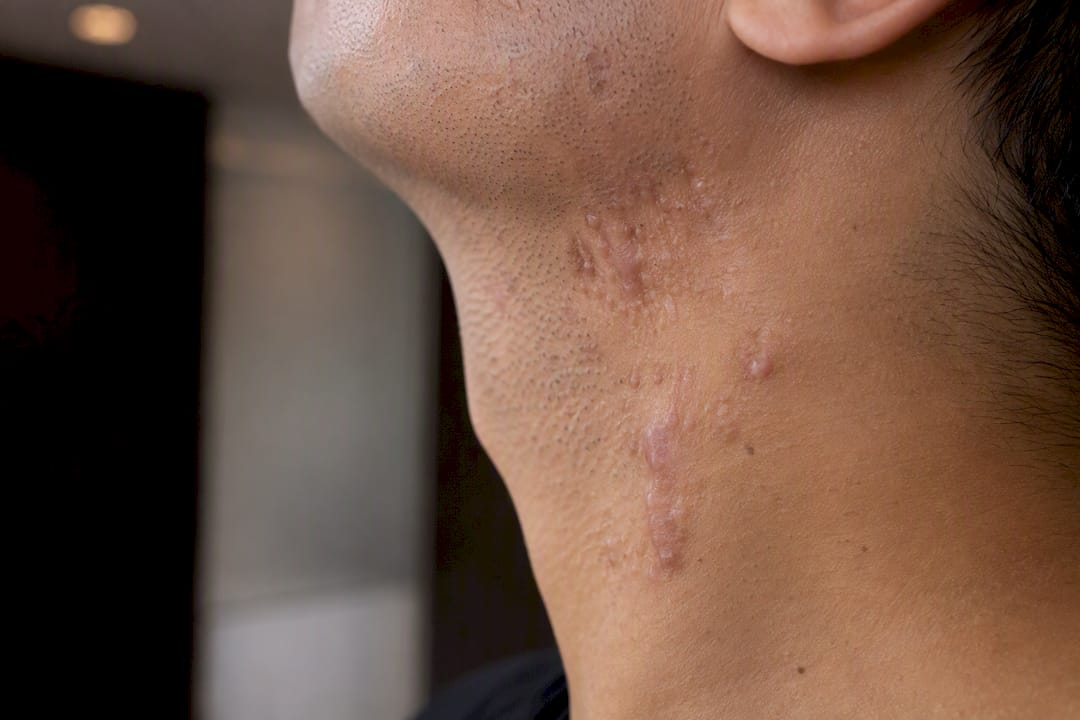
Depressed, atrophic scarring, the shallow pitted marks left after repeated inflamed bumps, responds well to a build-up approach. Microneedling stimulates collagen from underneath the skin, and fractional resurfacing can address more established textural damage once active flare-ups are under control. A microneedling course typically needs several sessions spaced a month apart to show meaningful change, and results build gradually rather than appearing after one visit.
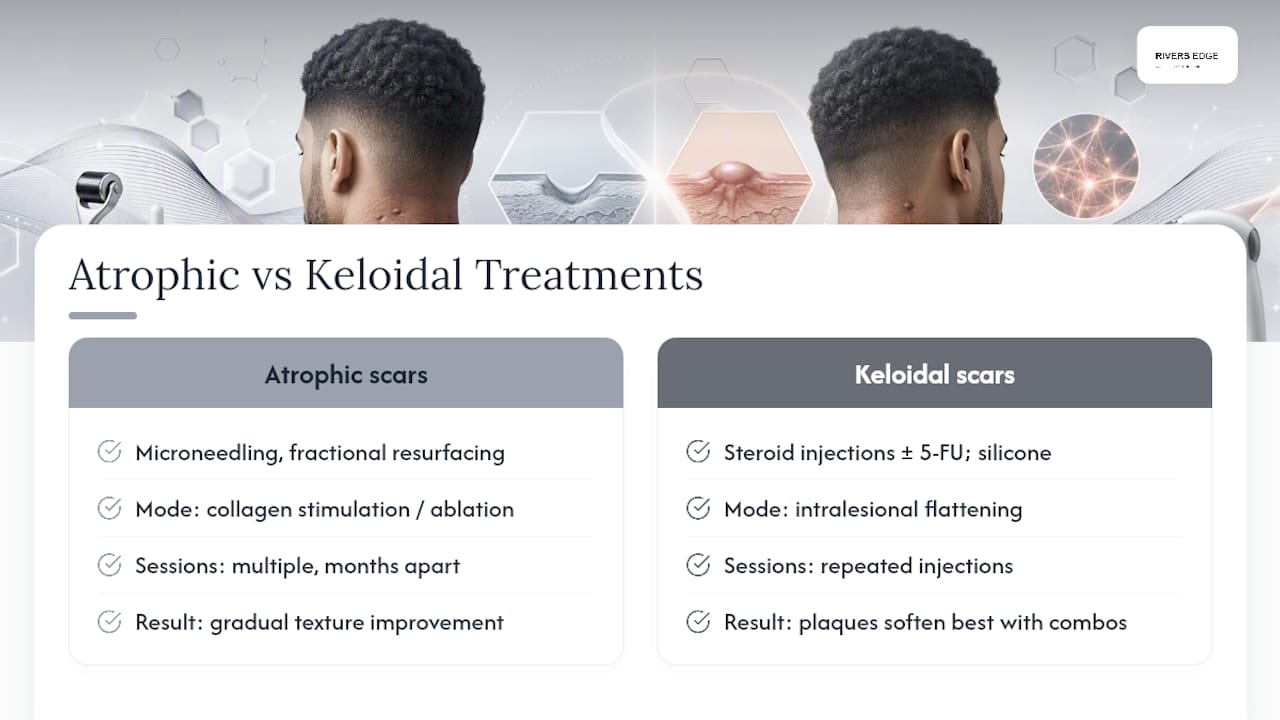
Raised, keloidal or hypertrophic scarring needs a different strategy entirely. Intralesional steroid injections, sometimes combined with 5-fluorouracil, are the first-line approach for softening and flattening these plaques. Silicone sheeting or gel can support the results between sessions, and combined therapy consistently outperforms any single treatment on its own.
Surgical excision is sometimes considered for longstanding keloids that haven't responded to anything else, but excision alone carries a real recurrence risk. It only tends to hold if it's followed by ongoing steroid or laser maintenance rather than treated as a one-off fix. A clinically led approach to men's acne scarring that assesses scar type before choosing a technique will always outperform picking a treatment off the shelf, and it's why an accurate diagnosis matters more here than almost anywhere else in this guide.
Why treating the cause matters more than treating the bump
Most advice on ingrown hairs focuses entirely on the bump in front of you: what cream to try, what razor to switch to, how to calm this week's flare-up. That misses the point for men who've been dealing with this for years. The bump is a symptom. The cause is a hair growth pattern combined with repeated mechanical injury, and until you address that combination, you're managing symptoms on a loop.
What genuinely surprises men who've lived with this for a decade is how much of the damage is reversible once the hair regrowth itself is reduced. Laser hair reduction isn't a cosmetic upgrade on top of good skincare, it removes the trigger. Everything else, the peels, the topicals, the microneedling, works far better once that trigger is gone rather than while it's still firing every time you shave.
The other underestimated factor is timing. Men tend to wait until scarring is obvious before seeking help, when the better window was months earlier while the tissue was still soft and responsive. A men's-focused clinical setting matters here specifically because general skincare advice built for women's skin and hair patterns doesn't translate cleanly to coarse, curved facial and neck hair. The assessment needs to start from how men's hair actually grows, not a generic template.
— David
Book a review at Rivers Edge Skin Studio
Rivers Edge Skin Studio treats this specific problem every week, which means your first appointment isn't a guessing game, it's a proper assessment of whether you're dealing with straightforward razor bumps, early AKN, or established scarring, and which combination of treatments actually fits your case.

A first visit typically involves a skin and hair assessment, a look at how you currently shave or get your hair cut, and a plan that draws from the same toolkit covered in this guide: Nd:YAG laser hair reduction for the underlying cause, chemical peels or microneedling for pigment and texture, and intralesional therapy where scarring has already become raised or keloidal. Treatment is paced honestly, most men need several sessions rather than one visit, and the plan reflects that from the start rather than overpromising a quick fix. If neck bumps or scarring have been a recurring problem, the full range of men's skin treatments is a reasonable place to see what a structured plan looks like and book a first consultation.
Sources
- PubMed: comparative assessments of Nd:YAG laser vs chemical peel for PFB
- Acne keloidalis nuchae: evaluation and management (NCBI Bookshelf)
- Mayo Clinic: ingrown hair diagnosis and treatment