
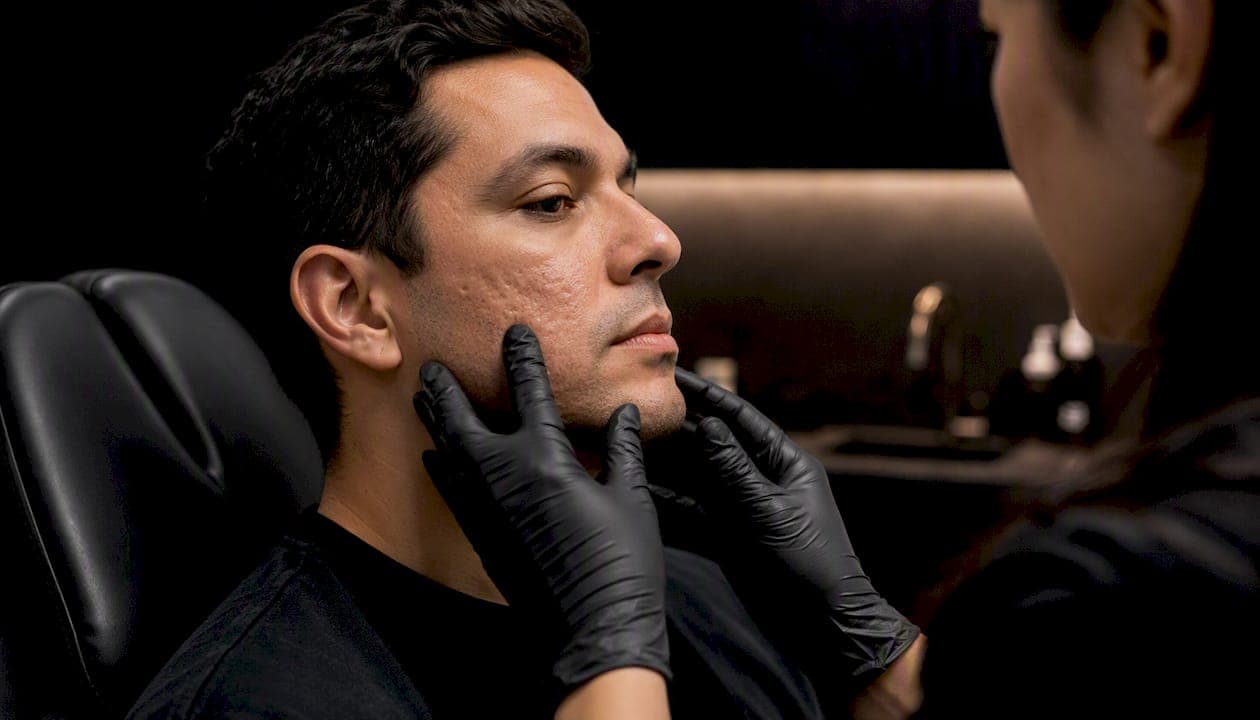
Acne scarring in men responds best to a morphology-driven, multimodal plan delivered under clinician supervision, not a single quick fix. No procedure removes scarring completely, but combining techniques matched to your specific scar type gives you the most realistic route to visible, lasting improvement.
A specialist assessment typically points towards a shortlist like this:
- Ice pick scars: TCA CROSS (chemical reconstruction) combined with fractional laser
- Rolling scars: subcision to release tethering, often paired with fillers
- Boxcar scars: punch excision or punch elevation for deeper defects
- Widespread atrophic scarring: microneedling or fractional laser as a base treatment
Your next move is a clinical assessment at a specialist men's skin clinic. Bring photos of your skin over time, a list of any acne medications you've used (including isotretinoin), and be ready to discuss how long your skin has looked this way.
Key Takeaways
Effective acne scar treatment for men combines multiple clinician-led techniques matched precisely to scar morphology, since no single procedure eliminates scarring on its own.
| Point | Details |
|---|---|
| Scar type drives treatment | Ice pick, boxcar, and rolling scars each need a different clinical approach, not a generic procedure. |
| Multimodal beats monotherapy | Combining techniques like subcision, laser, and microneedling outperforms aggressive single-session treatments. |
| Darker skin needs caution | Conservative laser settings or picosecond devices reduce post-inflammatory hyperpigmentation risk. |
| Results take months | Collagen remodelling continues for 3 to 6 months after sessions, spaced roughly 4 to 6 weeks apart. |
| Rivers Edge Skin Studio | Offers assessment-led, scar-mapped treatment plans using microneedling, peels, and laser under clinician supervision. |
This article is general information, not a substitute for advice from a qualified doctor. Consult a qualified healthcare professional about your own circumstances before acting on anything here.
Table of Contents
- How clinicians classify acne scars before treating them
- Which professional treatments suit each type of acne scar?
- How many sessions does acne scar treatment usually take?
- When should you see a consultant dermatologist?
- How a specialist clinic evaluates and stages your treatment
- Book a clinical assessment for your acne scarring
- Sources
How clinicians classify acne scars before treating them
Scar type dictates everything that follows, which is why a proper assessment always comes before any procedure. Ice pick scars are narrow, deep punctures that tunnel into the skin. Boxcar scars are wider with sharp, defined edges, like a shallow crater. Rolling scars have a wave-like appearance caused by tethering beneath the skin's surface. Some men also develop hypertrophic or raised scars, which behave very differently and need their own precautions.
Clinicians assess three things before recommending anything: depth, tethering, and pliability, since these determine whether a scar needs mechanical release, volume replacement, or resurfacing.
A proper clinical work-up typically includes:
- Scar mapping across the whole face, not just the obvious areas
- Fitzpatrick skin phototyping to gauge pigmentation risk
- A history of active acne and any isotretinoin use
- Honest discussion about achievable outcomes before treatment starts
Skin tone matters more than most men realise. Darker skin types carry a higher risk of post-inflammatory hyperpigmentation (PIH) from aggressive laser or peel treatments, according to a recent review in Frontiers in Medicine. This is why conservative energy settings, patch testing, or gentler modalities such as picosecond lasers are often preferred over standard fractional ablative devices for men with richer pigmentation.
Which professional treatments suit each type of acne scar?
Effective acne scar removal options work with the physical structure of the scar, not against it. Ice pick scars need something that reaches deep and narrow; rolling scars need release; boxcar scars often need physical excision. Here's how clinicians typically map treatment to morphology.
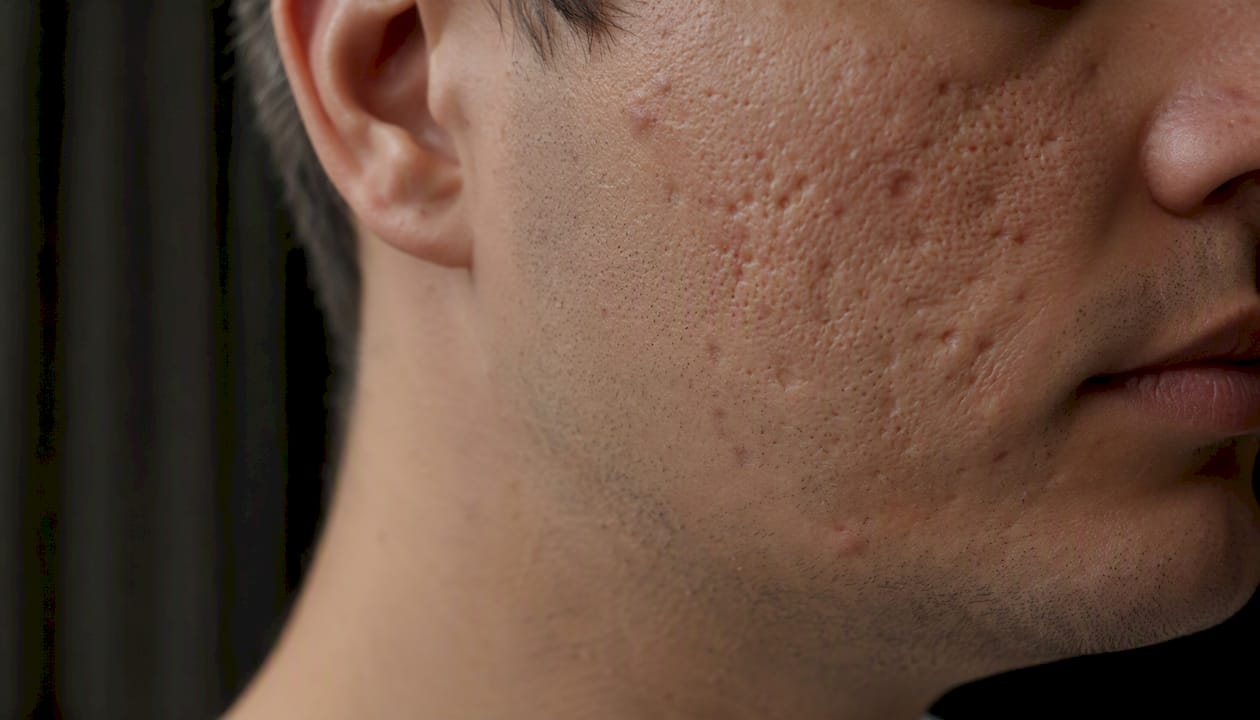
Ice pick scars respond well to TCA CROSS, where a concentrated trichloroacetic acid solution is applied precisely into the scar to trigger controlled collagen reconstruction. Fractional laser is frequently layered in afterwards to refine surrounding texture.
Rolling scars are caused by fibrous bands pulling the skin surface downward, so subcision (a needle technique that mechanically releases these bands) is often the first step, followed by dermal fillers such as hyaluronic acid, calcium hydroxylapatite, or poly-L-lactic acid to restore lost volume.
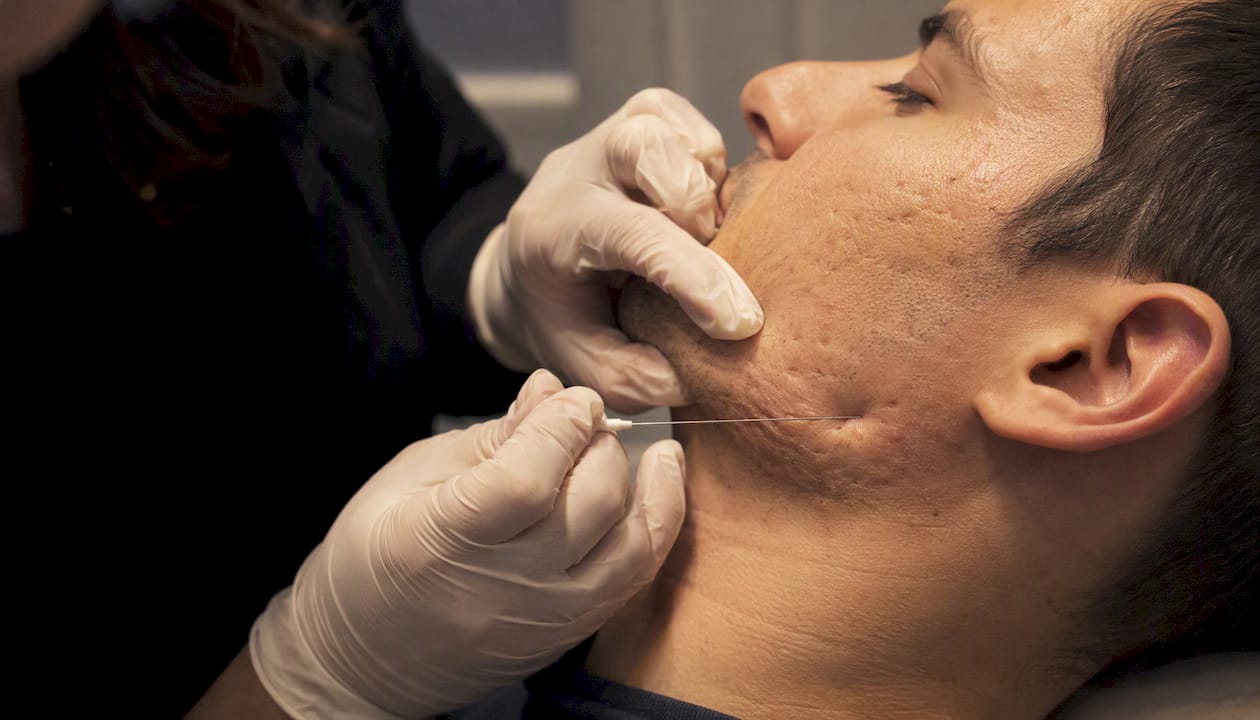
Boxcar scars, particularly deeper ones, often need punch excision or punch elevation, physically removing or raising the scarred tissue so it sits level with surrounding skin.
Hypertrophic or raised scars are managed differently again, usually with steroid injections rather than resurfacing, because aggressive energy-based treatment can worsen raised tissue in scar-prone skin.
Across all these approaches, a recent multimodal review found fractional CO2 and Er:YAG lasers highly effective for texture, though they carry a higher PIH risk than picosecond 1,064nm devices with microlens array technology, which deliver comparable collagen remodelling with less downtime.
Key pros and cons worth knowing:
- Fractional CO2/Er:YAG laser: strong results, higher PIH risk, longer downtime
- Picosecond laser (MLA): gentler recovery, safer for darker skin, slightly less dramatic per session
- Microneedling ± PRP: low downtime, works well as a base treatment or maintenance
- Chemical peels (glycolic, TCA/CROSS): cost-effective, precise for ice pick scars, requires several sessions
- Subcision: essential for tethered rolling scars, bruising is common
- Dermabrasion: effective on textured scarring but largely superseded by laser precision
Pro Tip: Never let one aggressive session replace a proper sequence. Combining gentler techniques over time consistently outperforms a single high-intensity treatment, and it's far safer for scar-prone or pigmented skin.
How many sessions does acne scar treatment usually take?
Results build gradually, and expecting instant change sets you up for disappointment. A realistic course of professional acne scar solutions looks something like this:
- Laser resurfacing: typically 1 to 4 sessions, spaced weeks apart depending on depth of scarring
- Microneedling: usually 3 to 6 sessions for meaningful texture change
- Subcision and fillers: often combined in one sitting, with maintenance filler top-ups later
- Chemical peels (CROSS technique): several sessions targeting ice pick scars specifically
Sessions are commonly spaced 4 to 6 weeks apart, because collagen remodelling continues well after the visible redness fades, and cumulative improvement generally becomes noticeable over 3 to 6 months rather than after a single visit.
Expect some redness, mild swelling, and occasionally temporary darkening of the treated skin in the days following a procedure. Your clinician should recommend a test patch before full treatment, particularly for laser or peel work, and stricter sun protection alongside topical depigmenting agents where pigmentation risk is a concern.
NHS guidance confirms laser treatment can be appropriate for mild to moderate acne scarring but is clear that risks and complications need discussing before you proceed. A separate guideline review found reasonable evidence specifically for CO2 laser, punch elevation, and glycolic acid peels.
When should you see a consultant dermatologist?
Not every case needs specialist referral, but some do. Seek consultant dermatology or a specialist clinic if you notice any of the following:
- Scarring that remains severe more than a year after active acne has cleared
- A personal or family history suggesting a tendency toward keloid scarring
- Extensive scarring that mixes several types (ice pick, boxcar, and rolling together)
- A previous poor reaction to a cosmetic procedure elsewhere
Bring photographs showing how your skin has changed, a full list of past treatments and medications (including isotretinoin), and a clear question list for the consultation. NHS availability for some scarring treatments varies by area, and a guideline review notes that persistent severe scarring a year after acne clearance is a recognised threshold for consultant-led care.
How a specialist clinic evaluates and stages your treatment
A trustworthy local skin clinic doesn't reach for one procedure and hope it works. The pathway generally runs:
- Assessment: discussion of history, skin type, and goals
- Scar mapping: documenting exactly where and how deep the scarring runs
- Tailored plan: a multimodal sequence built around your scar morphology
- Staged treatment: procedures delivered in the right order, with photographic documentation tracking progress at each stage
Objective tracking matters. Photographic records and a written treatment plan give you and your clinician something concrete to measure against, rather than relying on memory of how your skin looked months ago.
Pro Tip: Ask to see how your clinic documents progress before you commit to a plan. A clinic that can show you a mapped treatment schedule is one that's thinking in stages, not just selling single sessions.
A first assessment should always end with a plan specific to your scarring, not a generic package.
A clinician's note on realistic outcomes
Identifying scar subtype correctly and delivering controlled treatment under supervision matters more than the intensity of any single session. The aim is marked, visible improvement, not perfection, and every plan should reflect that honestly.
Book a clinical assessment for your acne scarring
Rivers Edge Skin Studio treats acne scarring the way this guide describes it should be treated: assessed first, mapped by scar type, then addressed with a plan built specifically for your skin, not a one-size package. Where other options leave you guessing between DIY peels and unclear online reviews, you get clinician oversight from the first conversation.

Our approach draws on the same modalities covered here, microneedling, chemical peels, and clinician-guided treatment sequencing, delivered in an environment built specifically around men's skin concerns rather than adapted from a general aesthetics menu.
Your first visit includes a full assessment, scar mapping, and a proposed treatment sequence with realistic timeframes discussed upfront. There's no pressure to commit to a full course on day one. Book your consultation through our services page and find out exactly what a tailored plan looks like for your skin.
Sources
- Advances in the treatment of acne scars (Frontiers in Medicine)
- Management of acne vulgaris‑associated scarring (NCBI Bookshelf / guideline review)
- Acne - Complications (NHS)