

Daily SPF 30+ and a nightly retinoid, used consistently, are the two habits Dermatology UK rates as highest value for reducing forehead lines naturally. Everything else, from serums to facial exercises, supports these two.
Soften is the right word here, not erase. Sunscreen protects skin from further UV damage from the moment you apply it. Retinoids work differently: they nudge collagen production, but that process is slow.
- Sunscreen (SPF 30+): protects immediately, every single morning.
- Retinoid: visible softening typically takes 8 to 12 weeks of consistent nightly use.
- Realistic goal: fewer, shallower lines, not a completely blank forehead.
Pro Tip: Take a photo of your forehead under the same light once a month. Retinoid progress is gradual enough that you won't notice it day to day, but you'll see it across 12 weeks.
Key Takeaways
Daily SPF 30+ combined with a nightly retinoid delivers more measurable improvement in forehead lines than any other single natural intervention available to men.
| Point | Details |
|---|---|
| SPF and retinoid first | Apply SPF 30+ every morning and a retinoid nightly; expect visible softening in 8 to 12 weeks. |
| Buffer new retinoids | Apply moisturiser first, wait five minutes, then add retinoid to reduce irritation early on. |
| Fundamentals outrank products | Sleep, resistance training, a Mediterranean-pattern diet, and less alcohol support every topical you use. |
| Match treatment to line type | Anti-wrinkle injections suit dynamic lines; microneedling and skin boosters suit static ones. |
| Break the movement habit | Reduce squinting and unconscious frowning, since repeated muscle movement is what turns lines static. |
Table of Contents
- A daily routine that helps reduce forehead lines naturally
- Lifestyle habits that reinforce your skincare efforts
- Targeted techniques and what they realistically achieve
- When in-clinic options make sense: Botox, microneedling, fillers and skin boosters
- Common mistakes and quick fixes men can implement today
- How a men's specialist clinic fits into this routine
- Facial exercises and massage techniques for forehead lines
- Why repetitive facial movements make forehead lines worse
- Why the basics beat the breakthroughs
- Frequently asked questions
- Sources
A daily routine that helps reduce forehead lines naturally
You don't need eleven products. You need the right five, used in the right order, every day.
Morning:
- Cleanse with a gentle, non‑stripping wash. Hot water and harsh soap undo everything that follows.
- Apply a vitamin C or antioxidant serum. This helps defend against the free‑radical damage that accelerates fine lines.
- Finish with a moisturiser containing SPF 30+. If you sweat during the day, a water‑resistant formula matters more than the brand on the bottle, and GQ notes that active foreheads need more frequent reapplication because sweat compromises coverage.
Evening:
- Cleanse again to remove sweat, oil, and pollution.
- Apply your retinoid two or three nights a week to start. Skin needs time to adjust.
- Follow with a moisturiser containing hyaluronic acid, peptides, or ceramides.
Retinoids cause dryness and flaking in the first few weeks for most men, which is normal rather than a sign something's wrong. The buffering technique helps: apply moisturiser first, wait five minutes, then apply the retinoid over it. This blunts the intensity without cancelling the benefit, and it's a simple adjustment that makes the difference between sticking with a retinoid and abandoning it after a fortnight.
Hyaluronic acid draws water into the skin and plumps the surface, which makes fine lines look less obvious almost immediately. Peptides and ceramides work slower, rebuilding the skin barrier so it holds moisture and resists irritation. If you're bearded, pay attention to your hairline and temple, where product often gets missed. Sensitive skin should start retinoids at the lowest strength available and stretch application to once every three nights before building up.
Lifestyle habits that reinforce your skincare efforts
Products only do part of the job. Men's Fitness reports that experts consistently rank basic lifestyle habits above expensive treatments for overall skin ageing, and forehead lines are no exception.
- Sleep 7 to 8 hours. Skin repair and collagen synthesis happen predominantly during deep sleep; chronic short sleep shows up as dullness and slower recovery from daily UV exposure.
- Strength train two to three times a week. Resistance training supports the hormone balance that maintains skin thickness and elasticity as you move through your thirties and forties.
- Eat a Mediterranean-pattern diet. Prioritise oily fish, olive oil, vegetables, and lean protein. Antioxidants from produce work alongside your topical vitamin C rather than replacing it.
- Cut back on alcohol. It dehydrates skin and disrupts sleep quality, undermining both pillars above.
- Stop smoking. It restricts blood flow to skin and breaks down collagen directly, one of the fastest ways to deepen forehead lines regardless of what you apply topically.
- Manage stress. Frowning under stress repeats the exact muscle movement that carves dynamic lines into static ones over time. Short daily mindfulness or breathing practice reduces that unconscious tension.
Targeted techniques and what they realistically achieve
Microneedling and professional chemical peels create controlled micro-injury that prompts your skin to rebuild collagen. Results build gradually across a course of sessions, usually spaced weeks apart, rather than appearing after one visit.
- Microneedling: improves skin texture and fine lines over a course of treatments; better suited to softening than to erasing deep static creases.
- At-home devices: derma rollers and LED tools offer mild, gradual improvement but lack the depth and precision of professional-grade equipment.
- Facial massage: increases circulation and can temporarily relax tension in the frontalis muscle, though the effect on visible lines is modest and short-lived.
At-home microneedling carries real infection risk if the roller isn't sterilised properly or is pressed too hard against skin. Redness for a day is expected; pain, prolonged swelling, or broken skin is not.
Pro Tip: If you're tempted by an at-home microneedling device, treat it the same way you'd treat a razor. Never share it, replace the head regularly, and stop immediately if you see broken skin rather than simple redness.
Realistic timescale for visible improvement from professional microneedling or peels sits around three to six months across a course of sessions. When lines persist despite a disciplined routine for several months, that's the point to consult a professional rather than escalate the product shelf.
When in-clinic options make sense: Botox, microneedling, fillers and skin boosters
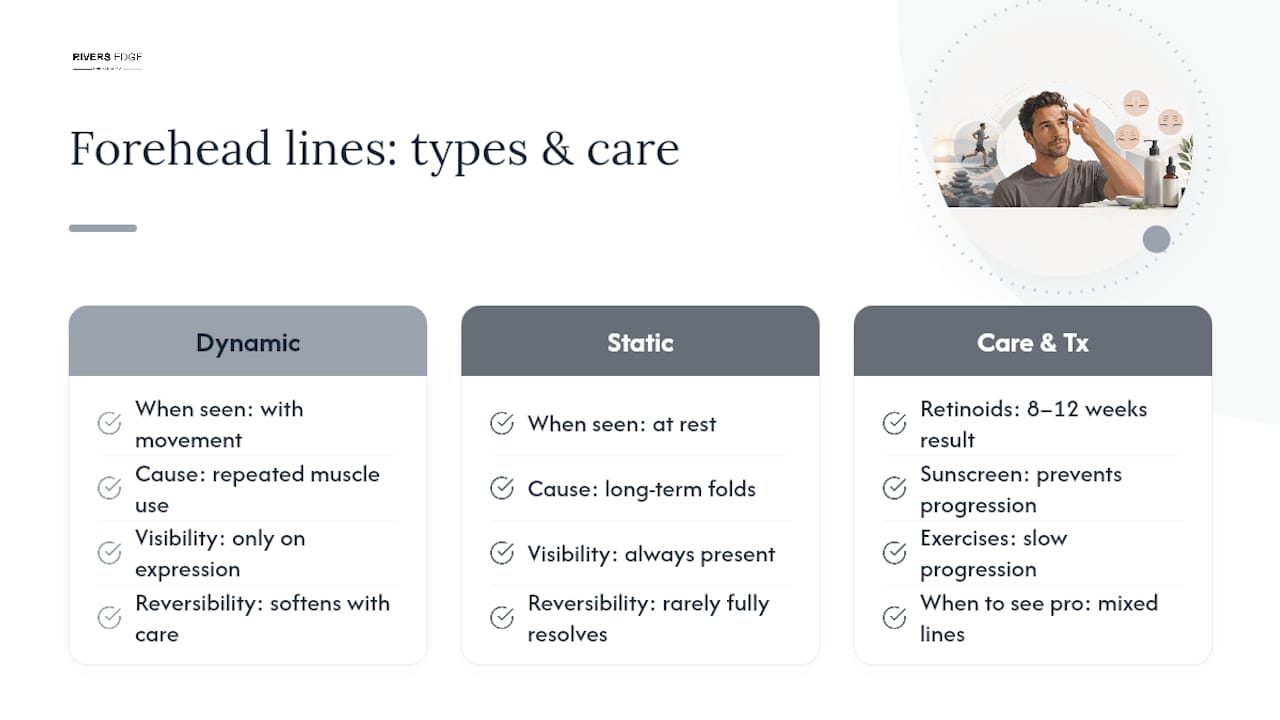
The Man‑some review of male facial ageing makes the case that treatment planning should distinguish dynamic lines, which appear only when you move your face, from static lines, which remain visible at rest. This distinction decides which clinic treatment actually fits.
Anti-wrinkle injections relax the muscle causing dynamic lines, with visible effect within 3 to 14 days and results lasting roughly three to four months before a repeat session. Microneedling and skin boosters (polynucleotides) work differently: they rebuild the dermis over a course of sessions, addressing static lines and overall skin quality rather than muscle movement. Fillers add volume where lines have become deep grooves.
- Mostly dynamic lines, want to preserve expression: anti‑wrinkle injections alone often suffice.
- Mostly static lines, want firmer skin overall: microneedling or skin boosters build results gradually.
- Both types present: combining approaches typically delivers the most natural outcome.
| Treatment | Best for | Typical timeline |
|---|---|---|
| Anti‑wrinkle injections | Dynamic lines from muscle movement | Onset 3–14 days, lasts 3–4 months |
| Microneedling / skin boosters | Static lines, overall skin quality | Course of sessions over months |
| Fillers | Deep, established grooves | Immediate, lasts several months |
Your decision comes down to line depth and your tolerance for downtime, not which treatment sounds most impressive.
Common mistakes and quick fixes men can implement today
Small errors quietly undo months of good habits. Here's what to fix first.
- Skipping sunscreen, or using the wrong type. Men are statistically less consistent with SPF than women, and a standard sunscreen sweats off within hours on an active forehead. Switch to a water‑resistant SPF 30+ and keep the bottle visible on your bathroom shelf as a trigger.
- Layering retinol and vitamin C in the same routine. They can irritate skin together. Use vitamin C in the morning and retinoid at night, never both at once.
- Chasing miracle creams instead of consistency. No serum outperforms three months of disciplined SPF and retinoid use.
- Forgetting reapplication. Set a midday phone reminder if you're outdoors or sweating heavily.
How a men's specialist clinic fits into this routine
Rivers Edge Skin Studio works with men specifically, offering anti-wrinkle injections, microneedling, HydraFacials, and chemical peels tailored to male skin rather than adapted from women's protocols. That distinction matters given how differently male skin and forehead musculature respond, as the research on male facial ageing makes clear.
A consultation makes sense when your forehead shows both dynamic and static lines, or when you want subtle, natural-looking results rather than a frozen appearance. Clinic treatments and your at-home routine aren't rivals. A course of microneedling rebuilds the skin your retinoid is already supporting, and anti-wrinkle injections buy time while your daily habits do the slower work underneath.
If that sounds like where you're at, the Rivers Edge Skin Studio services page outlines what a consultation involves.
Facial exercises and massage techniques for forehead lines
Facial exercises work on the same principle as resistance training elsewhere in your body: controlled tension followed by release. For the forehead, that means gently working the frontalis muscle without encouraging the repetitive furrowing that creates lines in the first place.
A simple routine: place your fingertips flat across your forehead, apply light resistance, then try to raise your eyebrows against that pressure for five seconds before releasing. Repeat ten times. This builds awareness of the muscle without letting it contract freely into a habitual frown.
Massage complements this. Using a facial oil or your regular moisturiser, sweep your fingers outward from the centre of your forehead towards your temples in slow, firm strokes. This increases blood flow to the area and can temporarily ease tension held in the muscle from a day of screen squinting or stress. Jade rollers and gua sha tools work on the same principle, though the tool matters far less than the technique and consistency.

None of this rebuilds collagen or erases an established line. What it does is interrupt the unconscious muscle patterns that deepen dynamic lines into static ones over years. Five minutes after your evening cleanse, before your retinoid goes on, is the easiest slot to make it a genuine habit rather than an occasional afterthought.
Why repetitive facial movements make forehead lines worse
Every deep static line started as a dynamic one. The crease you see at rest today is the physical record of thousands of repeated frowns, squints, and raised eyebrows over years, etched in by the same muscle movement each time skin loses a little elasticity to rebound fully.
Screen use is the modern culprit most men underestimate. Squinting at a phone in bright light, or straining to focus on a laptop for hours without adjusting brightness or distance, forces the same forehead muscle contraction repeatedly across a working day. Sunglasses reduce squinting outdoors; correctly adjusted screen brightness and text size reduce it indoors.
Stress compounds this because tension shows up on the forehead before almost anywhere else, often as an unconscious low-grade frown held for hours. Catching that habit, deliberately relaxing your forehead a few times a day, does more for prevention than most products on the shelf.
The practical fix isn't dramatic: get your eyes tested if you're squinting to see clearly, wear sunglasses outdoors, and build brief moments of conscious muscle relaxation into a stressful day. It's less glamorous than a new serum, but it addresses the actual mechanical cause rather than papering over the result.
Why the basics beat the breakthroughs
Most men reach for a new product before they've properly used the ones they already own. That's the real gap this research points to: not a lack of options, but a lack of patience with the two that actually work. SPF and retinoid aren't exciting. They're also, by a wide margin, the highest-return habits available before you ever consider a clinic.
The conventional wisdom oversells in-clinic procedures as a shortcut and undersells consistency as boring. Both framings are backwards. Anti-wrinkle injections and microneedling are genuinely useful, but they work best as an addition to a disciplined routine, not a replacement for one skipped for three months. If you're only going to fix one habit this year, fix your sunscreen use. It's the cheapest, least glamorous, and most consequential change on this entire list, and it's the one most men still get wrong.
Frequently asked questions
How long does it take to reduce forehead lines naturally? Retinoids typically show visible softening after 8 to 12 weeks of consistent nightly use, according to Dermatology UK. Sunscreen protects from the first application but its wrinkle-prevention benefit compounds over months and years.
Can forehead lines disappear completely without treatment? Fine, dynamic lines can soften substantially with consistent SPF, retinoid use, and reduced muscle repetition. Deep, static creases rarely disappear fully without a professional procedure such as microneedling or anti‑wrinkle injections.
What's the difference between dynamic and static forehead lines? Dynamic lines appear only when you move your face, such as raising your eyebrows. Static lines remain visible even when your face is completely relaxed, usually because a dynamic line has been repeated for years.
Do facial exercises actually help with forehead lines? They can build muscle awareness and interrupt habitual frowning, which slows the progression from dynamic to static lines. They won't rebuild collagen or remove an established deep line on their own.
Is it worth seeing a specialist clinic for forehead lines? If you have a mix of dynamic and static lines, or want subtle results without guessing at home, a consultation with a men-focused provider like Rivers Edge Skin Studio can clarify which combination of at-home care and clinic treatment fits your skin.
This article is general information, not a substitute for advice from a qualified doctor. Consult a qualified healthcare professional about your own circumstances before acting on anything here.
Sources
- Forehead lines: how to soften them (retinol, Botox, microneedling) - Dermatology UK
- “Man‑some”: a review of male facial aging and beauty
- The longevity shift: the science‑backed habits that could help men age better | Men's Fitness
- How to get rid of forehead wrinkles - GQ