
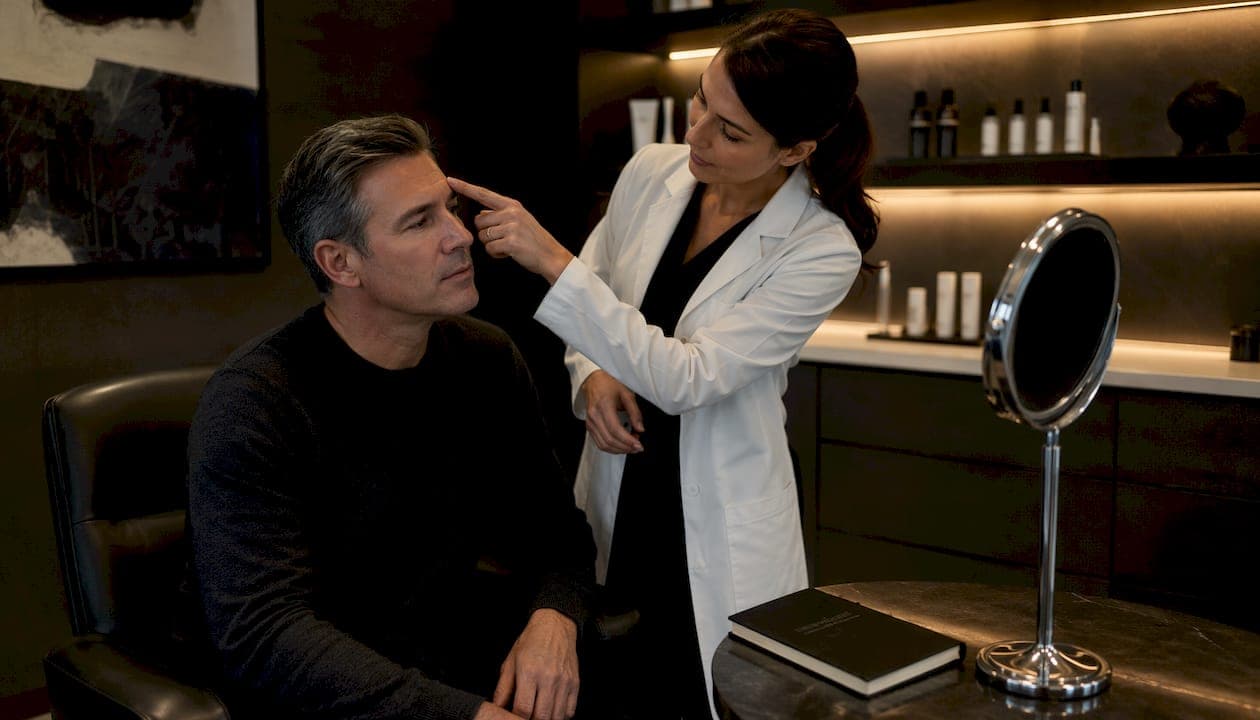
Frown line treatment refers to any clinical or preventive approach that softens or reduces the glabellar creases — the vertical lines between the eyebrows, often called the "11s." The most effective options are neuromodulators such as onabotulinumtoxinA (Botox), dermal fillers, microneedling, and collagen-stimulating procedures, used alone or in combination. Neuromodulators show results within days, with peak effect at 30–60 days and a median duration of several months. Fillers deliver immediate volume; microneedling and laser resurfacing build collagen over 4–8 weeks across multiple sessions. The right choice depends on whether your lines are dynamic (movement-driven) or static (visible at rest). Riversedgeskinstudio offers anti-wrinkle injections for men as part of a personalised clinical pathway, with all treatments carried out by qualified prescribers under UK regulatory standards.
Table of Contents
- What are frown (glabellar) lines and why does the distinction matter?
- What causes frown lines to form?
- Prevention and a realistic at-home routine
- Professional non-surgical treatments: how each one works
- Botox versus dermal fillers: choosing between them
- Surgical options and when they become relevant
- How to choose a practitioner and what to ask at consultation
- Why a medical assessment changes everything
- Key takeaways
- The gap between what people expect and what treatment actually does
- Riversedgeskinstudio: men's skin treatments in Merseyside
- Useful sources for further reading
What are frown (glabellar) lines and why does the distinction matter?
Glabellar lines form between the eyebrows as a direct result of two muscles: the procerus, which pulls the brow downward, and the corrugator supercilii, which draws the brows together. Every time you frown, squint, or concentrate, these muscles contract and fold the overlying skin. Over years, that repeated folding leaves a permanent crease — the characteristic "11" pattern.
The clinical distinction between dynamic and static wrinkles is the single most important factor in choosing a treatment. Dynamic lines only appear when the muscles move; they respond well to neuromodulators because relaxing the muscle removes the cause. Static lines are visible even when your face is completely at rest — they represent structural loss of collagen and elastin in the dermis, not just muscle activity. Static lines need volume restoration or collagen stimulation, and often a combination of both.
As collagen and elastin decline with age, dynamic lines gradually become static. That progression is why early treatment and prevention genuinely matter — catching lines while they are still dynamic gives you far more options and better results.
A qualified clinician will assess your lines at rest and during movement to classify them accurately before recommending anything. That assessment, not a product name, drives the treatment plan.
What causes frown lines to form?
Frown lines are caused by a combination of factors, some you can change and some you cannot. Understanding both helps you focus effort where it counts.
- Repeated muscle movement: every frown, squint, and look of concentration contracts the procerus and corrugator supercilii, gradually etching creases into the skin
- Age-related collagen and elastin loss: the dermis thins over time, reducing its ability to spring back after repeated folding
- UV exposure: sun damage degrades collagen fibres and accelerates skin ageing, deepening existing lines
- Smoking: reduces blood flow to the skin and accelerates collagen breakdown
- Genetics: skin thickness, elasticity, and the depth of muscle attachment are partly inherited
- Habitual squinting: often triggered by poor eyesight or bright light, it compounds the mechanical stress on the glabellar area
- Sleep position: sleeping face-down or on your side presses the skin against a pillow, adding mechanical creasing overnight
The most impactful modifiable risks are UV exposure, smoking, and habitual squinting. Daily SPF, stopping smoking, and wearing sunglasses outdoors address all three directly.
Prevention and a realistic at-home routine
Home care will not erase deep static creases, but it is genuinely effective at slowing new line formation and improving overall skin quality. The gap between what a good routine achieves and what clinical treatment achieves is real — knowing where that line sits saves you both time and money.
AM routine
- Cleanser — a gentle, non-stripping wash suited to your skin type
- Antioxidant serum — vitamin C (L-ascorbic acid, ideally 10–20%) neutralises free radical damage from UV and pollution, protecting collagen
- Moisturiser — hyaluronic acid-based formulas draw water into the skin, temporarily plumping fine lines
- Sunscreen (SPF 30 minimum, SPF 50 preferred) — this is the single highest-value step in any anti-ageing routine; daily SPF plus a nightly retinoid is the most evidence-backed preventive combination available without a prescription
PM routine
- Cleanser — remove SPF, pollution, and sebum thoroughly
- Retinoid or retinol — speeds up skin cell turnover and stimulates collagen production; OTC retinol is available in the UK without a prescription, while stronger prescription retinoids (tretinoin) require a GP or prescribing clinician; expect 3–6 months before visible collagen-related improvement
- Moisturiser — supports the skin barrier, especially when introducing a retinoid
Pro Tip: Start retinol two nights per week and build slowly over 4–6 weeks. Apply it to dry skin and always follow with moisturiser. Patch-test first, and avoid retinoids entirely during pregnancy or breastfeeding.
Non-topical habits
Wearing sunglasses outdoors reduces squinting significantly. Sleeping on your back removes the nightly mechanical pressure that contributes to facial creasing. Smoking cessation is one of the most impactful steps you can take for skin quality at any age.
Topical products soften fine lines and slow progression, but they do not address the muscular drivers of glabellar creases. For established lines, clinical treatment is where the meaningful change happens.
Professional non-surgical treatments: how each one works
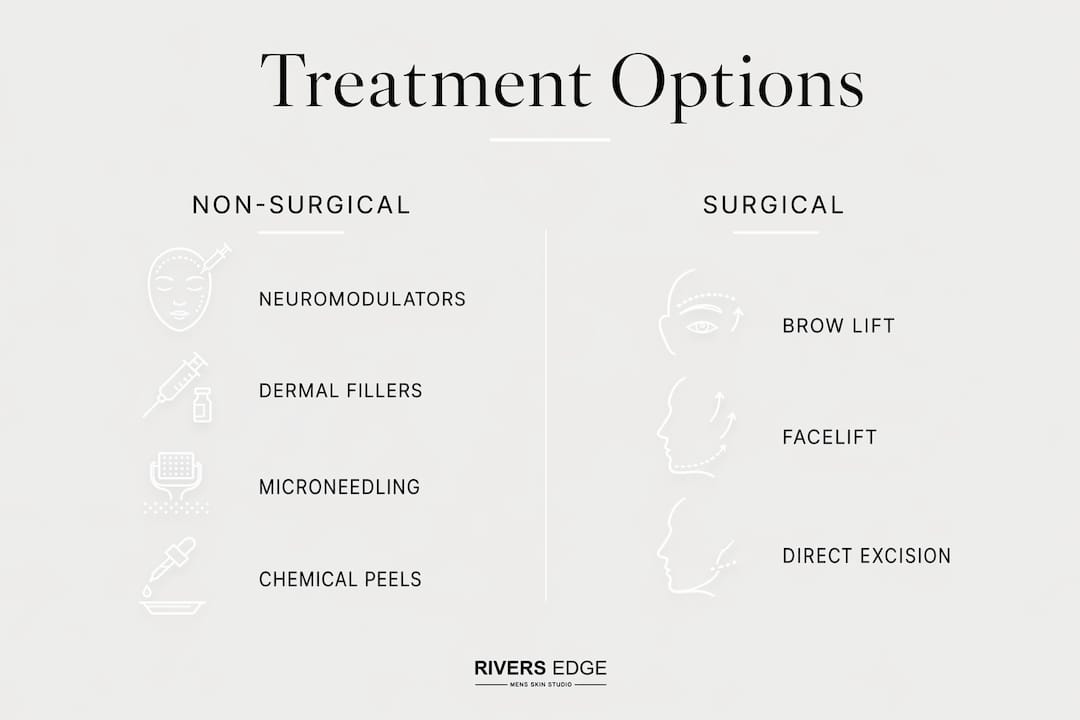
Each clinical option targets frown lines through a different mechanism. The right choice depends on line type, depth, skin quality, and your tolerance for downtime.
| Treatment | Best for | How it works | Typical duration | Downtime | Typical UK cost | Sessions/maintenance |
|---|---|---|---|---|---|---|
| Neuromodulators (Botox/Dysport) | Dynamic lines | Relaxes procerus/corrugator muscles | ~3–4 months | Minimal (hours) | — | Every 3–4 months |
| Hyaluronic acid fillers (Juvederm, Restylane) | Static lines, volume loss | Restores volume, immediate lift | 6–12 months | 24–48 hrs (swelling) | — | Every 6–12 months |
| Microneedling | Static lines, skin quality | Controlled micro-injury triggers collagen | Builds over 4–8 weeks | 24–72 hrs (redness) | — | 3–6 sessions; annual maintenance |
| Laser resurfacing | Deep static lines, texture | Thermal energy stimulates collagen remodelling | Months (progressive) | Days to 1–2 weeks | — | 1–3 sessions |
| Chemical peels | Fine lines, skin texture | Exfoliates and stimulates cell renewal | Weeks (progressive) | 3–4 days | — | Course of 3–6; seasonal maintenance |
| Collagen-stimulating injectables (e.g. polynucleotides) | Skin quality, early static lines | Biostimulation of fibroblasts | Months (progressive) | Minimal | — | 2–4 sessions; annual top-up |
Neuromodulators
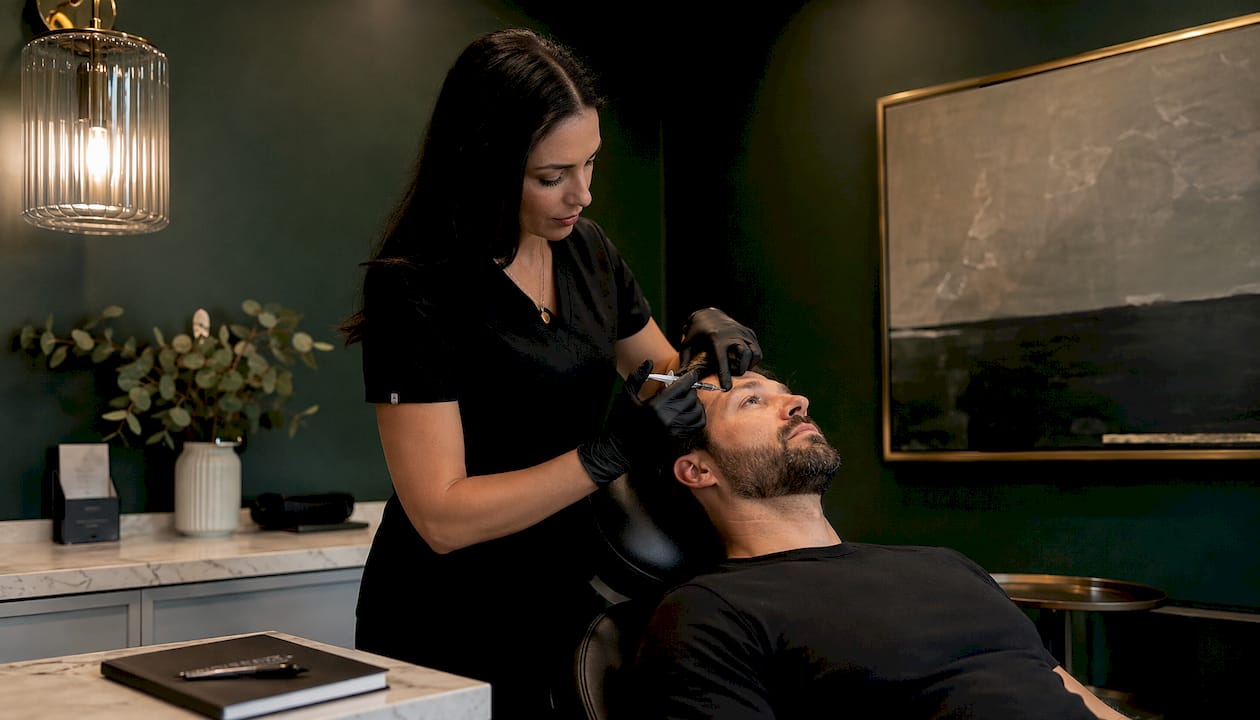
Botox (onabotulinumtoxinA) and Dysport (abobotulinumtoxinA) both block the nerve signal to the procerus and corrugator supercilii, preventing the muscle contractions that crease the skin. Results appear within days, peak at 30–60 days, and typically last around 3–4 months. They are the gold standard for dynamic lines. Dysport has a slightly different unit dosing profile to Botox, so the two are not interchangeable unit-for-unit — your clinician will advise on the appropriate product and dose for your anatomy.
Dermal fillers
Hyaluronic acid fillers such as Juvederm and Restylane restore volume in the glabellar area, physically filling the crease from below. Results are immediate. They are best suited to static lines where the crease persists at rest and neuromodulators alone would not fully address the depth. Duration is typically 6–12 months, after which the filler is gradually broken down by the body. For more detail on how fillers work and what aftercare involves, dermal filler treatment is worth reading before your consultation.
Microneedling
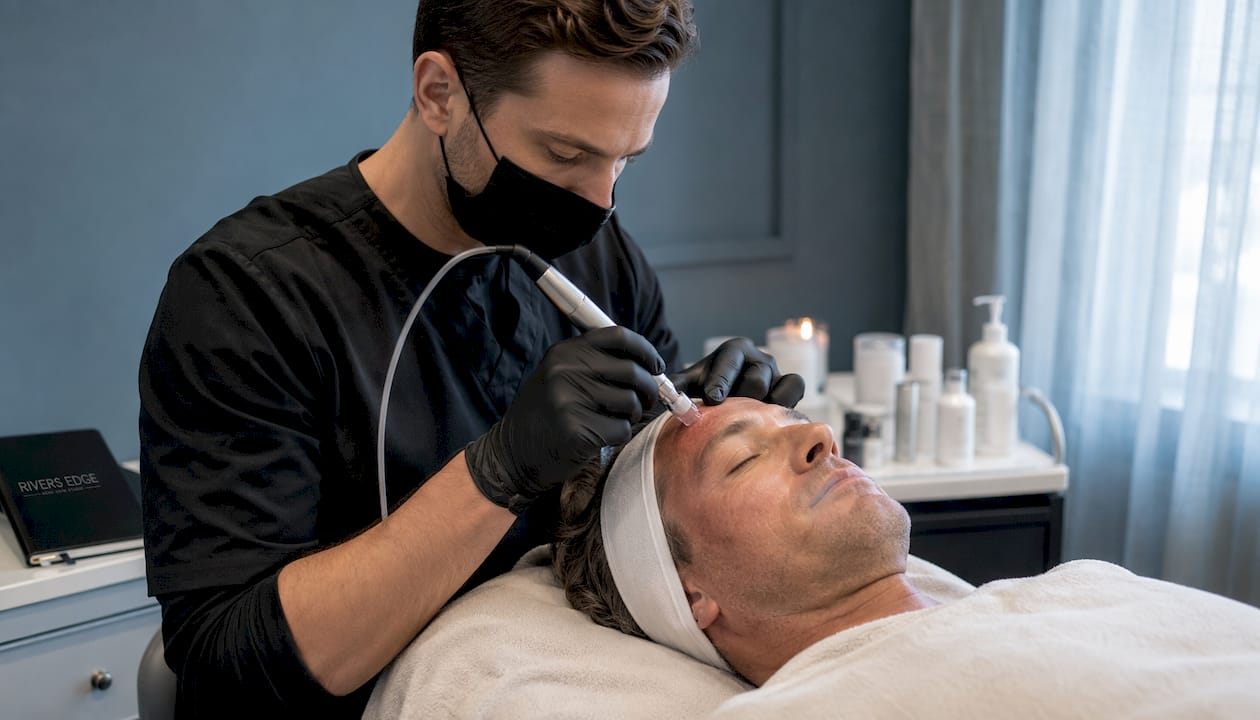
Microneedling triggers collagen through controlled micro-injury to the dermis. Fine needles create channels that activate the skin's wound-healing response, producing new collagen and elastin over several weeks. Results build progressively across a course of sessions, typically 3–6 spaced 4–6 weeks apart. Downtime is short — usually 24–72 hours of redness. It suits static lines and general skin quality improvement rather than active muscle-driven creasing.
Chemical peels and laser resurfacing
Professional chemical peels use higher concentrations of active acids than any OTC product, penetrating deeper to stimulate cell renewal and improve skin laxity. Laser resurfacing goes further, using thermal energy to remodel collagen at a structural level. Both require a course of sessions for best results. Laser carries more downtime but can address deeper static lines that peels cannot reach.
Combination approaches
For many men, the most effective strategy combines a neuromodulator to relax the muscle with a collagen-stimulating procedure or filler to address the residual static crease. A common sequence is to rebuild skin quality first with microneedling or peels, then introduce a neuromodulator once the skin foundation is stronger. Your clinician will advise on sequencing based on your specific presentation.
Botox versus dermal fillers: choosing between them
The core decision between neuromodulators and fillers comes down to one question: are your lines caused by muscle movement, or by lost volume and structural change?
Neuromodulators (Botox, Dysport):
- Mechanism: block acetylcholine release at the neuromuscular junction, preventing muscle contraction
- Best for: dynamic lines that appear with expression and fade at rest
- Onset: visible within days; peak at 30–60 days
- Duration: approximately 3–4 months; repeat treatments every 3–4 months in clinical practice
- Downtime: minimal; small injection-site redness resolves within hours
- Common side effects: temporary bruising, mild headache, asymmetry if technique is imprecise
Dermal fillers (Juvederm, Restylane):
- Mechanism: hyaluronic acid adds physical volume beneath the crease, lifting it from below
- Best for: static lines visible at rest, volume deficit in the glabellar area
- Onset: immediate
- Duration: 6–12 months depending on product, placement, and individual metabolism
- Downtime: 24–48 hours of swelling and possible bruising
- Common side effects: bruising, swelling, rare vascular complications if technique is poor
Pro Tip: If your lines are deep at rest but worsen with expression, a combination approach — neuromodulator to stop the movement, filler or microneedling to address the existing crease — often produces the most natural-looking result. Discuss this explicitly with your clinician.
Safety and technique
Injection placement is not optional detail — it is the difference between a good result and a complication. Practitioners are advised to avoid injecting onabotulinumtoxinA closer than 1 cm above the central eyebrow, and to place lateral corrugator injections at least 1 cm above the supraorbital rim. Injecting too close to the levator palpebrae superioris risks blepharoptosis (eyelid droop) — a temporary but unwanted outcome. This is why practitioner anatomy knowledge matters as much as the product itself.
Surgical options and when they become relevant
Surgery is not the first line of treatment for frown lines, but it becomes a reasonable consideration when non-surgical options have reached their limits.
A brow lift (also called a forehead lift) repositions the brow and smooths the overlying skin, directly addressing the appearance of deep glabellar creases and a heavy brow. It does not stop muscle movement, so many patients continue with neuromodulators post-operatively for the best long-term result. Recovery typically involves 1–2 weeks of visible swelling and bruising, with full healing over several weeks. UK costs vary widely but generally start from £3,000–£6,000 depending on technique and clinic.
A facelift addresses broader facial ageing — jowls, neck laxity, mid-face volume loss — and has an indirect benefit on the upper face. It is rarely indicated for frown lines alone, but for someone with significant overall facial ageing, it may be part of a comprehensive plan. Recovery is longer, typically 2–4 weeks before returning to normal activity.
Surgery carries greater risks than any non-surgical option: general or sedation anaesthesia, scarring, infection, nerve damage, and longer recovery. The trade-off is longevity — structural surgical change lasts years rather than months. Candidates are typically those with severe skin laxity, very deep static creases, or broader facial ageing goals that injectables cannot adequately address. A consultation with a GMC-registered plastic or maxillofacial surgeon is the right starting point.
How to choose a practitioner and what to ask at consultation
Choosing the right practitioner matters more than choosing the right product. In the UK, aesthetic injectables must be prescribed by a regulated prescriber — a doctor, dentist, nurse prescriber, or pharmacist prescriber. Since 2023, non-surgical cosmetic procedures including Botox require a prescription from a qualified prescriber, and clinics must meet governance standards.
Before your consultation: what to prepare
- Note your current medications, including blood thinners, supplements, and topical prescriptions
- List any allergies, previous adverse reactions to injectables, or autoimmune conditions
- Bring photographs showing your face at rest and during expression — these help the clinician assess dynamic versus static line severity
- Write down your goals and any previous treatments, including what worked and what did not
- Set a realistic expectation: softening is the achievable goal for deep static lines, not complete removal
Practitioner credential checklist
- Registered with the GMC (doctors), NMC (nurses), or GDC (dentists) — verify on the relevant register
- Holds a prescribing qualification for injectables
- Has specific training in facial anatomy and aesthetic injections
- Works in a clinic with a written emergency protocol and access to hyaluronidase (to dissolve filler if needed)
- Provides a formal consent form and a written aftercare plan
Red flags
- No consultation before treatment; pressure to book immediately
- No consent form or written record of your medical history
- Unwillingness to discuss risks, downtime, or realistic outcomes
- No aftercare plan or follow-up appointment offered
- Prices significantly below the UK market range (often a sign of unqualified practitioners or unlicensed products)
Questions to ask
- Are you a regulated prescriber, and can I verify your registration?
- Which product will you use and why is it appropriate for my lines?
- What are the realistic outcomes for my specific presentation?
- What are the risks, and how would you manage a complication?
- What does the maintenance schedule look like and what is the total annual cost?
Why a medical assessment changes everything
A clinical assessment before any frown line treatment is not a formality — it changes the treatment selected, the technique used, and the safety of the outcome. Muscle anatomy varies between individuals; the depth and attachment of the corrugator supercilii affects both product dosing and injection placement. Skin quality, thickness, and degree of photodamage all influence whether a neuromodulator alone will suffice or whether collagen stimulation is needed alongside it.
At Riversedgeskinstudio, the clinical pathway follows a clear structure:
- Consultation: full medical history, skin assessment, dynamic and static line classification, and discussion of realistic outcomes
- Tailored plan: treatment selected and sequenced based on your specific anatomy and goals, not a standard package
- Treatment: carried out by a qualified prescriber using MHRA-regulated products
- Follow-up: review at 2–4 weeks post-treatment to assess results and plan maintenance
The clinic follows UK safety and regulatory standards, including MHRA guidance on prescription-only medicines used in aesthetics. Before-and-after photography is taken with consent to track progress objectively. Informed consent is obtained before every procedure, covering risks, alternatives, and realistic expectations.
Studies report over 80% patient satisfaction through day 60 following onabotulinumtoxinA treatment, with subjects perceiving a noticeably younger appearance at weeks 4 and 12. Those results are consistent with what a well-executed, properly assessed treatment plan delivers. Riversedgeskinstudio's approach to men's facial rejuvenation is built on exactly that evidence base.
Key takeaways
Clinical frown line treatment works best when the type of line (dynamic or static) is correctly identified first, and when home care and clinical procedures are combined rather than treated as alternatives.
| Point | Details |
|---|---|
| Dynamic vs static lines | Dynamic lines suit neuromodulators; static lines need fillers, microneedling, or collagen stimulators. |
| SPF and retinoid daily | The most cost-effective preventive combination; retinoids take 3–6 months to show collagen-related effects. |
| Neuromodulator timeline | Botox peaks at 30–60 days and lasts approximately 3–4 months; maintenance every 3–4 months. |
| Realistic expectations | Deep static creases soften with treatment but rarely disappear entirely; maintenance is required for lasting results. |
| Riversedgeskinstudio | Offers anti-wrinkle injections, microneedling, chemical peels, and skin boosters for men in a qualified clinical setting in Merseyside. |
The gap between what people expect and what treatment actually does
There is a persistent gap between what men expect from frown line treatment and what any single procedure can realistically deliver. The most common misunderstanding is treating a neuromodulator as a one-off fix. It is not. It is a maintenance treatment — effective, safe, and well-evidenced, but requiring repeat sessions every few months to sustain results.
The second misunderstanding is expecting deep static creases to disappear entirely. They will not. The realistic and honest goal is softening — a meaningful improvement that makes lines less prominent and the face less fatigued-looking. That is still a worthwhile outcome, and for most men it is more than enough. But a clinician who promises complete removal of established static lines is overpromising.
What I find genuinely encouraging is the evidence for progressive improvement with repeat treatments. Patients who commit to a consistent maintenance schedule — neuromodulator every 3–4 months, supported by a daily SPF and retinoid routine — tend to see cumulative benefit over time. The skin quality improves alongside the muscle relaxation, and the lines that were once deep at rest often become shallower. That is a realistic, achievable outcome when combining skincare treatments sensibly rather than chasing a single dramatic result.
Start with the right assessment. Be honest with your clinician about your goals. And treat maintenance as part of the plan from day one.
Riversedgeskinstudio: men's skin treatments in Merseyside
Men's skin is different — thicker, oilier, and subject to daily shaving stress — and frown line treatment works best when the approach accounts for that. Riversedgeskinstudio is a specialist men's skin clinic in Merseyside offering anti-wrinkle injections, microneedling, chemical peels, dermal fillers, and skin boosters (polynucleotides), all delivered by qualified prescribers with personalised treatment plans.

Every consultation starts with a proper clinical assessment: your lines are classified, your skin quality assessed, and a plan built around your anatomy and goals — not a standard menu. Products used are MHRA-regulated, consent is taken before every procedure, and follow-up is built into the process. There are no hard-sell packages and no pressure to book on the day.
If you are ready to understand what your options actually are, book a consultation at Riversedgeskinstudio and get a clear, honest picture of what treatment can achieve for you.
This article is general information, not medical advice. Confirm current treatment options and suitability with a qualified prescriber for your own situation.
Useful sources for further reading
These UK and clinical sources are worth consulting before booking any aesthetic treatment:
- MHRA (Medicines and Healthcare products Regulatory Agency) — the UK regulator for medicines and medical devices; check product licensing and safety guidance for injectables
- NHS — cosmetic procedures — clear, impartial overview of non-surgical and surgical cosmetic options, risks, and what to expect
- British Association of Dermatologists — professional body for UK dermatologists; patient information on skin ageing and treatments
- Joint Council for Cosmetic Practitioners (JCCP) — UK register of qualified aesthetic practitioners; use the practitioner search to verify credentials before booking
- PMC — onabotulinumtoxinA clinical review — peer-reviewed clinical evidence on Botox mechanism, efficacy, and safety for glabellar lines
Consult regulated professional guidance and verify your practitioner's credentials before proceeding with any injectable or invasive treatment.