
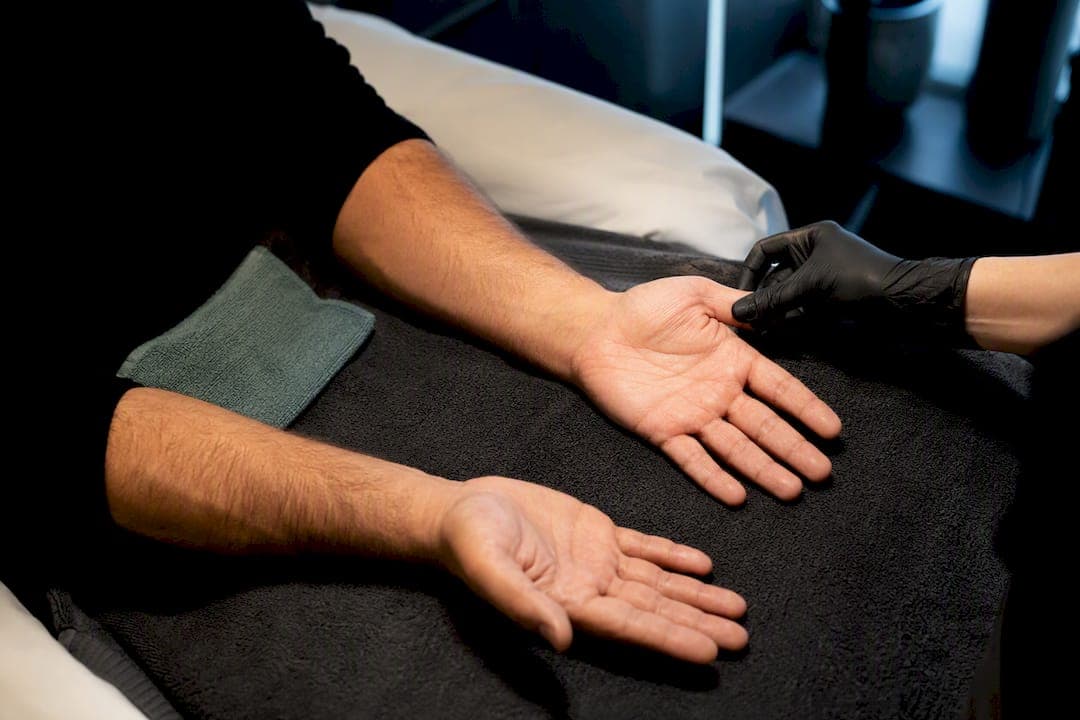
Botox reduces palmar sweating for most people who try it, typically cutting sweat production for around six months at a time. It's not licensed specifically for palms, so treatment is offered off-label, and some patients notice temporary grip weakness in the days after injection. For a man dealing with hands that sweat through every handshake and phone screen, that trade-off is usually worth discussing with a clinician face to face before deciding.
TL;DR:
- Botox typically reduces palm sweating for around six months, with some patients experiencing longer or shorter durations based on dose and individual factors.
- Treatment effectiveness is high in most cases, and repeat sessions remain safe and do not lead to diminishing results over time.
- The procedure requires precise mapping and injection technique, often with local anesthesia and pain mitigation methods, to minimize side effects and maximize efficacy.
- Common side effects include temporary grip weakness and mild injection-site discomfort, which usually resolve within weeks.
- Costs vary based on units needed, clinic expertise, and location, with private sessions generally more expensive than other treatments like antiperspirants or iontophoresis.
Table of Contents
- How Botox treats sweaty hands: the science behind it
- Does Botox actually work for sweaty palms?
- Who should consider Botox and what comes before it?
- What happens during a Botox session for sweaty hands?
- What are the side effects and risks of Botox for sweaty hands?
- How much does Botox for sweaty hands cost, and does the NHS pay?
- How to choose a clinic for Botox on sweaty hands
- Our experience treating palmar hyperhidrosis in men
- Book a Botox consultation for sweaty hands at Rivers Edge Skin Studio
- Sources
How Botox treats sweaty hands: the science behind it
Botulinum toxin works by blocking the release of acetylcholine, the chemical messenger that tells your eccrine sweat glands to switch on. Without that signal, the glands in the treated area stay dormant. It doesn't shut down your body's ability to sweat elsewhere, and it doesn't touch your core temperature regulation. Palms carry a dense concentration of sweat glands relative to their surface area, but they still represent a small fraction of your total sweat output, which is why treating them locally has no meaningful effect on how your body cools itself overall.
The timeline follows a fairly predictable pattern:
- Noticeable dryness often begins within a few days of injection.
- Full effect typically sets in by around two weeks, a timeline consistent across most botulinum toxin injections.
- Results commonly last a moderate number of months, though this varies by dose, metabolism, and how quickly your nerve endings regenerate.
Palms are more sensitive to injection than other treatment sites, partly because the skin is thicker and richer in nerve endings, and partly because the muscles sitting just beneath the surface are small and easily affected by toxin that migrates slightly off-target. That anatomy shapes both the dose a clinician chooses and how carefully they place each injection, which is why technique matters as much as the product itself.
Does Botox actually work for sweaty palms?
Clinical data on palmar Botox is genuinely encouraging. The International Hyperhidrosis Society reports effectiveness in a high majority of treated patients of treated patients, a range echoed across multiple clinical reviews of the treatment.
Effectiveness snapshot: Most patients treated for palmar hyperhidrosis see meaningful sweat reduction, with benefits generally holding for several months before a top-up is needed.
Durability isn't identical for everyone. Some men find their hands stay dry for eight months or longer; others notice sweating creeping back after four. Factors like the total dose used, the accuracy of the injection grid, and individual differences in nerve regeneration all play a part. What research consistently shows is that repeat treatment remains safe and effective over time; there's no evidence of diminishing returns from having the procedure done again and again.
Quality of life is where the numbers become personal. Studies measuring outcomes with standardised scales report real improvements in how patients rate their comfort in social and professional situations. That matters more for palmar sweating than almost any other body area, because hands are involved in nearly every interaction you have.
- Reduced palm sweating shows up in improved DLQI (Dermatology Life Quality Index) scores in clinical literature.
- Response is generally consistent across repeat sessions, not just the first one.
- Individual variation in duration is normal and doesn't necessarily predict how the next round will perform.
Who should consider Botox and what comes before it?
Botox for sweaty hands rarely sits as the very first thing a clinician suggests. Most guidance follows a step-wise approach, and understanding where injections fit helps set the right expectations before you book anything.
- Topical antiperspirants. Aluminium-based formulas, including stronger clinical-strength options, are the usual starting point and work well for mild cases.
- Iontophoresis. A low-level electrical current passed through water reduces sweat gland activity for many patients, though it requires ongoing sessions at home.
- Botox injections. Recommended once topical and device-based options haven't given enough relief, or when sweating is severe enough to interfere with daily function.
- Oral anticholinergics. Tablets that reduce sweating body-wide, generally considered when localised treatments aren't practical or haven't worked.
- Surgery (sympathectomy). A last resort, given the risk of permanent side effects like compensatory sweating elsewhere on the body.
Clinicians tend to move to Botox when sweating is disrupting work, relationships, or basic tasks like gripping a pen or a steering wheel, and when antiperspirants or iontophoresis haven't delivered enough improvement. It sits comfortably in the middle of the treatment ladder, offering a stronger effect than topicals without the systemic side effects that come with oral medication.
Before treatment, disclose any history of neuromuscular disorders (such as myasthenia gravis), pregnancy or plans to become pregnant, and any current medications. Aminoglycoside antibiotics, cholinesterase inhibitors, and certain calcium channel blockers can theoretically interact with botulinum toxin, so your clinician needs the full picture before injecting.
Compared with iontophoresis, Botox demands far less of your time day to day but costs more upfront. Compared with oral anticholinergics, it avoids the dry mouth, blurred vision, and other body-wide effects that tablets often bring, at the cost of being a more invasive procedure repeated every few months.
What happens during a Botox session for sweaty hands?
The appointment starts with mapping, not injecting. Many clinics use Minor's starch-iodine test, where iodine solution and starch powder are applied to the palm; the areas producing sweat turn a visible blue-black, giving your clinician a precise outline of exactly where to treat rather than guessing at the boundaries.
From there, treatment follows a fairly standard pattern:
- Injections are placed intradermally in a grid pattern, spaced roughly a centimetre apart across the mapped sweating area.
- Dosing is individualised based on the size of the area and how severe your sweating is.
- Pain control matters more here than almost anywhere else Botox is used, and clinics may offer nerve blocks, topical anaesthetic cream, ice, or vibration devices to take the edge off the discomfort.
- A full session typically runs 30 to 45 minutes once mapping and anaesthesia are accounted for.
Pro Tip: Ask your clinic whether they offer a vibration or cold-air device during injections. It sounds minor, but distracting the nerve pathway that carries pain signals genuinely reduces how much you feel each injection, especially across the more sensitive centre of the palm.
Recovery is usually immediate. Most men can drive home and return to normal activities the same day, though clinics generally advise avoiding heavy gripping exercise or hot environments for 24 hours. Bruising and mild tenderness can linger for a few days. Follow-up is typically scheduled around the six-month mark, or sooner if effects fade early, and our detailed account of the treatment experience walks through what that first visit actually feels like.
What are the side effects and risks of Botox for sweaty hands?
Local side effects are the most common and least concerning: injection-site pain, small bruises, and a day or two of tenderness are typical and resolve on their own.
The risk that deserves proper attention is temporary grip weakness. Because palmar muscles sit close to the sweat glands being targeted, some toxin can diffuse into the small muscles of the hand, and studies treating palmoplantar hyperhidrosis with BoNT-A and BoNT-B document a measurable rate of transient weakness alongside the symptomatic improvement.
- Weakness, when it occurs, is usually mild and affects fine motor tasks like buttoning a shirt or turning a key.
- It typically resolves within a few weeks as the toxin's effect on muscle fibres wears off alongside the sweat gland effect.
- Some clinics use BoNT-B specifically in the thenar and hypothenar muscle regions as a way to reduce weakness risk while keeping BoNT-A centrally, an approach that requires real experience to dose correctly.
- Toxin brands aren't interchangeable; different formulations vary in potency, which is another reason product choice and clinician judgement matter more here than in most cosmetic Botox work.
Contact your clinic promptly if you notice weakness that worsens rather than improves, signs of infection at injection sites, or any symptoms suggesting an allergic reaction. If you're taking aminoglycoside antibiotics or cholinesterase inhibitors, flag this immediately, as these can theoretically prolong the toxin's effect.
How much does Botox for sweaty hands cost, and does the NHS pay?
Private pricing depends on three things: how many units your hands need, the clinic's location, and the practitioner's experience level. Palms generally require more units than underarms because the treatment area and gland density are both greater, which pushes the price toward the higher end of what you'd expect for cosmetic Botox.
- Expect a private session for both hands to sit in a noticeably higher bracket than a single-area facial treatment, given the unit count involved.
- Specialist or consultant-led clinics often charge more than general aesthetic practitioners, reflecting the technical demand of palmar injections.
- Repeat treatments every six months or so should be factored into your annual budget from the outset, not treated as a surprise cost.
NHS funding for palmar Botox exists but is inconsistent across the country. Axillary (underarm) hyperhidrosis is more commonly commissioned by NHS services than palmar cases, partly because underarm treatment requires less precision and carries less risk of functional side effects. If you want to explore NHS routes, start with your GP and ask specifically about your local Integrated Care Board's commissioning policy for hyperhidrosis, since criteria and waiting times vary significantly by region. Many patients end up paying privately for palms even when underarm treatment is available through the NHS.
How to choose a clinic for Botox on sweaty hands
Not every practitioner offering Botox has genuine experience with palmar cases specifically, and that gap shows up in outcomes.
- Check prescriber status. Botox is a prescription-only medicine, so your injector must be a qualified prescriber, not someone working under a generic template plan.
- Ask about hyperhidrosis-specific training. Clinicians educated through resources like the International Hyperhidrosis Society tend to have deeper familiarity with palmar dosing and technique than those who mainly do cosmetic facial work.
- Ask direct questions. Which toxin brand do they use, what dose do they anticipate, what pain control is offered, and what does follow-up look like if effects fade early?
- Watch for red flags. No sweat-mapping test, vague answers about dosing, no clear plan if something goes wrong, or high-pressure upselling are all signs to walk away.
Pro Tip: A clinician who can't explain roughly how many units your hands are likely to need, even as an estimate, probably hasn't treated many palmar cases. Ask before you book.
Our longer guide to excessive sweat treatment covers how to compare providers in more depth if you want to weigh this against other options first.
Our experience treating palmar hyperhidrosis in men
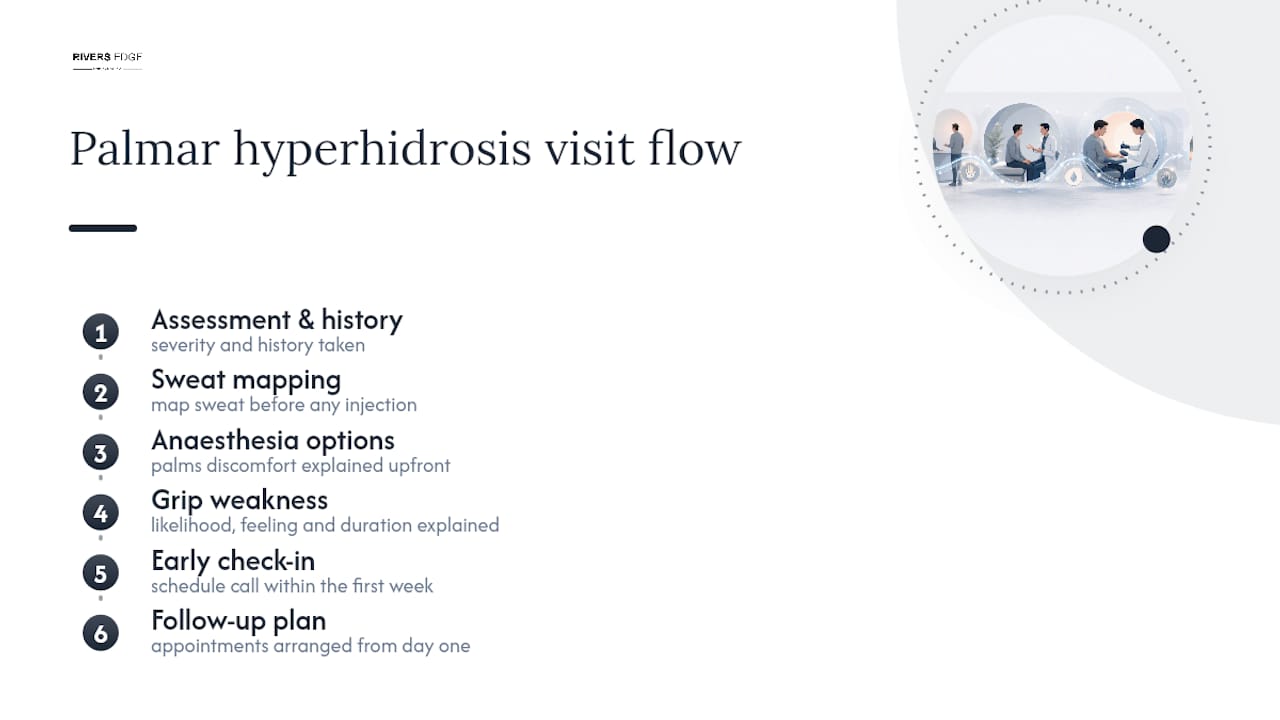
Every consultation for sweaty hands at Rivers Edge Skin Studio starts with an honest assessment of severity and history, followed by sweat mapping before any injection is discussed. We talk through anaesthesia options upfront, since palms are genuinely one of the more uncomfortable areas to treat, and we'd rather a patient know what to expect than be surprised mid-session.
Grip weakness gets addressed directly during consultation, not glossed over. We explain the realistic likelihood, what it tends to feel like, and how long it typically lasts, then schedule a check-in call within the first week so nobody is left wondering whether what they're feeling is normal. Follow-up appointments are built into the plan from day one, not treated as an afterthought once the six-month mark rolls around.
— David
Book a Botox consultation for sweaty hands at Rivers Edge Skin Studio
Sweaty palms are a specific problem that needs a specialist's hands, not a generalist's rushed template session. Rivers Edge Skin Studio treats palmar hyperhidrosis with the same precision we apply to every men's skin concern: proper sweat mapping, individualised dosing, and real pain-control options rather than a one-size-fits-all injection pattern.

What sets a focused clinic apart here is time. Palmar cases need a longer consultation to map sweat patterns properly and a longer injection session to work through the grid pattern accurately, and that's exactly how we structure the appointment rather than squeezing it between unrelated treatments. If your hands are affecting how confidently you shake a colleague's hand or hold a phone in a meeting, book a consultation through our men's skin treatments page and bring a note of what's failed so far, whether that's antiperspirants, iontophoresis, or nothing at all. We'll map your palms, talk through realistic outcomes for your specific case, and get you scheduled for treatment.
This article is general information, not a substitute for advice from a qualified doctor. Consult a qualified healthcare professional about your own circumstances before acting on anything here.
Sources
- Botulinum toxin injections — Cleveland Clinic
- Management strategies of palmar hyperhidrosis: challenges and solutions