
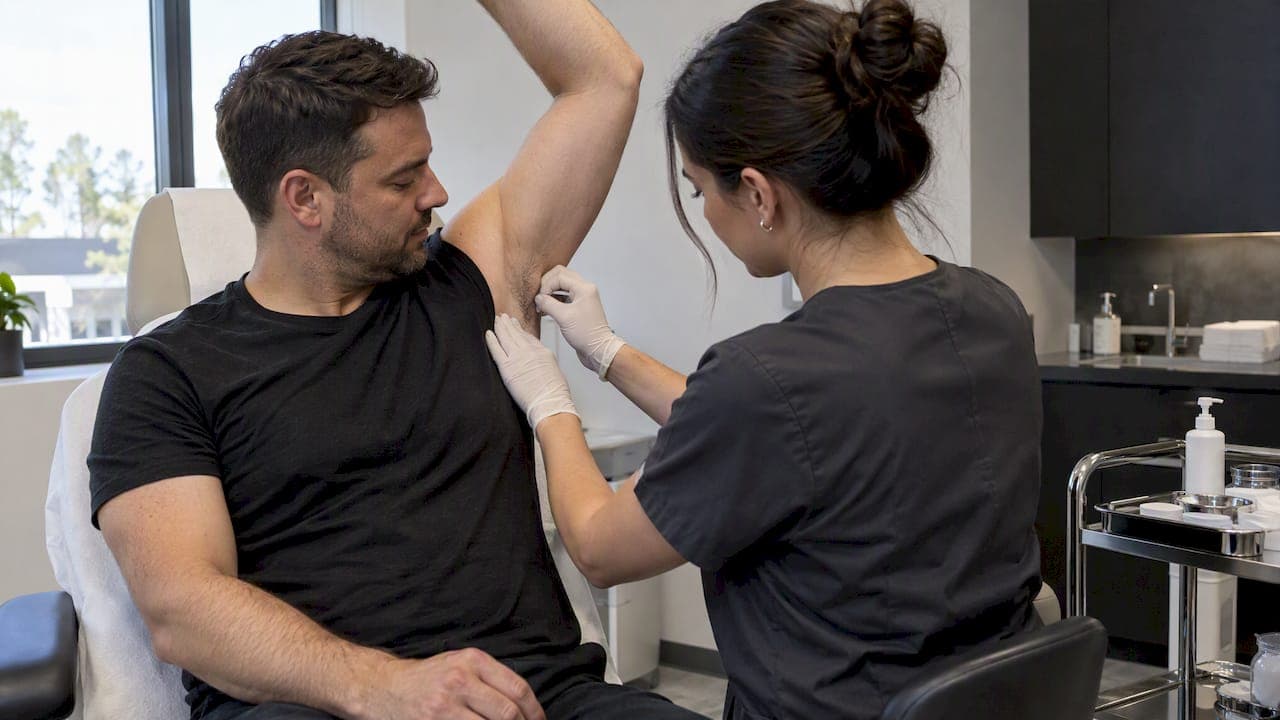
Underarm Botox typically keeps sweating under control for 3 to 6 months, with some men seeing benefits stretch towards a year. Most notice drier armpits within about a week, with the full effect settling in by around two weeks. Results vary by dose, metabolism and technique, and the treatment needs repeating to maintain the effect.
TL;DR:
- Larger armpit areas may require higher doses and more precise mapping to extend sweat reduction duration beyond the usual 3 to 6 months.
- Technique and injector skill significantly influence how long results last, making careful placement essential for optimal outcomes.
- Most men experience maximum dryness within two weeks, with effects typically diminishing after four to six months, though individual factors vary.
- Retreatment is recommended every six months or when sweating begins to return, with licensed minimum intervals of 12 to 16 weeks between sessions.
- Side effects are generally mild, with 11% experiencing minor issues such as redness or discomfort, and serious adverse events are rare.
Table of Contents
- What the evidence and NHS guidance say about how long effects last
- How Botox stops armpit sweat and why it fades
- What makes your results last longer or shorter
- What to expect at your appointment and how the timeline unfolds
- Common side-effects and when to see someone
- How often you'll need to repeat treatment
- What Rivers Edge Skin Studio sees in male patients
- Why the six-month figure gets oversold
- Booking an underarm sweat consultation with Rivers Edge Skin Studio
- Sources
- FAQ
What the evidence and NHS guidance say about how long effects last
The clearest picture comes from a 2001 multicentre, placebo-controlled trial that remains the reference point for underarm Botox. Using 50 units per armpit, delivered through 10 to 15 small intradermal injections, researchers found that 94% of treated patients had more than half their sweat reduced at four weeks, with 82% still responding at sixteen weeks.
NHS patient information on intradermal Botox aligns closely with that trial.
A more recent 2024 randomised trial comparing Botox with microwave thermolysis adds useful nuance. At six months, Botox outperformed the device-based alternative, with a median sweat reduction exceeding half the baseline level. By the one-year mark, the two treatments had largely converged, with Botox's reduction remaining substantial. That pattern suggests Botox has a clear edge in the middle months, but the gap narrows over the longer term.
- A 2001 trial found 94% of men and women responded at four weeks, dropping to 82% at sixteen weeks.
- NHS guidance notes improvement frequently occurs within a week for many patients.
- A 2024 trial found Botox had a clearer advantage over microwave thermolysis at six months.
94% response rate at four weeks: this remains the headline figure most clinics quote when setting expectations for new patients.
How Botox stops armpit sweat and why it fades
Botox works by blocking the release of acetylcholine, the chemical messenger that nerve endings use to signal sweat glands into action. Without that signal, the glands in the treated area stop producing sweat, even though the underlying biology hasn't changed.
The dose and pattern used in the 2001 trial, 50 units per armpit spread across 10 to 15 injection points, remains the standard most clinics reference today. The injections sit just under the skin, in the dermis, rather than deeper into muscle.
The effect fades because nerve endings regrow. NHS guidance notes this regrowth typically takes around six to twelve weeks, after which the nerve signal reaches the sweat glands again and sweating gradually returns to baseline.
- Botox blocks the chemical signal nerves use to trigger sweat glands.
- Typical clinical doses often approximate 50 units per armpit across multiple injection points.
- Nerve endings regrow over a period roughly between six and twelve weeks, resulting in a temporary effect.
What makes your results last longer or shorter
No two men get exactly the same number of dry months from a single treatment, and several factors explain why.
Dose and surface area matter: larger underarms may need more units spread across a wider injection pattern to cover active sweat glands. Technique also matters; some clinics map active sweat gland areas before injection using a dye or starch-iodine test to improve accuracy and coverage.
Your own metabolism, activity levels and baseline sweating also play a part, as does whether you've had other treatments to the area, such as surgery or energy-based devices, which can change how your sweat glands respond long-term. Compensatory sweating, where other areas of the body sweat more to make up for reduced underarm output, is a recognised but uncommon possibility worth asking about.
- Higher doses and broader injection coverage generally help extend results for larger armpit areas.
- Accurate mapping methods such as starch-iodine tests can better target active sweat glands.
- Individual factors like baseline sweat level and activity affect duration of effect.
- Compensatory sweating in other areas can occur but is relatively uncommon.
Pro Tip: Ask your clinic whether they use a sweat-mapping test before injecting. It takes a few extra minutes but helps make sure every active gland gets treated.
What to expect at your appointment and how the timeline unfolds

A typical underarm Botox session is short, usually under thirty minutes, with the injections themselves taking only a few minutes once the area is mapped and marked. Most men need no numbing beyond a cold pack or topical cream.
Aftercare is simple. Clinics commonly advise staying upright and avoiding strenuous exercise or heavy sweating for around four hours after treatment, giving the Botox time to settle into place before blood flow and movement increase around the injection sites.
- Days 1 to 3: little visible change yet, though some men notice slightly less sweating almost immediately.
- Week 1: NHS guidance notes many patients see meaningful improvement by this point.
- Weeks 1 to 2: the effect typically peaks, with maximum dryness achieved.
- Months 3 to 6: this is the window where sweating most commonly starts to return, in line with trial data.
If dryness hasn't improved noticeably within two to three weeks, it's worth contacting your clinic rather than waiting out the full six months.
Common side-effects and when to see someone
Underarm Botox has a well-documented safety profile, though it isn't free of side-effects. The 2001 trial reported that 11% of treated patients experienced an adverse event, most commonly mild and localised.
- Pain, redness or itching at the injection sites, usually settling within a day or two.
- Occasional headache, which tends to be mild and short-lived.
- Rare reports of nausea following treatment.
- Compensatory sweating in other areas, an uncommon but recognised effect.
A medical assessment matters before treatment starts. Clinical resources recommend ruling out secondary causes of sweating, such as new, widespread, or night-time sweating, which can point to an underlying medical condition rather than primary localised hyperhidrosis. If that sounds like your pattern, speak to a doctor before booking cosmetic treatment.
How often you'll need to repeat treatment
Licensed guidance is consistent on one point: Botox shouldn't be re-injected sooner than roughly 12 to 16 weeks after the last session, giving the nerve endings time to settle and reducing the risk of over-treatment. In practice, most men find a rhythm closer to every six months fits how long their results actually last.
Rather than booking by the calendar alone, it makes sense to go back when sweating starts returning rather than on a fixed schedule, since individual duration varies.
- Minimum licensed interval between treatments is around 12 to 16 weeks.
- Many men settle into a roughly six-month repeat cycle.
- Retreatment timing should follow symptom return, not just the calendar.
- Long-term repeated use is common, and stopping treatment simply means sweating gradually returns to its original baseline over a few months.
What Rivers Edge Skin Studio sees in male patients
Trial data gives a reliable baseline, but it helps to know what happens in practice for men specifically. Rivers Edge Skin Studio's underarm Botox results report an 82% to 87% reduction in underarm sweat among treated men, a range that sits comfortably alongside the published trial figures above.
Men tend to measure success differently to clinical trial criteria: fewer visible sweat marks, less deodorant needed, fewer shirt changes during the day, rather than a target percentage.
Worth raising at consultation: how the clinic measures improvement, what a realistic reduction looks like for your specific sweating pattern, and how your underarm anatomy might affect dosing. The same mechanism applies to other sweat-prone areas: palm sweat treatment follows a similar six-month pattern, which is a useful comparison if you're weighing up more than one area.
Why the six-month figure gets oversold
The "lasts six months" line gets repeated so often that it starts to sound like a guarantee rather than an average. It isn't.
What gets underrated is technique. Two men with identical underarm anatomy can get different results from the same total dose, depending on how carefully the injections are mapped and spread. That's a bigger lever than most online guidance admits, because it's easier to quote a trial average than to explain why injector skill matters.
If there's one thing worth prioritising, it's asking your clinic how they decide injection placement, rather than just accepting a quoted duration at face value. Duration is the outcome. Technique and dose are the inputs that actually determine it, and that's where your questions should go.
— David
Booking an underarm sweat consultation with Rivers Edge Skin Studio
Rivers Edge Skin Studio offers an Excessive Sweating Treatment designed specifically for men dealing with underarm sweat that affects daily life, priced at £240 per session. The initial consultation covers your sweating pattern, medical history and any previous treatments, so bring details of current medications and anything you've tried before.

- Treatments are carried out by medically qualified injectors in private clinics focused on male clients.
- Expect a discussion of realistic outcomes tailored to individual underarm size and baseline sweating rather than a one-size-fits-all answer.
- Alternatives, including devices and topical options, are worth discussing if Botox isn't the right fit for you.
If underarm sweat is affecting your confidence or wardrobe choices, book a consultation and get a plan built around your own skin and sweat pattern rather than a generic average.
Sources
- Botulinum toxin type A in treatment of bilateral primary axillary hyperhidrosis: randomised, parallel group, double blind, placebo controlled trial
- Hyperhidrosis and intradermal Botox® (patient information leaflet)
- Prospective randomized trial of BTX vs MWT for axillary hyperhidrosis (2024)
This article is general information, not a substitute for advice from a qualified doctor. Consult a qualified healthcare professional about your own circumstances before acting on anything here.
FAQ
What is the 4 hour rule after Botox?
Clinics commonly advise staying upright and avoiding strenuous exercise or heavy sweating for around four hours after underarm Botox. This gives the injected Botox time to settle into the treated tissue before increased blood flow or movement has a chance to shift it.
Is Botox three times a year too much?
It depends on spacing. Licensed guidance sets a minimum interval of around 12 to 16 weeks between sessions, so three treatments a year, spaced roughly four months apart, generally falls within that guidance rather than exceeding it.
Is it good to get Botox in your armpits?
For men with bothersome underarm sweating, Botox is a well-studied option, with a 2001 trial showing 94% of patients responding at four weeks. It suits localised sweating rather than sweating linked to an underlying medical condition, which should be ruled out first.
How painful is Botox in the armpits?
Most men describe the injections as a brief pinching or stinging sensation rather than significant pain, and the armpit is generally well tolerated compared with more sensitive areas. Discomfort typically settles quickly, and some clinics offer a cold pack or topical numbing beforehand.
How often do side-effects happen with armpit Botox?
A 2001 trial reported that 11% of treated patients had some form of adverse event, mostly mild and limited to the injection site, such as redness or minor discomfort. Headache and, rarely, nausea have also been reported.