
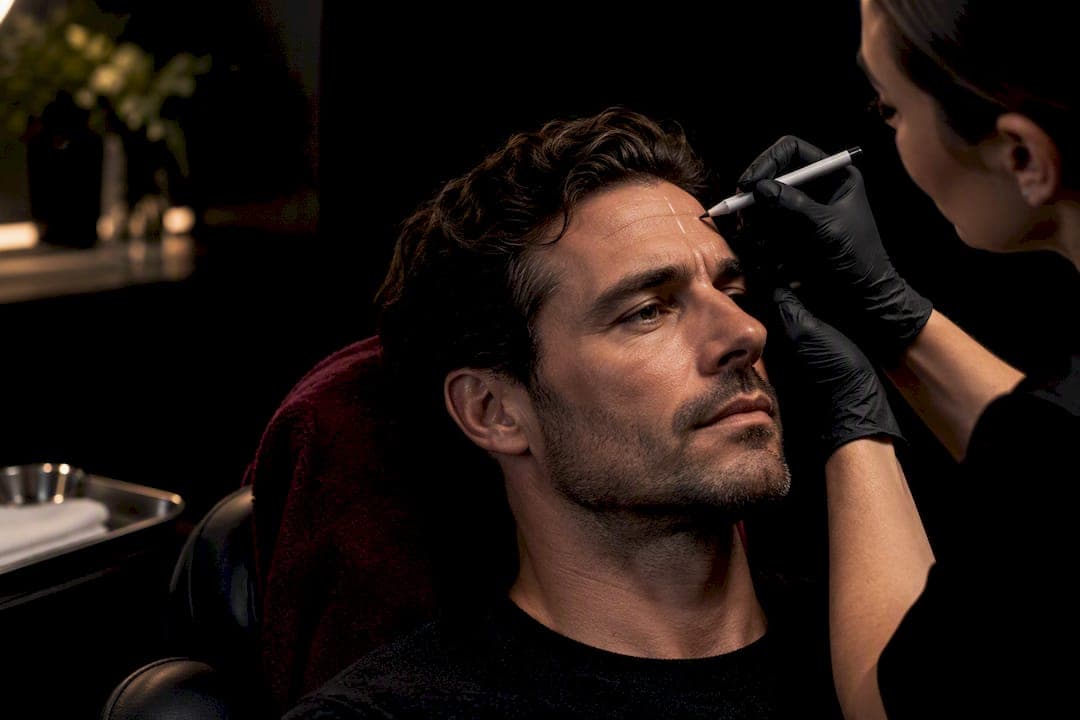
Botox typically lasts around three to four months for men, though some notice results fading sooner and others hold onto them longer. Men often need a tailored, higher dose than women to reach that expected timeline, since standard dosing is frequently calibrated for smaller facial muscles. Most clinics recommend waiting at least several months between treatments, and specialist clinics can help you plan a schedule that fits your own response.
TL;DR:
- Men often need higher doses and tailored injection sites because their facial muscles are stronger and denser than women’s, leading to longer-lasting results.
- The typical effects of Botox last three to four months, with variability depending on injection technique, metabolism, lifestyle, and skin condition.
- To extend results, men should schedule follow-up treatments around three months, increase doses if effects fade early, and maintain sun protection and a consistent skincare routine.
- Retreatment intervals shorter than three months pose risks of side effects and antibody development, so spacing treatments appropriately is crucial for safety and effectiveness.
- Outcomes rely heavily on personalized treatment plans built around male facial anatomy, not on generic dosing protocols or waiting longer without adjusting treatment details.
Table of Contents
- Typical duration and clinical retreatment guidance
- Why Botox may last differently in men compared with women
- Factors that influence how long Botox lasts
- How to make Botox last longer
- Safety, side effects and safe repeat intervals
- What to expect after treatment: onset to wearing off
- Rivers Edge Skin Studio's male-focused approach
- What men usually get wrong about Botox duration
- Ready to plan your own Botox schedule?
- Sources
- FAQ
Typical duration and clinical retreatment guidance
Most clinical guidance places the average effect of cosmetic anti-wrinkle injections at three to four months, with maximum effect reached within about two weeks of treatment and gradual fading after that. Some patients, depending on the injection site and individual response, see results stretch to four to six months, while others notice movement returning before the three-month mark.
Official patient information from UCLH confirms this pattern: effects usually begin within two to seven days, peak by around fourteen days, and last roughly three to four months for most people. The same guidance notes that repeat treatments are not usually given more frequently than every three months, a limit designed to reduce the risk of overtreatment and antibody formation.
For planning purposes, it helps to know the shape of the curve rather than a single number:
- Onset usually starts within a week of treatment.
- Peak effect arrives around two weeks in, sometimes a little later.
- Fading happens gradually over the following months, not all at once.
- Retreatment is generally safe from the three-month mark onward.
If you want a fuller picture of how these injections work before booking, our guide to anti-wrinkle injections covers the mechanism in plain terms.
Why Botox may last differently in men compared with women
Men's facial muscles are, on average, stronger and denser than women's, particularly around the forehead and glabellar area (the muscles between the eyebrows that cause frown lines). A dose calibrated for a smaller, weaker muscle group often falls short when used on male anatomy, which means the effect can wear off sooner than expected, not because the treatment failed, but because it was undersized for the job.
Dermatology research examining Botox use in men reports that men commonly need higher starting doses for areas like the glabellar complex, and that under-dosing is a frequent cause of disappointing or short-lived results in male patients. Product safety summaries reflect this too, noting different recommended dosing ranges depending on the muscle mass being treated.
The practical takeaway is straightforward: if a man's previous Botox faded quickly, the first thing worth checking is whether the dose and injection sites were actually suited to his anatomy. A protocol built for men, rather than a standard treatment applied uniformly, gives a far better chance of hitting that three to four month benchmark. Our guide to reducing forehead lines touches on how male forehead structure changes the approach.

Factors that influence how long Botox lasts
Duration is not fixed. It moves depending on a mix of treatment choices and personal biology, some of which you can influence and some you cannot.
- Dose and injection points: a tailored, often higher dose for men supports longer-lasting results.
- Injection technique: precise placement into the target muscle matters as much as the dose itself.
- Product formulation: different botulinum toxin products vary slightly in onset and duration, without one being universally superior.
- Metabolism and lifestyle: smoking, intense exercise and a fast metabolism can shorten how long effects hold.
- Medications and rare antibody formation: certain medications and, occasionally, antibody development can reduce responsiveness over repeated treatments.
- Age and skin condition: thicker, more elastic skin and younger muscle tone tend to show results for longer.
Pro Tip: Mention any previous Botox experience, including how long it lasted, at your consultation. It gives your practitioner a starting point for adjusting dose or technique.
None of these factors work in isolation. A man who smokes heavily but receives a well-placed, correctly dosed injection may still see solid results, while a non-smoker with an under-dosed treatment may not.
How to make Botox last longer
A few practical decisions, made before and after treatment, can extend how long your results hold.
- Book your follow-up around the three-month mark, when most men start noticing the earliest signs of movement returning.
- Discuss dose adjustment before changing product: if results faded early, increasing the dose at the next session is often the first step, rather than switching brands.
- Consider complementary treatments such as skin boosters, which support skin quality between anti-wrinkle sessions.
- Keep a consistent skincare routine and use daily sun protection, since UV damage accelerates the visible return of lines.
- Avoid vigorous facial exercise or excessive rubbing of the treated area in the first 24 to 48 hours.
Pro Tip: Photoprotection is one of the simplest ways to protect your results. Sun exposure breaks down collagen and speeds up how quickly lines resurface, regardless of how long the Botox itself remains active.
Over several rounds of treatment, some men find their muscles adapt to working at a lower baseline, which can allow slightly longer gaps between sessions. Others, particularly fast metabolisers, may need to stick closely to the three-month interval indefinitely.
Safety, side effects and safe repeat intervals
Botox is generally well tolerated, but it is not without minor risks. Bruising at the injection site, temporary asymmetry and mild headache are the most commonly reported effects, and most settle within days. Rare complications include ptosis (drooping of the eyelid), which usually resolves as the treatment wears off but should be reviewed by a clinician if it occurs.
Product safety documentation from BOCOUTURE's official SmPC recommends a minimum interval of around three months between treatments. This spacing reduces the risk of cumulative side effects and lowers the chance of the body developing antibodies that make future treatments less effective. Any unusual swallowing difficulty, breathing changes or widespread muscle weakness after treatment warrants urgent medical review, though these are uncommon.
What to expect after treatment: onset to wearing off
The timeline is fairly predictable. Effects typically begin within two to seven days of injection, so do not expect an immediate change. Maximum effect usually arrives around fourteen to thirty days in, which is the best point to judge whether the dose was right for you. From there, the effect fades gradually over the following months rather than dropping off suddenly, and because the muscle has been resting, wrinkles often take longer to reappear than you might expect.

Rivers Edge Skin Studio's male-focused approach
Treating men exclusively means dosing decisions are built around male muscle mass from the outset, not adapted from a female-first protocol. Our hyperhidrosis treatment results reflect that dosing expertise in practice, with strong reductions in excessive underarm and hand sweating reported among treated clients. The same principle carries over to anti-wrinkle injections: correct units in the right muscle groups, aimed at natural-looking movement rather than a frozen result. If you are considering treatment, a consultation with David at Rivers Edge Skin Studio starts with an honest assessment of your anatomy and goals.
What men usually get wrong about Botox duration
The most common mistake is judging Botox by someone else's timeline, usually a partner's or a friend's, without accounting for the fact that male muscle mass changes the equation entirely. A three-month average is a reasonable starting expectation, but it assumes the dose was matched to the muscle being treated. When it is not, men often conclude Botox "does not work for them," when the real issue was a dose built for a different physiology.
The conventional advice to simply "wait longer between sessions" also misses the point for a lot of men. If your results faded at eight weeks instead of twelve, the fix is rarely patience. It is usually a conversation about dose and technique at your next appointment. Prioritise finding a practitioner who treats men regularly and understands how facial strength and muscle pattern differ, rather than chasing a specific brand or a lower price. Duration follows from getting the fundamentals right the first time.
— David
Ready to plan your own Botox schedule?
Getting a duration that actually matches the three to four month benchmark starts with a dose built for your anatomy, not a generic protocol. The clinic specialises exclusively in men's skin and aesthetic treatments, which means every anti-wrinkle plan is shaped around male muscle mass and facial structure from the first appointment.

A first consultation includes:
- An assessment of your facial muscle pattern and treatment goals.
- A bespoke dosing plan for the areas you want treated.
- A clear aftercare and follow-up schedule so you know when to expect your next session.
You can view treatment options and book directly through our services and booking page.
This article is general information, not a substitute for advice from a qualified doctor. Consult a qualified healthcare professional about your own circumstances before acting on anything here.
Sources
FAQ
Is Botox worth it for men?
For men who want a natural, less tired-looking appearance without surgery, Botox is generally considered a worthwhile option when dosed correctly for male muscle mass. Results depend heavily on getting the dose and technique matched to your anatomy, which is why a men-focused consultation tends to produce more predictable outcomes.
Does Botox 100% wear off?
Yes, Botox effects are temporary and wear off gradually as the muscle regains normal activity, typically within a three to four month window. There is no permanent muscle change from a single treatment, though the skin itself may show fewer lines for a while afterwards as it recovers from prolonged smoothness.
What does Botox look like 20 years after use?
There is no evidence that Botox causes lasting changes to the skin or muscles after use stops, since each treatment's effect fades within months and the muscle returns to its normal pattern. Any long-term change in appearance over decades reflects natural ageing and skin condition rather than a cumulative effect of past injections.
Is Botox three times a year too much?
Three treatments a year fits comfortably within the minimum interval of around three months between sessions, so it is not considered excessive for most men. What matters more than frequency is whether each session uses an appropriate dose for your muscle strength, since spacing sessions correctly reduces the risk of overtreatment.