
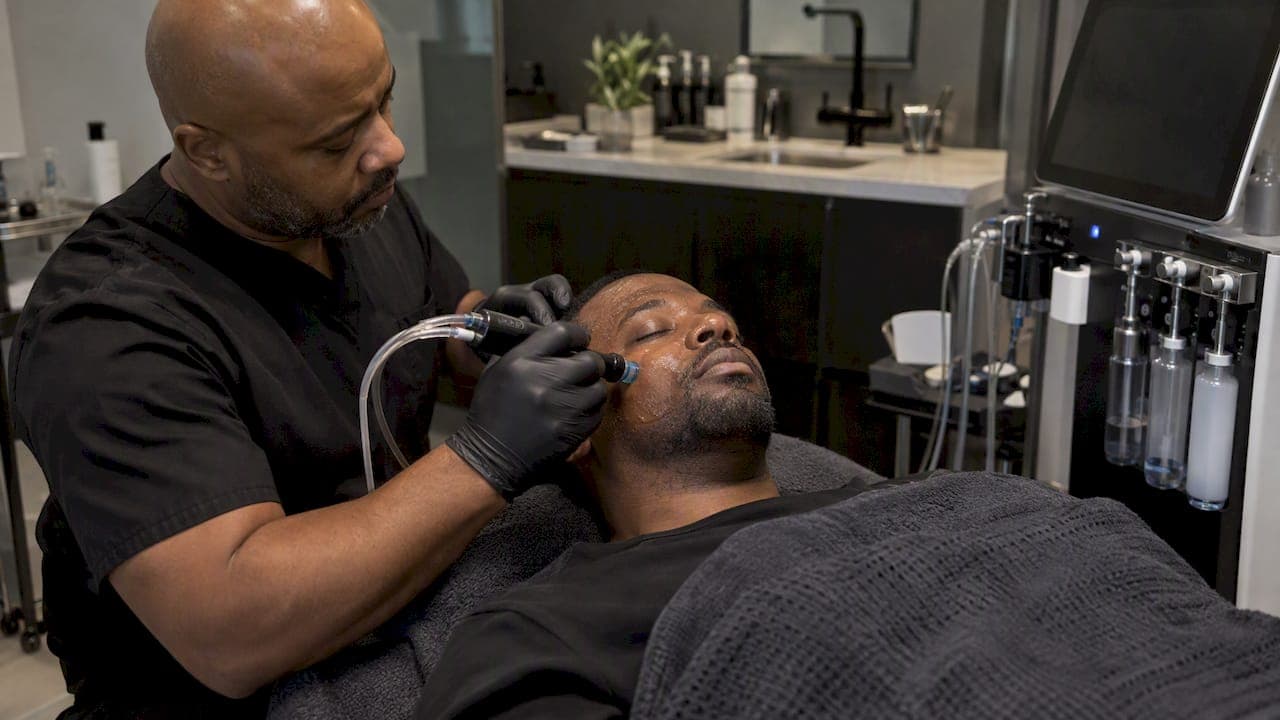
Hydrafacial is a suitable option for most men with black or darker skin tones, including those managing congestion, acne marks or dullness, provided the provider customises the treatment and keeps inflammation to a minimum. The main benefits are clearer pores, better hydration and a smoother finish. The main caveat is this: settings, boosters and session pacing need to match your skin, not a generic protocol.
TL;DR:
- A small study found clear acne ratings rose from 20% to 65% after six treatments over 12 weeks, but its lack of controls limits certainty.
- Choose a provider who starts with lighter exfoliation, a lower strength booster, and a test spot when pigment concerns exist, then raises intensity gradually.
- Consult a dermatologist before booking if you recently used isotretinoin or have an active infection, eczema, or psoriasis flare in the treatment area.
- Wait 24 to 48 hours after treatment before shaving, and use tinted sunscreen with iron oxide daily to help limit irritation and new dark marks.
- Once congestion is controlled, maintenance can range from monthly to quarterly, while chemical peels and microneedling should be spaced apart to limit inflammation.
Table of Contents
- What benefits can men with darker skin tones expect?
- How does the Hydrafacial procedure actually work?
- Is Hydrafacial safe for melanin-rich skin, and what should you watch for?
- What results and timeline should you realistically expect?
- How should you prepare for and recover from treatment?
- How often should you book sessions, and what pairs well with Hydrafacial?
- Why Rivers Edge Skin Studio for men's Hydrafacial care
- Customising Hydrafacial for male hormonal skin differences
- How does Hydrafacial compare with chemical peels and microneedling?
- Managing side effects on black men's skin specifically
- How to choose a provider experienced with darker skin
- How does Hydrafacial fit with beard care routines?
- Our approach to treating darker skin tones safely
- Book a Hydrafacial built around your skin
- FAQ
- Sources
What benefits can men with darker skin tones expect?
The most immediate result men notice is clearer, less congested skin. The suction-based extraction step lifts debris from pores without the scraping or squeezing that tends to trigger marks on melanin-rich skin, so blackheads and built-up oil come out with far less trauma than manual extraction.
Hydration is the second big win. Darker skin can mask dehydration behind an oily surface, and the infusion step leaves most men with a noticeably plumper, smoother look straight after a single session.
Beyond the immediate glow, a course of treatments can support genuine improvement in acne and skin texture. A 12-week, multicentre study of the HydraFacial Clarifying Treatment found that the proportion of patients rated as having no or almost clear acne rose from 20% to 65% after six treatments. The trial was small and open-label, so it points to a promising trend rather than a guarantee, but it is one of the few published datasets on this specific protocol.
Tone and pigmentation are a slower process. Hydrafacial alone will not erase existing dark marks, but paired with the right boosters and daily sun protection it can support more even-looking skin over time.
What you can expect, split by timeframe:
- Same day: smoother texture, reduced shine, visibly clearer pores.
- Over a course: fewer breakouts, calmer congestion, gradual improvement in acne-related marks.
- With adjuncts: better pigment evenness when combined with topicals and sunscreen.
Our HydraFacial benefits for men guide covers how these outcomes apply across different skin concerns, and our piece on clearing blackheads in a single session walks through what a first appointment typically achieves.
How does the Hydrafacial procedure actually work?
Hydrafacial follows a consistent four-step sequence, regardless of skin tone: cleanse, exfoliate or peel, extract and hydrate. The device uses Vortex-Fusion technology to spiral a solution across the skin while simultaneously vacuuming out debris, which is what makes the extraction step comfortable rather than abrasive.
The cleanse and exfoliation phase loosens dead skin and surface oil. The extraction step then uses gentle suction to draw out congestion, and the final hydration step infuses serums suited to your goal.
This is where boosters change the outcome. Hyaluronic acid is the default for plumping and hydration. Vitamin C supports brightness and antioxidant defence. For acne-prone or congested skin, many providers use a GlySal blend, combining glycolic and salicylic acids, as part of a clarifying protocol described in the manufacturer's own treatment materials. LED light and lymphatic drainage add-ons can also be layered in, depending on whether the goal is calming inflammation or reducing puffiness.
For darker skin, tip selection and booster strength matter more than for lighter skin tones, because overly aggressive exfoliation is the main trigger for post-inflammatory marks. A provider who adjusts these variables session by session, rather than running the same settings on everyone, is doing the part of the job that actually protects your results. Our breakdown of the full Hydrafacial procedure covers each stage in more depth.
Is Hydrafacial safe for melanin-rich skin, and what should you watch for?
Darker skin carries a higher risk of post-inflammatory hyperpigmentation, known as PIH: dark marks that form after any inflammation, including acne, shaving irritation or aggressive exfoliation. This is not unique to Hydrafacial, but it does mean the treatment needs to be handled with more care on melanin-rich skin than on lighter tones.
British skin-of-colour guidance notes that PIH and shaving-related pseudofolliculitis are both more common in people with darker skin, and that controlling inflammation is central to preventing recurring marks. In practice, that means a provider working on darker skin should start conservative: lighter exfoliation, a lower-strength booster on the first visit, and a test spot where pigment concerns are already present. Settings can then be escalated gradually as your skin's tolerance becomes clear, rather than running a full-strength protocol from session one.
Shaving history matters too. Men who experience razor bumps along the jawline or neck are dealing with an inflammatory condition in that exact area a Hydrafacial also works on, so the two need to be coordinated rather than treated separately.
A few groups should get a dermatologist's opinion before booking: anyone with a recent history of isotretinoin use, active skin infections, or active eczema or psoriasis flares in the treatment area. For most other men, a conservative first session with a provider who understands darker skin is a reasonable starting point. Our guide to staged sessions for darker skin covers how this escalation typically works in practice.

What results and timeline should you realistically expect?
A single session delivers an immediate, visible lift: smoother texture, a brighter look and skin that feels noticeably more hydrated. That glow typically fades over several days as the skin returns to its normal oil balance, which is why most clarifying or pigment-focused goals need a course rather than one visit.
The clearest evidence for a course comes from the 12-week clarifying study, which used six treatments, one every two weeks, and reported a jump in clear-skin ratings from 20% to 65% of patients. It is a small, open-label trial without a control group, so the figures describe what happened in that study rather than a guaranteed outcome, but they do show that repeated sessions, not a single visit, drive meaningful acne improvement.

Pigmentation follows a slower path again. Existing dark marks generally need a topical routine alongside in-clinic care. AAD guidance on fading dark spots points to ingredients such as azelaic acid, glycolic acid, kojic acid, retinoids and vitamin C, combined with daily sun protection, including a tinted sunscreen containing iron oxide, which blocks visible light known to worsen pigmentation in darker skin.
Worth raising with your provider before a course: how they will track whether congestion is reducing, whether any new marks appear, and what pace of tone improvement is realistic for your skin.
How should you prepare for and recover from treatment?
Good preparation reduces the risk of irritation and makes the results last longer.
Before your appointment:
- Pause strong retinoids or at-home exfoliating acids for a few days beforehand.
- Tell your provider about any medications, especially isotretinoin history or recent prescription actives.
- Ask for a test patch if you have existing dark marks or very reactive skin.
After your appointment, stick to gentle cleansers and a simple moisturiser for a day or two, and avoid strong acids, saunas or intense heat while your skin settles. A tinted sunscreen with iron oxide is worth using daily afterwards, not just on treatment days, since UV and visible light both encourage new marks to form.
Shaving needs its own rule. Give your skin 24 to 48 hours after a facial before shaving, since freshly treated skin is more reactive to a blade. When you do shave, a sharp single-blade razor and a short stroke with the grain reduces the irritation that leads to razor bumps. Our 24 to 48 hour shaving rule explains the reasoning and technique in more detail.
Pro Tip: Book your Hydrafacial a day or two before a planned shave-free stretch, so your skin has time to calm down before a blade touches it again.
How often should you book sessions, and what pairs well with Hydrafacial?
Session frequency depends on your goal. A clarifying course for active acne typically runs six treatments over 12 weeks, spaced two weeks apart, matching the protocol used in the published clarifying study. Once congestion is under control, most men shift to maintenance, anywhere from monthly to quarterly, depending on how quickly their skin re-congests.
Combining treatments works well when the timing avoids overlapping inflammation. Topical skincare routines run alongside Hydrafacial without issue. Chemical peels and microneedling can complement a course but generally need spacing between sessions rather than back-to-back booking, since stacking two inflammatory treatments too close together raises PIH risk on darker skin.
A practical way to plan a course:
- Define your main goal: congestion, acne, hydration or tone.
- Agree a course length with your provider, typically three to six sessions.
- Set check-in points every two or three sessions to review progress and adjust boosters.
- Decide on a maintenance schedule once the initial goal is met.
Our guide to men's facial treatment types covers how Hydrafacial sits alongside peels and microneedling in a broader skincare plan, and our microneedling versus Hydrafacial comparison helps with sequencing decisions.
Why Rivers Edge Skin Studio for men's Hydrafacial care
We specialise in men's skin, tailoring Hydrafacial treatments to address concerns that often appear on male skin such as shaving-related irritation, beard-area congestion and hormonal oiliness. Hydrafacial is one of our core in-clinic treatments, detailed on our services page alongside chemical peels and microneedling.
A first consultation typically covers your shaving routine, any history of dark marks or sensitivity, and whether a test patch makes sense before a full session. From there, we agree booster selection and a staged approach if your skin is new to professional exfoliation. You can read more on our guide to men's facial treatment near Merseyside or book directly through our booking page.
Customising Hydrafacial for male hormonal skin differences
Men's skin tends to run thicker and oilier than women's, driven by higher androgen activity, which means pores clog faster and congestion builds up more visibly. That has a direct bearing on how a Hydrafacial should be tailored.
A provider working on male skin often leans towards a stronger clarifying focus from the outset, since excess sebum production is usually the bigger driver of congestion than dryness. Boosters chosen for oil control and gentle exfoliation, rather than pure hydration, tend to suit male skin better on a first visit, before adjusting based on how the skin responds.
Beard coverage adds another layer. Thicker terminal hair traps oil and dead skin at the follicle, so the exfoliation and extraction steps need to work slightly harder in bearded areas without tipping into irritation, particularly where ingrown hairs or razor bumps are already present.
None of this changes the core four-step sequence, but it does change booster strength, tip pressure and how much attention goes to the jawline and neck compared with the cheeks and forehead. A provider who treats male and female skin identically is missing a genuine physiological difference that affects outcomes.
How does Hydrafacial compare with chemical peels and microneedling?
Hydrafacial, chemical peels and microneedling all address skin texture and tone, but they work through different mechanisms and suit slightly different goals.
Hydrafacial is the gentlest of the three, combining cleansing, light exfoliation, extraction and hydration in one low-downtime session. It suits men wanting a visible glow with minimal recovery, or those easing into professional skincare for the first time.
Chemical peels use acids to remove damaged surface layers more aggressively, which makes them better suited to tackling existing pigmentation or sun damage, but they carry a higher PIH risk on darker skin if the strength is not carefully matched.
Microneedling creates controlled micro-injuries to stimulate collagen, making it the strongest option for acne scarring and deeper texture concerns, though it needs more recovery time than a Hydrafacial.
For most men starting out, Hydrafacial is a reasonable first step, with peels or microneedling introduced later once your provider understands how your skin responds to controlled inflammation.
Managing side effects on black men's skin specifically
Most men tolerate Hydrafacial well, with mild redness that settles within a few hours being the most common response. On darker skin, the side effect that deserves real attention is post-inflammatory hyperpigmentation rather than redness itself, since marks can persist for weeks or months if triggered.
The main trigger is excess exfoliation or peel strength relative to what your skin can handle on a given day. Managing this starts before the appointment: flagging any recent sun exposure, active breakouts or irritation to your provider, who can then dial back intensity accordingly.
If a mark does appear after a session, early action matters. Daily sunscreen with iron oxide, avoiding further exfoliation in that area until it settles, and introducing a brightening ingredient such as azelaic acid or vitamin C, as outlined in AAD guidance on dark spots, all help limit how visible and how long-lasting it becomes.
Some men also notice increased sensitivity in freshly shaved areas straight after treatment. Spacing shaving and facials by at least a day, as covered in our shaving timing guide, reduces this overlap significantly.
How to choose a provider experienced with darker skin
Not every clinic offering Hydrafacial has genuine experience tailoring it for darker skin tones, and that experience is the single biggest factor in avoiding PIH.
Ask directly how the provider adjusts settings for melanin-rich skin: do they start conservative on a first session, do they offer test patches, and can they explain why a particular booster suits your concern rather than defaulting to a standard package. A provider who cannot answer specifically is likely running the same protocol on everyone.
It is also worth asking whether the provider regularly treats men, since male skin brings its own variables: thicker sebaceous activity, beard-area congestion and shaving-related inflammation that a provider used mainly to female clients may not routinely factor in.
Reviews and before-and-after examples on darker skin specifically are more useful than general testimonials, since tolerance and results can differ noticeably by skin tone. A short consultation before committing to a course is a reasonable way to judge whether a provider takes these variables seriously before you book multiple sessions.
How does Hydrafacial fit with beard care routines?
Beard care and Hydrafacial interact more than most men expect, mainly because beard-area skin is usually the most congested and most shaved part of the face.
Heavy beard oils and waxes, especially those with occlusive or heavily fragranced bases, can build up at the follicle and contribute to the congestion a Hydrafacial is designed to clear. It is worth easing off thick styling products for a day before a session so the extraction step has a cleaner surface to work with.
After treatment, freshly cleansed and hydrated beard-area skin is more receptive to lighter beard oils, but it is sensible to hold off on heavier products or balms for a few hours while the skin settles. Men managing ingrown hairs or razor bumps along the jawline often see the biggest visible improvement in that specific area, since the suction extraction clears trapped debris that daily beard brushing cannot reach.
Supporting skin health from within can help too. Some men pair in-clinic treatments with collagen peptide supplementation, which has been studied for improvements in skin appearance over eight to twelve weeks, as a complement to topical and in-clinic care rather than a replacement for either.
Our approach to treating darker skin tones safely
We start conservative on every new client with darker skin: lighter exfoliation, a measured booster, and a clear look at how your skin responds before building up intensity. Pigment-prone skin rewards patience over speed, and that staged approach is what keeps results moving forward without new marks appearing. If you are weighing up whether to book, a short consultation is the easiest way to get a straight answer for your own skin.
— David
Book a Hydrafacial built around your skin
We treat men exclusively, ensuring that every Hydrafacial booking is designed with male skin concerns in mind from the start. Alongside Hydrafacial, our services include chemical peels and microneedling for men wanting a more targeted approach to texture or pigmentation.

A first appointment typically starts with a consultation covering your skin history, shaving routine and any pigment concerns, followed by a recommended course length and a test patch where needed. From there we agree booster selection and pacing together, rather than running a fixed protocol regardless of how your skin responds.
If you are ready to get a straight answer on what your skin needs, book your consultation and we will take it from there.
This article is general information, not a substitute for advice from a qualified doctor. Consult a qualified healthcare professional about your own circumstances before acting on anything here.
FAQ
Does Hydrafacial work for men?
Yes, Hydrafacial works on men's skin in largely the same way as it does for women, clearing congestion and improving hydration regardless of gender. Male skin tends to be oilier and thicker, so providers often adjust booster strength and focus accordingly to get the best result.
What is a good daily face care routine for black men?
A solid daily routine for darker skin includes a gentle cleanser, a lightweight moisturiser and daily sunscreen, ideally a tinted formula containing iron oxide to protect against visible light as well as UV. Adding a brightening ingredient such as vitamin C or azelaic acid, as outlined in AAD guidance, can help manage existing dark marks over time.
What not to use on black skin?
Harsh physical scrubs and overly strong acid exfoliants used too frequently are the biggest risk, since they trigger the inflammation that leads to post-inflammatory hyperpigmentation on darker skin. It is generally safer to introduce any new active ingredient gradually and watch how your skin responds before increasing frequency or strength.
How to get glowing black skin naturally?
Consistent hydration, daily sun protection and gentle exfoliation a few times a week tend to do more for an even, glowing look than any single product. Professional treatments such as Hydrafacial can support this by clearing congestion that at-home routines struggle to reach, particularly when paired with a tailored skincare plan.
Sources
- Efficacy and tolerability of HydraFacial Clarifying Treatment series in the treatment of active acne vulgaris — PMC
- HydraFacial treatment | solutions, boosters & more — Hydrafacial
- How to fade dark spots in darker skin tones — American Academy of Dermatology (AAD)