
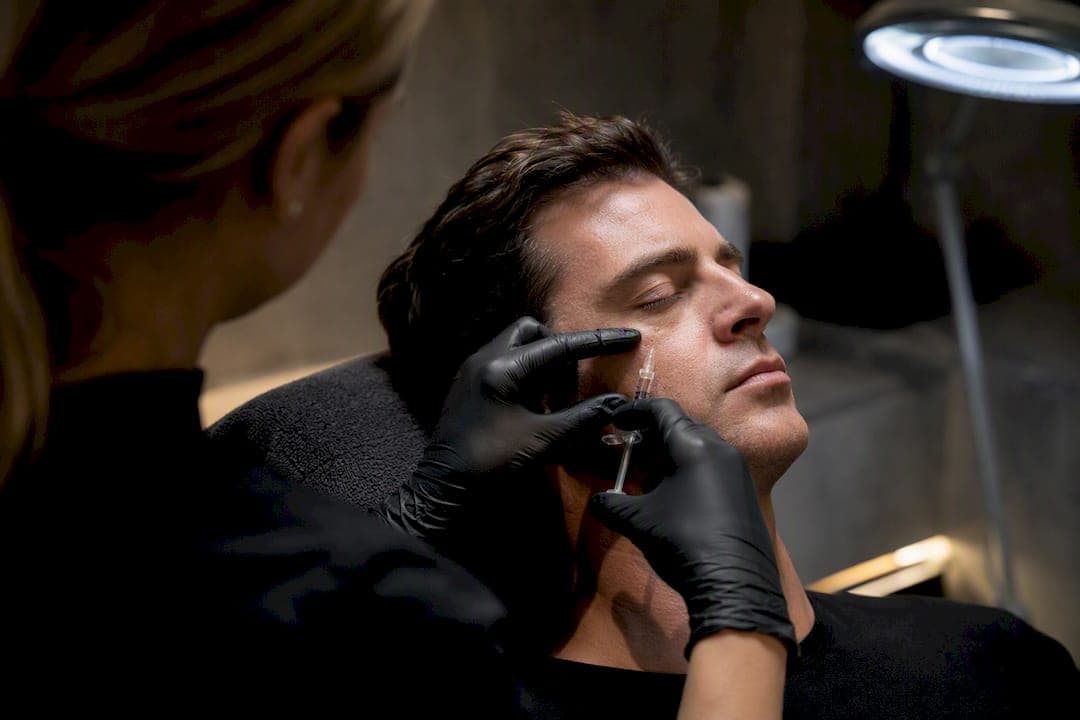
Polynucleotide injections are purified DNA fragment injectables that typically produce modest, gradual improvements in skin hydration, texture and fine lines. The clearest evidence is for under-eye rejuvenation, with results building over two sessions and peaking around three months. If you're weighing this up, the right next step is a proper consultation with a clinic that treats male skin specifically, not a generic aesthetics list.
TL;DR:
- Polynucleotide injections primarily improve skin hydration and texture around the eyes, with peak results appearing three months after two sessions.
- The effectiveness depends heavily on formulation factors like molecular weight, concentration, and purity, which vary between products.
- Treatments involve three initial sessions spaced three to four weeks apart, with maintenance typically every few months, and should be performed by experienced, qualified practitioners.
- Risks are minimal, mostly involving temporary swelling or bruising, making PN suitable for men seeking subtle, natural enhancement rather than dramatic volume changes.
- The strongest evidence supports eye area results, while proof for other facial regions remains limited due to small sample sizes and inconsistent study protocols.
Table of Contents
- What are polynucleotide injections and how do they differ from fillers?
- How do they work, and what does the clinical evidence actually show?
- What does a typical treatment protocol involve?
- Are you a good candidate, and what are the risks?
- What happens during and after a session, and what does it cost?
- How do you choose the right clinic for polynucleotide treatment?
- Rivers Edge Skin Studio's approach to polynucleotide treatment for men
- Where polynucleotides fit in a man's anti-ageing plan
- Ready to find out if polynucleotide injections suit your skin?
- Sources
What are polynucleotide injections and how do they differ from fillers?
Polynucleotide injections use fragments of DNA, usually extracted and purified from salmon roe, which is where the nickname "salmon sperm facial" originated online. Clinically, the correct term is polynucleotide (PN) therapy, and you'll often see the more specific abbreviation PDRN, which stands for polydeoxyribonucleotide. PDRN is a defined, purified subset of polynucleotides, and the two terms get used almost interchangeably in clinic literature, though PN is the broader category.
This is not a filler. Fillers add volume by physically occupying space under the skin. Polynucleotide injections work differently. Rather than plumping tissue, PN acts on the skin's own repair machinery, encouraging fibroblasts (the cells that produce collagen) to become more active. That's why the results look like better skin quality rather than a lifted or filled appearance, which tends to suit men who want to look refreshed without looking obviously "done".
It's also worth separating injectable PN from the topical PDRN products marketed for home use or combined with microneedling. Topical versions sit on the skin's surface or are pushed into the upper layers mechanically, while injectable PN is delivered directly into the dermis by a practitioner. The depth of delivery changes what the product can realistically achieve.
Formulation matters more than most people expect:
- Molecular weight affects how the product behaves in tissue and how long it persists before breaking down.
- Concentration varies between manufacturers, which changes dosing and the number of sessions needed.
- Purity and sourcing influence both safety profile and consistency of results.
- Some products are PN/HA hybrids, blending polynucleotides with hyaluronic acid for combined hydration and regenerative effects, an approach detailed in practitioner clinical guides on hybrid formulations.
None of this is something you need to memorise, but it's why the specific product and batch your practitioner uses is a legitimate question to ask, not an awkward one.
How do they work, and what does the clinical evidence actually show?
The proposed mechanism centres on a receptor called adenosine A2A, which polynucleotide fragments bind to and activate. This engagement appears to stimulate fibroblasts toward more collagen and matrix production, while the PN itself forms a hydrophilic (water-attracting) scaffold in the dermis that temporarily boosts hydration and skin turgor. That dual action, cellular signalling plus a moisture-holding matrix, is the basis for describing PN as a "regenerative" injectable rather than a filling one.
The strongest published evidence sits around the under-eye area. A 2026 prospective observational cohort of 42 patients treated with intradermal polynucleotide injections found significant improvements in periorbital appearance, with the greatest patient-reported satisfaction and effect size at three months, following two treatment sessions.
**In that cohort, improvement was statistically significant at one, three and six months, with the peak response after two sessions around the three-month mark.
A separate prospective observational study of undereye rhytides reported a similar pattern: consistent subjective improvement, minimal short-term adverse events such as mild swelling and minor bruising, and a maximal response after two sessions that gradually attenuated by six months. That attenuation is the practical reason maintenance treatments exist, rather than a single course lasting indefinitely.
Clinical experience suggests the periocular zone shows the most visible change from PN, likely because the skin there is thinner, so modest dermal gains in hydration and collagen density show up more clearly than they would on thicker facial skin.
It's not all settled science, though. A 2024 systematic review concluded that while PN and PDRN show real promise for skin texture, hydration and wound healing, the overall evidence base is limited by small sample sizes, inconsistent protocols across studies and short follow-up periods. Larger, standardised randomised trials are still needed before PN can be ranked with the confidence given to longer-established treatments. That doesn't make the current data worthless. It means the honest answer is "promising and reasonably consistent for the eye area, less proven elsewhere" rather than a blanket guarantee.
What does a typical treatment protocol involve?
Protocols vary by product and treatment zone, but expert consensus has converged on a fairly narrow set of parameters. An international panel review recommends intradermal microdroplet injections of 0.02 to 0.04 mL per site, totalling 2 to 4 mL per session, delivered with a fine 34-gauge needle, with microdroplets spaced roughly 3 to 5 mm apart across the treatment area.
- Consultation and skin assessment. Your practitioner maps the treatment zone and checks for contraindications before touching a needle.
- Induction course. Most protocols call for three sessions spaced three to four weeks apart, giving the fibroblast response time to build between visits.
- Zone-specific technique. The under-eye area gets lower volumes and finer needles given how thin that skin is; some practitioners use blunt cannulas here to reduce bruising risk.
- Deeper structural injections. In areas needing more support, PN can be placed slightly deeper, though this remains a skin-quality treatment rather than a volumising one.
- Maintenance sessions. Once the induction course is complete, top-ups are generally spaced several months apart to sustain the effect.
Needle gauge tends to sit between 30G and 34G depending on the zone and product viscosity, finer for delicate periorbital skin, slightly larger where the product is more viscous or the tissue thicker.
PN rarely stands alone in a well-designed plan. Clinician surveys show it's frequently combined with hyaluronic acid boosters, microneedling or laser resurfacing rather than used as a solitary treatment, particularly for scar management protocols. If you're already having skin booster injections, PN often sequences well alongside or after that course, and understanding how to combine anti-ageing treatments effectively helps set realistic expectations for a multi-treatment plan.
Pro Tip: Ask your practitioner where PN sits in your treatment order. Sequencing it after microneedling, when the skin's repair response is already switched on, is a common approach, but it should be planned deliberately, not improvised on the day.
Are you a good candidate, and what are the risks?
You're likely a reasonable candidate for polynucleotide injections if you want subtle skin-quality improvement rather than significant lifting or volume change. Men who notice dullness, dehydration, fine crepey texture around the eyes, or skin that looks tired despite decent sleep and diet tend to see the most satisfying results. This isn't the treatment for someone expecting a dramatic jawline or major wrinkle reduction; that's a different conversation involving fillers or anti-wrinkle injections.
Certain factors rule out or delay treatment:
- Active skin infection or inflammation in the treatment area.
- Recent periorbital filler, which can complicate assessment of the treated zone.
- Pregnancy or breastfeeding.
- Known fish allergy, since many PN products are derived from salmon roe, a point flagged directly by consumer health reporting as a reason to disclose allergies before treatment.
What the safety data shows: Across the periorbital PN studies, reported adverse events were consistently minor and short-lived, primarily mild swelling and minor bruising, with no serious complications flagged in the follow-up periods studied.
The most common thing you'll actually notice is pinpoint bleeding at injection sites and small raised bumps called papules or "blebs" that form immediately after microdroplet injections. These are a normal part of the process, not a complication, and they typically settle within a few days as the product disperses. Bruising is possible, particularly around the eyes, and clinics generally manage this with ice, careful technique and honest pre-treatment warnings about scheduling around social commitments.
What happens during and after a session, and what does it cost?
A consultation should cover your skin goals, medical history and any allergies before a single needle comes near your face. Many clinics offer topical numbing cream for comfort, particularly around the eyes, and the treatment itself, including numbing time, usually takes 30 to 45 minutes.
Immediately afterwards, expect visible injection points and possibly small raised bumps that settle within days. This is cosmetically obvious enough that most men plan treatment around quieter weeks rather than the night before an important meeting.
- Days 1 to 3: Mild swelling, redness at injection points, occasional bruising.
- Weeks 1 to 4: Bumps resolve, early hydration improvements become noticeable.
- Around 3 months: Peak improvement in skin texture and periorbital appearance, following the second session.
- 4 to 6 months: Effect gradually softens, prompting a maintenance session.
Cost in the UK varies with the product used, the area treated and the practitioner's experience, and generally ranges from around £150 to £350 per session, with a full induction course of three sessions costing proportionally more. Clinics using higher-grade, more heavily researched formulations, or treating larger areas such as full face rather than under-eyes alone, tend to sit toward the top of that range. Treat any quote well below that band with some scepticism about product sourcing. For a sense of how PN fits into a broader annual skincare rhythm, a treatment frequency guide is worth reading before you commit to a course.
How do you choose the right clinic for polynucleotide treatment?
Not every clinic offering PN treats it with the same rigour, so a short vetting process protects you from disappointing results or worse.
- Check practitioner qualifications. Confirm they're medically trained and specifically experienced with PN, not just fillers or anti-wrinkle work.
- Ask for the product name and batch. A confident practitioner will tell you exactly what they're injecting and why they chose it for your zone.
- Review informed consent and complication policy. Ask what happens if you get an unexpected reaction, and how it's handled.
- Ask specifically about periorbital experience. The eye area demands more finesse than other zones, so ask how many periorbital PN treatments they've performed.
Pro Tip: If a clinic's sales pitch leans hard on price rather than outcomes, that's a signal to walk away. Ask instead to see documented before-and-after results and clear, written aftercare instructions. Consumer reporting has also flagged that not all injectable PN products carry the same regulatory approval status, so confirming product provenance isn't paranoia, it's basic due diligence.
Rivers Edge Skin Studio's approach to polynucleotide treatment for men
At Rivers Edge Skin Studio, David assesses male skin on its own terms, thicker, often affected by regular shaving or beard growth, and builds PN protocols around natural-looking outcomes rather than dramatic change. Beard-area skin gets specific consideration during planning, since injection technique needs adjusting around hair follicles and denser tissue. Treatment plans draw on the same protocols covered in our facial rejuvenation guide for men. Booking an in-clinic assessment is the clearest way to find out whether PN fits your skin goals.
Where polynucleotides fit in a man's anti-ageing plan
Polynucleotide injections are a skin-quality adjunct, not a replacement for volume restoration, muscle relaxation, or surgical correction. Men get the most value from PN when they're already reasonably happy with facial structure and simply want better texture and hydration, often alongside anti-wrinkle injections or HA boosters rather than instead of them.
Be wary of marketing that frames PN as a universal anti-ageing fix. The evidence supports real, measurable improvement in specific contexts, particularly around the eyes, not a wholesale reversal of ageing. Treat it as one well-evidenced tool among several, chosen deliberately rather than sold as a miracle.
— David
Ready to find out if polynucleotide injections suit your skin?
Some clinics treat men exclusively, designing polynucleotide protocols around male skin thickness, shaving patterns and realistic goals, rather than adapting from generic treatment menus. Specialist approaches focus specifically on what works for men's skin and how it responds to regenerative injectables.

A consultation covers your skin history, any allergies worth flagging, and an honest assessment of whether PN, or a combination approach, fits your goals. If topical hydration support interests you alongside injectable treatment, natural humectants for deep hydration makes a useful companion read. When you're ready to move forward, browse Rivers Edge Skin Studio's full range of men's skin treatments and book a consultation to get a personalised protocol rather than a generic one.
Sources
For readers who want to check the primary literature, the periorbital PN cohort study offers prospective clinical data on timing and outcomes, while the expert panel review sets out consensus dosing protocols. The 2024 systematic review gives the most balanced account of current evidence limitations, and the second periorbital study adds further safety and durability data.
- Prospective observational cohort — polynucleotide injections for periorbital rhytides (Journal of Cosmetic Dermatology)
- Prospective observational study — polynucleotide injections for periorbital rhytides