
Polynucleotides are generally well tolerated when a qualified clinician handles the injections properly. Most men notice mild redness, swelling, or bruising at the injection site for a day or two afterwards, and nothing more. Serious complications are rare, but they depend heavily on proper screening beforehand and sterile technique during treatment.
TL;DR:
- Serious complications from polynucleotide injections are rare and depend heavily on proper screening and sterile techniques.
- Post-treatment redness, swelling, bruising, and tenderness are common but typically resolve within a few days, especially after the first session.
- The main long-term concern is the lack of extensive data, as most studies involve small samples and short follow-ups, though decades of wound healing use suggest safety.
- Contraindications include active skin infections, autoimmune conditions, recent isotretinoin use, pregnancy, breastfeeding, and fish allergies due to the source material.
- Men’s thicker skin and facial anatomy require tailored techniques, making experienced practitioners essential for optimal safety and results.
Table of Contents
- Understanding polynucleotide side effects: how PN differs from fillers
- Common short-term side effects (what's normal and expected)
- Rare polynucleotide risks: lumps, allergies and infection
- Long-term polynucleotide safety: what the evidence actually shows
- How to manage polynucleotide side effects after treatment
- Who shouldn't have polynucleotide treatment (contraindications)
- Choosing a clinic that keeps polynucleotide risk low
- Why male-focused technique matters for polynucleotide safety
- Why "well tolerated" doesn't mean "risk-free"
- Book a polynucleotide consultation with a men's specialist clinic
- Sources
Understanding polynucleotide side effects: how PN differs from fillers
Polynucleotides, often shortened to PN and sold under names like PN-HPT, are purified fragments of DNA typically derived from salmon or trout. Clinics use them to improve skin quality, calm inflammation, and treat areas like the under-eye hollows where volume isn't the goal. That last point matters more than most men realise when they're weighing up risk.
Unlike hyaluronic acid fillers, polynucleotides don't add bulk under the skin. They work by stimulating fibroblast activity and encouraging the skin's own repair processes, which is why practitioners call them "biostimulatory" rather than volumising. This distinction has a direct bearing on safety. Because there's no gel-like filler material being placed into or near blood vessels, the risk of vascular occlusion, a rare but serious complication where a vessel gets blocked, is considered highly unlikely with polynucleotide treatments, according to a review of current PN practices. That's a genuinely different risk profile to some dermal filler treatments, where volumising products carry that concern in areas with delicate vasculature.
Most men will go through a short course rather than a single session. A typical protocol runs two to four treatments spaced two to four weeks apart, followed by maintenance sessions every few months. That staged approach matters for understanding side effects too. Reactions in session one often settle by session two, once your skin has adjusted and the practitioner has fine-tuned technique to your response.
The product class itself has a longer history than most patients assume. Polynucleotides have been used in wound healing and tissue repair for decades before aesthetic clinics adopted them, which gives practitioners a reasonable evidence base for how the material behaves in human tissue, even if aesthetic-specific data is still catching up.
Common short-term side effects (what's normal and expected)
Nearly every man who has a polynucleotide session will notice something at the injection sites over the following 24 to 48 hours. That's expected, not a sign anything has gone wrong.
Redness and warmth show up almost immediately and usually fade within a few hours to two days. It's the skin's normal inflammatory response to the needle and the biostimulatory effect kicking in. A cool compress applied for ten minutes at a time takes the edge off without interfering with healing.
Swelling tends to cluster around thinner-skinned areas, particularly under the eyes, and can last slightly longer than redness, sometimes up to 48 hours. Sleeping with your head slightly elevated the first night and avoiding alcohol reduces how pronounced it looks the next morning.
Bruising happens when the needle nicks a small blood vessel under the skin. It's more likely if you're on blood-thinning medication, fish oil supplements, or you've had a drink the night before treatment. Bruises generally clear within about a week, following the usual purple-to-yellow fading pattern.
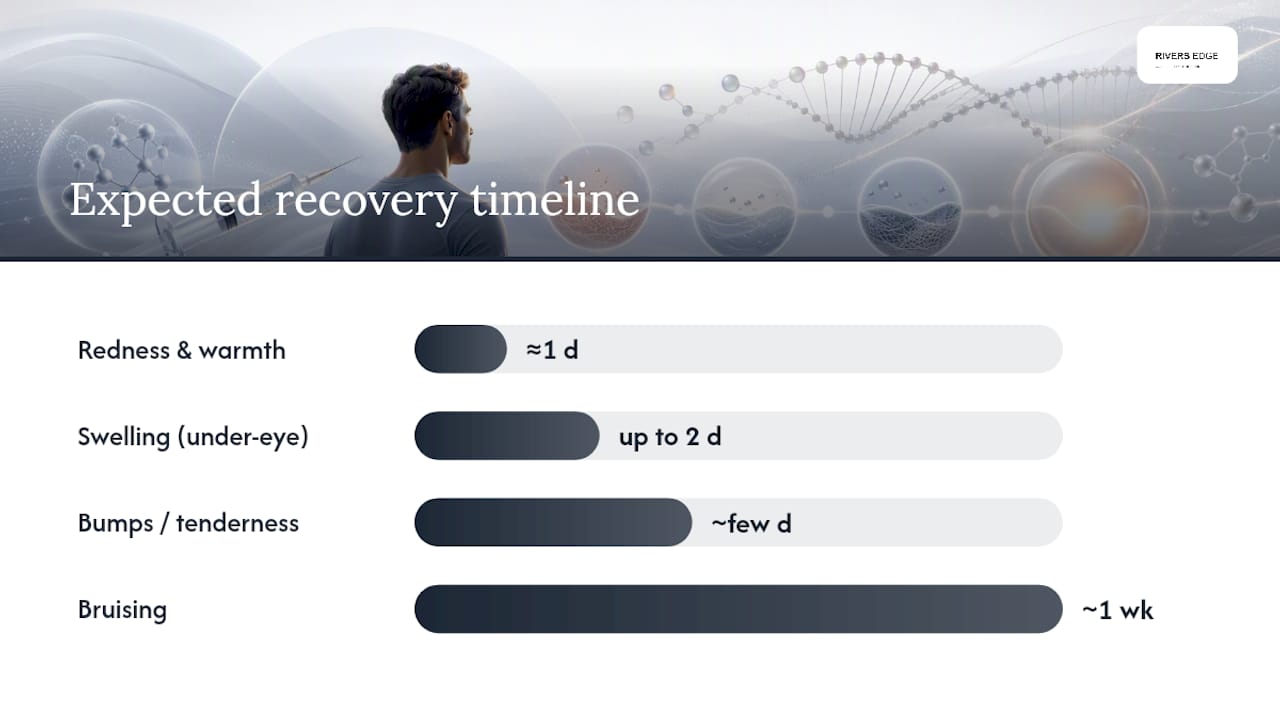
Minor bumps and tenderness at injection points are common in the first 24 hours because the product forms small deposits before it disperses. These almost always flatten out on their own within a few days.
A few practical points worth keeping in mind:
- Avoid non-essential blood thinners like aspirin or high-dose fish oil for a few days before treatment if your GP agrees it's safe to pause them.
- Skip alcohol the evening before and the evening after your appointment.
- Use arnica gel or cold compresses rather than anti-inflammatory creams, which some practitioners feel can blunt the biostimulatory response.
- Makeup can usually go back on after 12 to 24 hours once any pinpoint marks have settled.
None of this is unique to polynucleotides. Most skin booster injections carry a similar short-term profile, which is one reason practitioners consider the category low-risk for the average healthy adult.
Rare polynucleotide risks: lumps, allergies and infection
The side effects above cover the vast majority of patient experiences. What follows is rarer, but worth understanding so you know what genuinely warrants a phone call to your clinic rather than a shrug.
Nodules, lumps, and granulomas can develop weeks or months after treatment in a small number of cases. These are typically the result of the body forming a localised reaction around deposited product, sometimes linked to injection technique or depth. Clinics usually manage early nodules with massage, and if that doesn't resolve things, a steroid injection or hyaluronidase in some contexts. Persistent lumps need clinical assessment rather than home treatment.
Hypersensitivity and allergic responses are uncommon but recognised. Because many polynucleotide products are derived from fish DNA, anyone with a known fish allergy needs to flag this before treatment, full stop. Signs of a genuine allergic reaction include widespread hives, facial swelling beyond the injection site, or difficulty breathing, and these require immediate medical attention rather than a wait-and-see approach.
Infection is one of the risks most directly tied to how the treatment is delivered rather than the product itself. Clinical evidence consistently points to breaches in sterile technique, rather than the polynucleotide material, as the driver behind infection cases and unexpected hypersensitivity events, according to clinical safety literature. Warning signs include increasing redness that spreads beyond the original injection points, warmth, pus or discharge, and fever. Genuine infections usually appear a few days after treatment rather than within the first few hours.
Vascular occlusion deserves a mention even though it's considerably less likely with non-volumising polynucleotides than with HA fillers. The theoretical risk still exists if a vessel is directly injected. Symptoms include sudden, severe pain out of proportion to the injection, skin blanching or a mottled appearance, and the area turning unusually pale or dusky. Any of these need urgent clinical review, not a "let's see how it looks tomorrow" approach.
Statistic callout: The most common side effects reported across clinical literature are mild redness and swelling that typically resolve within a few days, with serious adverse events described as very rare in established aesthetic use.
A short checklist of when to escalate:
- Pain that intensifies rather than eases after the first 24 hours.
- Redness spreading well beyond the original injection points.
- Any discharge, pus, or an open sore at the injection site.
- Fever, chills, or feeling generally unwell after treatment.
- Skin colour changes suggesting reduced blood flow.
Long-term polynucleotide safety: what the evidence actually shows
The reassuring picture painted by short-term data doesn't fully extend to long-term safety, and it's worth being honest about that gap rather than glossing over it.
Review literature covering polynucleotide use in aesthetic medicine consistently reports the same pattern: mild, transient injection-site reactions dominate the data, and serious events are seldom recorded. A comparative study looking at polynucleotides against other biostimulatory agents found similar or even lower rates of swelling and bruising, which is a genuinely encouraging signal for anyone weighing up options.
The catch is sample size and follow-up length. Many of the studies feeding into this evidence base involve relatively small cohorts, sometimes a few dozen participants, and follow-up periods measured in months rather than years. The broader body of research also uses a variety of polynucleotide products and injection protocols across different studies, which makes it harder to generalise findings from one trial to every PN product on the market.
There's also the matter of formulation heterogeneity. Not every polynucleotide product is manufactured, purified, or concentrated identically, and a study using one specific PN-HPT formulation doesn't automatically tell you how a different manufacturer's product will behave over five or ten years of repeated use.
None of this means the treatment is poorly understood or experimental. Polynucleotides carry decades of clinical use in wound healing outside aesthetics, which gives practitioners a reasonable working knowledge of how the material interacts with human tissue. What it does mean is that if you're the sort of patient who wants ironclad, decade-long safety data before trying anything new, polynucleotides sit in the "reassuring but still accumulating evidence" category rather than the "settled science" one. That's a fair position to hold, and a good practitioner won't push back against it.
How to manage polynucleotide side effects after treatment
Aftercare isn't complicated, but skipping it is the easiest way to turn a normal reaction into a longer, more irritating one.
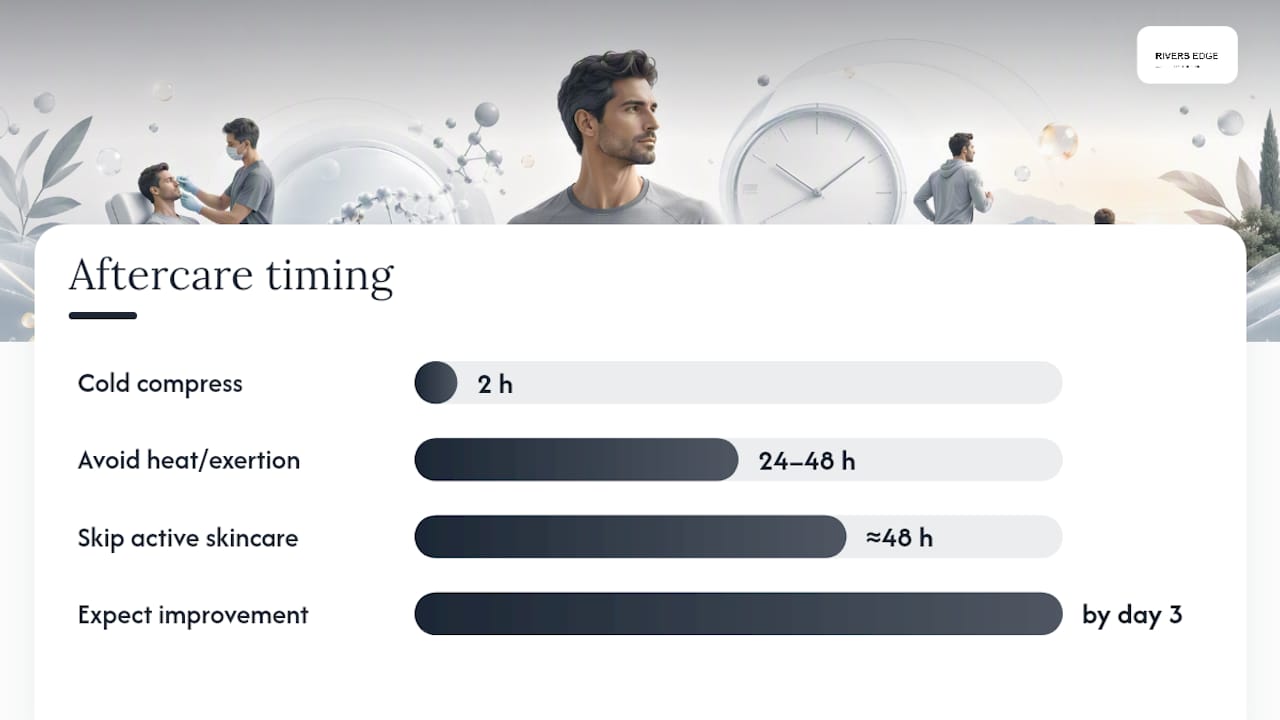
- In the first two hours, apply a cold compress in short bursts to any swollen or red areas. Avoid touching or massaging the injection sites unless your practitioner has specifically told you to.
- For the first 24 to 48 hours, skip strenuous exercise, saunas, steam rooms, and anything that raises your body temperature or blood pressure significantly. Heat and exertion both increase swelling and bruising.
- For bruising, arnica gel or tablets can help speed things along, though evidence for arnica is mixed at best. What's more reliably useful is simply avoiding blood thinners and alcohol in the days immediately after treatment, on top of whatever precautions you took beforehand.
- Avoid active skincare like retinoids, strong acids, or vitamin C serums on the treated area for around 48 hours, since freshly injected skin is more sensitive to irritation. A gentle SPF is the exception. If you're dealing with any sun sensitivity alongside your treatment, products formulated for sun-reactive skin can help calm things down while you heal.
- Watch the trajectory, not just the day-one reaction. Mild symptoms should be improving by day three. If something is getting worse rather than better, that's your cue to call the clinic.
Pro Tip: Take a photo of the treated area the morning after your session. It sounds unnecessary, but having a baseline image makes it far easier to judge, a few days later, whether swelling or redness is actually resolving or quietly getting worse.
If symptoms cross from "normal recovery" into "something's wrong" territory, most clinics have a straightforward pathway: a same-day review, a course of antibiotics if infection is suspected, or a steroid injection for a stubborn nodule. Persistent or worsening symptoms should always go back through the clinic that treated you rather than a pharmacy counter, since they know exactly what product and technique were used.
Who shouldn't have polynucleotide treatment (contraindications)
Not every man is a good candidate for polynucleotide treatment, and a properly run clinic will screen for this before you're anywhere near a needle.
Common contraindications include active skin infections at the treatment site, uncontrolled autoimmune conditions, and recent use of isotretinoin (commonly known by the brand name Roaccutane) for acne, which typically requires a waiting period before any injectable treatment. Pregnancy and breastfeeding are also standard exclusions across most injectable aesthetic treatments, polynucleotides included, largely because there isn't sufficient safety data in these groups rather than any specific known harm.
Medications and supplements matter just as much as underlying conditions. Blood-thinning medications and certain supplements noticeably raise the risk of bruising, and a good clinic will ask about these directly rather than waiting for you to mention them. Worth disclosing at consultation:
- Any blood-thinning medication, prescribed or over-the-counter.
- Regular fish oil, high-dose vitamin E, or other supplements known to affect clotting.
- A known fish allergy, given the salmon or trout DNA origin of most PN products.
- Any autoimmune condition, even if currently well managed.
- Previous reactions to injectable treatments of any kind.
Because most polynucleotide products come from fish sources, allergy screening deserves specific attention rather than a generic "any allergies?" tick-box question. A thorough consultation asks pointed questions and documents the answers, partly for your safety and partly so any prior reaction is on record if you return for future sessions. Informed consent isn't paperwork for its own sake; it's the point where a practitioner confirms you understand what's normal, what's rare, and what to do if something falls outside either category.
Choosing a clinic that keeps polynucleotide risk low
The product itself carries a good safety profile. Where things go wrong is almost always down to who's holding the needle and what protocols they follow, not the polynucleotides themselves. Practitioner technique, product provenance, and clear aftercare guidance are the biggest levers a clinic has over your actual risk on the day.
A few things worth checking before you book anywhere:
- Confirm the clinician is medically registered and the treatment happens in a proper clinical setting, not a back room or mobile pop-up.
- Ask directly about single-use needles and sterile technique. A practitioner who bristles at this question is a red flag in itself.
- Ask what specific PN-HPT product they use, where it's sourced, and how it's stored. Reputable clinics will answer this without hesitation.
- Check that your consultation genuinely covers medical history, realistic expectations, and what happens if you have a reaction, rather than being a five-minute formality before treatment starts.
- Be wary of heavily discounted treatments, walk-in-without-consultation offers, or anywhere that can't clearly explain their emergency protocol if a complication arises.
Pro Tip: If a clinic can't tell you, on the spot, what they'd do if you developed a nodule three weeks after treatment, that's a sign their aftercare planning hasn't gone much further than the appointment itself.
Sensible pre-treatment preparation on your end helps too. Working through a proper pre-treatment checklist before your appointment, covering medication timing, alcohol, and skincare, reduces the chance of an avoidable reaction regardless of how good the clinic is.
Why male-focused technique matters for polynucleotide safety
Most safety guidance for polynucleotides is written as if skin is skin, regardless of who's underneath it. That's a mistake. Men's skin is generally thicker and produces more sebum than women's, which changes how swelling presents and how quickly redness settles. A practitioner who only treats women day in, day out isn't necessarily calibrated to what "normal" looks like on a man's face at 48 hours post-treatment.
Treatment plans and technique can be tailored specifically for men's skin rather than adapted from a female-oriented protocol as an afterthought. That matters for something as simple as under-eye treatment, one of the most requested and most side-effect-sensitive areas for polynucleotide work. Our own clinic observation is that under-eye improvements in male patients tend to peak around three months after a two-session course, which is a useful benchmark for setting realistic expectations rather than expecting overnight results.
None of that removes the need for proper screening or sterile technique, which remain the two biggest safety levers regardless of who's in the chair. What it does mean is that the finer judgement calls, how much swelling is proportionate for a given man's skin thickness, how a beard line changes injection planning around the jaw, get made with actual experience behind them rather than generic assumptions carried over from a different patient population entirely.
Why "well tolerated" doesn't mean "risk-free"
Here's what tends to get lost in most polynucleotide marketing: "well tolerated" is a statistical statement about populations, not a personal guarantee about you. The data genuinely supports it, mild reactions dominate, serious events are rare, but that's an average across cohorts, not a promise that applies identically to every man walking into a clinic.
The gap that matters most, in my view, isn't between polynucleotides and other injectables. It's between patients who treat the consultation as a formality and those who treat it as the actual safety mechanism. The product's biostimulatory, non-volumising nature genuinely does lower certain risks compared with fillers. But that structural advantage means very little if a clinic skips proper screening, doesn't ask about fish allergies, or rushes past your medication history because the appointment's running late.
I'd also push back gently on the idea that rare complications are simply bad luck. The evidence points fairly consistently to procedure and screening as the real variables, not some inherent lottery in how individual bodies react to the product. That's actually good news for anyone weighing this up: it means your risk isn't fixed by biology alone. It's shaped, quite significantly, by the quality of the clinic you choose and how honestly you answer their questions beforehand. Men researching this treatment tend to focus heavily on "does it work", and rightly so, but the safety side deserves the same scrutiny rather than being treated as a footnote before booking.
— David
Book a polynucleotide consultation with a men's specialist clinic
Some clinics focus on treatments specifically designed for men's skin rather than adapting from protocols for other patients. That distinction shapes everything from how much product goes into a session to how swelling and redness are managed afterwards, because male skin behaves differently and deserves technique that accounts for it.

Consultations often cover full medical history, any medications that might affect bruising or healing, and discuss a realistic recovery timeline before treatment begins. That upfront screening is exactly what keeps a well-tolerated treatment well tolerated in practice, not just in theory. If you're considering polynucleotide treatment or want to understand whether it's the right fit alongside other options, take a look at our full range of men's skin treatments and services and book a consultation to talk through your history, your goals, and exactly what aftercare will look like for you.
Sources
For readers who want to go deeper than clinic guidance alone, the review of polynucleotide practices and effectiveness covers the current evidence base in detail, including how PN compares mechanistically with other injectables. The comparative study on biostimulatory agents offers useful data on tolerability against alternative treatments, while clinical safety literature on injection-related complications explains why sterile technique, rather than the product itself, drives most serious adverse events. For a male-specific perspective on timing and expectations, our own under-eye polynucleotide notes are worth a read.
This article is general information, not a substitute for advice from a qualified doctor. Consult a qualified healthcare professional about your own circumstances before acting on anything here.
- Polynucleotides in Aesthetic Medicine: A Review of Current Practices and Perceived Effectiveness
- PubMed-indexed clinical article
- DOI-indexed clinical study or relevant journal article