
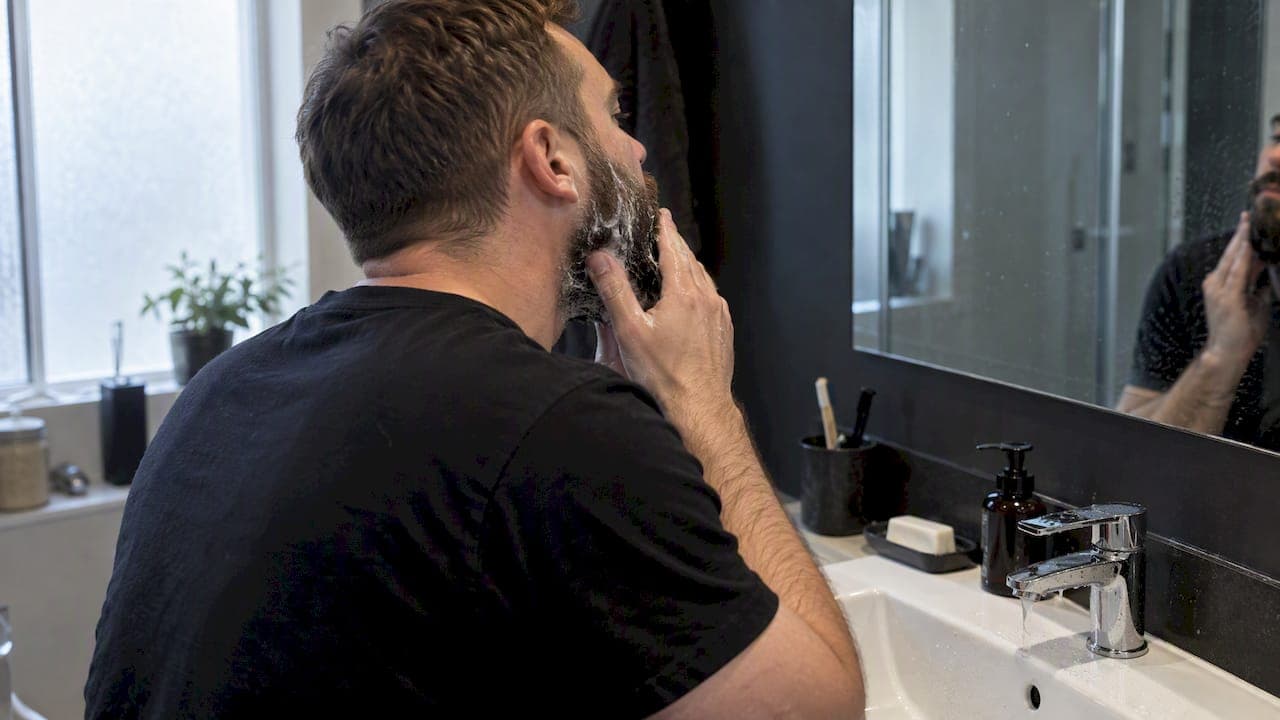
The simplest effective routine is this: cleanse, moisturise and apply SPF every morning; cleanse, treat and moisturise every night; exfoliate once a week; and use an antifungal shampoo on persistent dandruff. These steps work on the skin under and around your beard, not just the hair itself. A non-comedogenic moisturiser, daily SPF on exposed skin, and ketoconazole for flaking are the three items worth getting right first.
TL;DR:
- Use an antifungal shampoo like ketoconazole twice weekly to control dandruff and prevent recurrence over time.
- Rinse thoroughly after cleansing to remove residue that can cause irritation and breakouts in beard areas.
- Apply a light, non-comedogenic moisturizer and SPF on damp skin each morning to ensure even coverage and skin protection.
- Limit exfoliation to once weekly with a mild chemical exfoliant, avoiding physical scrubs that may irritate sensitive beard skin.
- Seek professional assessment if dandruff, redness, or texture issues persist beyond four weeks of home treatment.
Table of Contents
- Morning routine for bearded skin: step-by-step
- Night routine: cleanse, treat and repair
- Weekly and periodic care for beard skin
- How to choose beard-friendly skincare products
- Common beard skin problems and quick fixes
- A short checklist for daily and weekly beard care
- When professional treatment helps beard skin
- Author's note: stick to the basics
- Clinic option: beard skin support at Rivers Edge Skin Studio
- FAQ
- Sources
Morning routine for bearded skin: step-by-step
A beard traps oil, dead skin and yesterday's products against your face overnight, so the morning routine starts with properly clearing that away rather than just rinsing with water.
Wash your beard and the skin beneath it with a gentle, low-foam cleanser and warm (not hot) water. Work it right down to the skin, not just through the hair, then rinse thoroughly: leftover cleanser trapped in facial hair is a common, overlooked cause of irritation for bearded men. Pat dry rather than rubbing.
Next comes moisturiser. Choose a lightweight, non-comedogenic formula and apply it the way you'd apply a conditioner: part the beard in sections and massage the product down to the roots so it actually reaches skin, not just hair tips.
SPF comes last, and it matters even with full coverage. A beard does not reliably block UV exposure, and the NHS recommends daily broad-spectrum sunscreen on exposed skin, including cheeks, ears, nose and any visible scalp or stubble areas. Men in the early stubble phase, when coverage is patchy, often miss these areas entirely.
If you use beard oil or balm, apply a small amount last, focusing on the hair rather than the skin, so it doesn't sit underneath and compete with your moisturiser and SPF.
- Cleanse beard and skin with a gentle surfactant, rinsing until no residue remains.
- Apply non-comedogenic moisturiser directly to the skin beneath the beard.
- Apply SPF to all exposed skin, including stubble-covered areas.
- Finish with a small amount of beard oil or balm if you use one.
Pro Tip: Apply moisturiser and SPF to damp skin straight after cleansing: it helps both products spread more evenly through the beard.
Night routine: cleanse, treat and repair
Evenings are when you remove the day's build-up and, if needed, add any targeted treatment before your skin repairs itself overnight.
A single cleanse is usually enough for most men. If you've worn heavy product, sunscreen or sweated through a workout, a double cleanse, a quick rinse followed by a proper wash, clears everything before it settles into the hair follicles. Whichever you choose, rinse thoroughly: beard hair holds onto cleanser and residue far more than bare skin, and that trapped film is a frequent cause of itching and small breakouts.
This is the point in the day to apply any targeted treatment. If you're dealing with flaking or itch under the beard, an antifungal shampoo such as ketoconazole can be massaged into the beard and left for around five minutes before rinsing. For acne-prone skin, a mild topical active applied sparingly to affected areas works well, but stronger prescription-strength treatments should go through a GP or dermatologist rather than guesswork.
Finish with moisturiser, worked down to the skin as in the morning. Keep the layer light on bearded areas: a thick cream sitting on top of dense hair is more likely to clog pores than one that's properly massaged through.
- Cleanse once, or double-cleanse after heavy sweat or product use.
- Rinse thoroughly to avoid trapped residue in the beard.
- Apply targeted treatments (antifungal or acne actives) sparingly and only where needed.
- Moisturise last, massaging the product to the skin rather than leaving it on the hair surface.
For readers starting from scratch, our guide to starting a men's skincare routine breaks the basics down further.
Weekly and periodic care for beard skin
Daily cleansing and moisturising handle most of the work, but a weekly rhythm deals with the build-up and fungal issues that daily steps can't.
- Exfoliate once a week with a low-strength chemical exfoliant (a mild AHA or BHA), rather than a physical scrub, which tends to irritate skin already under pressure from beard hair.
- If you notice flaking, white specks caught in the beard or an itchy scalp-like feeling along the jawline, use an antifungal shampoo on the area one to two times a week, leaving it on for about five minutes before rinsing.
- If symptoms persist beyond four weeks of consistent antifungal use, or keep returning, book a GP or dermatology review rather than cycling through more products.
Beard dandruff and seborrhoeic dermatitis are common and usually treatable. Ketoconazole shampoo used two to three times weekly typically clears Malassezia-related dandruff within a few weeks, and a maintenance routine of once or twice weekly can keep it from coming back. Seborrhoeic dermatitis often responds well to antifungal treatment but commonly recurs, which is why ongoing maintenance, rather than a one-off fix, tends to work best.
If scale, itch or rough texture doesn't settle with home care, a professional beard facial or a clinical assessment can be a reasonable next step rather than continuing to experiment at home.

How to choose beard-friendly skincare products
Not every cleanser or moisturiser marketed to men is suited to skin covered in hair. A few checks make the difference.
- Avoid products containing sodium lauryl sulfate (SLS) or high concentrations of alcohol, both of which can aggravate sensitive or eczema-prone skin; fragrance-free, moisturising formulas are the safer default.
- Skip heavy, comedogenic oils in facial moisturisers if you're prone to breakouts beneath the beard; lighter lotions or gel-creams tend to sit better under hair.
- Choose a lotion or light cream over a thick balm for the skin layer, and reserve heavier balms for the hair itself.
- Patch test any new product on your forearm for a few days before using it on your face, particularly if you have a history of irritation.
- If dandruff or flaking is the issue, look specifically for antifungal actives such as ketoconazole or zinc pyrithione rather than a generic "dandruff" label.
Our rundown of essential men's skincare products covers ingredient basics in more depth if you're building a kit from scratch.
Common beard skin problems and quick fixes
Most irritation under a beard falls into one of four categories, and telling them apart makes treatment far more straightforward.
- Seborrhoeic dermatitis shows up as greasy, flaking patches with itch, often along the jawline and hairline, and tends to respond to antifungal shampoo.
- Contact dermatitis appears as redness and irritation shortly after switching products, usually settling once the irritant is removed.
- Folliculitis looks like small red or pus-filled bumps around individual hair follicles, often linked to shaving or tight trimming.
- Acne under a beard behaves as it would anywhere else on the face: blackheads, whiteheads and deeper, tender spots.
For most of these, the first moves are the same: switch to a gentle, emollient cleanser, stop anything newly introduced that might be the trigger, and use an antifungal shampoo on affected areas as directed if flaking is involved. Soap and heavily fragranced products can worsen inflamed skin, so swapping to a soap substitute is often enough on its own.
See a clinician if redness is spreading, itching is severe, there's any bleeding, or you've followed an appropriate over-the-counter routine for two to four weeks without improvement. For stubborn red bumps or texture concerns that don't settle with home care, further clinical context is available through resources such as Unity by MD's guidance on red bumps.
Pro Tip: Keep a simple note of what you changed and when: it's the fastest way to spot which product triggered a flare-up.
A short checklist for daily and weekly beard care
Keep this on your phone or print it out: a routine only works if it's easy to repeat.
- Morning: cleanse, moisturise, SPF, then beard oil if you use one.
- Night: cleanse, apply any targeted treatment, then moisturise.
- Weekly: exfoliate once, use antifungal shampoo if flaking appears, and check the skin under your beard for any new redness or bumps.
When professional treatment helps beard skin
Home care resolves most day-to-day issues, but some problems are worth a professional look. Persistent scale that keeps returning despite regular antifungal shampoo, recurring seborrhoeic dermatitis, or ongoing rough or uneven texture under the beard are all reasonable reasons to book an assessment rather than keep cycling through products.
A bearded facial, administered by someone trained in working around facial hair, can clear build-up more thoroughly than a home routine manages alone, while treatments such as chemical peels or microneedling are sometimes used for texture concerns once a clinician has assessed the skin. These sit alongside home care rather than replacing it, and they're generally considered after simpler steps haven't worked. If you're preparing for a treatment, our note on facial prep timing for bearded men explains what to do in the 24 to 48 hours beforehand.
Author's note: stick to the basics
Consistency beats complexity. Start with the core routine above, give it four to eight weeks, and add one active treatment at a time so you can tell what's actually working. If a problem doesn't shift, get it looked at.
— David
Clinic option: beard skin support at Rivers Edge Skin Studio
If home care isn't resolving a persistent issue, we offer an in-person route built around men's skin specifically. We provide a Bearded Man Facial designed to clean and assess skin that's often missed in general facials, with treatments such as chemical peels and microneedling available for texture concerns after assessment.

- Bearded Man Facial, Deep Cleanse Facial and other facial options for bearded and non-bearded skin.
- Chemical peels and microneedling for texture and resistant concerns.
- Personalised plans built around what we see at assessment, not a generic routine.
| Treatment | Price |
|---|---|
| Bearded Man Facial | £35 |
| Chemical Peel (Single Treatment) | £60 |
| Microneedling Facial (Single Treatment) | £70 |
Full details and booking are on our services page.
This article is general information, not a substitute for advice from a qualified doctor. Consult a qualified healthcare professional about your own circumstances before acting on anything here.
FAQ
What is a good skincare routine for men with a beard?
A good routine covers morning cleansing, non-comedogenic moisturiser and SPF, followed by an evening cleanse, any targeted treatment and a night moisturiser. Weekly exfoliation and, if needed, antifungal shampoo keep flaking and build-up under control.
What is a good beard care routine for men?
Beyond trimming and combing, the skin beneath the beard needs the same cleanse, moisturise and SPF steps as bare skin, applied by parting the hair to reach the surface. Proper rinsing after cleansing matters more for bearded men, since residue gets trapped in the hair more easily than on smooth skin.
What is the 3-month beard rule?
This refers to letting a beard grow untouched for around three months before shaping it, allowing the full pattern and density to come through. It's a grooming convention rather than a skincare one, and it doesn't change the need for a daily cleanse and moisturise routine underneath.
What is the 4-2-4 rule in skincare?
Definitions of this term vary and it isn't a standard clinical guideline, so we'd avoid relying on it as a routine framework. A dependable structure instead is the cleanse, moisturise and SPF approach covered above, adjusted with weekly exfoliation and antifungal shampoo where flaking is a problem.
How do I treat beard dandruff at home?
Ketoconazole shampoo used two to three times a week, left on for about five minutes, typically clears Malassezia-related dandruff within two to four weeks. If symptoms persist after consistent use or keep recurring, a GP or dermatology review is the next step.
Sources
- How and when to use ketoconazole | NHS
- Seborrhoeic dermatitis patient information leaflet
- Hair care for eczema of the scalp | Gloucestershire Hospitals NHS Foundation Trust