
Biotin injections can genuinely help hair that's thinning because of a diagnosed deficiency, certain medications, or specific hair‑shedding conditions. They are not a proven fix for male pattern baldness. The strongest trial evidence backs a biotin‑plus‑dexpanthenol combination for diffuse hair loss, while systematic reviews urge caution for otherwise healthy men. Start with a deficiency check or a proper consultation before booking a course.
TL;DR:
- Biotin injections are most effective for diffuse hair loss caused by deficiencies or specific medical conditions, not for male pattern baldness.
- The strongest evidence supports biotin combined with dexpanthenol, but the formulation's benefits cannot be separated, and results mainly apply to deficiency-related cases.
- Blood test interference from high-dose biotin is common and can distort thyroid and cardiac assessments, so medical professionals must be informed before testing.
- Proper evaluation for deficiency, medications, or underlying health issues is essential before considering biotin injections; they are not recommended for straightforward pattern baldness.
- Injections are safe generally, cause mild injection site reactions, and require a clinical consultation to identify contraindications like allergies or upcoming blood tests.
Table of Contents
- What is biotin and how do injections differ from tablets?
- What does the clinical evidence say about biotin injection hair growth?
- Who actually benefits from biotin injections?
- Are biotin injections safe? Side effects and blood test warnings
- What happens during treatment and how soon will you see results?
- Biotin injections vs oral supplements and other hair treatments
- How Rivers Edge Skin Studio approaches biotin injections
- Are biotin injections safe for everyone? Contraindications to know
- The verdict on biotin injections for hair
- Ready to book a biotin injection consultation?
- Sources
- FAQ
What is biotin and how do injections differ from tablets?
Biotin, also called vitamin B7, is a cofactor your body uses to build keratin, the structural protein in hair, skin and nails. Most men on a reasonably varied diet already get enough of it from eggs, oily fish, nuts and liver, which is one reason biotin deficiency is genuinely uncommon in well‑nourished populations.
Injections bypass the gut entirely, delivering biotin straight into muscle tissue for faster, more complete absorption. Many clinics pair it with dexpanthenol, a vitamin B5 derivative, because that's the combination used in the main clinical trial behind current injection protocols, not biotin on its own.
Oral tablets and injections each have trade-offs worth weighing before you commit to either:
- Oral biotin: cheap, convenient, no needle, but absorption varies and high doses are simply excreted if you're not deficient.
- Intramuscular injection: guaranteed delivery, often combined with dexpanthenol, but requires a clinic visit and carries a small injection‑site risk.
- Combination formulas: used in the strongest trial data, though this makes it hard to separate biotin's individual contribution from dexpanthenol's.
What does the clinical evidence say about biotin injection hair growth?
The best available data comes from a 2022 randomised, double‑blind controlled trial testing weekly intramuscular injections of biotin (5 mg) plus dexpanthenol over six weeks.
Trial snapshot: In 50 patients with diffuse pattern hair loss, the study found statistically significant reductions in hair fall count (p < 0.01) and increases in hair density (p = 0.04 and p = 0.02) after six weekly injections.
That's a meaningful result, but it comes with real caveats:
- The sample was small (50 people, mostly women), so results in men specifically deserve some caution.
- The formulation tested was biotin plus dexpanthenol, not biotin alone, so the trial can't tell you how much of the benefit is down to biotin by itself.
- Systematic reviews covering the wider literature conclude that evidence for biotin improving hair in otherwise healthy people remains thin, and that clearer benefit shows up mainly in confirmed deficiency or specific hair pathologies.
The practical takeaway: injections have solid backing for diffuse hair loss linked to deficiency or particular conditions. For healthy men with typical androgenetic (genetic) hair loss, the evidence simply doesn't support biotin as a standalone solution.
Who actually benefits from biotin injections?
Not every man losing hair is a good candidate, and a decent clinician will check before recommending a course. These are the scenarios where testing or treatment tends to make clinical sense:
- Confirmed or suspected biotin deficiency — often linked to restrictive diets, heavy alcohol use, or malabsorption.
- Post‑bariatric surgery patients, who commonly struggle to absorb enough biotin from food alone.
- Certain medications, such as long‑term anticonvulsants or isotretinoin, which can reduce biotin activity in the body.
- Specific hair‑shedding disorders, including diffuse telogen effluvion, rather than a receding hairline or crown thinning.
A proper assessment usually involves a history of diet, medications and recent illness, sometimes alongside a blood test for biotin or related markers. If your hair loss follows the classic pattern of a receding hairline or thinning crown with normal biotin levels, injections alone are unlikely to move the needle, and you'll get more from treatments aimed at genetic hair loss instead.
Are biotin injections safe? Side effects and blood test warnings
Biotin injections are generally well tolerated. Most men experience nothing worse than mild redness, tenderness or bruising at the injection site, which settles within a day or two. Serious reactions are rare.
The bigger issue isn't the injection itself, it's what high‑dose biotin does to your next blood test. High‑dose biotin can distort common laboratory assays, including thyroid function tests and cardiac troponin measurements used to investigate heart problems, sometimes producing results that look abnormal when nothing is actually wrong.
- Thyroid panels can show falsely low or falsely high readings depending on the assay used.
- Cardiac troponin tests, used in emergency chest pain assessments, are among the most clinically significant to be affected.
- Effects can persist for several days after the last dose, depending on how the test is run.
Pro Tip: Always tell your GP, hospital doctor or phlebotomist about any recent biotin injections or supplements before you have blood taken, especially thyroid or cardiac tests. It could be the difference between an accurate result and an unnecessary follow-up scan.
What happens during treatment and how soon will you see results?
A first appointment is straightforward but shouldn't feel rushed. Expect the following:
- History and consent — your clinician reviews your diet, medications, general health and hair loss pattern, and checks for red flags that point away from biotin as the right treatment.
- The injection itself — a quick intramuscular shot, typically taking a couple of minutes with minimal discomfort.
- A treatment schedule — many clinics follow a course similar to the trial protocol, weekly sessions for several weeks, then move to maintenance injections roughly every two to four weeks.
Patience matters here. Nail changes are often the first sign of improvement, since nails grow faster and reflect keratin changes sooner than hair does. Hair density and shedding changes take longer to become visible, because hair growth cycles run in months, not weeks, so most clinics ask you to commit to a full course before judging whether it's working.
Biotin injections vs oral supplements and other hair treatments
Injections win on delivery. Skipping digestion means the full dose reaches your bloodstream, which matters if you have a genuine absorption problem, but it counts for little if you're already getting enough biotin from food, since excess biotin is simply excreted rather than doing more good.
For most men with pattern hair loss, biotin injections work best as an adjunct rather than a headline treatment:
- Pair them with proven options like minoxidil or scalp microneedling, which target the follicle directly.
- Consider polynucleotide treatments alongside biotin for men focused on scalp health and hair quality rather than regrowth alone.
- Prioritise deficiency correction first, genetic hair loss treatment second, and use biotin to support overall hair condition rather than reverse a receding hairline.
How Rivers Edge Skin Studio approaches biotin injections
At Riversedgeskinstudio, every biotin injection starts with a proper conversation, not a generic top-up. Clinicians review your diet, medical history and hair loss pattern before recommending injections, sometimes alongside complementary treatments such as scalp microneedling or polynucleotides where genetic thinning is the bigger factor. The clinic also offers injectable B12 support for men interested in wellness injections beyond hair alone.
Are biotin injections safe for everyone? Contraindications to know
Biotin injections aren't automatically suitable for every man walking through the door, and a responsible clinic will screen for a handful of situations before proceeding.
Pregnancy and breastfeeding don't feature in this article's core audience, but it's worth stating plainly: injectable vitamin treatments, including biotin, should only be given to pregnant or breastfeeding women under direct medical guidance, since dosing safety data in these groups is limited.
Men on specific medications need a closer look before starting. Anticonvulsants such as valproic acid, and acne treatments like isotretinoin, can reduce biotin activity in the body, which is exactly why clinics document current medications during the initial consultation rather than treating biotin as a one-size-fits-all top-up.
Anyone with an upcoming blood test, particularly thyroid function tests or cardiac troponin assessments, should flag this before treatment given the assay interference risk covered earlier. If you have a hospital appointment, scan, or routine blood panel booked in the next week or two, mention it before your injection, not after.
People with a known allergy to biotin, dexpanthenol, or any injection component should avoid the treatment and discuss alternatives with their clinician. Men with active skin infections at the intended injection site should also wait until it clears.
None of these are unusual or complicated checks. They're the reason a proper consultation, rather than a walk-in jab, is the right way to approach biotin injections, and why a clinic asking detailed questions before treating you is doing its job properly rather than being overly cautious.
The verdict on biotin injections for hair
The honest read of the evidence is this: biotin injections work best as a precision tool, not a blanket solution. The trial data everyone quotes tested a specific combination, biotin plus dexpanthenol, in people with diffuse hair loss, many of whom likely had some degree of deficiency or a shedding pattern distinct from typical male pattern baldness. Extrapolating that result to every man with a receding hairline is where a lot of marketing overreaches.
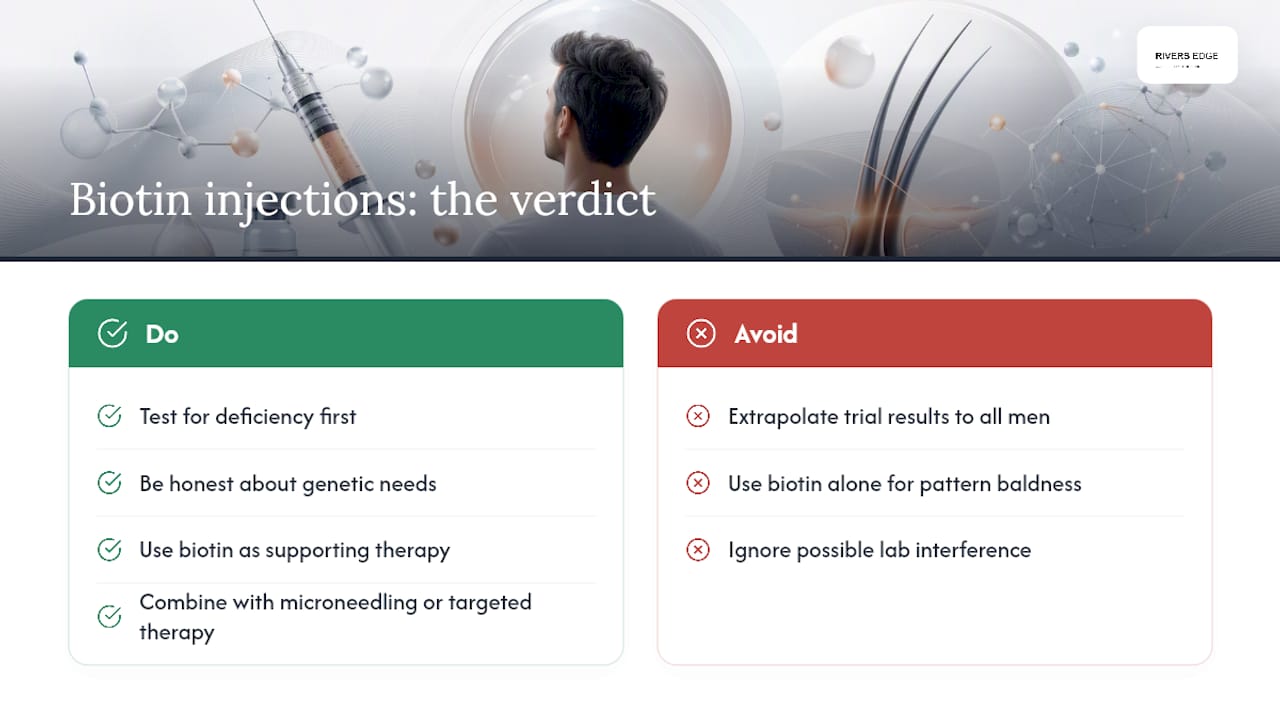
What gets underestimated is the blood test issue. Men fixate on whether injections will regrow hair and rarely ask about the downstream effect on their next thyroid panel or cardiac workup. That's backwards. The interference risk is well documented, cheap to avoid, and almost nobody mentions it until something looks wrong on a lab report.
My take: get tested for deficiency first, be honest about what genetic hair loss actually needs, and treat biotin as support rather than the centrepiece of your hair plan. Combined with microneedling or targeted therapies, it earns its place. Alone, for a man with straightforward pattern baldness, it's unlikely to deliver much.
— David
Ready to book a biotin injection consultation?
Most men trying biotin off the back of a forum thread never find out whether they're actually deficient, which means they're guessing at a treatment plan instead of following one. Riversedgeskinstudio replaces that guesswork with a proper consultation: a review of your diet, medications and hair pattern, followed by a tailored plan that might include a Biotin Injection alongside scalp microneedling or polynucleotides where genetic thinning is part of the picture.

A single Biotin Injection is offered, with clinicians happy to talk through whether a short course or a one-off session suits your situation better. If nutrition is part of your concern, the team at Gethair also covers useful background on protein and hair health worth reading before your appointment. Book your consultation through the full services and booking page and get a plan built around your actual hair, not a generic protocol.
This article is general information, not a substitute for advice from a qualified doctor. Consult a qualified healthcare professional about your own circumstances before acting on anything here.
Sources
- Efficacy of intramuscular injections of biotin and dexpanthenol in the treatment of diffuse hair loss: A randomized, double‐blind controlled study comparing two brands
- A review of the use of biotin for hair loss
FAQ
Is biotin injection good for hair growth?
It can help if your hair loss is linked to biotin deficiency or a diffuse shedding pattern, backed by a randomised trial showing reduced hair fall and increased density. For typical male pattern baldness in biotin‑replete men, evidence for benefit is limited.
How much does a biotin injection cost?
At Riversedgeskinstudio, a single Biotin Injection costs £30. Many clinics recommend a short course followed by maintenance sessions, so ask about a treatment plan rather than a one-off price during your consultation.
Does the NHS recommend biotin for hair loss?
The NHS doesn't routinely recommend biotin supplementation for hair loss in healthy adults, since reviews find limited high-quality evidence for benefit outside confirmed deficiency. It's more commonly discussed in private clinic settings for diffuse hair loss or diagnosed deficiency.
How long does it take for biotin injections to work?
Nail changes are often noticed first, since nails grow faster than hair. Hair density and shedding improvements typically take several months to become visible, which is why clinics ask patients to complete a full course before assessing results.
Can biotin injections affect my blood test results?
Yes. High‑dose biotin can distort thyroid and cardiac blood tests, sometimes producing misleading results. Always tell your doctor or phlebotomist about recent biotin injections before any blood test, particularly thyroid function or cardiac troponin panels.