
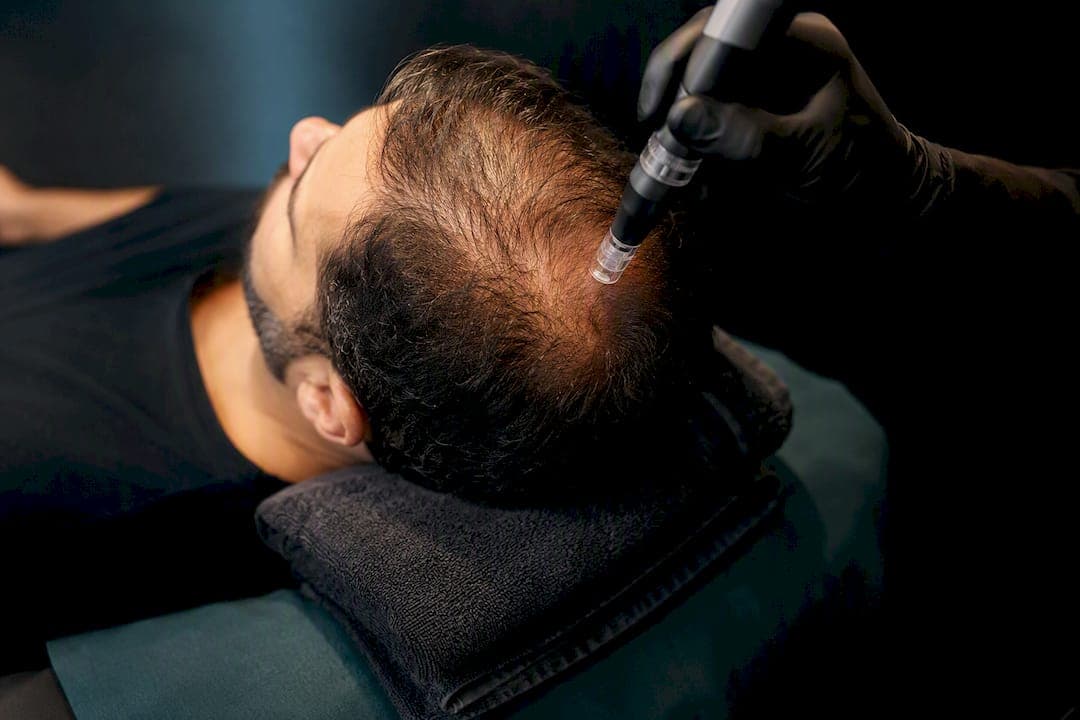
Microneedling can help with certain types of hair loss, most reliably androgenetic alopecia, and most reliably when paired with 5% minoxidil. It is not a fix for every bald patch or thinning crown, and it works best once a proper diagnosis has ruled out other causes. Performed by a trained clinician on a regulated device, it carries a good safety record. What follows covers the evidence, the protocols, the risks, and how to choose a provider.
TL;DR:
- Microneedling paired with 5% minoxidil has been shown to produce greater hair density increases than minoxidil alone, especially in androgenetic alopecia.
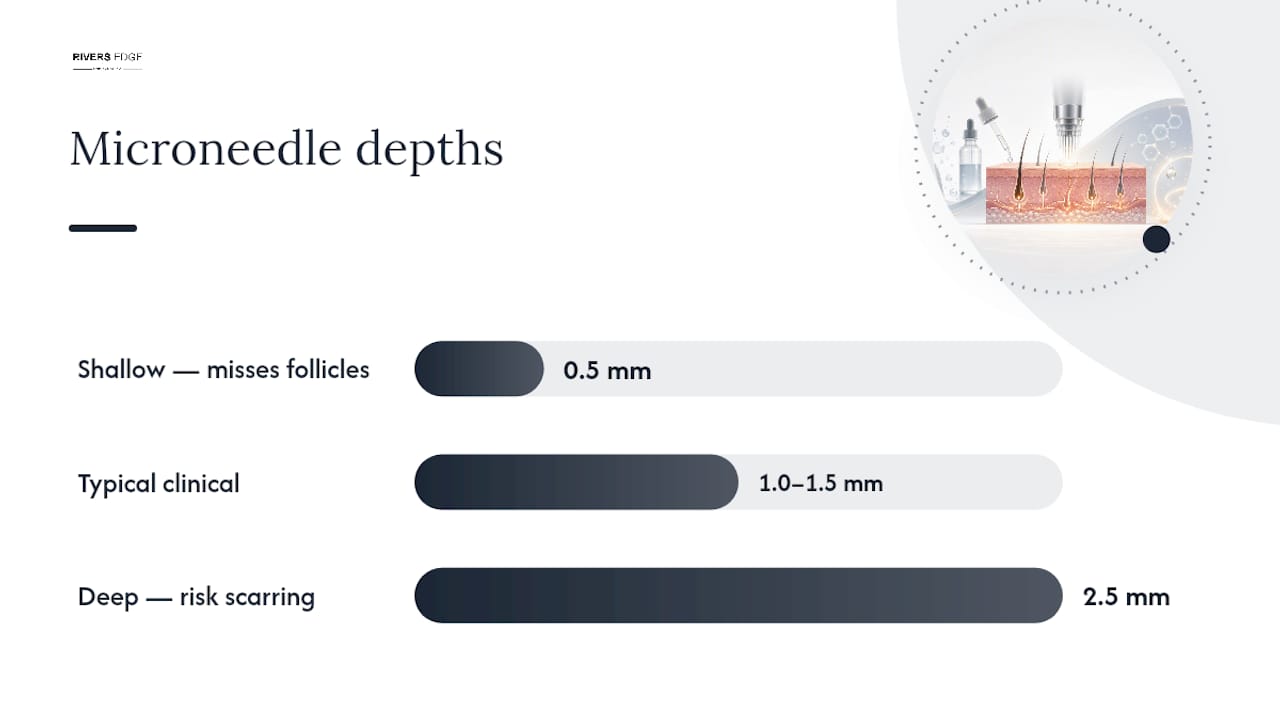
- The optimal needle depth for scalp treatment is around 1.0 to 1.5mm; shallower depths risk ineffective stimulation, while deeper depths may cause scarring.
- Adherence to a full treatment course, typically 8 to 12 weekly sessions followed by monthly maintenance, is crucial for visible results.
- Combining microneedling with injectables like PDRN or PRP can enhance hair growth, but sessions should be spaced 48 to 72 hours apart and follow a structured protocol.
- Proper evaluation to identify underlying causes such as hormonal or nutritional deficiencies is essential before starting microneedling treatment.
Table of Contents
- Does microneedling actually work for hair loss?
- Who benefits most from scalp microneedling?
- What happens during a scalp microneedling session?
- Should you combine microneedling with minoxidil, PRP, or PDRN?
- Is microneedling safe, and who should avoid it?
- How long until you see results from microneedling?
- What should you ask before booking a provider?
- A clinic view on what actually moves the needle
- Book a scalp microneedling consultation at Riversedgeskinstudio
- Where to read more
- Sources
- FAQ
Does microneedling actually work for hair loss?
The evidence base is stronger than most cosmetic scalp treatments manage. A systematic review of 22 studies covering roughly 1,127 subjects found that microneedling, used as an adjunct rather than a standalone fix, improved hair density and thickness in androgenetic alopecia and, to a lesser degree, alopecia areata. That is a meaningful sample size for a dermatological intervention, and it is why microneedling has moved from a niche add-on to a genuine part of mainstream hair-loss protocols.
The strongest single data point comes from randomised controlled trials comparing microneedling plus minoxidil against minoxidil on its own. Dhurat and colleagues' landmark RCT and related work found that weekly microneedling sessions added to twice-daily 5% minoxidil produced statistically significant increases in hair count over a 12- to 16-week period, compared with minoxidil alone. That is the pairing worth remembering: microneedling amplifies what minoxidil already does, rather than replacing it.
Why would puncturing the scalp help hair grow? Three mechanisms come up repeatedly in the literature:
- Wound-healing response. Controlled micro-injury triggers growth factor release around the follicle, prompting a localised repair cascade.
- Wnt/β-catenin signalling. This pathway governs whether a follicle stays dormant or re-enters the growth phase, and microneedling appears to switch it on.
- Transdermal delivery. The micro-channels created by the needles let topical minoxidil penetrate deeper into the dermis, where it can actually reach the follicle.
None of this makes microneedling a cure. The trials behind these findings are genuinely encouraging, but the field still leans on small sample sizes, a wide mix of devices and depths, and follow-up windows rarely longer than four months. Longer, larger, more standardised trials would settle the remaining questions about durability beyond a year. For now, the honest summary is: good evidence for benefit as an adjunct, thinner evidence for it as a solo treatment.
Who benefits most from scalp microneedling?
The evidence clusters around one condition above all others.
- Androgenetic alopecia (male or female pattern hair loss) has the best-supported response, particularly when microneedling runs alongside minoxidil.
- Alopecia areata shows some benefit in smaller studies, but results are inconsistent enough that it should be treated as a secondary option, not a primary plan.
- Hair loss from an untreated medical cause, such as iron deficiency, uncontrolled thyroid disease, or active inflammatory scalp conditions, will not respond well to microneedling until that underlying issue is addressed.
This is precisely why clinicians insist on assessment before treatment rather than jumping straight to needles. NHS guidance on hair loss recommends blood tests and a scalp examination as the first step, and clinical opinion backs this up: differential diagnosis before microneedling matters, because treating symptoms of an unaddressed hormonal or nutritional cause wastes both time and money. A sensible consultation should include a scalp exam, a run-through of your medical history, and, where relevant, blood work covering ferritin and thyroid function before any needle touches your scalp.
What happens during a scalp microneedling session?
Most clinics use automated pens rather than rollers for scalp work, largely because pens allow precise, consistent depth control across an uneven scalp surface. Rollers can still deliver benefit, but the depth varies more with hand pressure, which makes outcomes harder to predict. Whatever the device, single-use sterile cartridges are non-negotiable. Reusing needle tips on skin, even your own, invites infection.
Depth matters more than most people assume. Studies show huge variation across the literature, from 0.5mm to 2.5mm, but clinical practice converges on roughly 1.0 to 1.5mm for the scalp. Go too shallow and you miss the follicle stem cells that actually drive regrowth. Go too deep and you risk scarring instead of stimulation, with nothing to show for the extra discomfort.
A typical course looks like this:
- Loading phase: weekly sessions for 8 to 12 weeks, building the initial stimulation effect.
- Endpoint per session: mild erythema and pinpoint bleeding, which signal enough micro-injury without overdoing it.
- Maintenance phase: sessions spaced out, often monthly, once the loading phase is complete.
Pro Tip: Chasing more bleeding does not mean more results. A clinically effective protocol balances the right depth with a frequency you can actually stick to, and adherence to the full course tends to matter more for outcome than any single "aggressive" session.
At-home rollers have a place for improving topical product absorption, but they are not a substitute for in-clinic treatment at therapeutic depth. Deep home devices, in particular, carry a real infection risk with none of the sterility controls a clinic has in place.
Should you combine microneedling with minoxidil, PRP, or PDRN?
Microneedling rarely performs at its best alone. The trial data is clearest for the minoxidil pairing: adding weekly microneedling to twice-daily 5% minoxidil produced larger hair-count gains over 12 to 16 weeks than minoxidil used by itself. If you are already on minoxidil and progress has stalled, this is the first adjunct worth discussing with a clinician.
Platelet-rich plasma (PRP) is the other common pairing. It uses your own blood, spun down to concentrate growth factors, then injected into the scalp to improve thickness and density alongside needling.
Polynucleotides (PDRN) are the newer alternative, and they carry a genuine practical advantage: no blood draw required. Pilot studies on PDRN for hair loss report mean hair-count increases of around 17.9% alongside measurable thickness gains after a repeated course of injections. PDRN also offers a standardised concentration every time, compared with PRP's session-to-session variability depending on the individual's blood.
- If combining injectables with microneedling in the same programme, clinics typically space the two by around 48 to 72 hours, reducing the chance of introducing product into freshly irritated tissue.
- Apply topical minoxidil after needling, not before, so it uses the open micro-channels rather than being disrupted by them.
Is microneedling safe, and who should avoid it?
The safety data is reassuring. Across the systematic review of 22 studies, no serious adverse events were reported among the roughly 657 subjects who received treatment. Separate safety and clinical observation reviews back this up, describing microneedling as a minimally invasive procedure with a strong tolerability profile.
Expect the following in the days after a session:
- Localised redness lasting roughly 24 to 72 hours.
- Pinpoint bleeding at the time of treatment, which stops quickly.
- Mild, transient discomfort during the session itself.
Rarer but genuine risks include infection, scarring, and pigmentary changes, almost always linked to poor technique, unsterile equipment, or excessive depth. This is where single-use cartridges and regulated medical devices stop being a technicality and start being the thing that actually protects you.
Tell your clinician before treatment if you have any of the following, since each is a reason to delay or avoid microneedling:
- An active scalp infection or inflammatory skin condition.
- Recent use of isotretinoin (commonly needs a wash-out period first).
- A bleeding disorder or blood-thinning medication.
- Poorly controlled diabetes or another systemic condition affecting healing.
How long until you see results from microneedling?
Most people who respond well start noticing change around 12 to 16 weeks into a structured loading course, matching the timeframes reported across the key RCT evidence. Clinics track progress with a mix of objective and subjective measures.
- Hair counts in a defined scalp area, tracked photographically over time.
- Hair density and thickness, often assessed with magnified imaging.
- Patient-reported satisfaction, which matters just as much as the numbers on a chart.
A sensible follow-up rhythm is a review at 12 weeks, another at 16, then a decision point: continue as planned, extend the loading phase, or add an adjunct like PDRN if progress has plateaued. Our scalp microneedling results page breaks down what typical density gains in that window tend to look like.
What should you ask before booking a provider?
Not every clinic offering microneedling for hair loss treats it with the same rigour. A short checklist protects you from a poor outcome and wasted money.
- Confirm the practitioner's training specifically in scalp microneedling, not just facial treatments.
- Ask which device is used and confirm cartridges are single-use and sealed until your appointment.
- Ask what needle depth they use for the scalp and why, listening for a considered answer around the 1.0 to 1.5mm range rather than a vague one.
- Request before-and-after images and, where available, anonymised outcome data from previous patients.
- Get written aftercare instructions covering the 24 to 72 hour redness window and any product restrictions.
- Ask whether PRP or PDRN is offered as an adjunct, and how sessions are sequenced against the needling schedule.
A provider who answers these questions clearly, without hesitation, is generally one who takes the treatment seriously. Our guide on common microneedling mistakes to avoid covers several of the errors that separate a good outcome from a wasted course.
A clinic view on what actually moves the needle
The single biggest predictor of disappointing results isn't the device or the depth. It's patients stopping the loading phase early, usually around week four or five, right when the visible change is smallest and doubt creeps in. Density gains at 12 to 16 weeks depend on completing the course, not just starting it. Clinics that combine microneedling with minoxidil, and sequence PDRN sensibly around needling sessions, tend to see better adherence because patients feel something is actively being layered onto their plan....
— David
Book a scalp microneedling consultation at Riversedgeskinstudio
This specialist clinic focuses on men's skin and scalp treatments for hair loss, delivered in a dedicated clinic environment rather than as part of a general aesthetics menu.

If the evidence above has you weighing microneedling seriously, Head Microneedling is priced at £70 for a single treatment, giving you a low-commitment way to start a course without signing up to months of payments upfront. For men who want the added benefit PDRN studies point to, Scalp Polynucleotides is available at £240, and can be sequenced alongside microneedling as part of a tailored plan. Your first appointment includes a proper consultation, so any underlying causes get discussed before treatment starts, not after. Browse the full range of services and book a consultation to find out which combination suits your scalp and your goals.
Where to read more
For the primary evidence behind this guide, see the systematic review of 22 studies on microneedling for hair loss, the Dhurat RCT on microneedling with minoxidil, PDRN clinical trial data, UK guidance on regulating medical devices, and the NHS overview of hair loss. For a broader look at complementary treatment approaches, Bloom Society's microneedling overview is a useful comparison point.
Sources
FAQ
Do you lose hair after microneedling?
No, microneedling does not cause hair loss. Some people notice mild, temporary shedding of hairs already in the resting phase, which is normal turnover rather than a treatment side effect.
Is 40 too old for microneedling?
No. Age alone is not a barrier, since the trials behind microneedling's evidence base include adults across a wide age range; suitability depends far more on the cause and pattern of your hair loss than your age.
What did Jennifer Lopez or Elon Musk use for hair loss?
Public figures have discussed a range of treatments for hair loss over the years, including topical minoxidil and hair transplant procedures, but no verified, specific protocol for either has been confirmed. It's more useful to focus on what the clinical evidence supports, which points to microneedling combined with minoxidil for androgenetic alopecia.
How much does scalp microneedling cost at Riversedgeskinstudio?
A single Head Microneedling session is priced at £70, and Scalp Polynucleotides (PDRN) treatment is £240, both listed on the services page.
How long does a course of microneedling take to show results?
Most people see visible density improvement around 12 to 16 weeks into a structured weekly loading course, provided the sessions are completed rather than stopped early.