
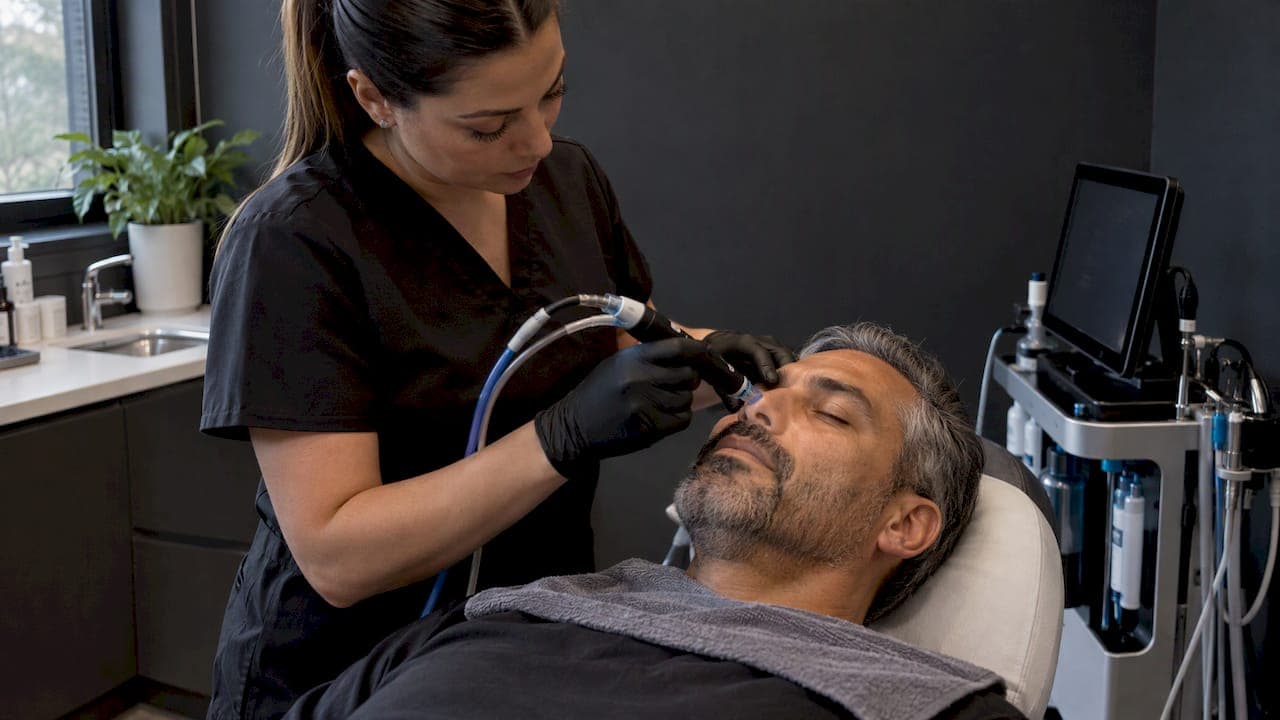
A HydraFacial gives you a visible, short-term change: cleaner pores, better hydration, a brighter and smoother look, often on the same day. It does not remove deep wrinkles or fix active inflammatory acne in one visit. This guide explains what the before-and-after difference really looks like, how to judge photos, what a first session involves and how many sessions make sense.
TL;DR
- Expect an immediate "fresh skin" effect: clearer pores, better hydration and a more even look, with little or no downtime.
- The best-supported effects are short-term. Lasting wrinkle reduction or pigmentation change needs other treatments or a course of sessions.
- Clinical data on acne shows a series works better than a single visit: six treatments over 12 weeks in one study.
- Treat before-and-after photos with care. Look for consistent lighting, angles and honest consent, not just the best case.
- Mild redness, dryness or stinging can follow. Sensitive skin or recent strong actives need a conversation before you book.
Table of Contents
- What a HydraFacial before and after really shows
- How soon will you see results?
- Results by skin concern
- How to judge before-and-after photos
- What happens at a first HydraFacial
- Side effects and aftercare
- How long do results last?
- Who is it suitable for?
- Our perspective
- Book a skin consultation in Liverpool
- FAQ
- Sources
What a HydraFacial before and after really shows
A HydraFacial is a multi-step facial that cleanses, exfoliates, extracts and hydrates in one sitting. OK! Magazine describes it as an approximately one-hour treatment using different nozzles and solutions, with boosters that can be added for concerns such as congestion, fine lines and loss of elasticity.
So a fair "after" photo shows skin that looks cleaner and fresher. In practice, that usually means:
- Pores that look smaller because they have been emptied.
- Skin that looks less shiny and less rough.
- A more even surface, so shaving can feel easier and products sit better.
- A healthier glow from better hydration.
The Aesthetic Journal reports that the best-supported short-term effects are improved hydration, light reflectance and visible comedonal congestion. Evidence for lasting wrinkle reduction, structural lifting, permanent pigmentation improvement or long-term acne resolution is limited. That is the honest frame for any photo you see: the change is real, and it is mostly about surface quality.
For men, the difference is often most obvious around the nose, the cheeks and the beard line, where oil, shaving and sweat leave skin congested. If you have a beard, the skin underneath benefits from a deep clean too, which is why we offer a facial designed for bearded men alongside the HydraFacial.
How soon will you see results?
Most people notice a difference straight after the session. Skin looks clearer and feels softer, and some people have a slight pink flush that settles. That immediate effect is why HydraFacials are popular before events, photos or a big week at work.
What builds over time is different. Skin that is consistently cleansed and hydrated tends to look calmer and more even. Consistency matters more than any single visit, and that is why a plan is usually set around your skin rather than a one-off.
What the clinical evidence says about a series
The strongest published data in our research is on acne. In a 12-week study of 20 adults with mild-to-moderate acne, six treatments given every two weeks increased the share of patients with clear or almost clear skin from 20% at baseline to 65% per investigator assessment. It is a small study, so it is a guide rather than a promise, but it supports the idea that a run of sessions does more than one.
If blemishes or blackheads are your main concern, our guides on HydraFacial for men's acne and on clearing blackheads in one session go into more detail.
Results by skin concern
The table below sets out what a HydraFacial can realistically do, based on the evidence above and how we plan treatments.
| Concern | What you can expect | How it is usually approached |
|---|---|---|
| Dull, tired skin | Brighter, fresher look straight after | One session, then a regular top-up |
| Dehydration | Skin feels softer and more hydrated | Hydrating boosters, plus a moisturiser at home |
| Blackheads and congestion | Visibly cleaner pores | Extraction step, then repeat sessions |
| Mild acne | Fewer breakouts over a series | A course of sessions, as in the study above |
| Fine lines | A softer look from hydration only | Often paired with other treatments |
| Deeper wrinkles | Little lasting change | Anti-wrinkle injections suit this better |
| Pigmentation, scarring | Limited change from HydraFacial alone | Peels or microneedling may suit better |
The Aesthetic Journal's expert view is that HydraFacial makes most sense for dull, dehydrated or mildly congested skin when you want a visible improvement without meaningful downtime. It is not a substitute for treating active inflammatory acne or deeper ageing. We agree, and we say so in the consultation so you book the right thing first time.
Ingredient transparency matters across skincare generally, and a guide to peptide blend contents and COA shows how lab verification of a product's contents is read.
When another treatment is the better first step
Some goals sit outside what a HydraFacial does. A few examples from our own menu:
- Deeper lines on the forehead or between the brows respond to anti-wrinkle injections. Two areas are £200 and three areas are £240.
- Uneven tone or rough texture may suit chemical peels. A single peel is £60, a course of two is £100 and a course of four is £200.
- Scarring and texture changes are where microneedling comes in. A single session is £70, a course of two is £100 and a course of four is £200.
If you are torn between a HydraFacial and microneedling, our comparison of HydraFacial vs microneedling sets out which suits which goal.
How to judge before-and-after photos
Photos are the first thing most people look for, and they are easy to get wrong. Here is what we would check.
Is the photography consistent?
Standard clinical photography uses consistent lighting, angles, facial expressions and neutral backgrounds so that the difference you see is the skin and not the camera. If the "after" has warmer light, a tilted angle, a tan or a smile that the "before" lacks, the gap may be exaggerated.

Is it the typical result or the best one?
Marketing images tend to show best-case outcomes. MedSpa Standard notes that this causes selection bias and advises looking for aggregate figures, such as the percentage of participants who reported improvement, for a more realistic expectation. One striking photo is a good day, not a guarantee.
What about the jar of extracted debris?
You may have seen the jar of residue shown beside treatment images. According to the same source, that jar is not a quantitative medical measure, and no independent analysis validates what the residue says about specific skin improvements. Look at the skin, not the jar.
Has the client consented?
In the UK, clinical standards say before-and-after images should be taken with written consent that is specific to marketing use and handled in line with data protection rules. The Aesthetics Journal's imagery guidelines also describe consent as ongoing, with the person able to withdraw permission at any time. A clinic that is open about how images are used is usually careful elsewhere too.
Ask for your own baseline
The most useful photos are your own. Take a picture at home in daylight before your first session, then repeat in the same spot and light two weeks later. It tells you far more than any gallery.
What happens at a first HydraFacial
Your first session follows a set order. The device uses spiral tips and a vortex action to gently lift impurities, and disposable, customisable tips control how strong the exfoliation is. The maker also states that the equipment should be operated only by properly trained people and used with its own consumables, so it is fair to ask who will treat you and what training they have.
A typical visit runs like this:
- Consultation. We ask about your skin, shaving routine, products and any medication, and agree a plan.
- Cleanse and exfoliate. Surface build-up is lifted away.
- Extraction. Pores are cleared with gentle suction.
- Hydrate and treat. Serums or boosters are applied to suit your skin.
- Finish. A calming product and sun protection.
Our full walk-through is in Hydrafacial steps: the full procedure explained.
How to prepare
- Come with a clean, makeup-free face if you can, and shave the day before rather than just before your appointment, so skin is not freshly irritated.
- Tell us about retinoids, exfoliating acids, antibiotics or any recent strong treatment. Skin that has recently had strong actives can be more prone to dryness or irritation, according to dermatologist Heather Rogers in Cosmopolitan UK.
- Avoid sunburn, and mention any active skin infection, cold sores or open spots before treatment.
- Arrive with a simple question: what do you want your skin to look like in a month?
Side effects and aftercare
HydraFacial is gentle for most people, but reactions can happen. Clinical studies report redness, stinging, itching, dryness and peeling, which typically occur after the first treatment and decrease with later sessions. The same study notes that, as a non-pharmaceutical treatment, it does not carry the risks linked to drugs such as retinoids and antibiotics.
For the first days, keep it simple:
- Use a gentle cleanser and a plain moisturiser.
- Wear SPF every morning.
- Hold off on strong exfoliating acids and retinoids until we tell you it is fine.
- Be gentle when shaving, and use a clean, sharp razor.
Our hour-by-hour aftercare guide covers the first week in detail. If redness is severe, spreading, painful or lasts longer than expected, or you develop blistering or signs of infection, contact the clinic and speak to your GP or pharmacist.
How long do results last?
The fresh, hydrated look is short-term, typically lasting days to a few weeks and depending on your skin, sun exposure, sweating and home routine. That is why a repeat schedule and daily care make a difference. Think of one session as a reset and a series as a habit. We set the spacing with you at the consultation, rather than quoting a one-size number.
Who is it suitable for?
There is no single best age for a HydraFacial. Cosmopolitan UK says it may suit people with clogged pores, dark spots or fine lines at different life stages. For men, common reasons to book include oily or congested skin, ingrown hairs, dullness from stress or sun, and wanting skin to look good ahead of an event.
Skin tone matters for treatment choice and aftercare. If you have darker skin, read our guides on HydraFacial for darker skin and HydraFacial for Black men. For a broader overview, see HydraFacial benefits for men.
Our perspective
We see the same thing in the clinic every week: men who have never had a facial arrive unsure and leave surprised at how simple it is. Skin that has been shaved daily, sweated in and left alone for years responds quickly to a proper deep clean.
Our approach is to be straightforward about what each treatment does. A HydraFacial is excellent for clearing congestion and bringing back hydration with no downtime. When your goal is deeper lines, texture or tone, we will say so and talk you through anti-wrinkle injections, peels or microneedling.
Because we work only with men's skin, we plan around beards, shaving irritation and the way men's skin tends to be thicker and oilier. Natural-looking results come from a plan built for you, not a template.
David
Book a skin consultation in Liverpool
If you want to see what your own before and after could look like, we can assess your skin and plan the right treatments, whether that is a HydraFacial, one of our facials from £35 or a course of peels or microneedling. We treat men across Merseyside at our studio.

You can book online or browse the full treatment list and prices.
FAQ
How long does it take to see results from a HydraFacial?
Most people see a fresher, clearer look straight after the session. Larger changes, such as fewer breakouts, build over a series of treatments rather than one visit. In the acne study above, results were measured after six sessions across 12 weeks.
Do HydraFacials actually make a difference?
Yes, for the right goals. The best-supported effects are better hydration, a brighter surface and clearer pores. Lasting wrinkle reduction or pigmentation correction is less well supported, so those goals usually need a different treatment.
What are the disadvantages of a HydraFacial?
The effects are short-term, so repeat visits are needed to keep the look. Some people get temporary redness, stinging, dryness or peeling, which tends to ease with later sessions. Tell your practitioner about sensitive skin or recent strong skincare so the treatment can be adjusted.
Which age is best for a HydraFacial?
There is no single best age. It can suit different life stages depending on the concern, such as clogged pores, dark spots or fine lines. What matters more is your skin type, your goal and how your skin is behaving on the day.
Sources
- Efficacy and Tolerability of HydraFacial Clarifying Treatment in Active Acne Vulgaris (JCAD)
- HydraFacial in London: what it costs and how to choose a clinic (The Aesthetic Journal)
- What is a HydraFacial? (OK! Magazine)
- Hydrafacial treatment review 2025 (Cosmopolitan UK)
- Aesthetics before and after imagery guidelines (Aesthetics Journal)
- How to evaluate before-and-after claims in aesthetics (Science Aesthetics)
- HydraFacial Before and After: What Results Show (MedSpa Standard)
- The HydraFacial device (HydraFacial UK)
- HydraFacial terms of use (HydraFacial UK)
- GLOW Peptide Blend: vial contents and COA checklist