
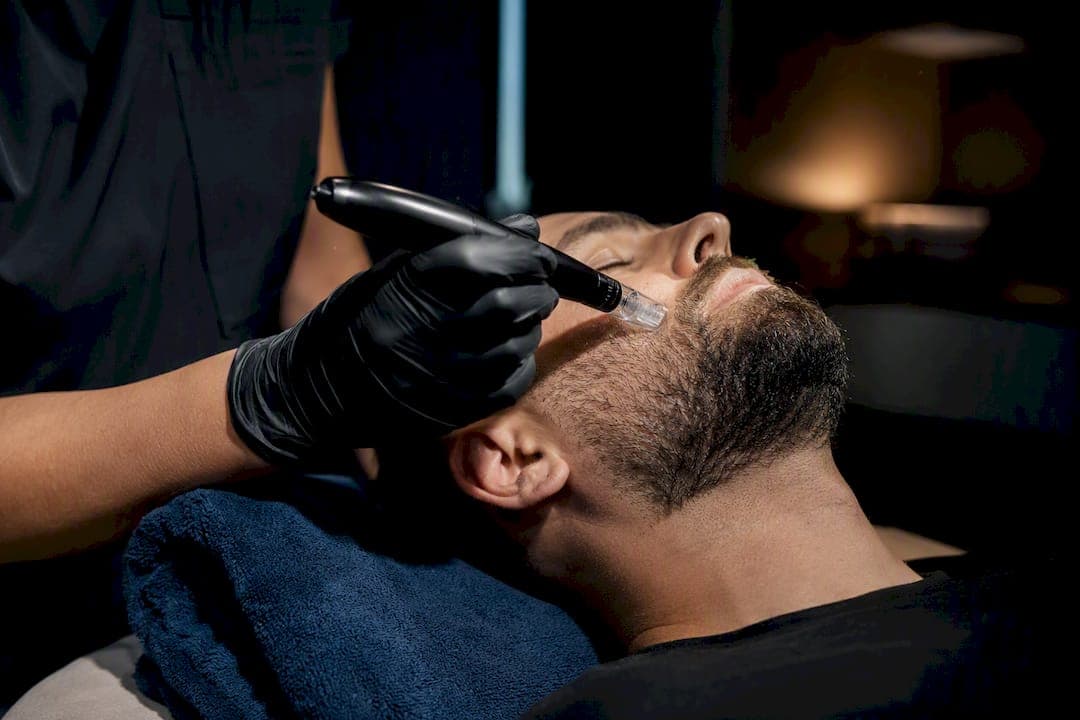
Microneedling can support thicker beard coverage, but treat it as a supporting act, not the headline treatment. The strongest evidence comes from scalp studies, not beards, and works best paired with proven options like minoxidil. One rule matters immediately: never apply minoxidil straight after needling. Wait at least 24 hours and get clinical advice, since using it on facial skin is off-label.
TL;DR:
- Microneedling primarily supports existing hair follicles by increasing blood flow and promoting collagen, but it does not create new hair follicles.
- Combining microneedling with minoxidil can significantly enhance results, provided application is timed at least 24 hours apart to minimize irritation.
- The strongest evidence for microneedling's effectiveness comes from scalp studies; beard-specific data shows promising but limited results.
- Safe home use requires careful needle length selection, sterile technique, and avoiding areas with active skin conditions or broken skin.
- Visible beard improvements typically appear around 12 weeks of consistent treatment, with early signs possible between six and eight weeks.
Table of Contents
- How microneedling might stimulate beard hair growth
- What does the evidence actually show?
- Can you use microneedling and minoxidil together safely?
- What's the safest way to microneedle a beard at home?
- How long before you see beard growth results?
- What are the risks and when should you stop?
- Why professional microneedling delivers more for beard-area care
- Your printable at-home microneedling checklist
- Is microneedling for beard growth worth the effort?
- Considering professional microneedling for your beard?
- Sources
How microneedling might stimulate beard hair growth
A derma roller or stamp works by creating hundreds of tiny punctures in the skin. That controlled injury sets off a repair response: collagen production ramps up, and the body releases growth factors, including PDGF and VEGF, into the tissue around each follicle. Blood flow to the area increases too, which theoretically gives dormant or miniaturised follicles better access to oxygen and nutrients.
The other mechanism worth understanding is absorption. Needling opens microchannels in the skin, so anything applied afterwards, including topical minoxidil, penetrates far more effectively than it would on intact skin. That's precisely why timing matters so much when combining the two.
- Micro-injury triggers collagen synthesis and growth factor release near hair follicles
- Increased local blood flow may support follicle health and activity
- Microchannels boost absorption of topical treatments applied afterwards
- The effect is limited to existing follicles; it cannot generate new ones
Dermatologists are consistent on that last point: microneedling optimises the environment around follicles that already exist. It won't produce hair where there's no follicle at all, which matters if you're dealing with genuinely bald patches rather than patchy or slow-growing areas.
What does the evidence actually show?
The most cited data on microneedling and hair growth comes from the scalp, not the face, and the gap between the two matters.
The key figure: In a 2013 randomised trial, men using weekly microneedling alongside twice-daily 5% minoxidil saw hair density rise significantly more than minoxidil alone over 12 weeks, a difference that suggests needling meaningfully amplified minoxidil's effect.
That trial was conducted on scalp hair loss, so applying it to beards involves a genuine leap of faith. The more directly relevant data comes from a 2026 randomised, placebo-controlled trial, which tested topical 3% minoxidil specifically for facial hair. It found a mean beard density increase over 12 weeks, notably higher than placebo.
- Scalp trial: combined therapy roughly quadrupled density gains versus minoxidil alone
- Beard trial: minoxidil alone produced a clear, measurable density increase over placebo
- No large-scale randomised trial has yet tested microneedling specifically on beard follicles
Put together, the evidence supports microneedling as a plausible booster, particularly alongside minoxidil, but direct beard-specific trials remain thin. Manage your expectations accordingly rather than assuming scalp results will transfer one-for-one.
Can you use microneedling and minoxidil together safely?
Yes, but the order and timing matter more than most guides admit. Because needling increases skin permeability, applying minoxidil too soon after a session pushes more of the active ingredient into the skin than intended, raising the risk of irritation and unwanted systemic absorption, a concern Harvard Health and other absorption studies both flag directly.
- Needle once weekly in the evening, then resume daily minoxidil the following morning, leaving a full 24 hours between the two.
- Alternatively, needle only on a day you skip minoxidil entirely, then return to your normal minoxidil routine the next day.
Pro Tip: Keep a simple calendar note of needling days. It takes ten seconds and stops the common mistake of applying minoxidil the same evening out of habit.
Minoxidil on the face is off-label use. Speak to a pharmacist or clinician before starting, especially if you have any cardiovascular history or sensitive skin.
What's the safest way to microneedle a beard at home?
Needle length is the single biggest safety decision you'll make. DermNet NZ puts 0.25 to 0.5 mm as the appropriate range for home facial use; anything from 1.0 to 1.5 mm belongs in a professional setting only, where sterile technique and depth control reduce the risk of bleeding and scarring.
- Cleanse the beard area thoroughly and let the skin dry completely.
- Roll or stamp with light, even pressure, four to six passes per direction (vertical, horizontal, diagonal).
- Avoid dragging the roller through longer beard hair, since it tugs and pulls rather than needling cleanly. A stamping device suits denser beards better.
- Skip any area with active acne, eczema, or broken skin.
- Sanitise the device before and after use with 70% isopropyl alcohol, then air-dry it
- Replace the roller or stamp head every three months, sooner with heavy use
- Avoid needling if you have a bleeding disorder or have taken isotretinoin within the last six months
Our guide to common microneedling mistakes covers hygiene errors that undo most of the benefit.
How long before you see beard growth results?
Patience matters here more than technique. Early signs, if they appear at all, tend to show up around six to eight weeks, usually when microneedling is paired with an active treatment like minoxidil rather than used alone. More reliable, visible change tends to arrive closer to the 12-week mark or beyond.
Think of 12 weeks as a fair trial period, not a guaranteed finish line. It's roughly the point where both the 2013 scalp trial and the 2026 beard trial measured their results, so it's a sensible benchmark to judge your own progress against.
- Take photos in the same lighting and position every two weeks
- Compare density in specific patches rather than judging the whole beard at once
- If there's genuinely no change by 12 to 16 weeks, reassess with a clinician rather than continuing indefinitely
What are the risks and when should you stop?
Most side effects are mild and short-lived. Expect some redness, mild soreness, and occasionally light pinpoint bleeding, particularly with anything beyond the shortest needle lengths, a pattern Cleveland Clinic documents as typical and self-resolving.
More serious problems are rarer but worth knowing. Overusing the device, needling too frequently, or working over broken skin raises the risk of infection and, with repeated damage, scarring. Applying topical drugs to compromised skin also increases how much of that drug gets absorbed into the bloodstream.
Stop and seek advice if you notice: spreading redness beyond the treated area, pus or discharge, severe or worsening pain, unusual scarring, or any systemic symptoms like fever after applying a topical product.
- Mild redness and swelling that fade within a day or two are expected
- Infection signs, spreading heat, or pus are not, and need medical review
- Scarring risk rises sharply with needle lengths beyond home-use range
Why professional microneedling delivers more for beard-area care
Professional devices give something a home roller simply can't: precise, adjustable depth control paired with sterile, single-use tips. That matters most for patchy areas, more complex skin history, or when you want to combine needling with prescription therapies under supervision.
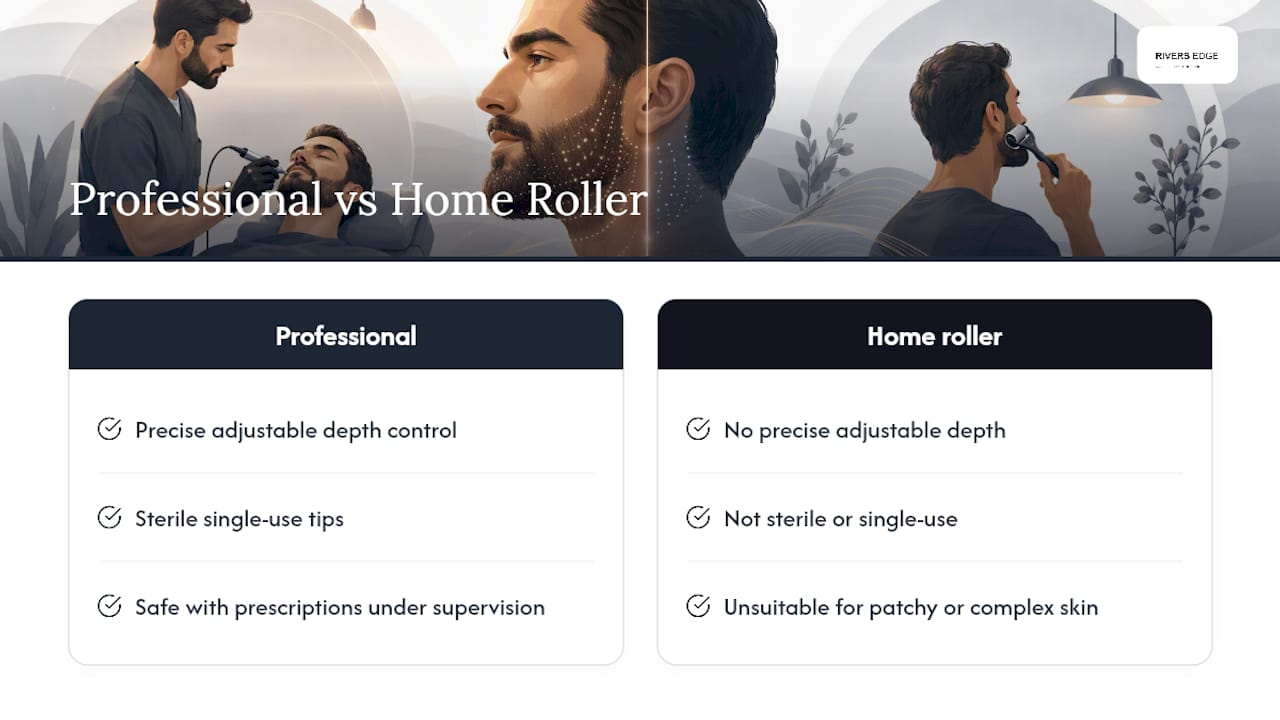
Clinics also use motorised pens that can reach deeper dermal layers safely, sometimes alongside serums or skin boosters, an approach detailed in our step-by-step microneedling guide. For thicker or coarser beards, professional stamping avoids the tugging that home rollers cause on longer hair. There's also a practical side benefit worth knowing: microneedling frequently improves skin texture and reduces razor bumps, which makes beard coverage look fuller even before density genuinely changes.
Your printable at-home microneedling checklist
- Cleanse the beard area and dry it fully.
- Sanitise the roller or stamp with 70% isopropyl alcohol.
- Roll or stamp four to six passes per direction, avoiding tugging on long hairs.
- Stop immediately if you see more than light pinpoint bleeding.
- Wait 24 hours before applying minoxidil or other topicals.
- Take a progress photo in consistent lighting.
- Never share your device with anyone else.
Shorter needles (0.25 mm) suit twice-weekly use; 0.5 mm is better spaced to once weekly, giving skin time to recover between sessions.
Is microneedling for beard growth worth the effort?
The honest judgement, based on where the evidence actually stands, is that microneedling deserves a place in a beard growth routine, but not the starring role most forum threads give it. The scalp data is genuinely strong. The beard-specific data is thin. Conflating the two is the single biggest mistake I see repeated across grooming forums and product marketing alike.
Where conventional advice falls short is in treating microneedling as a standalone fix. It isn't one, and no credible trial claims it is. What the 2026 minoxidil trial actually shows is that the topical drug itself does the heavy lifting on beard density, with needling most plausibly acting as an amplifier rather than a solo act.
If you're going to try this, prioritise the safety rules first, the 24-hour separation from minoxidil, correct needle length, sterile technique, and set your expectation window at 12 weeks rather than two. Men who abandon the routine after three weeks were never going to see anything different regardless of technique. Consistency across a full quarter, done safely, is what actually separates the men who see change from the men who give up early.
— David
Considering professional microneedling for your beard?
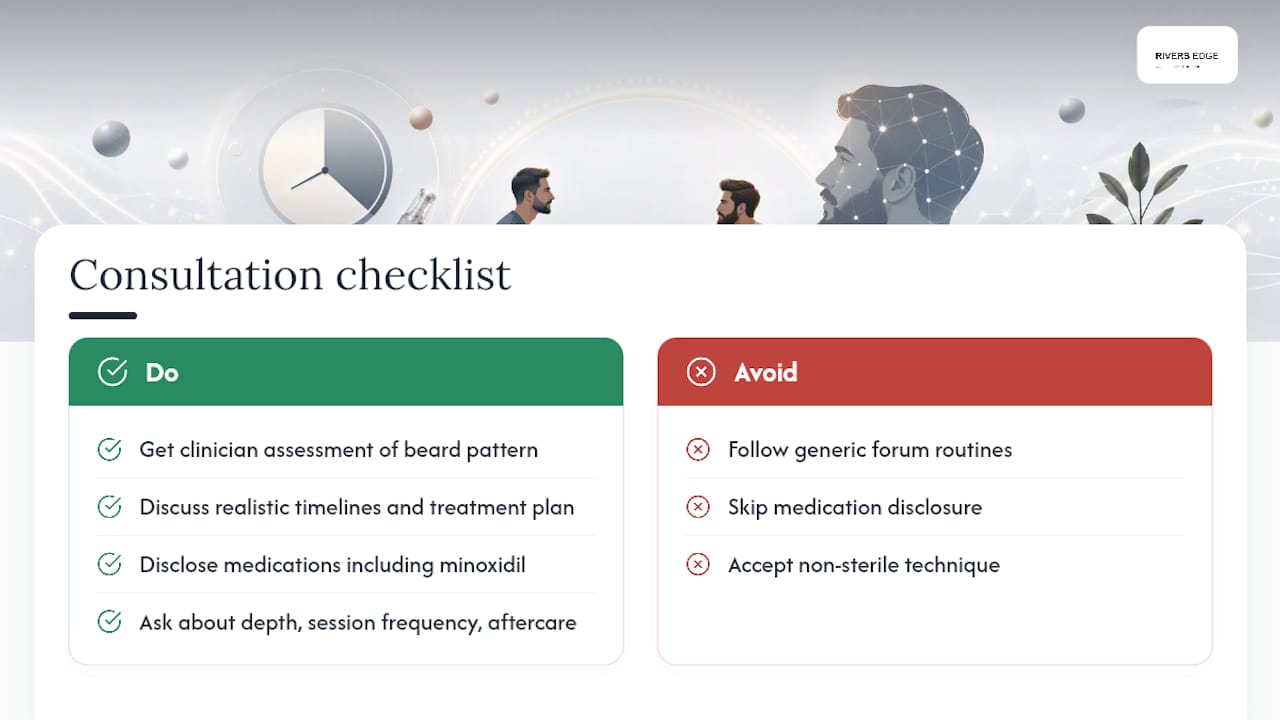
If you'd rather leave the depth control, needle choice, and timing decisions to someone trained for it, consider a professional clinic that uses precise, sterile, clinic-grade technique with a treatment plan tailored to your skin and beard pattern, not a generic routine copied off a forum.

At a consultation, expect a clinician to assess your beard pattern, discuss realistic timelines, and talk through whether combining microneedling with other approaches suits your skin history. It's also worth raising any medication use, including minoxidil, so your plan accounts for timing properly from day one. For broader facial aesthetic context, treatments like those outlined by Ringway Dental reflect the same emphasis on professional safety standards that underpins clinic-based care generally.
Ready to see what a tailored plan looks like for your beard? Book a consultation through Rivers Edge Skin Studio's services page and ask about depth, session frequency, and aftercare specific to your skin.
Sources
For readers who want to check the underlying research: the 2013 scalp microneedling trial established the combination-therapy data; the 2026 minoxidil beard trial provides the direct facial hair evidence; and DermNet NZ and Cleveland Clinic offer reliable technique and safety guidance.
This article is general information, not a substitute for advice from a qualified doctor. Consult a qualified healthcare professional about your own circumstances before acting on anything here.
- A randomized study of microneedling plus minoxidil (2013)
- Randomised trial of topical 3% minoxidil for facial hair enhancement (2026)
- Harvard Health — needling and skin health
- DermNet NZ — skin needling overview
- Cleveland Clinic — microneedling