
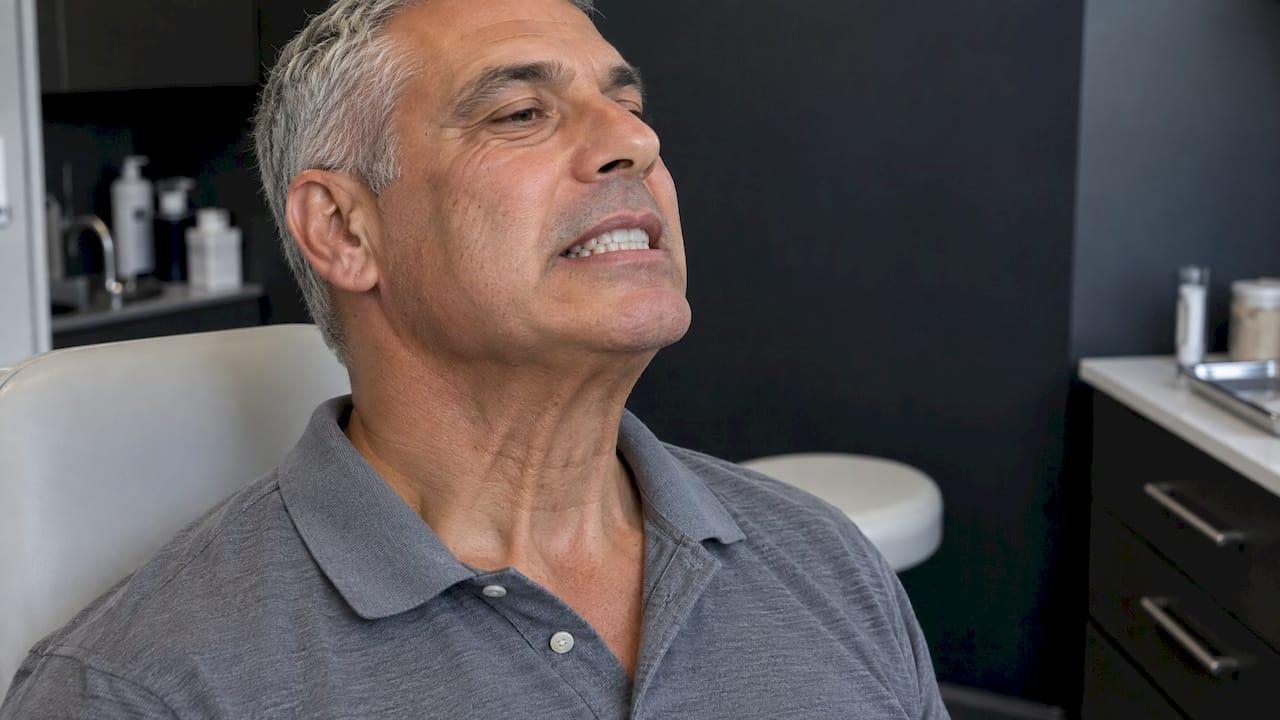
Botox can soften the vertical cords that stand out on a man's neck when he talks, strains or clenches his jaw. It does this by relaxing the platysma muscle that pulls them tight. A related technique, the Nefertiti lift, places a small amount along the jawline to sharpen its outline. Both use the same product in the same muscle, and both are done by trained, prescribing practitioners after a face-to-face assessment. Here is what the treatment does, what it cannot do, how doses are decided for men and what to expect afterwards.
TL;DR
- Neck bands (platysmal bands) are vertical cords of muscle. Botox relaxes the muscle so the cords look softer, but it does not tighten loose skin.
- The Nefertiti lift is a placement pattern along the jawline. It is often done alongside band treatment, and it has a different goal: a cleaner jaw contour.
- Published guidance gives a starting range of 10 to 40 units for men. The right dose depends on your anatomy and is set at a face-to-face consultation.
- In the UK, neck Botox is off-licence use of a prescription-only medicine, so choose a practitioner who is qualified to prescribe.
- Expect results to build over about two weeks and to fade over a few months. A review appointment should be offered.
Table of Contents
- What neck bands are and why men get them
- How Botox works on platysmal bands
- What the Nefertiti lift adds
- How many units do men need?
- What happens at the appointment
- Results: how soon and how long
- What Botox will not do for your neck
- Safety, licensing and when to get help
- Perspective
- Booking in Merseyside
- FAQ
- Sources
What neck bands are and why men get them
The platysma is a thin sheet of muscle that runs from the collarbone area up to the jaw and lower face. At the front edge, two strips of that muscle can become prominent as two vertical cords down either side of the neck. These are platysmal bands.
They tend to show most when you tense your neck, grit your teeth or say "eeee". Many men first notice them in photos, in a shaving mirror or when wearing an open collar.
There is no single cause. Healthline's overview lists age, genetics and muscle activity among the factors. It cites a 2017 study of 25 people with facial palsy on one side. After ten years, 76 percent had visible bands on the side that still moved. The researchers concluded that muscle activity combined with natural ageing produces prominent bands.
For men, a few things make bands more noticeable:
- A leaner neck and jaw, where there is less soft tissue to hide the muscle.
- Frequent jaw clenching or tension in the neck.
- Thinner, sun-damaged skin over the area, which shows the muscle more clearly.
- A shaved or short-trimmed neckline, which leaves nothing to soften the view.
If your concern is horizontal lines rather than vertical cords, that is a different problem with different options. Our guide to neck lines treatment for men covers it.
How Botox works on platysmal bands
Botulinum toxin blocks the signal that tells a muscle to contract. A 2020 academic review of platysma treatment describes it as blocking acetylcholine release at the neuromuscular junction, which leaves the targeted muscle relaxed. When the platysma stops pulling so hard, the cords soften and the neck looks smoother at rest and in movement.
The practitioner injects small amounts at several points along each band. The same review describes 3 to 5 injection sites per band.
This is a muscle treatment. It changes how the bands behave. It does not remove excess skin or fat.
What the Nefertiti lift adds
The name comes from the sculpted jawline associated with the Egyptian queen. The technique was described in 2007 by Dr Phillip Levy in a paper on the Nefertiti lift. He reported on 130 patients using doses of up to 20 units, with very high patient satisfaction and a low rate of side effects. He presented it as a minimally invasive option for people who want to put off surgery.
In practice, the difference comes down to the target:
| Neck band Botox | Nefertiti lift | |
|---|---|---|
| Main target | Vertical cords down the front of the neck | The lower edge of the jaw |
| Main goal | Softer, smoother bands | A crisper jaw contour |
| Same product and muscle? | Yes | Yes |
| Often combined? | Yes, in one session | Yes, in one session |
The Rohrich review gives about 10 units along the mandibular border (the lower edge of the jaw) for the Nefertiti effect. It also stresses injecting no closer than one finger breadth below that border. Going higher risks affecting the muscles used for chewing and the ones that pull the lower lip down. That is a technique point, and a good reason to choose someone who treats this area regularly.
If you want more jaw definition from the muscle at the back of the jaw, that is a separate treatment. See our article on masseter Botox for men.
How many units do men need?
Men usually have larger, stronger muscles than women, so doses are typically higher. The Rohrich review gives a starting dose of 10 to 30 units for women and 10 to 40 units for men. It says a total of 40 to 100 units is used for effective treatment in some cases.
More is not better. A paper by Chen and Cohen in the Journal of Drugs in Dermatology notes that a French multidisciplinary consensus suggested no more than 100 units in total, even for severe bands. Most study authors used no more than 30 to 40 units in one session. The platysma is thin, and toxin can spread to nearby structures. The authors report swallowing difficulty and neck flexor weakness at higher doses.
The practical point for you: a careful practitioner starts conservatively, treats the bands that actually show and reviews the result before adding more. A small first dose with a top-up is a sensible approach for a neck that has not been treated before. Units are only a measure. What matters is where they go and how many your muscles need.

What happens at the appointment
Expect a short, straightforward process.
- Face-to-face consultation. UK professional standards say that prescribing can only follow a face-to-face assessment, not a remote consultation. The practitioner looks at your neck at rest and while you tense it, checks your medical history and discusses what you want.
- Mapping. Bands are marked while you contract the muscle, so the injection points follow your own anatomy.
- Injections. Tiny injections along each band, and along the jaw if a Nefertiti pattern is planned. It takes minutes. Healthline's overview describes the use of Botox in the lower face and neck as relatively painless.
- Aftercare advice. You will be told what to avoid in the first hours, such as heavy exercise and rubbing the area. For the specifics, read what to do in the first 24 hours after Botox.
- Review. UK toxin standards say a follow-up at 2 to 4 weeks must be offered, covering the outcome, any asymmetry and photographs.
Two practical points. Botulinum toxin products are single use, and the same standards say vials should not be shared between patients. And you should not be treated under the influence of alcohol. Our piece on alcohol before Botox for men explains the usual 24-hour guidance and how to limit bruising.
Results: how soon and how long
Botox does not work instantly. Most men see the first change within several days, with the full effect around two weeks.
A systematic review of 78 patients treated with botulinum toxin for platysma bands found a response rate of 93.7 percent after 14 days. At three months the response rate was 86 percent, though the average improvement had reduced from 2.0 points to 1.2 points. That fits what clinics see: the effect is strongest early and fades gradually.

So plan on a few months of benefit, then a repeat if you want to keep the look. Our guide on how long Botox lasts in men covers the typical range and why men sometimes metabolise it faster. Neck bands are not identical to forehead lines, so your own timeline may differ.
One rule from the product information: the interval between treatments should be no shorter than three months. That figure comes from the Azzalure UK prescribing information, and the product is not recommended under 18.
What Botox will not do for your neck
Botox is the right tool for muscle bands. It is not a skin tightener.
If the main issue is loose skin or heavy sagging, the British Association of Aesthetic Plastic Surgeons says facelifts and necklifts are the most effective way to tighten skin of the face and neck. It also notes that injections like Botox can help with wrinkles, which surgery does not change.
A simple way to judge: if you see cords when you tense your neck but the skin is otherwise smooth, bands are the likely cause and Botox is the usual answer. If skin hangs loose even at rest, tell your practitioner so you can discuss the full picture.
For surface texture, fine lines and dull skin on the neck and face, treatments such as chemical peels and microneedling work on the skin itself, and many men pair them with muscle relaxing treatment.
Safety, licensing and when to get help
In the UK, botulinum toxin is a prescription-only medicine. The Joint Council for Cosmetic Practitioners explains that three brands hold a licence (Azzalure, Bocouture and Botox), and that the licences cover specified upper facial areas. Treating the neck is therefore off-licence. Off-licence use must only be performed by practitioners qualified to prescribe. It is a normal, accepted part of aesthetic practice when done properly.
So when you book, ask who will prescribe and who will inject. Choosing a qualified prescriber is the single most useful safety step.
Who should not have it. The MHRA prescribing information lists known hypersensitivity, infection at the injection site, and conditions such as myasthenia gravis, Eaton-Lambert syndrome and amyotrophic lateral sclerosis. Tell your practitioner about any neurological condition or past swallowing problems. The MHRA's July 2026 safety update says risk can be higher with underlying neurological disorders, a history of swallowing difficulty, high doses or unapproved injection sites. It also warns about unlicensed and counterfeit products, which is another reason to treat only with a clinic that sources genuine, prescribed product.
When to seek help. The same MHRA update advises getting medical attention straight away if you have difficulty swallowing, slurred speech, breathing difficulties or muscle weakness. That applies in the days after treatment and up to four weeks later. Call 999 or go to A&E for breathing or swallowing trouble, and tell staff you have had botulinum toxin.
Common side effects. The CPSA standards class neck injection as minimal risk, with mild, temporary symptoms. The systematic review above reported complications in 15.4 percent of patients, with none needing further intervention. Mild bruising, tenderness or a feeling of tightness are the sort of effects to expect, and your practitioner will talk you through them.
Perspective
Men come to us with the same question about their necks: "Can you make it look less stringy without making me look done?" We think that is the right question.
Men's necks are different. The muscle is stronger, the skin is often thicker and the neckline is on show every day. That is why we believe a plan built around a man's own anatomy gives the most natural result, rather than a template borrowed from a women's clinic.
Our approach is simple. We assess you in person, talk through what you want to change and what you would rather leave alone, and plan treatment around that. Where it suits, we combine muscle relaxing treatment with skin treatments so the neck and face look consistent. Natural-looking, visible results are what we aim for.
If you are unsure whether bands, jawline or skin quality is your main issue, that is exactly what a consultation is for.
David
Booking in Merseyside
If you are in Liverpool or elsewhere in Merseyside and want to talk about your neck, we are a men-only skin studio. Our anti-wrinkle injections for men are priced by the number of areas treated: £200 for two areas and £240 for three. We plan treatment around you, and you can ask at your consultation how your neck and jawline fit into that plan.

If you also want to improve skin texture, our single chemical peel costs £60 and a single microneedling facial costs £70. You can see everything we offer on our services page, or read about local anti-wrinkle treatment for men before you book.
FAQ
Does Botox work on neck bands in men?
Yes, for the muscle bands themselves. Botox relaxes the platysma so the cords look softer. In a review of 78 patients, 93.7 percent responded by 14 days. It will not tighten loose skin.
How many units of Botox do men need for neck bands?
Published guidance gives a starting range of 10 to 40 units for men, with a higher total only for stronger or more extensive bands. Researchers advise caution at high doses. Your practitioner sets the amount after assessing your neck in person.
What is a Nefertiti lift for men?
It is a way of placing small doses of Botox along the lower edge of the jaw to give a cleaner outline. Doctors describe it as a technique using about 10 to 20 units, depending on the source. It is often done in the same session as neck band treatment.
How long do results last?
Expect a few months. In the systematic review, the response rate was 86 percent at three months, though the average improvement was smaller than at two weeks. Repeat treatments should be at least three months apart.
Sources
- Platysmal Bands: Causes, Medical Treatment, and Remedies (Healthline)
- Effective Treatment of Platysma Bands with Neurotoxin (PMC)
- The Nefertiti lift: a new technique (Levy, 2007)
- Botulinum Toxin-A Chemical Denervation for Platysmal Bands (Journal of Drugs in Dermatology)
- CPSA overarching principles for consultation
- CPSA toxins standards
- Botulinum Toxin Treatment for Mild to Moderate Platysma Bands (systematic review)
- Azzalure UK prescribing information
- Facelift and Necklift (BAAPS)
- Prescribing unlicensed medicines in cosmetic practice (JCCP)
- MHRA botulinum toxin type A prescribing information
- Updated warnings for botulinum toxin products (MHRA, GOV.UK)