

Two things fix men's neck lines: consistent daily protection and active skincare for prevention and early lines, and clinic-based procedures for lines that are already visible. Sun protection and a well-chosen topical routine slow the process and soften fine texture; they will not remove a deep, established crease or a banded platysma muscle. For that, you need injectables, microneedling, energy devices, or in structural cases, surgery.
Start today with the basics:
- Apply broad-spectrum sunscreen to your neck and chest every morning, not just your face
- Patch-test a lower-strength retinoid and introduce it at night, two to three times a week initially
- Book a clinical consultation if your lines are deep, bunched into visible bands, or paired with loose, crepey skin
Rivers Edge Skin Studio sees this pattern constantly among male clients in Merseyside: years of sun exposure and "tech neck" posture catch up all at once, usually somewhere between the late thirties and fifties. A proper clinical assessment tells you within minutes whether you're dealing with texture (topicals and microneedling territory) or structure (injectables, devices, or surgery).
Key Takeaways
Neck lines in men respond best to a staged approach: daily SPF and topicals for prevention, clinic procedures for visible lines, and surgery only for genuine structural laxity or banding.
| Point | Details |
|---|---|
| Start with sun protection | Apply broad-spectrum sunscreen to neck and chest daily; this is the single most protective daily habit. |
| Match treatment to severity | Mild texture needs topicals, moderate lines need microneedling or filler, banding needs toxin or devices, structural excess needs surgery. |
| Combine modalities for durability | Pairing microneedling with topical maintenance or toxin with devices tends to outlast any single treatment alone. |
| Lifestyle changes extend results | Quitting smoking and correcting posture slow new line formation and help treatments hold longer. |
| Book a clinical assessment | Rivers Edge Skin Studio offers male-focused diagnosis and personalised treatment planning before any procedure begins. |
Table of Contents
- What causes neck lines in men?
- How do you treat neck lines at home?
- Which clinic treatments work best for neck lines?
- When does a neck lift or platysmaplasty make sense?
- What should you ask before booking a clinic?
- Why trust Rivers Edge Skin Studio and author David on this topic
- How do you maintain results after treatment?
- What side effects and risks should men know about?
- Do lifestyle changes actually improve treatment results?
- How long do results last, and what should you budget for?
- What treatment plan fits your severity level?
- Do men's and women's necks age differently?
- Editorial take: what the evidence actually supports
- Get a tailored neck treatment plan at Rivers Edge Skin Studio
- Sources
What causes neck lines in men?
Neck skin ages differently to facial skin because it's built differently. It's thinner, carries fewer oil glands, and has less structural support to begin with, so it shows signs of ageing earlier and more visibly than the face does. Collagen and elastin production drops steadily from your mid-twenties onward, and the neck feels that decline before most other areas.
External factors accelerate the process considerably. Ultraviolet exposure breaks down collagen fibres over years of unprotected exposure, smoking restricts blood flow and starves skin of oxygen, and general pollution exposure adds oxidative stress on top of both. Most men apply SPF to their face and forget the neck entirely, which leaves it under-protected for decades.
Mechanical folding plays a bigger role than most men realise. Looking down at a phone or laptop screen for hours creates repeated creasing along the same horizontal lines, and excessive screen time also reinforces forward head posture, which compounds the folding pattern over months and years. This is sometimes called "tech neck," and it's a genuinely mechanical cause distinct from pure photoageing.
Male anatomy adds its own variables:
- A more prominent platysma muscle, which can form visible vertical bands as it loses tone
- Beard growth patterns, which affect where certain devices and peels can be safely applied
- Typically thicker skin than women's, which changes how quickly topicals penetrate and how devices respond
- Fat distribution around the jawline and submental area, which shapes whether volume or laxity is the dominant issue
Understanding which of these factors is driving your particular lines matters more than any single product recommendation. A crease from years of downward phone use responds differently to treatment than a band caused by muscle activity, and a clinic assessment separates the two quickly.
How do you treat neck lines at home?
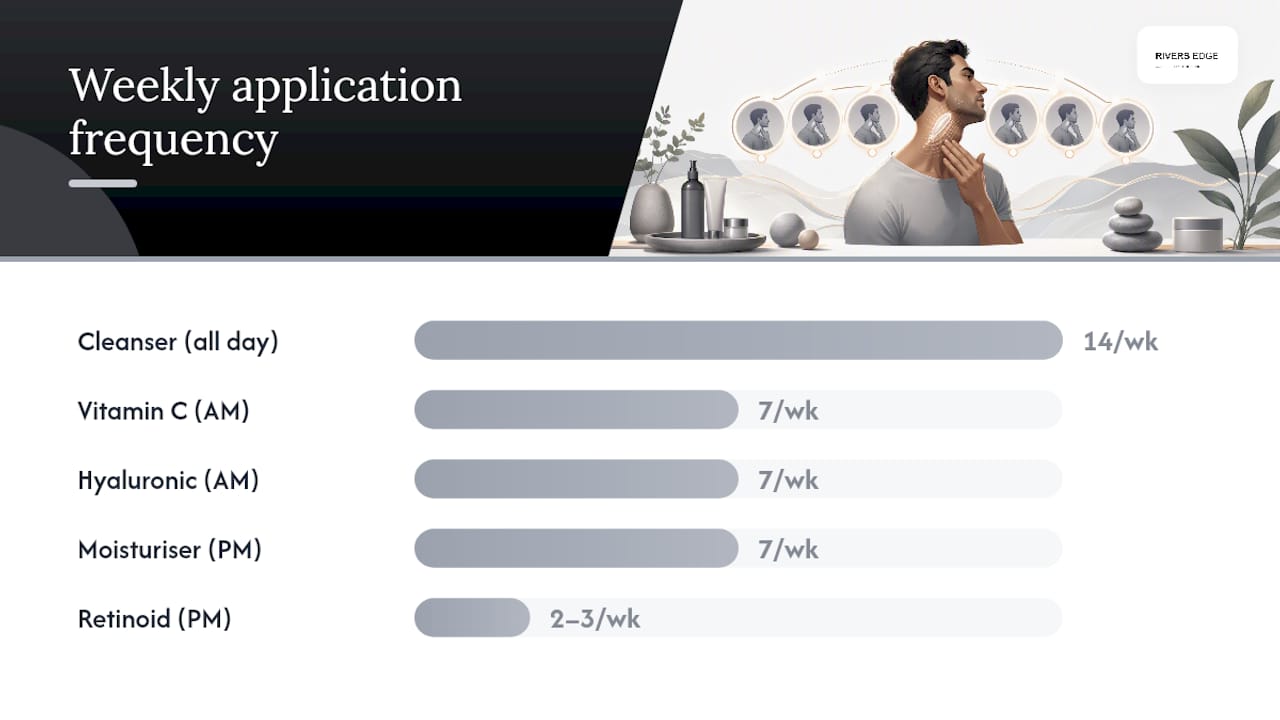
A neck skincare routine only works if you actually run it twice a day, every day, and adjust the strength of actives to match how thin and reactive neck skin actually is. Here's the sequence worth following.
Morning routine:
- Cleanse gently with a non-foaming, fragrance-free cleanser to avoid stripping the thin neck barrier
- Apply a topical vitamin C serum for antioxidant protection and to help manage pigment irregularities
- Layer on a hyaluronic acid serum while skin is still slightly damp, to lock in hydration
- Finish with broad-spectrum sunscreen across the neck and down onto the chest, reapplying if you're outdoors for long periods
Evening routine:
- Cleanse again to remove sweat, sunscreen and pollutants from the day
- Two to three nights a week, apply a lower-strength retinoid than you'd use on your face, since neck skin has fewer oil glands and tolerates actives less well
- Follow immediately with a rich, emollient moisturiser to buffer any irritation
- Increase retinoid frequency gradually over several weeks only if skin shows no redness or flaking
Each ingredient earns its place for a specific reason. Vitamin C works as an antioxidant and supports even pigmentation over time. Hyaluronic acid draws water into the epidermis and gives an almost immediate plumping effect on fine lines, though the result is temporary and needs daily reapplication. Retinoids stimulate collagen turnover more slowly, over weeks rather than days, which is why patience matters more here than with hyaluronic acid.
Pro Tip: Layer thinnest to thickest, and always let each product absorb for sixty seconds before the next. Rushing the layering on neck skin is the fastest way to trigger irritation, because the barrier is thinner than on your face and less forgiving of product build-up.
A few practical notes worth flagging. Avoid alcohol-heavy toners and strong astringents on the neck entirely, since they dry out an area that's already prone to dehydration. Patch-test any new active on a small section of neck skin for several days before applying it broadly. And keep expectations grounded: a consistent routine genuinely improves texture and softens fine lines over roughly 8 to 24 weeks, but it will not touch a deep, established crease or resolve loose, excess skin. Those need clinical intervention.
Which clinic treatments work best for neck lines?
Clinic treatments split cleanly by the problem they solve, and picking the wrong one for your specific issue wastes money and time. Here's how the main options match up against common male neck complaints.
Botulinum toxin works well for dynamic platysmal band activity, the vertical cords that tighten visibly when you clench your jaw or grimace. It relaxes the muscle pull that creates the bands, with effects typically lasting three to four months before a repeat session is needed. It does nothing for loose skin itself, so if excess skin rather than muscle activity is the primary issue, this isn't the right tool.
Hyaluronic acid fillers target horizontal "necklace" lines by restoring lost volume beneath them, which softens the crease from underneath rather than treating the surface. Downtime is minimal, usually a day or two of mild swelling, though durability varies depending on the specific product and how deeply it's placed.
Microneedling, often combined with skin boosters or PRP, creates controlled micro-injuries that trigger the body's own collagen remodelling process. It works best on crepey texture and fine lines rather than deep folds, and typically requires a series of three to six sessions spaced roughly a month apart, with improvement building progressively across the course rather than appearing after one visit.
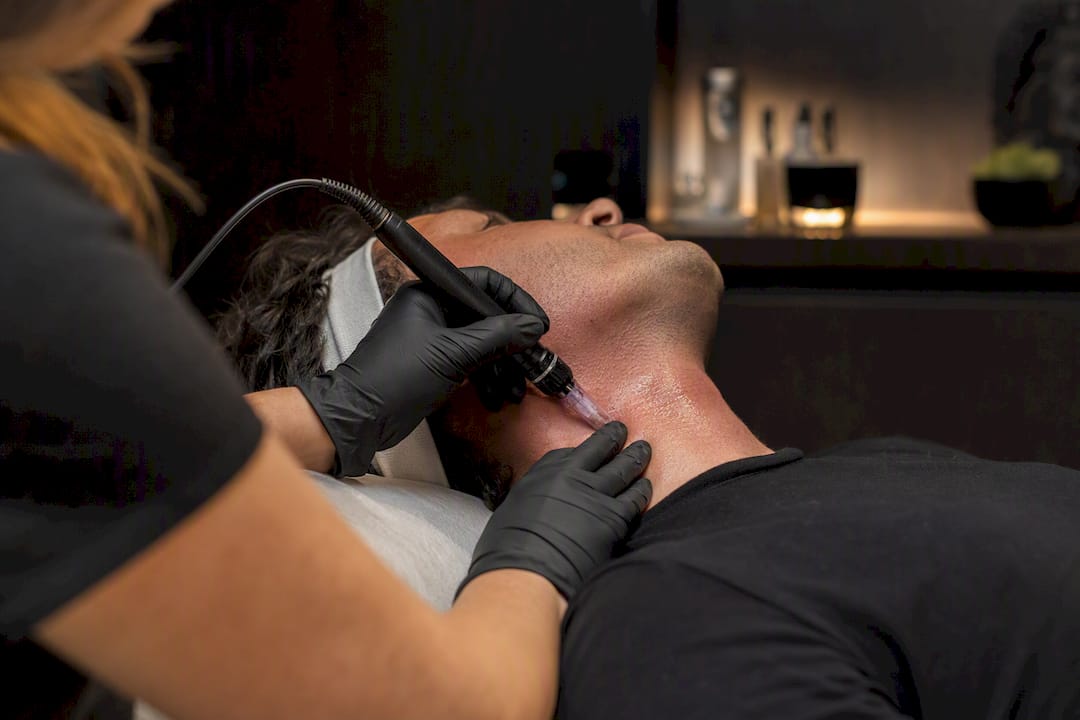
Energy-based devices, including radiofrequency, fractionated RF and ultrasound tightening, deliver modest-to-moderate tightening for early laxity. These tend to suit men who notice their neck skin has started to feel less firm but haven't developed true excess skin yet. Results build gradually over three to six months and usually need maintenance sessions to sustain.
Laser resurfacing and chemical peels improve surface texture and pigmentation, though male skin thickness and beard-bearing areas need careful consideration when planning depth and technique. A peel that works cleanly on facial skin can behave differently across a bearded jawline transitioning into neck skin.
The strongest results tend to come from combining approaches rather than relying on one modality alone. A typical staged plan might pair microneedling sessions with a topical skin booster and ongoing retinoid maintenance at home, which layers a procedural collagen stimulus on top of a daily preventative routine. Our guide to advanced aesthetic treatments for men breaks down how these combinations are typically sequenced in practice.
One caveat applies across every option above: none of these devices or injectables reposition or excise skin. They improve surface quality and address mild-to-moderate laxity, but a platysma muscle that's genuinely separated and banded, or skin that's genuinely excess rather than just lax, needs a different conversation entirely.
When does a neck lift or platysmaplasty make sense?
Surgery becomes the right answer when the problem is structural rather than superficial. True excess skin, marked platysmal banding that persists even at rest, or deep submental fullness that hasn't responded to non-surgical measures are the clearest signals. Nonsurgical options help with early and moderate ageing but can't reliably correct these more advanced structural issues, and no amount of extra microneedling sessions changes that.
The common surgical routes include:
- Neck lift, involving skin excision and often platysmaplasty (muscle tightening) together, addressing both the skin surface and the underlying muscle laxity
- Liposuction for submental fat, useful when a fuller under-chin profile is the dominant concern rather than skin laxity itself
- Combination procedures, sometimes paired with a facelift when jowling and neck laxity occur together
Recovery typically runs one to three weeks before you're comfortable in public, with some residual swelling settling over the following months. Scarring, bleeding and infection are the standard surgical risks to weigh, and male-specific surgical planning pays particular attention to scar placement, since men's shorter hairstyles and often visible neck skin leave less room to hide incision lines than women's typical styling allows. Muscle repair and preserving a defined jaw-to-neck angle are usually priorities in male procedures, aiming for a natural, masculine contour rather than an overly smoothed result.
The trade-off is straightforward: surgical correction is more durable than any injectable or device, but it carries genuine downtime and permanent trade-offs that non-surgical routes don't. For men whose neck concerns combine fat, muscle laxity and skin excess simultaneously, a combined surgical approach, such as liposuction with platysma tightening followed later by resurfacing, often delivers the most balanced result. Our piece on skin laxity treatment for men goes into more detail on where that line between non-surgical and surgical sits.
What should you ask before booking a clinic?
Choosing the right practitioner matters as much as choosing the right treatment. Start by verifying medical registration, confirming genuine facial aesthetic experience specifically, and checking the clinic carries proper indemnity cover.
At consultation, ask directly:
- What's your diagnosis of what's actually causing my specific lines?
- Do you recommend a single treatment or a combination plan, and why?
- How many sessions will this realistically take, and how far apart?
- What's the recovery time, and will it affect my work or social plans?
- What's the likely cost range, and does that include follow-up sessions?
- Are there risks specific to male neck anatomy I should know about?
- What aftercare will I need, and for how long?
Walk away from any clinic promising a "permanent" fix from a non-surgical treatment, since that claim doesn't hold up against how skin actually ages. Be equally wary of pressure to buy treatment packages before any proper assessment has taken place, practitioners who won't confirm their name or credentials, or a lack of written consent and aftercare information.
Pro Tip: Ask to see a portfolio of male before-and-after results specifically, not just female cases. Male neck anatomy, skin thickness and scar visibility behave differently enough that results on female clients don't tell you much about your own likely outcome.
Why trust Rivers Edge Skin Studio and author David on this topic
This guide is written by David, a contributing author at Rivers Edge Skin Studio, a clinic built specifically around men's aesthetic and skincare needs. That specialisation matters here: male neck anatomy, from platysma prominence to beard-area treatment limits, changes how procedures should be planned and delivered.
Rivers Edge Skin Studio's proof points sit in the treatments themselves. The clinic runs male-focused anti-wrinkle injections, microneedling, HydraFacials and chemical peels, backs each with educational content explaining what to expect, and documents real results across its social channels. Our guide on local men's aesthetic treatment covers what a typical consultation looks like in more depth.
The honest recommendation is simple: book an assessment rather than self-diagnosing from photos or forums. A short consultation tells you far more about your specific neck than any generic article can, and costs and downtime get discussed properly once a practitioner has actually looked at your skin.
How do you maintain results after treatment?
Whatever you have done, at-home care afterwards is what stretches the result. After microneedling or peels, skin needs gentle handling for several days: avoid direct sun exposure, skip retinoids and exfoliants until any redness settles, and stick to a bland moisturiser plus mineral SPF until the practitioner clears you to resume actives.
Once healed, the maintenance protocol usually mirrors the prevention routine you should already be running: daily SPF, a morning antioxidant, and a retinoid reintroduced gradually a week or two after any resurfacing procedure. For injectables, there's no special aftercare beyond avoiding intense heat or vigorous exercise for 24 hours, though scheduling your next session before the previous one fully wears off tends to keep results looking more consistent than letting the effect drop away completely between visits.
Device treatments such as radiofrequency or microneedling benefit from a structured maintenance calendar rather than one-off sessions. Most clinics suggest a top-up every four to six months after the initial series, timed to catch collagen turnover before visible regression sets in. Skipping maintenance doesn't undo previous work, but it does let the underlying ageing process catch up faster than if you'd kept a light ongoing schedule.
The single habit that protects every treatment outcome, surgical or non-surgical, is consistent sun protection. Skip it for a summer and you'll likely undo a meaningful portion of whatever collagen gains your microneedling series or retinoid routine achieved.
What side effects and risks should men know about?
Every treatment carries some risk, and a few considerations apply specifically to male anatomy. Retinoids and chemical peels can cause more visible irritation around beard-covered skin, where shaving disrupts the barrier daily, so men who shave regularly often need a gentler introduction pace than the standard advice suggests.
Botulinum toxin around the neck carries a rare but recognised risk of temporary swallowing difficulty if the dose or placement isn't calibrated to the size and strength of a male platysma muscle, which is typically more substantial than a female patient's. This is precisely why practitioner experience with male anatomy specifically matters, rather than experience with neck treatments generally.
Energy-based devices and lasers need adjusted settings for denser male skin, since under-treating wastes money and over-treating on thicker tissue raises burn or scarring risk. Men with contraindications such as active skin infections, certain autoimmune conditions, or those on blood-thinning medication should flag this clearly before any injectable or device session, since it changes both eligibility and technique.
Surgical procedures carry standard risks of bleeding, infection and scarring, with male-specific attention needed on scar placement given typically shorter hairstyles that offer less natural camouflage. Smokers face measurably higher complication rates with any surgical healing, which is one more reason cessation before a procedure is worth taking seriously rather than treating as optional advice.
Do lifestyle changes actually improve treatment results?
Treatment outcomes improve noticeably when paired with lifestyle changes, and the two most impactful are stopping smoking and correcting posture. Smoking restricts blood flow to skin and accelerates collagen breakdown, working directly against whatever a retinoid routine or microneedling series is trying to achieve. Men who quit before starting a treatment plan tend to see results hold longer and heal more predictably after procedures.
Posture correction addresses the mechanical side of the problem directly. Since repeated neck folding from screen use contributes measurably to horizontal line formation, raising your phone and laptop screen to eye level rather than looking down reduces the folding that creates new creases even while existing ones are being treated. This won't reverse lines that already exist, but it slows the rate new ones form.
Diet and hydration play a smaller supporting role. Adequate water intake supports the plumping effect of topical hyaluronic acid, and a diet with sufficient protein supports the collagen synthesis that retinoids and microneedling are trying to stimulate. None of these lifestyle factors alone will fix an established crease or a banded platysma, but combined with active treatment, they meaningfully extend how long results last and how well skin responds to each session.
How long do results last, and what should you budget for?
Durability varies enormously by treatment type, and setting realistic expectations upfront avoids disappointment. Topical routines need daily maintenance indefinitely. Stop the SPF and retinoid habit, and the protective and collagen-stimulating benefits fade within weeks, since there's nothing stored up to draw on.
Botulinum toxin typically lasts three to four months before a repeat session is needed, making it one of the shorter-duration options despite being one of the fastest to show visible change. Hyaluronic acid fillers last longer, often six months to over a year depending on the product and placement, though individual metabolism affects this considerably. Microneedling and device-based series build results progressively across a course of treatments, and the improvement tends to hold for several months to a year with occasional maintenance sessions.
Surgical correction sits at the other end of the durability scale entirely, with results generally lasting years rather than months, since the procedure physically removes excess skin and tightens muscle rather than working on the skin's surface chemistry.
Cost ranges vary by clinic, geography and the complexity of your specific case, so exact figures are best discussed directly during a consultation rather than assumed from a generic price list online. What's worth knowing going in is that combination plans, layering a procedure with ongoing topical maintenance, usually cost more upfront than a single treatment but tend to produce results that last longer and look more natural than any single modality used in isolation.
What treatment plan fits your severity level?
Matching treatment intensity to how advanced your neck lines actually are prevents both under-treating a real problem and over-treating something a simple routine would have fixed.
Mild lines, mostly fine texture with no visible banding: a disciplined daily topical routine, SPF, vitamin C, hyaluronic acid, and a gently introduced retinoid, is often sufficient on its own. Reassess after 12 weeks before considering anything clinical.
Moderate lines, visible horizontal creases or early crepiness that a routine hasn't resolved: microneedling series combined with skin boosters, alongside the same topical maintenance, tends to be the appropriate next step. This is also where hyaluronic acid filler can help if the lines are specifically volume-related rather than textural.
Pronounced lines, visible platysmal banding or noticeable early laxity: botulinum toxin for dynamic bands, paired with energy-based tightening devices, addresses both the muscle and skin-quality components. Expect a staged plan across several months rather than a single visit.
Significant structural change, true excess skin or persistent banding at rest: this is surgical territory. Non-surgical measures at this stage manage maintenance around a surgical outcome rather than replacing the need for one.
Do men's and women's necks age differently?
Yes, and the differences genuinely change which treatments make sense. Male skin is typically thicker than female skin, largely due to higher androgen-driven collagen density, which means men often need higher energy settings on devices and slightly different peel strengths to achieve comparable results.
The platysma muscle tends to be more prominent and muscular in men, making dynamic banding a more common concern than it typically is for women, and shifting botulinum toxin higher up the priority list for male patients specifically. Beard growth adds another layer entirely: treatment zones, laser settings and peel application all need adjusting around hair-bearing skin in ways that simply don't apply to most female patients.
Fat distribution differs too, with men more prone to submental fullness that can mask or exaggerate skin laxity depending on how the two interact. All of this is why treatments genuinely tailored to male skin tend to outperform generic protocols borrowed from female-focused clinics, even when the underlying technology is identical.
Editorial take: what the evidence actually supports
The conventional advice on neck lines splits into two unhelpful camps: skincare brands promising creams will fix everything, and clinics implying every line needs an injectable. Neither is honest. The evidence supports a genuinely staged approach, and most men skip the first stage entirely because it feels too slow to bother with.
What's underrated is how much mechanical folding from posture contributes to new lines forming, separate from ageing itself. Fixing screen height costs nothing and slows new damage while any treatment plan does its work on existing lines.
What's overrated is expecting a single microneedling session or one round of filler to deliver a lasting transformation. Real, durable improvement comes from combining a genuinely consistent topical routine with the right procedural step for your specific severity level, not from chasing the newest device.
If there's one priority worth acting on now, it's getting an honest diagnosis before spending money. A ten-minute assessment tells you whether you're dealing with texture, muscle, or structure, and that distinction should drive every decision that follows.
Get a tailored neck treatment plan at Rivers Edge Skin Studio
If you've read this far, you already know home routines and clinic procedures solve different problems, and guessing which one you need wastes both time and money. Rivers Edge Skin Studio gives Merseyside men a proper diagnostic starting point instead: a clinical assessment that identifies whether your neck lines are textural, muscular or structural, then builds a treatment plan around that answer rather than a generic package.

The clinic runs the full range covered in this guide, from microneedling and skin boosters through to anti-wrinkle injections for platysmal banding, alongside HydraFacials and peels suited to male skin thickness and beard-area considerations. Every plan is personalised rather than templated, and costs, session counts and downtime get discussed openly during your consultation rather than buried in a price list. If your neck lines have moved past what a topical routine can manage, the sensible next step is booking a proper assessment through the Rivers Edge Skin Studio services page, where you can see the full treatment menu and check availability directly.
Sources
- Neck wrinkles? Here’s what can help — Cleveland Clinic
- Fix tech neck: Surgical and nonsurgical treatment options — ASPS
- PMC article on microneedling and skin remodelling
This article is general information, not a substitute for advice from a qualified doctor. Consult a qualified healthcare professional about your own circumstances before acting on anything here.