
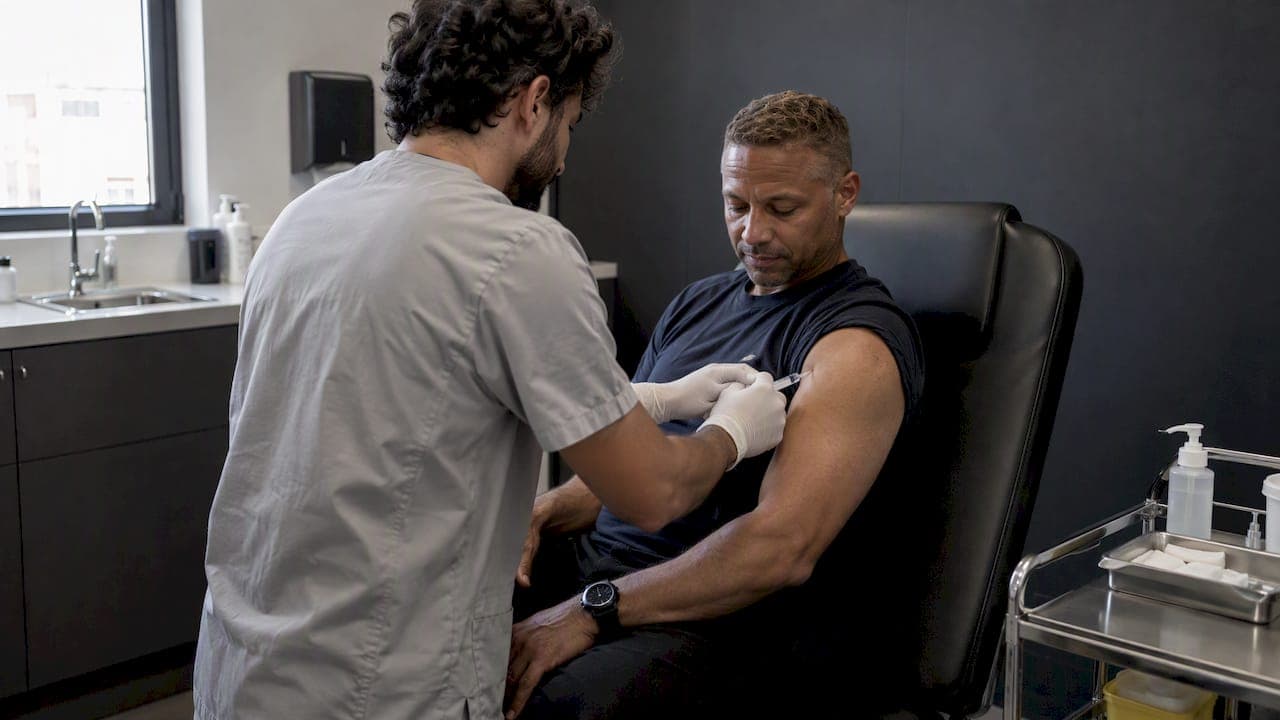
A vitamin C injection delivers the vitamin straight into the body instead of through your gut. Vitamin C plays a well-established part in normal skin health, and that is the reason most men ask about the shot. The honest picture is more specific than the marketing: the nutrient matters for skin, but research does not show that injecting it beats a good diet for people who are not deficient. This guide explains what the injection is, what it may offer your skin and energy, the side effects, who should avoid it and how it fits into a wider men's skincare plan.
TL;DR
- Vitamin C helps maintain healthy skin, protect cells and heal wounds, according to the NHS.
- Most adults can get all the vitamin C they need from a varied diet, so an injection is a personal choice, not a necessity.
- Research on high-dose infusions is limited, and nobody should expect a guaranteed result from a single shot.
- Kidney disease, haemochromatosis and G6PD deficiency are reasons to speak to a doctor before any vitamin C injection.
- At Rivers Edge Skin Studio in Liverpool, a Vitamin C Injection costs £30.
Table of Contents
- What a vitamin C injection actually is
- What vitamin C does for your skin
- What the research says about injections
- Are vitamin C shots different for men?
- Side effects and who should avoid it
- Food first, injection second
- Our perspective
- How a vitamin C injection fits with other treatments
- What to expect at your appointment
- Book a vitamin C injection in Liverpool
- FAQ
- Sources
What a vitamin C injection actually is
Vitamin C is also called ascorbic acid. When you swallow it, your body absorbs only a limited amount, and the rest is lost. Injecting it bypasses that limit. A review of vitamin C pharmacology explains that intravenous delivery avoids the controls that cap oral absorption, and that blood levels can climb to roughly 70 times higher than the highest tolerated oral dose.
That comparison is about intravenous (IV) delivery, where a drip runs into a vein through a cannula. An IV vitamin drip is a saline solution with nutrients, given into the bloodstream. A vitamin C shot is different in format: a small injection, usually into muscle, over in a minute or two with no drip and no chair time. The levels reached by a single shot are not the same as a high-dose infusion, so claims made for infusions should not be borrowed for shots.

It also helps to know the legal position in the UK. Injectable vitamins are not food supplements. GOV.UK guidance defines food supplements as products meant to be eaten, which rules out anything intended to be injected. Licensed injectable vitamins are prescription-only medicines that should be supplied and administered by suitably qualified healthcare professionals, as a 2023 review sets out. So where you get your injection matters as much as whether you get one.
What vitamin C does for your skin
The case for vitamin C and skin starts with what the vitamin does in the body. The NHS says vitamin C helps protect cells, maintain healthy skin, blood vessels, bones and cartilage, and helps wounds heal. Without enough of it, deficiency can lead to scurvy, which shows up in the skin, gums and joints.
That is the foundation behind the benefits clinics describe:
- Collagen support. Collagen is the structural protein that gives skin firmness. Vitamin C is part of normal collagen formation, which is why it comes up in every conversation about ageing skin.
- Skin that looks fresher. Men who feel their skin looks dull, tired or uneven often ask about vitamin C for brightness.
- Healing. Because the vitamin is involved in wound healing, it is relevant to skin that is regularly irritated, for example by daily shaving.
- Cell protection. Vitamin C helps protect cells, which is part of the reason it features in skincare generally.
Note what that list is: the role of vitamin C in the body. It does not prove that an extra injection on top of a healthy diet will visibly change your face. For someone whose levels are already adequate, the extra vitamin may add little, and any visible difference is likely to be subtle. We would rather tell you that before you book than after.
What the research says about injections
Official guidance is cautious, and you should know what it says.
The British National Formulary says vitamins taken as general pick-me-ups are of unproven value, and that vitamins on the NHS are prescribed for specific deficiency states or inadequate diets rather than as dietary supplements. A 2023 peer-reviewed review concluded that high-dose IV vitamin infusions lack high-quality evidence of benefit in people without a specific deficiency or medical condition. The Royal Australian College of General Practitioners says studies have found vitamin C infusions do not seem to give health benefits for any condition.
There is a more nuanced side too. A 2023 meta-analysis in critically ill patients suggested IV vitamin C alone may be linked to lower mortality, though the certainty was low. A 2025 review describes the role of high-dose IV vitamin C in cancer care as supportive and still exploratory, with early studies reporting safety and quality-of-life gains. The National Cancer Institute adds that early results looked promising but the trials lacked rigour. Those are hospital and oncology settings with medical supervision, not a cosmetic appointment, and they are not a reason to expect anything from a skin clinic shot.
In the US, vitamin C injections are FDA-approved for treating vitamin C deficiency and helping to treat serious wounds from burns or trauma, typically when tablets cannot be taken.
The fair summary: vitamin C matters for skin, injection is a way to deliver it, and the evidence for dramatic cosmetic or energy effects from a shot in a healthy adult is limited. Anyone offering guaranteed results is overselling.
Are vitamin C shots different for men?
We could find no research showing that men respond to vitamin C injections differently from other adults, so we will not claim it. What differs is the context in which men ask about them.
Many of the men who come to a men's skin clinic want to look rested without looking "done". They deal with daily shaving, beard care, sun exposure and the skin of a face they have rarely treated. Vitamin C is a familiar name, easy to understand and low commitment, so it is a natural first question. A men's clinic can help you see where it fits among treatments that have a clearer visible effect on texture and tone, such as chemical peels or microneedling.
The NHS figure for adults aged 19 to 64 is 40 mg of vitamin C a day, and the NHS says a varied, balanced diet should provide it. That applies to men and women alike. If your diet is poor, if you smoke, or if you have a medical reason for low levels, it is worth raising with your GP first.
Side effects and who should avoid it
Safe use is the part to read twice.
The RACGP lists common side effects of vitamin C infusions as temporary nausea, vomiting, headache and discomfort at the injection site. Potential risks include kidney stones and worsening kidney function in some people with kidney disease, and red blood cell breakdown in people with G6PD deficiency. The same source says people with kidney disease, haemochromatosis or G6PD deficiency should not have infusions. A 2025 systematic review names oxalate nephropathy and haemolysis in G6PD deficiency as risks and says pre-screening may help avoid them.
BBC reporting quoted UK clinical experts warning that IV treatments can cause infection at the entry site and put stress on the liver and kidneys. That is a reason to choose a clean, professional setting and to accept a proper health check beforehand.
On oral intake, the NHS says that taking more than 1,000 mg a day can cause stomach pain, diarrhoea and flatulence. Keep that in mind if you already take high-dose vitamin C tablets or effervescent drinks.
Sensible precautions before any vitamin C injection:
- Tell the practitioner about any kidney problems, past kidney stones, iron overload (haemochromatosis) or G6PD deficiency. If any applies, speak to your GP or specialist before booking.
- List every medicine and supplement you take, including anything for a long-term condition. If you are having cancer treatment, ask your oncology team first.
- Say if you have had a reaction to an injection before.
- Book with a clinic that takes a medical history and explains the process in plain terms.
- Watch the injection site. Tenderness for a short while is common; spreading redness, heat or fever means you should contact a medical professional.
Food first, injection second
The Department of Health and Social Care advice reflected on the NHS vitamin C page is that you should be able to get all the vitamin C you need from a varied and balanced diet. Citrus fruit, peppers, strawberries, broccoli and potatoes all contribute. For most men, that, plus sensible sun protection and a simple cleanse and moisturise routine, does the heavy lifting for skin health.

An injection is not a substitute for that base. It is an add-on for men who want an extra step and understand what it is. If you are weighing it up against other vitamin options, our guides to vitamin D injections versus tablets, B complex injection benefits and B12 injections for men cover how each differs, and our piece on biotin injections and hair loss explains an important lab-test caution.
Our perspective
We see men every week who want better skin but do not know where to start. Vitamin C is often the first name they mention, because it is familiar and the shot is quick.
Our view is simple. A vitamin C injection is a low-commitment, low-cost way to give your skin and general wellbeing a boost, and we offer it for men who want exactly that. We are clear about what it is: a supportive step, not a miracle, and not a substitute for a good diet or for treatments aimed at specific concerns.
Where it works best is as part of a plan. A man with dull, tired-looking skin might start with a vitamin C shot alongside a facial, then add a chemical peel or microneedling course if he wants a stronger change in texture and tone. A man with fine lines on the forehead may be better served by anti-wrinkle injections. We tailor each plan to the individual, and we talk through your health history first.
Our studio treats only men's skin, so the conversation starts from how your skin behaves, shaving, beard, sun and all, rather than from a generic menu. If a vitamin C injection is not the right first step for you, we will say so.
David
How a vitamin C injection fits with other treatments
Men who want visible change usually combine a few steps over time rather than relying on one. Our guide on combining anti-ageing treatments for men sets out sensible sequencing. In outline:
| Your goal | Where vitamin C injection fits | What else to consider |
|---|---|---|
| Tired, dull-looking skin | A simple supportive add-on | A facial for deeper cleansing |
| Uneven texture or tone | Supportive, not the main treatment | Chemical peel or microneedling course |
| Fine lines and forehead creases | Does not target lines directly | Anti-wrinkle injections |
| Loss of skin quality and hydration | Supportive | Skin boosters (polynucleotides) |
| Hair thinning | Not a hair treatment | Scalp microneedling or scalp polynucleotides |
This table shows our own approach to matching treatments to concerns, not a clinical rule. A consultation will refine it for your skin.
If you want to read more first, skin booster injections: a guide for men explains the polynucleotide option, and what to ask a men's skin clinic gives you a checklist for any appointment.
What to expect at your appointment
A sensible vitamin C injection visit looks like this:
- A conversation first. You talk through your skin concerns, your health, your medicines and what you want from the treatment.
- A clear explanation. The practitioner tells you what the injection can reasonably do and what it cannot.
- The injection itself. It is a small injection and takes a minute or two.
- Aftercare. You are told what to expect at the site and what to do if anything feels wrong.
There is no downtime in the sense of needing to hide your face. A little soreness where the needle went in is the usual extent of it. Because results from a vitamin that supports normal skin function are gradual and subtle, think of the injection as part of a routine, not a one-off fix.
Book a vitamin C injection in Liverpool
Rivers Edge Skin Studio is a men-only skin clinic serving Liverpool and Merseyside. A Vitamin C Injection is £30. If you would like to pair it with a facial, our facials are £35 each, and the full list of treatments and prices is on our services page.

If you are not sure which treatment suits you, book a visit and we will talk it through. We build a personalised plan around your skin and your goals, and we will not recommend what you do not need. Looking after your skin should not be complicated.
For stronger visible changes, you may also like our chemical peels, microneedling and anti-wrinkle injections for men.
FAQ
Do vitamin C injections work for skin?
Vitamin C is involved in normal collagen formation and helps maintain healthy skin, according to the NHS. That is a solid reason it features in skincare. Research on injections for cosmetic results in healthy adults is limited, so expect a supportive, gradual effect and not a dramatic change.
What are the side effects of a vitamin C injection?
Temporary nausea, headache and soreness at the injection site are the commonly reported effects. Rarer risks involve the kidneys and, for people with G6PD deficiency, the blood. Tell your practitioner about kidney disease, haemochromatosis or G6PD deficiency before booking.
Is a vitamin C shot better than taking tablets?
Injection avoids the limit on how much your gut absorbs, so blood levels can rise higher. Whether that gives a noticeable benefit to someone with a normal diet is not established. For many men, food and a good skincare routine cover the basics.
How much does a vitamin C injection cost in Liverpool?
At Rivers Edge Skin Studio, a Vitamin C Injection costs £30. Check the services page for the current price list before you book.
Can I have a vitamin C injection if I take other medicines?
Speak to your GP or the practitioner first and bring a full list of what you take. If you are having chemotherapy or treatment for a long-term condition, ask your specialist team before any injection.
Sources
- NHS: Vitamin C
- BNF: Vitamins treatment summary
- GOV.UK: Food supplements guidance
- Vitamin C: A Concentration-Function Approach
- Harper's Bazaar UK: IV vitamin drips explained
- Intravenous vitamin injections: where is the evidence?
- RACGP: Vitamin C infusions
- Intravenous vitamin C monotherapy in critically ill patients
- Clinical benefits and risks of high-dose intravenous vitamin C
- NCI: Intravenous Vitamin C (PDQ)
- Healthline: Vitamin C injection and IV vitamin C
- BBC News: Is it really worth injecting vitamins?