
The single most effective pseudofolliculitis barbae treatment is stopping shaving altogether, with most men seeing real improvement within 4 to 6 weeks as trapped hairs grow past the skin. If shaving isn't optional, switch technique first, add topical treatment second, and consider long-pulsed 1064 nm Nd:YAG laser for lasting control. See a clinician promptly if you notice spreading pustules, fever, or thickening scars.
TL;DR:
- Stopping shaving entirely typically resolves pseudofolliculitis barbae within four to six weeks as trapped hairs grow past the skin.
- If shaving is necessary, changing technique by shaving with the grain, using single-blade razors, and leaving minimal stubble can significantly reduce flare-ups.
- Long-pulsed 1064 nm Nd:YAG laser treatment is the most proven for long-term control, requiring multiple sessions with lower risks for darker skin tones.
- Topical treatments like retinoids and benzoyl peroxide help manage symptoms, but permanent removal of hair follicles through laser or electrolysis offers the most lasting solution.
- Patient education on sun protection and avoiding picking or digging at ingrown hairs accelerates fading dark marks and reduces scarring risk.
Table of Contents
- Stopping or changing shaving: your first practical steps
- What medicines actually treat razor bumps?
- Which laser treatment works best for razor bumps?
- How do you fade dark marks left by razor bumps?
- How long does pseudofolliculitis barbae take to clear up?
- What a clinic assessment for razor bumps actually involves
- What the research actually tells us about treating razor bumps
- Ready to deal with persistent razor bumps properly?
- Sources
- FAQ
Stopping or changing shaving: your first practical steps
Pseudofolliculitis barbae happens because cut hairs curl back and pierce the skin, triggering a foreign-body inflammatory reaction. Stop the cutting and you stop the cycle. The British Association of Dermatologists is clear on this: cessation of shaving, waxing, or tweezing is the single most effective intervention, with inflammation typically settling over four to six weeks as hairs work their way past the surface.
Growing out your beard isn't always workable, whether for work, personal preference, or simply patience. If that's you, technique changes make a genuine difference:
- Shave with the grain, never against it, even though it feels less thorough.
- Use a single-blade or foil razor rather than multi-blade cartridges, which cut hair below the skin surface and encourage ingrowth.
- Avoid stretching the skin taut while shaving.
- Leave roughly 1mm of stubble rather than aiming for a completely smooth finish.
- Shave every other day instead of daily to give follicles a chance to recover.
When you need a genuinely clean-shaven look for an event or role, professional hairstyling clippers set to leave stubble are gentler than a blade. Chemical depilatory creams are another option, though they carry their own irritation risk, so patch-test on your jawline 48 hours before using them anywhere near sensitive skin.
For flare-ups, warm compresses held against the area for a few minutes loosen trapped hairs and calm redness. Gentle cleansing with a fragrance-free wash and short-term use of 1% hydrocortisone can settle acute inflammation, but this isn't a long-term fix. Whatever you do, don't dig at ingrown hairs with tweezers or fingernails. It's tempting, but it usually worsens inflammation and raises infection risk.

Pro Tip: Keep a small hand mirror in good light before you shave. Spotting curled hairs before you cut near them lets you shave around the worst-affected patches rather than through them.
Our guide on post-shave irritation covers more detail on aftercare routines that pair well with these technique changes.
What medicines actually treat razor bumps?
Medical treatment for pseudofolliculitis barbae works on two fronts: calming existing inflammation and preventing new lesions from forming. Which medicine you need depends on how severe things have become.
- Topical retinoids (tretinoin, adapalene) exfoliate the skin's surface and help prevent the follicular plugging that traps hairs underneath. Most people notice change after several weeks of consistent use, not days.
- Benzoyl peroxide, often combined with topical clindamycin, reduces the papules and pustules that come with secondary bacterial involvement.
- Short courses of topical steroids settle acute flares quickly, but prolonged use thins the skin and can worsen pigmentation changes, a particular concern for darker skin tones. Use them for days, not months.
- Eflornithine, a prescription cream, slows hair regrowth rather than treating inflammation directly. It works best as an adjunct to laser hair reduction rather than a standalone fix, and a PubMed review found combined laser-plus-eflornithine regimens outperform either approach alone, though the effect only holds with continuous use.
- Oral antibiotics, typically doxycycline or minocycline, come into play for moderate to severe inflammatory disease where topical treatment alone isn't controlling things. The Merck Manual notes oral tetracyclines are reserved for these more stubborn cases rather than first-line use.
For deeper, cystic-feeling nodules that don't respond to creams, a clinician may inject a diluted steroid directly into the lesion. This intralesional approach reduces inflammation fast but needs proper training to avoid skin thinning at the injection site, so it's not something to attempt outside a clinical setting.
A peer-reviewed review on current treatment options for pseudofolliculitis barbae makes an important point worth sitting with: topical steroids, retinoids, keratolytics, and antibiotics are genuinely useful adjuncts, but definitive, lasting therapy almost always comes down to removing the hair follicle itself, whether through laser or another depilation method. Creams manage symptoms. They rarely resolve the underlying problem on their own.
Which laser treatment works best for razor bumps?
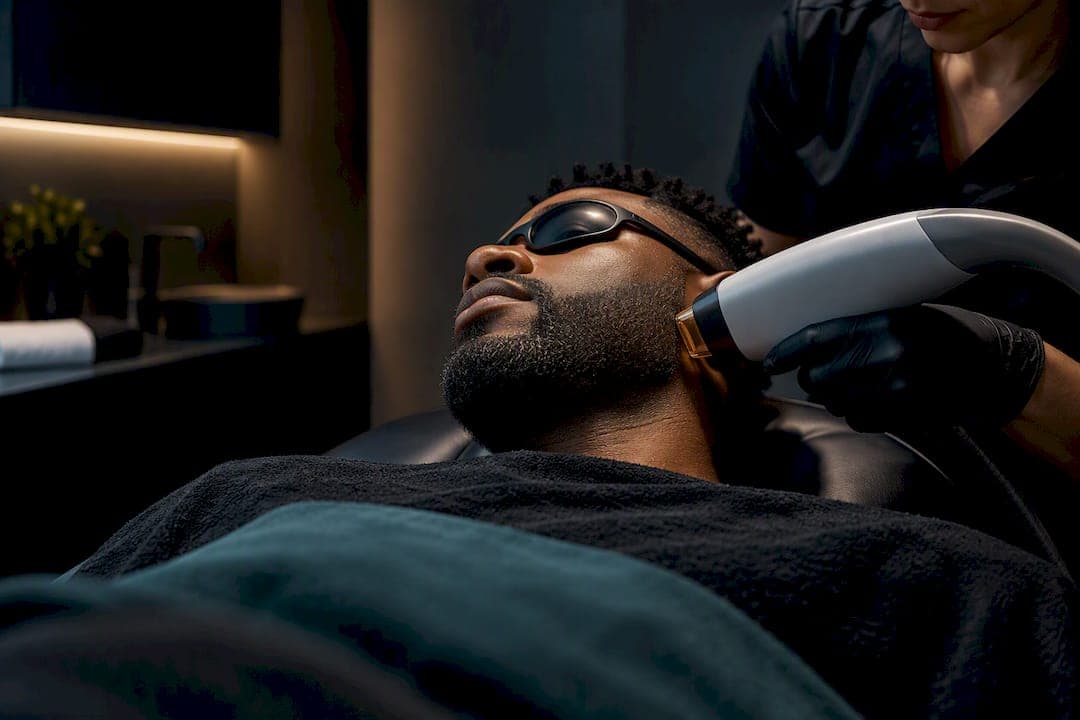
Long-pulsed 1064 nm Nd:YAG laser hair reduction is the clinic-based treatment with the strongest evidence behind it, particularly for men with darker skin tones. The physics matters here: this wavelength penetrates deeper into the follicle while being absorbed less by melanin in the epidermis, which is exactly why it carries lower risk of post-inflammatory hyperpigmentation than shorter-wavelength lasers on Fitzpatrick IV to VI skin.
Most patients need 3 to 7 treatment sessions spaced several weeks apart before seeing durable results. Each session miniaturises more hair follicles, meaning the hairs that do regrow are finer and less prone to curling back into the skin, which is what drives down recurrence over time.
- Chemical peels (glycolic or salicylic acid) reduce hair curvature at the surface and help fade post-inflammatory marks between laser sessions.
- Microneedling improves texture and scarring once active inflammation has settled.
- Electrolysis permanently destroys individual follicles but is slow and impractical for treating a full beard area.
- Surgical excision is reserved for severe, scarred cases that haven't responded to anything else, and it carries its own scarring risk.
A comparative study testing chemical peeling against long-pulsed Nd:YAG laser found the laser produced greater reduction in papules, which supports it as the stronger procedural choice where both are viable options.
Pro Tip: Ask any clinic offering laser hair reduction how many Nd:YAG treatments they perform on darker skin tones specifically. Operator experience with pulse duration and cooling settings matters more than the brand of machine sitting in the room.
Side effects are generally mild when settings are conservative: temporary redness, occasional blistering if settings run too aggressive, and a small risk of pigment change. A test patch before full treatment, particularly for Fitzpatrick IV to VI skin, catches problems before they spread across the whole beard area.
How do you fade dark marks left by razor bumps?
Post-inflammatory hyperpigmentation, the dark marks left behind after bumps heal, responds to a fairly predictable sequence, though patience matters more than any single product.
Daily sun protection is the foundation everything else builds on. UV exposure darkens existing pigment and undoes progress from other treatments, so this isn't optional if you want marks to fade rather than linger for months.
- Azelaic acid is a gentler option for ongoing use and suits sensitive or reactive skin well.
- Hydroquinone, used under medical supervision, remains one of the more effective pigment-lightening agents but needs monitoring for irritation with extended use.
- Chemical peels using glycolic or salicylic acid accelerate cell turnover and even out tone, with visible change typically building over a course of treatments rather than one session.
- Microneedling helps texture and shallow scarring once marks have started fading, though it's not the first tool to reach for while inflammation is still active.
For raised, thickened scars or keloids, intralesional steroid injections are considered, but this needs specialist assessment. Deeper resurfacing procedures carry real risk of worsening pigmentation in darker skin if attempted without proper expertise, so this is one area where a professional consult beats a DIY approach every time. Our chemical peel guide walks through what a typical course involves.
How long does pseudofolliculitis barbae take to clear up?
Timelines vary by treatment, and knowing what to expect prevents you from giving up on something that's actually working.
- Stopping shaving: inflammation generally settles over 4 to 6 weeks as hairs grow past the skin surface. Some men see a brief worsening in the first week or two as trapped hairs work their way out, which is normal rather than a sign of failure.
- Topical medicines: expect 4 to 8 weeks of consistent use before judging whether retinoids or benzoyl peroxide are helping.
- Laser hair reduction: meaningful results build across multiple sessions over several months, not after a single visit.
Lack of response after these windows, rather than slow progress, is what should prompt escalation. Red flags that need prompt medical attention include spreading infection, fever, rapidly enlarging or painful nodules, and any suspicion of keloid scarring. A GP can prescribe oral antibiotics or refer you for dermatology assessment; a dermatology or clinic consult adds the ability to distinguish pseudofolliculitis barbae from true folliculitis, which is usually an infection requiring different treatment entirely, and from conditions such as acne keloidalis, which needs its own management approach.
What a clinic assessment for razor bumps actually involves
A proper assessment starts with history and a close examination, not guesswork. We look at hair growth pattern, shave frequency, and lesion distribution to confirm this is pseudofolliculitis barbae rather than bacterial folliculitis or another follicular condition, since the treatment paths diverge sharply from there. Photographic records at the first visit make it possible to track genuine progress rather than relying on memory.
From there, the pathway is usually staged: conservative shaving advice first, topical prescriptions or GP liaison where inflammation needs medical management, then in-clinic procedures such as peels or microneedling once active flares have settled. Laser hair reduction enters the conversation for men wanting a long-term solution rather than ongoing symptom management.

Before any in-clinic treatment, we ask patients to stop shaving the area for a short period so we can properly assess hair growth and skin condition. A first consultation typically covers your history, a skin examination, and a realistic discussion of which combination of approaches fits your skin tone and lifestyle.
What the research actually tells us about treating razor bumps
Most advice on razor bumps treats laser and creams as competing options, pick one or the other. That framing doesn't hold up against the evidence. The strongest outcomes come from combining approaches: behavioural shaving changes alongside topical retinoids or benzoyl peroxide, short antibiotic courses when inflammation is active, and Nd:YAG laser with or without eflornithine for men who need to stay clean-shaven long term.
Where conventional advice falls shortest is skin tone nuance. Plenty of guidance still treats laser hair reduction as one-size-fits-all, when device selection, pulse duration, and operator experience matter enormously for Fitzpatrick IV to VI skin. Get that wrong and you trade razor bumps for hyperpigmentation, which is arguably harder to treat.
If you take one thing from this, prioritise getting an accurate diagnosis before spending money on treatment. Pseudofolliculitis barbae, true folliculitis, and acne keloidalis all look superficially similar but respond to different interventions entirely. A few minutes of proper assessment save months of treating the wrong condition.
— David
Ready to deal with persistent razor bumps properly?
Home care handles plenty of mild cases, but persistent or scarring pseudofolliculitis barbae usually needs professional input, and that's precisely where Riversedgeskinstudio specialises exclusively in men's skin rather than treating it as an afterthought alongside general dermatology.

A first appointment starts with an honest assessment of your skin and shave history before recommending anything. Depending on what we find, that might mean a Bearded Man Facial at £35 to calm active inflammation and deep-cleanse the area, a course of chemical peels starting at £60 for a single treatment to address post-inflammatory marks, or a microneedling course from £70 to improve texture and scarring once flares have settled. For men considering laser hair reduction, we talk through what a realistic course looks like for your skin tone and hair pattern before you commit to anything.
Courses typically run across several visits rather than one-off fixes, and pricing for each service is set out clearly on our services page before you book. If persistent bumps, dark marks, or scarring have been bothering you for months, book a consultation and get a proper plan rather than another product to try.
This article is general information, not a substitute for advice from a qualified doctor. Consult a qualified healthcare professional about your own circumstances before acting on anything here.
Sources
- Pseudofolliculitis (British Association of Dermatologists patient information)
- Pseudofolliculitis barbae; current treatment options (PMC review)
- Pseudofolliculitis barbae (Merck Manual/ MSD Manual professional)
- Evaluation of efficacy and safety of chemical peeling and long-pulse Nd:YAG laser in treatment of pseudofolliculitis barbae
FAQ
How do you get rid of pseudofolliculitis barbae?
Stopping shaving is the most effective single step, with inflammation typically settling within 4 to 6 weeks. Where that isn't practical, combining shaving technique changes with topical retinoids or benzoyl peroxide, and considering Nd:YAG laser hair reduction for long-term control, gives the most reliable results.
What clears folliculitis fast?
True folliculitis is usually infective and needs different handling from pseudofolliculitis barbae, so getting the diagnosis right matters before treating it. A GP or clinician can distinguish between the two on examination and prescribe antibiotics if infection is confirmed, while warm compresses and gentle cleansing help either condition settle faster in the meantime.
What is the NHS approach to treating folliculitis?
NHS guidance generally starts with conservative measures such as warm compresses and good hygiene, moving to topical or oral antibiotics if there are signs of bacterial infection. For pseudofolliculitis specifically, stopping shaving and adjusting technique are the first recommended steps before medication is considered.
How long does it take for pseudofolliculitis to go away?
Most people see real improvement within four to six weeks of stopping shaving, as trapped hairs work their way past the skin. Topical treatments typically need 4 to 8 weeks of consistent use before judging their effect, while laser hair reduction builds results across multiple sessions over several months.
Does Riversedgeskinstudio offer treatment for razor bumps?
Yes. Riversedgeskinstudio offers the Bearded Man Facial at £35, along with chemical peels and microneedling courses suited to inflammation, texture, and post-inflammatory marks from pseudofolliculitis barbae. Full pricing and booking details sit on the services page.