

What is the role of collagen in men's skin?
Collagen is the structural protein that keeps your skin firm, resilient, and intact. It accounts for roughly 30% of the body's total protein and forms the scaffolding that holds the dermal layers together. Without it, skin loses its ability to bounce back, hold moisture, or resist the visible signs of ageing.
Men's skin has a biological advantage here. Men's skin is thicker than women's, with a denser collagen network supported by testosterone. That means a stronger baseline, but not immunity from decline.
The problem starts earlier than most men expect. Men naturally lose about 1% of dermal collagen production annually starting in their late 20s, contributing to gradual skin ageing. The effects are cumulative and often silent until they are not.
Key functions collagen performs in men's skin:
- Provides structural firmness and prevents sagging
- Maintains skin elasticity alongside elastin
- Supports the skin barrier, reducing moisture loss
- Aids repair after cuts, abrasions, and environmental damage
- Keeps skin texture smooth and even
How collagen decline affects men's skin health
Men's thicker dermis creates a deceptive buffer. Because the collagen network is denser, the visible effects of loss tend to accumulate quietly, then appear more abruptly in the 40s or 50s rather than gradually across decades. By the time deep forehead lines or pronounced nasolabial folds appear, significant degradation has already occurred.
Lifestyle accelerates the process considerably. UV radiation is the single most destructive external force on skin collagen, fragmenting fibres and suppressing new synthesis. Smoking, chronic stress, poor sleep, and diets high in processed sugar all compound the rate of breakdown.
Signs of collagen loss specific to men's skin include:
- Deeper forehead lines and pronounced nasolabial folds
- Reduced skin bounce and firmness along the jawline
- Increased dryness and impaired moisture retention
- Slower healing after cuts or skin irritation
- A generally duller, less even skin tone
One distinction worth understanding: topical collagen creams do not rebuild dermal collagen. Traditional collagen molecules are too large to penetrate the skin and act instead as humectants, drawing in surface moisture. They improve texture temporarily but do not stimulate production at a structural level.
How to support collagen production effectively
The most direct approach combines oral supplementation with topical actives that stimulate your skin's own collagen synthesis. Oral hydrolysed collagen peptides taken consistently for several weeks produce measurable improvements in skin elasticity and hydration. Results are not instant, but they are backed by clinical evidence.
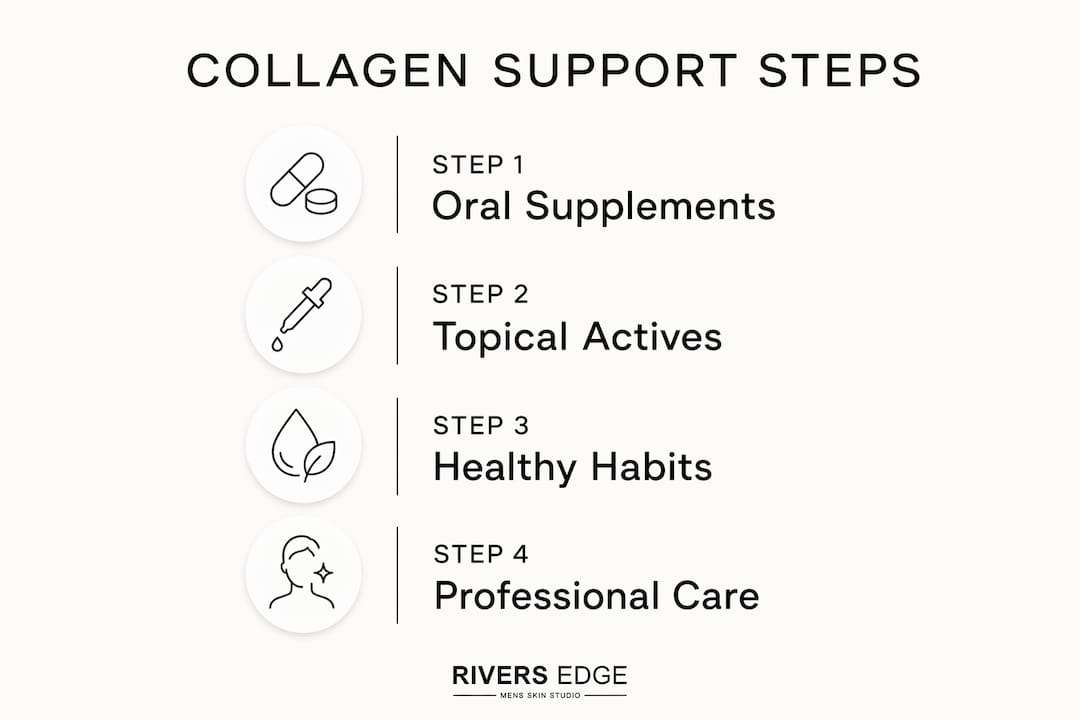
On the topical side, the ingredients that genuinely move the needle are retinol, vitamin C, AHAs, and peptides. Retinol speeds up cell turnover and stimulates fibroblasts, the cells responsible for producing collagen. Vitamin C is an essential co-factor in collagen synthesis and also protects against free radical damage. AHAs such as glycolic acid encourage new cell growth and support collagen renewal. Peptides signal the skin to produce more collagen at a cellular level. For guidance on combining these actives effectively, a structured approach matters more than layering products at random.
Pro Tip: Keep your routine to three or four products maximum. Men who use fewer, multifunctional products are more likely to stick with them consistently, and consistency is what produces results.
Practical collagen-supporting habits:
- Apply broad-spectrum SPF daily. UV exposure degrades collagen faster than any other external factor.
- Reduce sugar intake. High-glycaemic diets accelerate collagen breakdown through a process called glycation.
- Stop smoking. Smoking directly suppresses collagen synthesis and impairs skin repair.
- Prioritise sleep. Collagen production peaks during cellular repair at night.
- Pair oral collagen with 500mg of vitamin C to support synthesis.
Stimulating collagen production through daily habits and the right topical ingredients is where most men see the clearest long-term gains.
Expert perspective from Riversedgeskinstudio on men's collagen care

At Riversedgeskinstudio, the approach to collagen care is built around male skin biology, not adapted from generic protocols. Men's skin responds differently to treatment, and the clinic's regimens reflect that. Male patients respond better to performance-focused language and simplified, multifunctional routines than to complex multi-step programmes, and that philosophy shapes every treatment plan.
Treatments such as microneedling create controlled micro-injuries that trigger the skin's natural collagen repair response, producing measurable improvements in firmness and texture over a course of sessions. Chemical peels remove the surface layer of skin and stimulate collagen renewal in the deeper dermis. HydraFacials support skin barrier function and hydration, complementing collagen-focused treatments rather than replacing them.
Collagen care for men is not about cosmetic vanity. It is about maintaining the structural integrity of your skin so it continues to perform, protect, and look the part, whether you are 30 or 55.
Riversedgeskinstudio also offers scalp microneedling and wellness injections for men dealing with hair thinning alongside skin concerns, recognising that collagen's role in hair follicle support and scalp health is part of the same picture. Every treatment plan is personalised, built around your skin's current condition and your goals.
Collagen's role beyond skin in active men
Collagen is not only a skin protein. It is essential for joint comfort, tendon strength, and muscle recovery in physically active men. Tendons, ligaments, and cartilage are all primarily collagen-based structures, and their resilience depends on adequate collagen turnover.
For men who train regularly, this matters practically. Collagen peptide supplementation supports tendon resilience and may reduce joint discomfort, particularly relevant for men over 30 whose connective tissue recovery slows alongside skin collagen decline. The combined effects of whey protein and collagen supplementation in resistance-trained men have shown superior improvements in muscle mass and strength compared to either supplement alone, suggesting the two work best together rather than as alternatives.
Systemic benefits and best practices for active men:
- Take collagen peptides within an hour of training to support connective tissue repair
- Combine with whey protein for muscle and structural support
- Expect joint stiffness improvements at 8–12 weeks, tendon changes at 12 weeks or beyond
- Type I and III collagen (bovine source) covers skin, tendons, and ligaments
- Type II collagen is the dominant cartilage type, relevant for men prioritising joint health
Which collagen types matter most for men's skin?
Not all collagen is the same, and the type you supplement with affects what you get from it.
| Collagen type | Found in | Relevance for men |
|---|---|---|
| Type I | Skin, tendons, bone | Primary skin collagen; provides firmness and structure |
| Type III | Skin, blood vessels | Supports elasticity and wound healing |
| Type II | Cartilage | Joint health; less relevant for skin specifically |
For most men focused on skin health, Types I and III from a bovine or marine source cover the primary goals. Bovine collagen is the most studied and cost-effective option. Marine collagen offers higher bioavailability due to smaller peptide size and suits men avoiding bovine sources. Men over 40 or those with active joint concerns benefit from multi-collagen blends that include Type II alongside Types I and III.
What does collagen loss actually look like on men's skin?
The signs are structural rather than superficial. Men tend to develop deep forehead lines, pronounced nasolabial folds, and changes in jawline definition rather than the fine surface lines that appear earlier in women. Skin loses its ability to spring back after being pressed or stretched. Dryness becomes more persistent because the barrier function weakens as collagen thins. Healing slows noticeably after shaving irritation or minor cuts.
The cumulative nature of the decline is what catches most men off guard. Because men's denser collagen network absorbs the early losses without obvious symptoms, the visible change can feel sudden, even though the degradation has been building for years. Starting a premature ageing prevention routine before the signs appear is consistently more effective than trying to reverse established damage.
What does the clinical evidence say?
The evidence base for collagen supplementation has strengthened considerably in recent years. A 2023 meta-analysis of 26 randomised controlled trials involving over 1,700 participants found that oral hydrolysed collagen supplementation significantly improved skin hydration and elasticity compared to placebo. A separate 2024 meta-analysis of 23 RCTs with nearly 1,500 participants confirmed improvements in hydration, elasticity, and wrinkle reduction.
Topical actives also carry strong clinical backing. Retinoids remain among the most studied and effective topical treatments for stimulating collagen in ageing skin. Oral collagen supplementation improves skin elasticity and hydration most effectively when combined with sun protection, reduced sugar intake, and collagen-stimulating topical ingredients. The combination approach consistently outperforms any single intervention. For a structured view of men's skincare essentials grounded in this evidence, a clear routine framework helps translate the research into daily practice.
Riversedgeskinstudio: specialist skin treatments for men
Men who want results beyond what a home routine can deliver have a clear next step.

Riversedgeskinstudio is a specialist men's skin clinic offering advanced treatments designed specifically for male skin biology. From microneedling and chemical peels to HydraFacials and anti-wrinkle injections, every procedure is chosen and delivered with male skin's thicker dermis and distinct ageing patterns in mind. There are no generic protocols here. Treatment plans are built around your skin's current condition, your lifestyle, and what you actually want to achieve. Book your consultation at Riversedgeskinstudio's treatments page and get a clear, personalised plan from a clinic that specialises in exactly this.
Key takeaways
Collagen is the structural foundation of men's skin, and supporting it consistently through the right combination of supplementation, topical actives, and lifestyle habits produces measurable results.
| Point | Details |
|---|---|
| Collagen decline starts early | Men lose roughly 1% of natural collagen production annually from their late 20s. |
| Men's skin ages differently | A denser collagen network means visible ageing often appears suddenly in the 40s or 50s. |
| Topical collagen has limits | Collagen molecules cannot penetrate the dermis; retinol, vitamin C, and AHAs stimulate actual production. |
| Supplementation works with time | Oral hydrolysed collagen at 10g daily shows measurable skin benefits after 8–12 weeks of consistent use. |
| Riversedgeskinstudio | Offers personalised, male-specific treatments including microneedling and chemical peels to support collagen renewal. |