
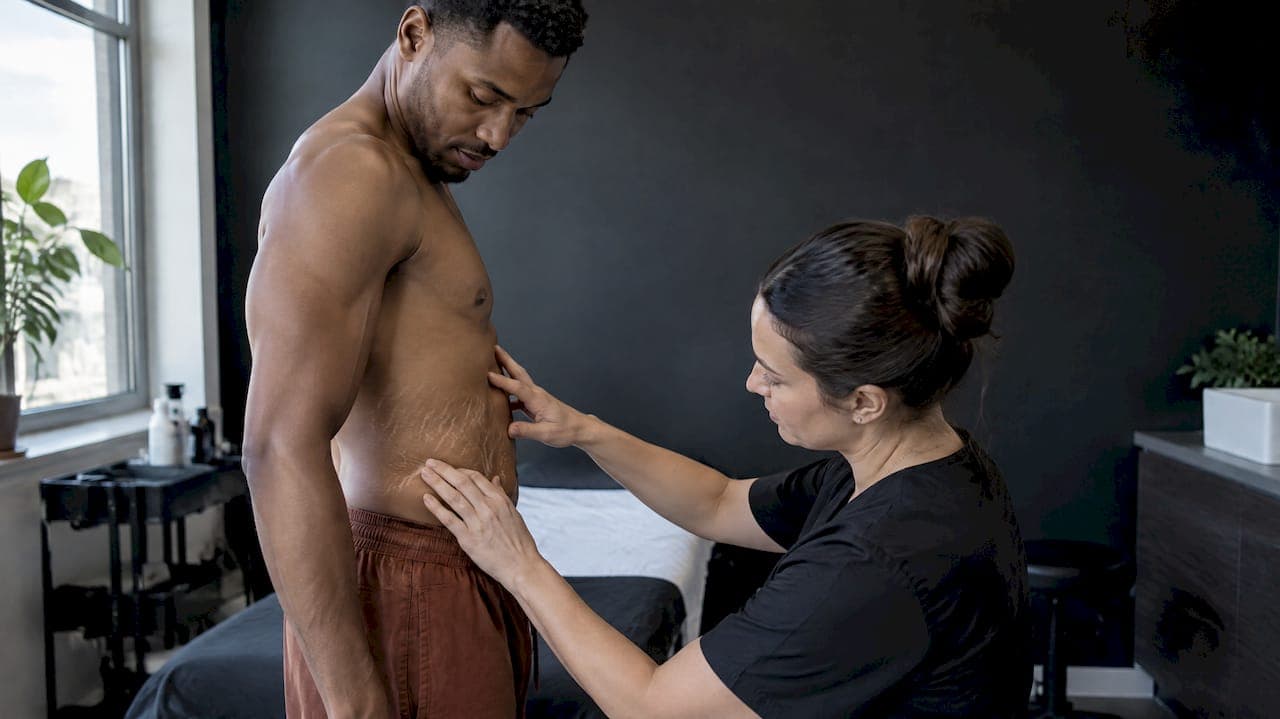
Stretch marks in men are common, harmless and usually fade by themselves. Treatment can make them less noticeable, but no creams, lasers or injections remove them completely. The best results come from treating them early, setting honest expectations and ruling out a medical cause first. This guide covers what causes them in men, what the evidence supports, what is a waste of money and when to see a GP.
TL;DR
- Stretch marks are scars in the deeper layer of skin. The NHS says they are harmless and often become less visible over time.
- Men most often get them from growth spurts, fast weight change, or rapid muscle gain from lifting. Long-term steroid use can also cause them.
- No treatment gets rid of them. Creams have very little evidence behind them, and procedures such as microneedling may improve how they look.
- Early, red or purple marks respond better than old white ones.
- See a GP if large stretch marks come with weight gain around the middle, a rounded red face or easy bruising.
Table of Contents
- Why men get stretch marks
- Can you get rid of stretch marks completely?
- What does not work
- What may help
- Can you treat 20-year-old stretch marks?
- Can sperm remove stretch marks?
- When to see a GP
- Our perspective at Rivers Edge
- Microneedling at our Liverpool studio
- Prevention: what you can control
- Related reading
- FAQ
- Sources
Why men get stretch marks
Skin has a stretchy framework of collagen and elastin in its deeper layer. When the body changes size faster than that framework can keep up, the fibres tear. The American Academy of Dermatology explains that rapid stretching or shrinking can rupture collagen and elastin. The skin on top stays intact, which is why the damage shows as streaks rather than open wounds.
For men, the usual triggers are:
- Puberty and growth spurts. The Primary Care Dermatology Society (PCDS) lists adolescence, obesity and bodybuilding as the usual causes. It names the lower back as a characteristic site in boys.
- Rapid muscle gain. Heavy training with a quick increase in size is a classic cause. PCDS names the shoulders as the typical site in bodybuilders.
- Weight gain or loss. The NHS lists rapid weight gain or loss and being overweight among the causes.
- Steroids. Some steroid creams or tablets can cause stretch marks. The British Association of Dermatologists warns that prolonged or potent topical corticosteroids can thin the skin and cause bruising and stretch marks, so they should only be used as a professional has instructed.
- A medical condition. Rarely, Cushing's syndrome is behind them. More on that below.
Where they appear
The NHS names the tummy, chest, upper arms, legs, bottom, hips and back as common sites. In men that often means the lower back, outer thighs, shoulders, upper arms, chest and the sides of the waist.
What they look like over time
New marks are usually pink, red, purple or brown, and they often look slightly raised or itchy. The NHS notes they tend to start darker before fading. Over several years they become paler, flatter and closer to skin colour. These older marks are called striae alba, and they are the hardest to improve.
Can you get rid of stretch marks completely?
No. The NHS is direct on this: stretch marks usually fade but may not disappear completely, and treatments will not get rid of them. The AAD describes them as behaving like scars. Procedures and prescription products can make them less noticeable but cannot reliably erase them.
The research is also modest. A systematic review of striae treatments found that no treatment was completely effective. It also noted low-quality evidence, small samples and varied methods. PCDS goes further and says there is no evidence that any treatment is effective, although appearance generally improves over time.
That is useful when you are weighing up what to spend. A good clinic will tell you the same thing at the first consultation. Be wary of anyone who promises the marks will vanish. The Advertising Standards Authority says marketers must not claim that lasers remove stretch marks. Evidence can support "improvement in appearance" only, and only where it exists for that specific treatment.

What does not work
Much of the money men spend on stretch marks goes on products with no evidence behind them.
- Oils and butters. The AAD reports that studies of almond oil, cocoa butter, olive oil and vitamin E massaged into stretch marks found they did not make the marks fade.
- Moisturisers. The ASA says moisturisers may make skin feel smoother and more supple. It adds there is insufficient evidence they prevent or remove stretch marks.
- Tanning. The AAD says tanning does not remove stretch marks and can make them more noticeable. Pale scars next to tanned skin stand out more.
- Creams in general. The NHS says creams and lotions have very little evidence of working.
A good moisturiser still has a place. It keeps skin comfortable while it is stretching, and a daily routine is easy to stick to. Just don't expect it to change the marks themselves. If you want to build a prevention habit around a natural balm, a guide to tallow balm and stretch mark prevention covers the factors linked to stretch marks, including healthy weight and rapid muscle growth. It also makes the point that prevention is not always possible.
What may help
Here is how the main options compare. The evidence is limited for all of them, so treat the table as a guide to likelihood, not a promise.
| Option | Best for | What to expect |
|---|---|---|
| Tretinoin (a retinoid cream, on prescription) | New, red or purple marks | May help early marks. Not for use in pregnancy, so not for a partner borrowing your tube |
| Hyaluronic acid cream | New marks | The NHS lists it alongside tretinoin as possibly helpful for new marks |
| Microneedling | Early and older marks | Gradual improvement over months, usually in a course |
| Light or laser treatments | Marks that bother you enough to pay for a procedure | May improve appearance, will not remove the marks |
| Microdermabrasion | Surface texture | May improve appearance, with modest effect |
| Skin camouflage | Any mark you want hidden today | Conceals rather than treats |
Prescription creams for new marks
The NHS says retinoid creams (often called tretinoin) or hyaluronic acid may help if used on new stretch marks. The AAD agrees that topical treatment is more likely to help early marks than mature ones. When results do appear, products generally need gentle massage and daily use for weeks. If the marks are already pale and years old, a cream is unlikely to do much.
Ask a GP or a qualified prescriber before starting a retinoid. It can irritate skin, and it is not suitable for everyone.
Microneedling
Microneedling uses very fine needles to create tiny controlled injuries in the skin. The aim is to prompt the skin to rebuild collagen. A comparative study of microneedling for striae reported progressive improvement in both early (rubrae) and older (albae) marks, continuing between three and six months after treatment. Early marks improved more overall. That study was small, and the review above reminds us that the whole field has limited evidence, but it matches what clinics see: earlier is better, and patience is needed.
A few practical points:
- Expect a course, not a single session.
- Improvement is gradual. Judge results over months, not days.
- Photos taken in the same light before you start give you a fair comparison.
- Sun protection matters during the course, and pausing treatment if your skin is irritated or broken.
Lasers, light and microdermabrasion
The NHS says light or laser treatments or microdermabrasion may improve the appearance of stretch marks, but they will not get rid of them. These are usually the most expensive routes. They suit someone who has read the evidence, accepts a partial result and wants to go further than creams.
Skin camouflage
If the aim is simply to stop noticing the marks on holiday or in the gym, specialist camouflage works from day one. The British Association of Dermatologists says skin camouflage can conceal scars, marks and discolouration, including stretch marks. It should be removed daily without aggressive scrubbing.
Can you treat 20-year-old stretch marks?
You can try, but set the bar low. After years, marks are pale, flat and scar-like, and the skin has little left to respond to. The AAD's advice is that treatment works best on early marks. The microneedling study above found older marks did improve, just less than early ones. Realistically, an old mark may look slightly smoother and less obvious, not gone.
If your marks are old and you want to try something, a sensible order is:
- Decide what bothers you most: colour, texture or visibility.
- Book a consultation with a qualified practitioner and ask what they would expect for marks of that age.
- Start with the lowest-risk option, then review before committing to a full course.
- Keep your expectations to "less noticeable".
Can sperm remove stretch marks?
No. This is an internet myth. None of the dermatology guidance used for this article lists it as a treatment, and there is no evidence behind it. Skip it, and use the options above.
When to see a GP
Most stretch marks need no medical attention. The NHS says to see a GP if you have large stretch marks together with more fat on your chest and tummy but slim arms and legs, a build-up of fat on the back of your neck and shoulders, or a red, puffy, rounded face. These can be symptoms of Cushing's syndrome. The NHS also lists easy bruising and muscle weakness among its signs.
Also speak to a GP if you use steroid creams for a long time, and the marks are appearing in the areas you apply them. Don't stop a prescribed treatment without advice.
Our perspective at Rivers Edge
We see men who are bothered by marks on their skin and who want a straight answer. Ours is this: we won't promise to remove stretch marks, because nobody honestly can. What we can do is look at your skin, explain what is realistic and build a plan around it.

We specialise exclusively in men's skin, so we plan treatments around how male skin behaves: typically thicker, oilier, often with beard or body hair to work around. Microneedling is one of the core treatments we offer, and our approach is a short, honest conversation first. If the marks are new and red, there may be more to gain from acting early. If they are old and pale, we will say so. If anything about them suggests a medical cause, we will send you to your GP before any cosmetic treatment.
We would rather you spend £70 on a considered session than hundreds on a product that was never going to work.
— David
Microneedling at our Liverpool studio
Our microneedling for men in Liverpool is priced simply. A single facial microneedling treatment is £70, a course of 2 is £100 and a course of 4 is £200, as listed on our services page. Chemical peels are £60 for a single treatment, £100 for a course of 2 and £200 for a course of 4. Many men pair these with our other skin treatments.
If you want to talk through your skin first, you can book an appointment at the studio. After any treatment, our guide to skin treatment aftercare in Merseyside explains what to do in the first days.
Prevention: what you can control
Prevention is not always possible. The NHS says maintaining a healthy weight may reduce the chance of stretch marks. A few habits help in practice:
- Gain or lose weight gradually. Slow change gives skin time to adapt.
- Build muscle progressively. Very fast size gains are a known trigger in lifters.
- Moisturise regularly. It won't prevent marks on its own, but it keeps skin comfortable.
- Use steroid creams only as directed. Ask your prescriber about the weakest strength that works and the shortest course.
- Treat new marks early. If you spot red or purple lines forming, see a pharmacist or GP promptly rather than waiting for them to fade to white.
Related reading
Stretch marks are one part of how men's skin changes over time. These guides go further:
FAQ
How do guys get rid of stretch marks?
They can't be removed completely, but they can be made less noticeable. Tretinoin or hyaluronic acid may help new marks, while microneedling, laser or light treatments may improve the look of older ones. Give any treatment months, not weeks, and expect improvement rather than erasure.
Can you 100% get rid of stretch marks?
No. The NHS says stretch marks usually fade but may not disappear completely, and treatments will not get rid of them. Dermatologists compare them to scars. Anyone promising total removal is overselling.
Do stretch mark creams work for men?
Mostly not. The NHS says creams and lotions have very little evidence of working, and the ASA says there is insufficient evidence that moisturisers prevent or remove them. Tretinoin or hyaluronic acid may help new marks, so ask a GP or pharmacist before buying anything expensive.
Why do bodybuilders and gym-goers get them?
Fast muscle growth stretches the skin quicker than collagen can adapt, particularly across the shoulders, chest and upper arms. The AAD lists rapid muscle growth from weight training as a cause. Building size gradually lowers the risk, though it can't remove it entirely.
Should I worry about my stretch marks?
Usually not, as they are harmless. See a GP if they are large and come with fat gain on the chest, tummy and back of the neck, slim limbs, a rounded red face or easy bruising, as these can point to Cushing's syndrome.
Sources
- Stretch marks - NHS
- Cushing's syndrome - NHS
- Striae - stretch marks - Primary Care Dermatology Society
- Stretch marks: why they appear and how to get rid of them - American Academy of Dermatology
- Stretch marks - Advertising Standards Authority
- Therapeutic targets in the management of striae distensae
- Skin camouflage - British Association of Dermatologists
- Topical corticosteroids - British Association of Dermatologists
- Microneedling for striae rubrae and albae - PubMed