
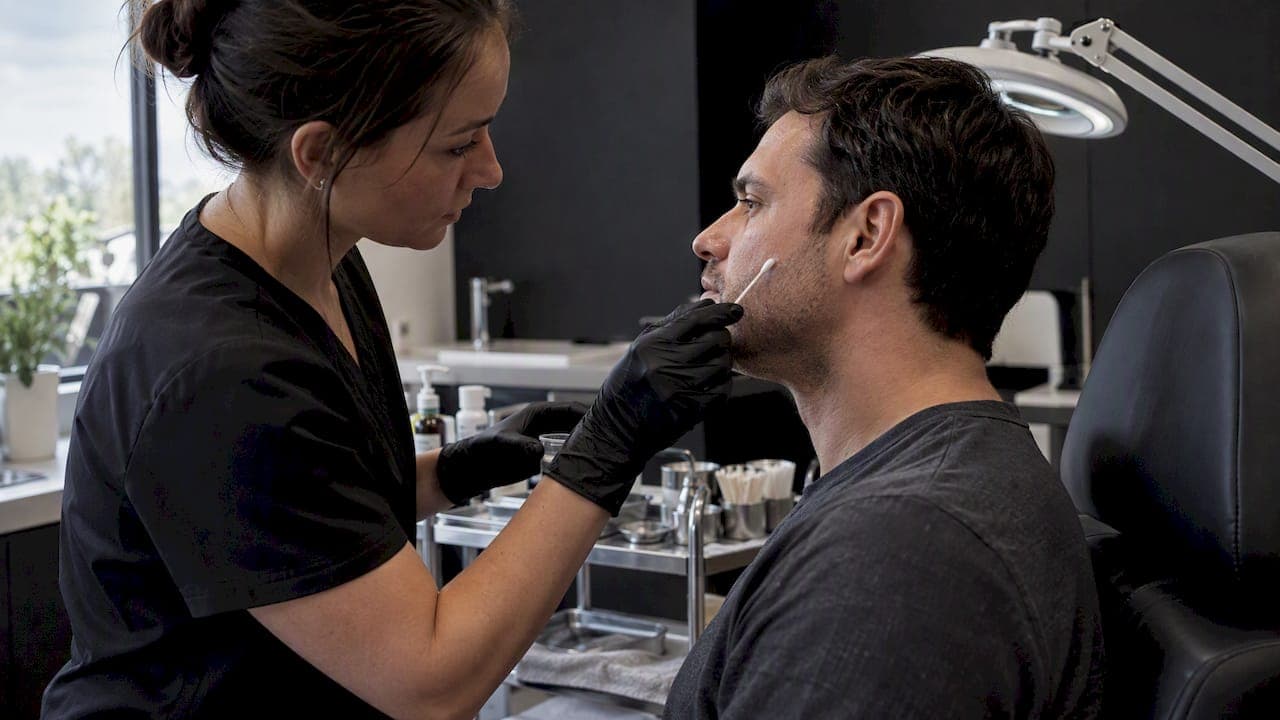
A professionally supervised TCA peel can improve acne scarring, rough texture and some signs of ageing in men, provided the strength and depth are matched to the problem and the skin type. We recommend a clinical assessment before any treatment: the right concentration for a fair-skinned man with fine lines may be wrong for a man with acne scarring and a darker phototype. Every peel plan should start with an assessment rather than a fixed protocol.
TL;DR:
- A TCA peel's effectiveness depends on matching its depth to the skin concern, with concentrations around 25 to 30 percent commonly used for acne scars.
- Medium-depth TCA peels are most suitable for addressing superficial scarring and uneven texture, offering visible improvements after proper planning and assessment.
- Darker skin phototypes require conservative approaches to minimize risks of pigment disturbance, especially in higher-risk skin types.
- Active acne or recent isotretinoin use necessitates delaying treatment until skin conditions stabilize and a test patch confirms tolerability.
- Proper aftercare—including sun protection and avoiding picking—is critical for optimal healing and reducing the risk of pigment changes or scarring.
Table of Contents
- What a TCA peel is and how it works
- Benefits for men: what TCA peels reliably help
- Who is suitable and who should avoid TCA peels
- What happens in clinic: step-by-step procedure and timeline
- Risks and how clinicians reduce them
- Aftercare: day 0 to week 4 practical checklist
- How to choose a clinic and what to ask at booking
- Clinician perspective: tailoring peels for male skin
- Rivers Edge Skin Studio's TCA peel services and how to book
- FAQ
- Sources
What a TCA peel is and how it works
Trichloroacetic acid works by coagulating proteins in the skin's surface layers, causing a controlled injury that triggers the skin to shed and regenerate. The result, when depth is judged correctly, is smoother texture, more even tone and a fresher appearance.
Clinicians group TCA peels by depth, and the depth decides both the result and the downtime:
- Superficial peels (typically lower concentrations) refresh the outer skin with minimal recovery time.
- Medium-depth peels reach further into the dermis and address scarring, pigment and moderate texture issues, with more visible peeling.
- Medium to deep peels are reserved for more significant damage and carry longer recovery and higher risk.
Small clinical trials and split-face studies consistently describe concentrations around 25 to 30% as the range used for superficial-to-medium work on acne and scarring, with stronger concentrations producing deeper effects and more downtime. A medium-depth peel sits in the middle of that spectrum and is the category most men asking about TCA are actually describing.
Benefits for men: what TCA peels reliably help
TCA peels have the strongest evidence for improving superficial acne scarring, rough or uneven texture, and some pigment changes from sun damage. A split-face study comparing 70% glycolic acid with 30% TCA found the TCA side showed superior improvement in atrophic acne scars at follow-up, with TCA penetrating deeper than glycolic acid and often outperforming it for this specific concern.
For active acne itself, the picture is more balanced. A randomised trial found that 25% TCA and 30% salicylic acid produced similar improvement in mild-to-moderate acne vulgaris, but salicylic acid caused less burning and less post-inflammatory hyperpigmentation. For oily, acne-prone male skin, a lipophilic acid like salicylic may suit active breakouts better, with TCA reserved for the scarring left behind.

TCA is also used for fine lines, though it is not the right tool for deep wrinkles or significant skin laxity, both of which usually need a different approach entirely.
Who is suitable and who should avoid TCA peels
Most men with acne scarring, uneven texture or early photodamage are reasonable candidates, but a few factors rule treatment out or demand a more cautious plan.
- Avoid or delay treatment if you have used isotretinoin recently, have an active skin infection, are prone to keloid scarring, or cannot commit to strict sun protection afterwards.
- Pregnancy and breastfeeding are standard contraindications for chemical peels generally.
- Darker skin phototypes need a more conservative, physician-led approach, since deeper peels carry a higher risk of pigment disturbance in this group.
A large case series on TCA peels across different skin types found low overall complication rates when depth was deliberately tailored to the patient's phototype, with practitioners advised to stay conservative in higher-risk skin and for those still building experience.
Men's skin also brings practical differences: thicker dermis, higher sebum output, and facial hair that needs careful handling during application.
Pro Tip: If you are unsure of your skin's reaction to actives, ask your clinician for a test patch at least 48 hours before full treatment, not just a verbal risk discussion.
What happens in clinic: step-by-step procedure and timeline
A well-run TCA peel session follows a consistent sequence, built around safety checks before and during treatment.
- Assessment and test patch. Your clinician reviews your skin history, takes photographs for the record, and may apply a test patch to check your reaction before committing to a full treatment plan.
- Degreasing and preparation. The skin is thoroughly cleansed to remove oil, which matters more for men given typically higher sebum production, so the acid can penetrate evenly.
- Application and frosting. The acid is applied in careful passes. You will usually feel warmth or stinging, and the skin develops a visible white "frosting" that signals the depth reached.
- Neutralisation and immediate aftercare. Cooling and a calming moisturiser follow, along with clear written instructions before you leave.
- Recovery. Peeling typically begins within a few days and continues for several days to a week or more depending on depth, with most men able to return to normal social activity once visible flaking settles. Follow-up and any retreatment are usually spaced several weeks apart.
Risks and how clinicians reduce them
Most men experience transient burning, redness and visible peeling for several days, which is the expected mechanism of the treatment rather than a complication. Post-inflammatory hyperpigmentation is the most common genuine side effect, particularly in darker skin.
Rarer but more serious risks include infection, scarring and hypopigmentation. A retrospective review of sequential peels in phototypes IV to VI reported high irritation rates and recurrence of pigment issues, reinforcing why conservative, medically supervised protocols matter most in darker skin.
Clinicians reduce risk through several concrete measures:
- Choosing a shallower depth for higher phototypes rather than a one-size protocol.
- Using antiviral prophylaxis when a patient has a history of cold sores.
- Enforcing strict sun avoidance before and after treatment.
- Running a test patch before the first full session.
Contact your clinic promptly if you notice spreading redness, pain that worsens rather than settles, or any sign of infection such as pus or fever.
Aftercare: day 0 to week 4 practical checklist
The days immediately after a peel matter as much as the treatment itself. Cleanse gently, avoid scrubbing or picking at peeling skin, and apply a bland moisturiser or occlusive emollient to support the barrier while it heals. Friction from towels or tight collars can disrupt healing skin, so handle the area with care.
- Day 0 to 3: Expect tightness and mild redness; keep the area clean and moisturised.
- Day 3 to 7: Visible peeling usually begins; resist picking, as this raises the risk of scarring and pigment changes.
- Week 1 to 2: Flaking settles; reintroduce gentle, non-active skincare once skin feels fully recovered.
- Week 3 to 4: Retinoids and other actives can typically restart once your clinician confirms the skin barrier has recovered.
High-factor sunscreen from day one is non-negotiable, alongside a physical barrier like a hat when outdoors, since new skin is far more vulnerable to pigment damage. Our men's aftercare guide and this post-treatment skincare routine cover product choices in more detail, and this men's skincare starter guide is a useful reference for rebuilding your routine once the barrier has settled.
Pro Tip: Keep sunscreen within arm's reach of your front door for the first month. The habit matters more than the product.

How to choose a clinic and what to ask at booking
Safety in TCA peeling depends heavily on who performs the treatment and how carefully they plan it. A few checks separate a well-run clinic from a risky one:
- Confirm the peel is supervised by a trained clinician, not applied without a proper skin assessment.
- Ask whether a test patch is standard practice before full treatment.
- Look for before-and-after photographs and written aftercare instructions, not just verbal advice.
- Check that the clinic follows clear infection-control procedures.
At booking, it is reasonable to ask who will actually perform the peel, which concentration they plan to use and why, what downtime to expect, and how they manage pigment concerns if they arise. At Rivers Edge Skin Studio, our chemical peel plans are built around this kind of conversation first, with men-focused treatment guides published for anyone who wants to read further before their first visit.
Clinician perspective: tailoring peels for male skin
Men's skin tends to be thicker and oilier than the average peel protocol assumes, which means preparation and timing often need adjusting rather than simply reaching for a stronger acid. We find the better approach is to start conservative, particularly on darker skin, and combine treatments such as microneedling where scarring runs deeper than a single peel can reach. A tailored plan beats a standard one almost every time.
— David
Rivers Edge Skin Studio's TCA peel services and how to book
We offer chemical peels as a Single Treatment at £60, with course packages at £100 for two sessions and £200 for four, built around the same clinical assessment described throughout this guide. 
Every plan begins with a review of your skin and a test patch where appropriate, so the concentration and depth match your scarring, texture or pigment concern rather than a generic protocol. Book an assessment through our services page to find the right starting point.
This article is general information, not a substitute for advice from a qualified doctor. Consult a qualified healthcare professional about your own circumstances before acting on anything here.
FAQ
Are chemical peels good for men?
Yes, when matched to the right concern and skin type. TCA peels have reasonable evidence for improving acne scarring and texture, while milder options like salicylic acid often suit active acne better, so the best choice depends on what you are treating.
Is a 20% TCA peel strong?
Stronger results for scarring typically come from concentrations closer to 25 to 30%, which is the range used in the comparative acne scar study and others cited here.
How much does a TCA peel cost on average?
Pricing varies by clinic, concentration and whether you book a single session or a course. At Rivers Edge Skin Studio, a Single Treatment is £60, with a Course of 2 at £100 and a Course of 4 at £200.
What results can I expect from a TCA peel?
Most men see improvement in acne scarring, rough texture and mild pigment unevenness, with visible peeling over the following week as the skin renews. Results depend heavily on matching the peel's depth to the specific concern, which is why a proper assessment matters more than the percentage on the bottle.
Sources
- Efficacy and safety of 25% TCA versus 30% salicylic acid peel in mild-to-moderate acne vulgaris
- A comparative study of 70% glycolic acid and 30% trichloroacetic acid peel in the treatment of facial atrophic acne scars