
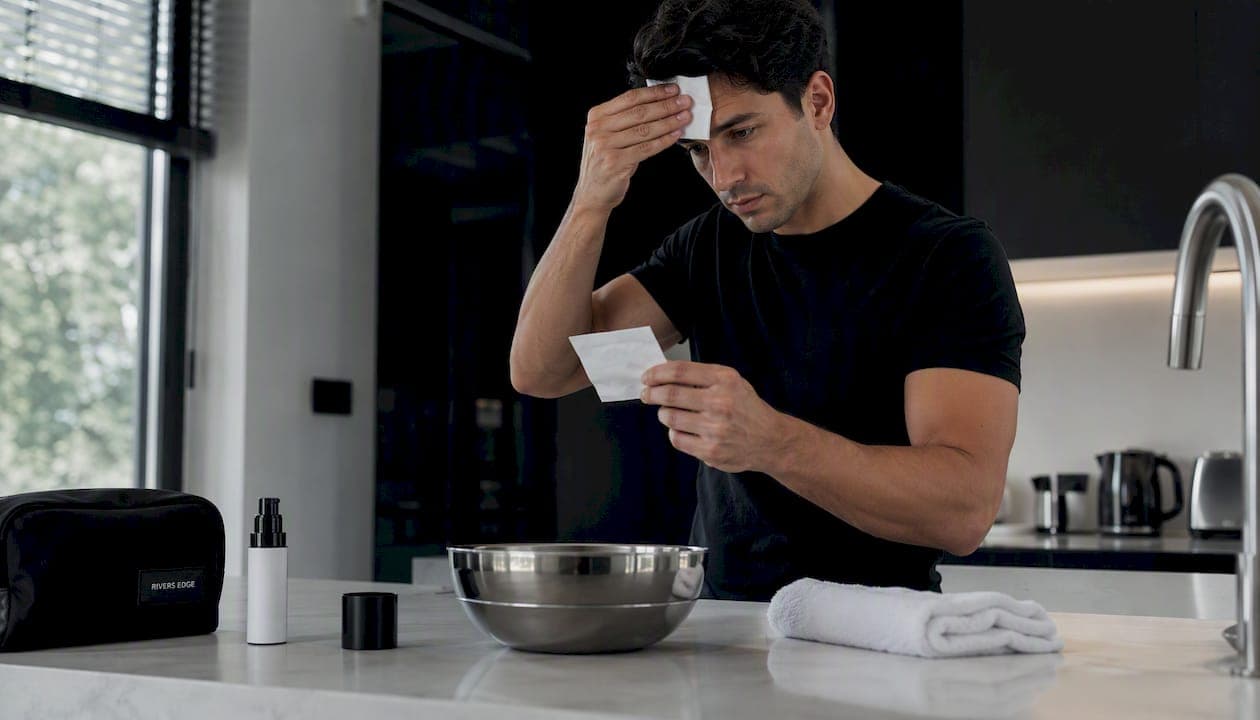
Men usually fall into five skin-type categories: normal, dry, oily, combination, and sensitive. A short home test tells you which one to treat first, and the right routine follows from there.
Dermatological consensus, backed by guidance from the British Association of Dermatologists and the NHS, confirms these five types as the standard framework for product selection and daily care. If you want a faster answer, the bare-faced wash test takes 30 minutes and costs nothing. If you want a professional read on your skin, Riversedgeskinstudio offers in-person assessments for men in Merseyside.
Quick TL;DR:
- Oily skin: choose a gel cleanser and an oil-free moisturiser with niacinamide.
- Dry skin: use a cream cleanser, a ceramide-rich moisturiser, and avoid foaming formulas.
- Sensitive skin: go fragrance-free across the board and patch-test every new product.
Table of Contents
- What are the five men's skin types?
- How do you identify your skin type at home?
- What should each skin type actually use?
- Why does sensitive skin behave differently?
- How does shaving change your skincare routine?
- When should you see a clinician rather than adjust your routine?
- Key takeaways
- The part most guides skip
- What Riversedgeskinstudio offers men who want more than a home routine
- Useful sources for further reading
What are the five men's skin types?
Skin type is a functional guide, not a medical diagnosis. It tells you how your skin behaves under normal conditions so you can pick products that work with it rather than against it.
Normal skin feels balanced throughout the day. Pores are small, shine is minimal, and the skin rarely feels tight or greasy. It is the least demanding type to maintain.
Dry skin produces less sebum than average. It often feels tight after washing, looks dull or flaky around the nose and forehead, and can develop fine lines earlier than oily skin. Cold weather and central heating make it worse.
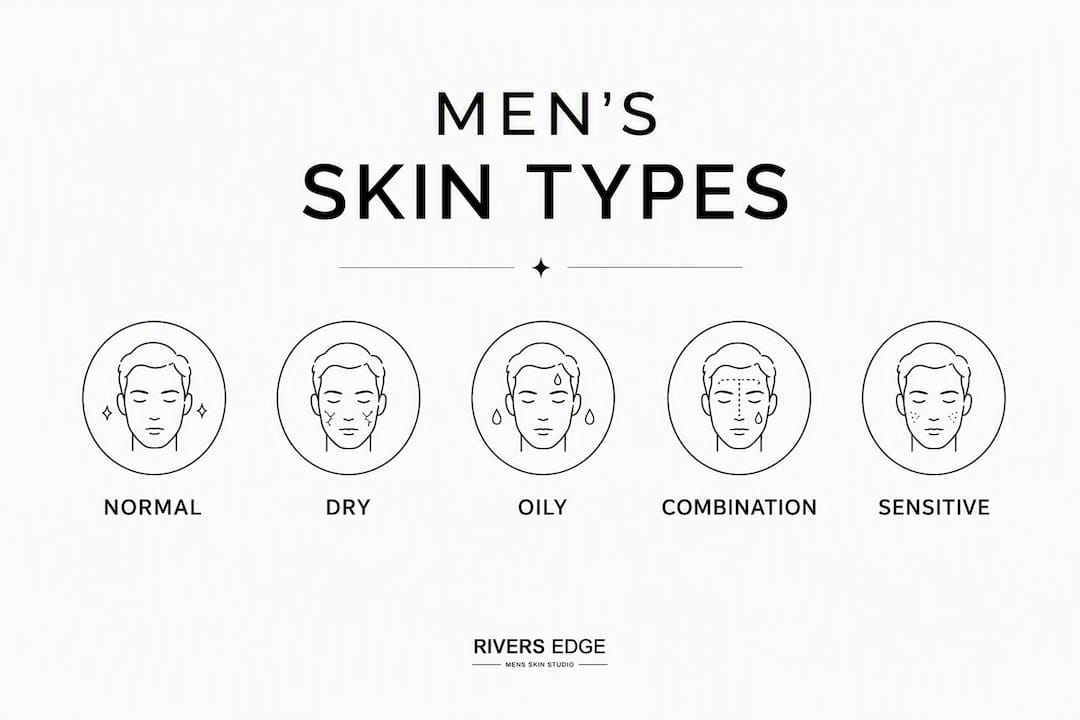
Oily skin produces excess sebum across most of the face. Pores appear enlarged, the skin looks shiny by mid-morning, and blackheads or breakouts are common. Male skin tends to be thicker than female skin, with larger pores and higher sebum output, which is why oiliness and congestion are more common in men.
Combination skin is oily in the T-zone (forehead, nose, chin) and normal or dry on the cheeks. It is the most common type and the trickiest to treat with a single product, because the two zones need different things.
Sensitive skin is defined by reactivity, not sebum production. It reflects a compromised skin barrier that responds to products, temperature changes, or shaving with stinging, redness, or tightness. Crucially, you can be oily and sensitive at the same time. Sensitive is not a fifth category sitting alongside the others; it overlays any of them.
| Skin type | How to identify | Key signs | Cleanser type | Moisturiser type |
|---|---|---|---|---|
| Normal | Balanced feel all day | Small pores, no shine or tightness | Gentle gel or foam | Lightweight lotion |
| Dry | Tight or flaky after washing | Dullness, rough patches, fine lines | Cream or oil cleanser | Rich cream with ceramides |
| Oily | Shiny by mid-morning | Enlarged pores, blackheads | Foaming or salicylic acid gel | Oil-free gel or fluid |
| Combination | Oily T-zone, dry cheeks | Mixed shine and tightness | Gentle balancing gel | Lightweight lotion, zone-targeted |
| Sensitive | Stinging or redness after products | Redness, tightness, reactivity | Fragrance-free cream cleanser | Fragrance-free, barrier-repair cream |
The NHS and British Association of Dermatologists both recommend the same baseline for every type: cleanse, moisturise, and apply a broad-spectrum SPF 30+ every morning. Everything else builds on that foundation.
How do you identify your skin type at home?
Three tests cover most situations. Run them on a typical day, not after heavy exercise, sun exposure, or a new product that has irritated your skin.
Test 1: The wash test (most reliable)
- Wash your face with a gentle, unfragranced cleanser.
- Pat dry. Apply nothing else.
- Wait 30 minutes.
- Observe: tight or flaky = dry; comfortable and balanced = normal; shiny across the whole face = oily; shiny on the forehead and nose only = combination; stinging, redness, or itching = likely sensitive.
Test 2: The day test
- Wash your face in the morning as normal.
- Go about your day without applying anything extra.
- Check your skin at lunchtime and again in the afternoon.
- Shine appearing by mid-morning across the whole face points to oily skin. Shine only in the T-zone by afternoon points to combination. Persistent tightness or flaking throughout the day points to dry.
Test 3: The blotting-sheet check
- Press a clean blotting sheet or a single sheet of tissue against different areas of your face.
- Hold it up to the light.
- Oil on the sheet from all zones = oily. Oil only from the T-zone = combination. Little or no oil from any zone = dry or normal.
These three methods give you a clear starting point. None of them is a clinical diagnosis, but together they are accurate enough to guide your first routine.
Pro Tip: Retest at the start of each season. Sebum production drops in cold weather and rises in heat and humidity, so the type you identify in January may not match what you see in July. A new shaving product or a course of antibiotics can also shift your results temporarily.
If your skin stings, peels, or breaks out despite following the right routine for your identified type, that is a signal to identify skin concerns more precisely, or to seek a clinical assessment.
What should each skin type actually use?
The baseline is the same for every man: a gentle cleanser morning and evening, a moisturiser suited to your type, and SPF 30+ every morning without exception. What changes is the texture, the actives, and the order of priority.
Dry skin
AM: Cream or oil cleanser, hyaluronic acid serum, ceramide-rich moisturiser, SPF 30+ (cream or mineral formula). PM: Same cleanser, ceramide moisturiser, retinoid two to three nights per week once the barrier is stable.
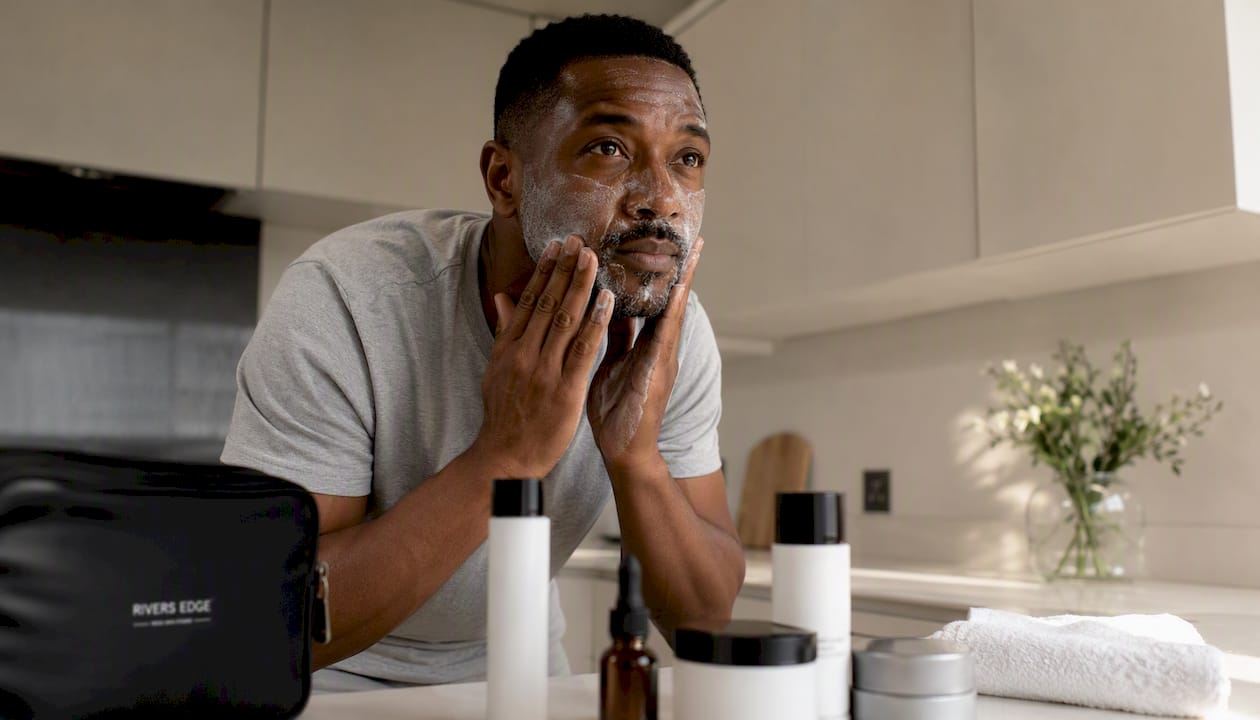
Avoid foaming cleansers with sodium lauryl sulphate; they strip the little sebum dry skin produces. Hyaluronic acid draws moisture into the skin, and ceramides lock it in. Retinoids accelerate cell turnover but can worsen dryness initially, so introduce them slowly.
Oily skin
AM: Foaming gel cleanser or one with salicylic acid, lightweight niacinamide serum, oil-free gel moisturiser, SPF 30+ (gel or fluid formula). PM: Same cleanser, niacinamide or a low-strength retinoid to regulate sebum over time.
Skipping moisturiser because your skin feels oily is a common mistake. Dehydrated skin often overproduces sebum to compensate. A lightweight, oil-free moisturiser keeps that cycle in check. Niacinamide at 5–10% visibly reduces pore appearance and controls shine without irritation.
Combination skin
AM: Gentle balancing gel cleanser, lightweight lotion on the cheeks, oil-free gel on the T-zone, SPF 30+ (gel formula works across both zones). PM: Same cleanser, niacinamide on the T-zone, a slightly richer moisturiser on the cheeks if needed.

Zone-targeting sounds complicated but takes seconds once it is habit. Use two products if the difference between your zones is significant; one lightweight lotion if the difference is mild.
Normal skin
AM: Gentle gel or foam cleanser, lightweight moisturiser with antioxidants (vitamin C or niacinamide), SPF 30+. PM: Same cleanser, a light moisturiser, retinoid two nights per week as a preventive measure.
Normal skin is forgiving, but that is not a reason to skip SPF. UV damage accumulates silently and is the single biggest driver of premature skin ageing in men.
Sensitive skin
AM: Fragrance-free cream cleanser, fragrance-free barrier-repair moisturiser with ceramides or colloidal oat, mineral SPF 30+ (zinc oxide or titanium dioxide). PM: Same cleanser, same moisturiser. Introduce any active ingredient one at a time, with at least two weeks between additions.
Avoid retinoids until the barrier is stable. When you do introduce them, start at the lowest available strength (0.025–0.05%) and use them once a week.
| Skin type | Shaving adjustment |
|---|---|
| Dry | Use a moisturising shaving cream; apply a ceramide balm immediately after. |
| Oily | Rinse thoroughly post-shave; avoid heavy balms that block pores. |
| Combination | Balm on the cheeks only; gel or nothing on the T-zone. |
| Normal | Standard shaving cream; a light post-shave moisturiser is sufficient. |
| Sensitive | Single-blade or double-edge razor; shave with the grain; fragrance-free balm only. |
For a full breakdown of men's skincare essentials by type, the Riversedgeskinstudio blog covers the current product landscape in detail.
Why does sensitive skin behave differently?
Sensitive skin is a barrier problem, not a sebum problem. When the skin barrier is compromised, irritants and allergens penetrate more easily, triggering inflammation, redness, and stinging. That barrier can be damaged by harsh products, over-exfoliation, aggressive shaving, or simply genetics.
Common irritants to avoid:
- Synthetic fragrances (listed as "parfum" or "fragrance" on the label)
- Some essential oils, including eucalyptus, peppermint, and citrus extracts
- Harsh sulphates (sodium lauryl sulphate, sodium laureth sulphate)
- High-concentration alcohol (denatured alcohol or SD alcohol near the top of an ingredient list)
- Physical scrubs used too frequently
Safe alternatives include ceramides, colloidal oat, allantoin, and niacinamide at lower concentrations (2–5%).
Patch-test method:
- Apply a small amount of the new product to the inside of your wrist or behind your ear.
- Leave it for 24 hours without washing.
- Check for redness, itching, or swelling. If none, apply to a small area of your face for 48 hours before full use.
Pro Tip: If your skin stings or reddens after shaving, do not immediately assume you have sensitive skin. Multi-blade razors, stretching the skin while shaving, and dry shaving all cause mechanical irritation that mimics sensitivity. Try a single-blade or double-edge razor with a moisturising cream and shave with the grain before changing your entire product routine.
Fragrance-free vs unscented: why it matters
These two labels are not the same thing. Products labelled "unscented" can still contain masking fragrances designed to neutralise the smell of other ingredients. Those masking agents trigger reactions in sensitive skin just as standard fragrances do. "Fragrance-free" means no fragrance compounds of any kind are present. For reactive skin, fragrance-free is the only label worth trusting.
Brands such as CeraVe and Bulldog both offer fragrance-free lines widely available in the UK. Kiehl's Ultra Facial range is another option, though always check the full ingredient list rather than relying on front-of-pack claims.
How does shaving change your skincare routine?
Shaving is a form of mechanical exfoliation. Done well, it removes dead skin cells and leaves the face smooth. Done poorly, it strips the barrier, causes ingrown hairs, and creates the kind of redness that gets misread as a skin condition.
Shaving checklist to reduce irritation:
- Soften the beard first: wash with warm water or shave after a shower.
- Use a moisturising shaving cream or gel, not a dry foam that evaporates quickly.
- Shave with the grain (in the direction of hair growth), especially on the neck.
- Change blades regularly; a dull blade drags and tears rather than cuts.
- Avoid stretching the skin taut while shaving.
- Rinse with cool water after to close pores.
- Apply a fragrance-free post-shave balm or your regular moisturiser immediately.
Beard care and product absorption
A beard changes how products reach the skin beneath. Moisturiser applied over a full beard sits on the hair rather than penetrating to the skin. The practical fix is to apply moisturiser directly to the skin at the beard line and on exposed areas, then use a lightweight beard oil or leave-in conditioner on the hair itself.
For men with combination skin and a beard, the T-zone often remains oily while the cheeks and beard skin become dry. Spot-treating those zones separately takes an extra 30 seconds and makes a real difference.
Beard care mini-routine:
- Cleanse under the beard with a gentle, water-soluble cleanser two to three times per week.
- Apply a lightweight, fragrance-free moisturiser directly to the skin beneath.
- Use a beard oil or balm on the hair to prevent brittleness and itching.
- Comb through to distribute product evenly and prevent ingrown hairs.
- Trim regularly to keep the beard line clean and reduce product build-up.
Understanding why men's skin differs biologically helps explain why shaving and beard care are not optional extras in a men's routine; they are central to it.
When should you see a clinician rather than adjust your routine?
Home testing and a well-chosen routine resolve most skin-type issues. Some symptoms, however, point to conditions that sit beyond skin type and need clinical diagnosis.
Red flags that warrant a professional assessment:
- Persistent stinging or peeling that continues despite switching to a fragrance-free, barrier-repair routine for four or more weeks.
- Spreading redness or a rash that does not clear with gentle care.
- Severe or cystic acne that does not respond to salicylic acid or niacinamide.
- Unexplained bleeding, crusting, or a sore that does not heal.
- A mole or pigmented area that changes in size, shape, or colour.
- Symptoms that match rosacea (persistent central facial redness, visible blood vessels) or eczema (intense itch, weeping, or thickened skin).
Home testing can miss sub-conditions such as rosacea or eczema entirely. A clinician distinguishes between a skin type and a skin disease, which changes the treatment approach completely.
Questions worth asking at a clinic appointment:
- Is this a skin-type issue or a diagnosable condition?
- Would patch testing identify specific allergens?
- What treatment options are available, and what is the expected downtime?
- Do I need a follow-up plan, and how long before I see results?
Clinic treatments relevant to men include HydraFacials for congestion and hydration, chemical peels for texture and pigmentation, prescription topicals for acne or rosacea, and microneedling for scarring or skin laxity. For a clear picture of what to expect, the men's skin clinic best practices guide covers the process in detail.
Key takeaways
Knowing your skin type is the single most practical step you can take before buying any skincare product, because the wrong formula for your type can make things worse rather than better.
| Point | Details |
|---|---|
| Five skin types | Normal, dry, oily, combination, and sensitive are the five categories; sensitive overlays any of the others. |
| Run the wash test | Wash, wait 30 minutes, and observe: tight = dry, shiny all over = oily, shiny T-zone only = combination. |
| Retest with seasons | Skin type shifts with age, hormones, and climate; re-evaluate your routine every season or after a major lifestyle change. |
| Go fragrance-free if reactive | "Fragrance-free" and "unscented" are not the same; choose fragrance-free for sensitive or reactive skin. |
| Riversedgeskinstudio | For persistent red flags or a professional skin assessment, Riversedgeskinstudio offers men-focused clinic appointments in Merseyside. |
The part most guides skip
Most men's skincare guides treat skin type as a fixed label you identify once and apply forever. That framing is too simple, and it leads men to stick with the wrong routine for years.
Skin type is not fixed. Many men move from oilier skin in their twenties to combination or dry skin in their forties as sebum production naturally declines. A man who identified as oily at 25 and built his routine around salicylic acid and oil-free everything may find that same routine is stripping his skin dry by 45. The products that worked brilliantly for a decade can quietly become the source of the problem.
The other thing guides underplay is the shaving variable. A significant number of men who believe they have sensitive skin are actually experiencing mechanical irritation from poor shaving technique. Switching to a single-blade razor and shaving with the grain resolves the "sensitivity" entirely, without a single product change. That distinction matters because treating mechanical irritation with sensitive-skin products does not fix the underlying cause; it just adds cost.
My honest advice: run the wash test, build a simple three-step routine matched to your type, and retest every six months. If your skin does not respond within four weeks, the issue is more likely a specific ingredient intolerance or an underlying condition than a wrong skin-type call. That is when a clinical assessment earns its value.
What Riversedgeskinstudio offers men who want more than a home routine
Home routines handle the day-to-day. For men whose skin is not responding, or who want results that products alone cannot deliver, Riversedgeskinstudio provides specialist in-person care built entirely around male skin.

The clinic's men's skin treatments include HydraFacials for deep cleansing and hydration, chemical peels for texture and pigmentation, microneedling for scarring and skin laxity, skin boosters including polynucleotides, anti-wrinkle injections, and dedicated facials for both bearded and non-bearded men. Every appointment starts with a thorough skin assessment and a personalised treatment plan, not a generic protocol.
The environment is designed specifically for male clients: private, straightforward, and focused on results. If you have been managing a persistent skin concern at home and not seeing progress, or if you simply want a professional read on your skin type before committing to a routine, booking an initial assessment at Riversedgeskinstudio is a practical next step. Visit the services page to see the full treatment list and book online.
This article provides general skincare information and is not a substitute for professional medical advice. For persistent or severe skin concerns, consult the NHS, a dermatologist, or a qualified clinician.
Useful sources for further reading
- British Association of Dermatologists — clinical guidance on skin conditions, treatment standards, and finding a dermatologist in the UK.
- NHS skin conditions guidance — practical advice on common skin conditions, when to seek help, and what to expect from a GP referral.
- British Skin Foundation: identifying your skin type — a dermatologist-authored guide to skin-type identification and when home assessment is insufficient.
- American Academy of Dermatology: skincare tips for men — evidence-based guidance on shaving, product selection, and daily routines; widely cited by UK dermatology sources.
- Riversedgeskinstudio blog: common men's skin concerns — a clinic-authored overview of the most frequent skin concerns in male clients and practical first responses.
- Riversedgeskinstudio blog: how to start a men's skincare routine — a step-by-step beginner routine guide written specifically for men, with product guidance by skin type.