

A first aesthetic appointment is a clinical consultation, not a sales meeting. Its purpose is to assess whether a treatment is right for you, establish your goals, check your medical history and plan a safe, realistic path forward. You leave knowing your options and next steps, with no obligation to commit to anything on the day.
What happens at a first aesthetic appointment:
- Medical history review, including medications, allergies and any previous treatments
- Goals conversation: what you want to change and what realistic outcomes look like
- Physical assessment of skin quality, muscle movement or volume, often with clinical photographs
- Discussion of treatment options, risks and alternatives
- Informed consent documentation if treatment proceeds
- Possible same-day minor treatment (for example, a single-area anti-wrinkle injection), or a follow-up booking for more involved procedures
The first clinic visit is a clinical assessment, not a commitment. You leave with a clear picture of what is possible, a realistic timeline and the choice of whether to proceed.
Table of Contents
- What should you do before booking your first appointment?
- What happens step by step during the consultation?
- Can treatment happen on the same day as the consultation?
- What aftercare and recovery should you expect?
- How long do appointments take and what do they cost in the UK?
- What red flags should you watch for?
- What questions should you ask before you leave?
- What do practitioners wish first-timers knew?
- Key takeaways
- A note on what makes a good consultation
- Ready to book your first appointment at Riversedgeskinstudio?
- Further reading and authority sources
What should you do before booking your first appointment?
Before you book, check that the practitioner is qualified and registered. In the UK, medical practitioners can be verified on the GMC register, and dental practitioners on the GDC register. Look for a clinic that takes a medical history in advance and has clear hygiene standards. A clinic that skips pre-screening questions before you even arrive is worth approaching with caution.
What to bring:
- A current list of medications, including supplements and blood thinners
- Dates of any previous aesthetic treatments
- Photo ID
- Any photos that show the concern you want to address (useful for injectables or skin texture issues)
- Your usual skincare products if you want advice on routine compatibility
For men attending facial treatment appointments, arrive with clean skin where possible. If you have a beard, consider whether the treatment area overlaps with it and mention this when booking. Avoid alcohol for 24 hours before injectable appointments, and hold off on NSAIDs such as ibuprofen for 48 hours beforehand to reduce bruising risk.
Pro Tip: The item men most commonly forget is their medication list. Missing this can delay the consultation or rule out same-day treatment entirely, so photograph your prescription bag or write the names down the night before.
What happens step by step during the consultation?
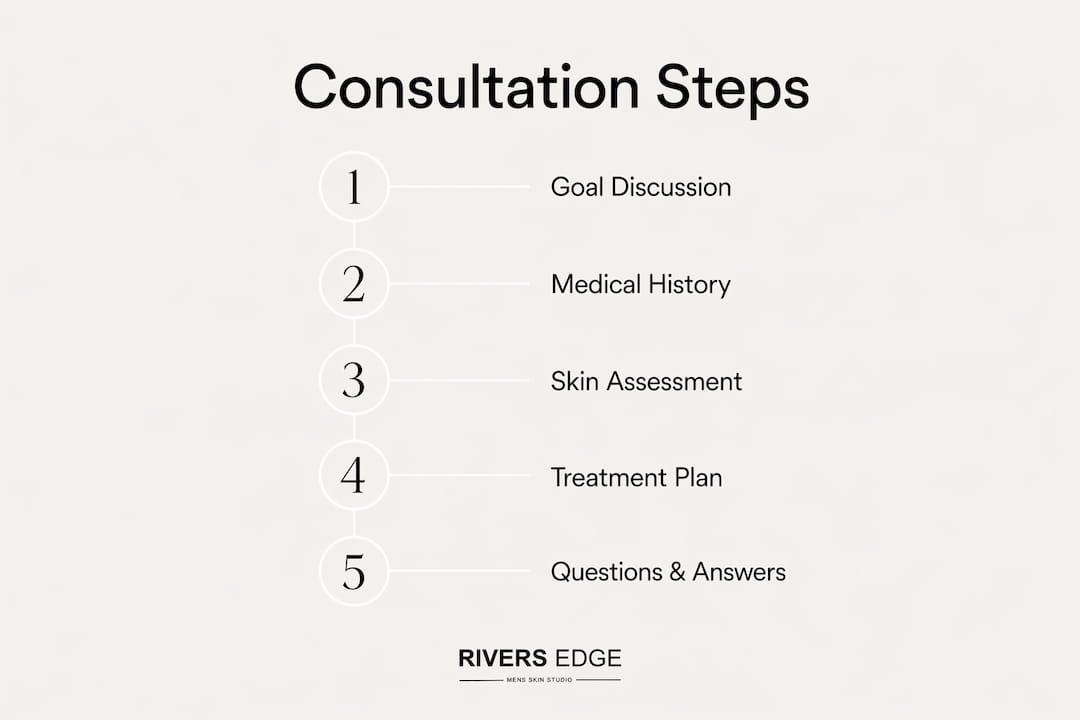
The consultation opens with a conversation about your goals. A good clinician will listen carefully and translate what you describe ("I look tired all the time") into clinical aims ("periorbital volume loss and brow position"). This is where expectations are shaped, and it is the most important part of the appointment.

Next comes the medical history. The practitioner will ask about medications, allergies and conditions such as autoimmune disorders, active skin infections or blood-clotting issues. Pregnancy and breastfeeding are screened at this stage too. These checks are not box-ticking; they directly determine which treatments are safe and which are not appropriate for you.
The physical assessment follows. The practitioner examines skin quality, facial symmetry, muscle movement and volume distribution. Clinical photographs are taken at this point. As noted by patient-facing clinical guidance, before-and-after photographs are used for planning and medical records, not for marketing pressure. They give both you and the clinician a documented baseline.
Treatment options, realistic outcomes, risks and alternatives are then discussed. This is when you should ask questions. A consent form is completed and documented before any treatment proceeds. Standard items on a consent checklist include:
- Confirmation that the risks and alternatives have been explained
- Your agreement that you are not pregnant or breastfeeding (where relevant)
- Acknowledgement of the aftercare instructions
- Your signature and the date
A consultation should feel like a clinical appointment, not a showroom visit. The role of the practitioner is to assess, advise and recommend — including recommending no treatment if that is the right answer. Pressure to commit on the day is a red flag, not a sales technique.
Can treatment happen on the same day as the consultation?
Yes, for certain procedures. A single-area neuromodulator (anti-wrinkle injection) is commonly performed immediately after the consultation, provided the medical history is clear and consent is documented. The procedure itself takes a short amount of time, making same-day treatment practical for straightforward cases.
More involved procedures are usually scheduled separately. Deeper skin resurfacing, staged filler plans, scalp microneedling programmes and combination treatment plans benefit from a separate booking. This gives you time to reflect, and gives the practitioner time to plan properly.
If topical anaesthetic is needed, factor in an additional 20–30 minutes for it to take effect before the procedure begins. A short observation period after treatment is standard practice, particularly for injectables, to check for any immediate reaction before you leave.
For guidance on layering treatments safely, it is worth reading up before your appointment if you are considering more than one procedure.
Pro Tip: If you are unsure whether to proceed on the day, say so. A reputable clinic will not push you. Booking a follow-up gives you time to review the treatment plan at home, which often leads to a clearer decision and better outcomes.
What aftercare and recovery should you expect?
Aftercare begins the moment treatment ends. You should receive written instructions before you leave; if you do not, ask for them. Verbal aftercare alone is not sufficient.

Settling times vary considerably by procedure. Neuromodulators take 1–2 weeks to show their full effect. Fillers can cause early swelling that resolves over 1–2 weeks, after which the final result becomes visible. Skin resurfacing treatments such as microneedling or chemical peels can continue to improve for weeks or months as collagen remodelling progresses. For men following post-treatment skincare steps, consistency in the days after treatment makes a measurable difference to the outcome.
| Procedure | Typical visible effect | Full result timeline |
|---|---|---|
| Anti-wrinkle injection | — | 1–2 weeks |
| Dermal filler | Immediate (with swelling) | 1–2 weeks |
| Microneedling | — | Weeks or months |
| Chemical peel | — | Weeks or months |
| HydraFacial | Immediate | 1–2 weeks |
First 48–72 hour aftercare checklist:
- Avoid touching, rubbing or applying pressure to the treated area
- No intense exercise, saunas or steam rooms for 24–48 hours after injectables
- Keep the skin clean and moisturised as instructed
- Avoid alcohol and blood-thinning medications unless medically required
- Stay out of direct sun and apply SPF if going outdoors
- Book your two-week review if one has not already been scheduled
How long do appointments take and what do they cost in the UK?
Appointment durations vary by procedure and clinic. Consultations generally take under an hour, with longer sessions needed when treatments are added. Procedures like microneedling or laser treatments typically require additional time for preparation and completion.
UK price ranges vary by practitioner grade, clinic location, product volumes used and whether follow-up appointments are included. The figures below are indicative ranges; always confirm pricing at your consultation.
| Treatment | Typical UK price range | Procedure time |
|---|---|---|
| Anti-wrinkle injection (1 area) | prices vary by clinic and practitioner | procedure takes about 10–20 minutes |
| Dermal filler (1 syringe) | prices vary by clinic and practitioner | — |
| Microneedling (face) | prices vary by clinic and practitioner | procedure takes about 30 minutes |
| Chemical peel | prices vary by clinic and practitioner | — |
| HydraFacial | prices vary by clinic and practitioner | — |
| Skin booster (polynucleotides) | prices vary by clinic and practitioner | procedure takes about 20–30 minutes |
Practitioner grade is the single biggest driver of cost variation. A nurse prescriber, doctor or dentist with specialist aesthetic training will typically charge more than a beauty therapist, and for good reason: the clinical oversight and ability to manage complications is meaningfully different.
What red flags should you watch for?
Some warning signs are visible during the consultation itself. Others appear in the hours or days after treatment.
During the consultation:
- No medical history taken before treatment is discussed
- Pressure to book or pay on the spot
- Practitioner cannot or will not confirm their qualifications or registration
- No written consent form presented before treatment
- Vague or dismissive answers to questions about risks
After treatment:
- Severe or worsening pain beyond the expected mild discomfort
- Blanching (white patches) of skin near an injection site, which can indicate vascular compromise and requires urgent attention
- Signs of infection: increasing redness, warmth, swelling or discharge beyond 48 hours
- Asymmetry or lumps that worsen rather than improve after the first week
If you suspect vascular compromise after an injectable treatment, contact the clinic immediately. This is a medical emergency. The British College of Aesthetic Medicine describes the consultation as a safety gate designed to screen for exactly these risks before treatment begins. If something feels wrong after you leave, call the clinic first. If you cannot reach them and symptoms are severe, go to A&E.
What questions should you ask before you leave?
Knowing what to ask makes the difference between leaving informed and leaving uncertain. Frame questions so the answers have to be specific.
Ask: "How long until I see the final result?" rather than "Will it look better?" Ask: "What are the most common side effects for this treatment in men?" rather than "Is it safe?" Specific questions get specific answers.
Questions worth asking at every first appointment:
- What qualifications do you hold, and are you registered with the GMC or GDC?
- What are the realistic risks for my skin type and the treatment you are recommending?
- What happens if I am not happy with the result?
- Is there a follow-up appointment included, and when should I book it?
- What alternatives exist if I decide not to proceed with this treatment?
For a fuller question set for men attending a skin clinic, it is worth reviewing before your appointment.
What to leave with in writing:
- Your documented treatment plan
- Written aftercare instructions
- The clinic's contact details for complications
- Confirmation of your follow-up appointment date
- A copy of your signed consent form
What do practitioners wish first-timers knew?
The most consistent message from experienced aesthetic practitioners is that results take time. Neuromodulators settle over 1–2 weeks. Fillers can look slightly uneven in the first few days due to swelling, then resolve. Skin treatments such as microneedling and chemical peels trigger collagen remodelling that continues for weeks or months after the session. Assessing a result too early leads to unnecessary anxiety or premature top-ups.
Building a relationship with one clinic over time produces better outcomes than moving between providers. A practitioner who knows your baseline, your previous treatments and your skin's response to products can make safer adjustments and plan cumulative programmes that a one-off appointment cannot replicate. For men considering natural-looking results in aesthetics, this long-term approach is what separates a subtle, well-maintained appearance from an overdone one.
Aesthetic medicine is not a quick fix, and the best results come from patience and a staged plan. At Riversedgeskinstudio, we see the biggest improvements in clients who commit to a treatment programme over time, not those who want everything addressed in one session. The consultation is where that plan starts — and it is the most important appointment you will have.
Key takeaways
A first aesthetic appointment is a clinical consultation, not a commitment: you leave with a plan, a timeline and the choice to proceed at your own pace.
| Point | Details |
|---|---|
| Prepare before you arrive | Bring a medication list, previous treatment dates and photos of your concern to avoid delays. |
| Consultation is clinical, not sales | Medical history, physical assessment and consent are completed before any treatment is discussed or agreed. |
| Same-day treatment is possible | Simple injectables (10–20 minutes) can follow the consultation; complex procedures need a separate booking. |
| Results take time to settle | Neuromodulators: 1–2 weeks; fillers: 1–2 weeks; skin resurfacing: weeks to months. |
| Riversedgeskinstudio offers personalised consultations | Men's-focused appointments at the clinic cover goals, safety checks and a staged treatment plan with no pressure to commit. |
A note on what makes a good consultation
Most articles about first aesthetic appointments focus on what happens in the room. What they underestimate is how much the quality of that conversation determines everything that follows. A practitioner who listens carefully, gives honest answers about what a treatment cannot achieve, and recommends patience over an immediate procedure is worth more than any particular technique or product.
The men who get the best results from aesthetic treatments are not the ones who book the most sessions. They are the ones who found a clinic they trust, asked the right questions early, and followed a staged plan rather than chasing immediate change. The consultation is where that trust is either built or lost.
At Riversedgeskinstudio, the focus is on men's skin specifically. That means the assessment accounts for beard growth patterns, skin thickness, sebaceous activity and the particular concerns men bring to a clinic: lines, texture, hair loss, excessive sweating, and overall vitality. The consultation is not a formality. It is the foundation of every treatment plan.
Ready to book your first appointment at Riversedgeskinstudio?
Riversedgeskinstudio is a men's skin clinic in Merseyside built around one straightforward idea: professional aesthetic care, personalised to how men's skin actually works. The consultation is no-pressure and clinically led, covering your goals, medical history and a realistic treatment plan before anything is agreed.

Treatments available for discussion at your first appointment include anti-wrinkle injections, skin boosters (polynucleotides), microneedling, chemical peels, HydraFacial, excessive sweating treatments and hair loss solutions including scalp microneedling. Online booking is available, and the team is happy to answer questions before you commit to anything.
Browse the full treatments and services at Riversedgeskinstudio and book your consultation online. If you have questions first, get in touch directly.
Further reading and authority sources
- GMC Register — verify that your practitioner is registered with the General Medical Council before booking any injectable or clinical treatment.
- GDC Register — for dental practitioners offering aesthetic treatments, check registration status here.
- British College of Aesthetic Medicine: Consultation & Patient Journey — clinical guidance on what a proper aesthetic consultation should include, including safety screening and consent.
- What to expect at your first aesthetic appointment — a patient-facing overview of the consultation process from a UK clinic.
- Ironwood Grooming: sensitive skin regimen — practical guidance on managing sensitive or post-treatment skin, relevant for men preparing for or recovering from aesthetic procedures.