
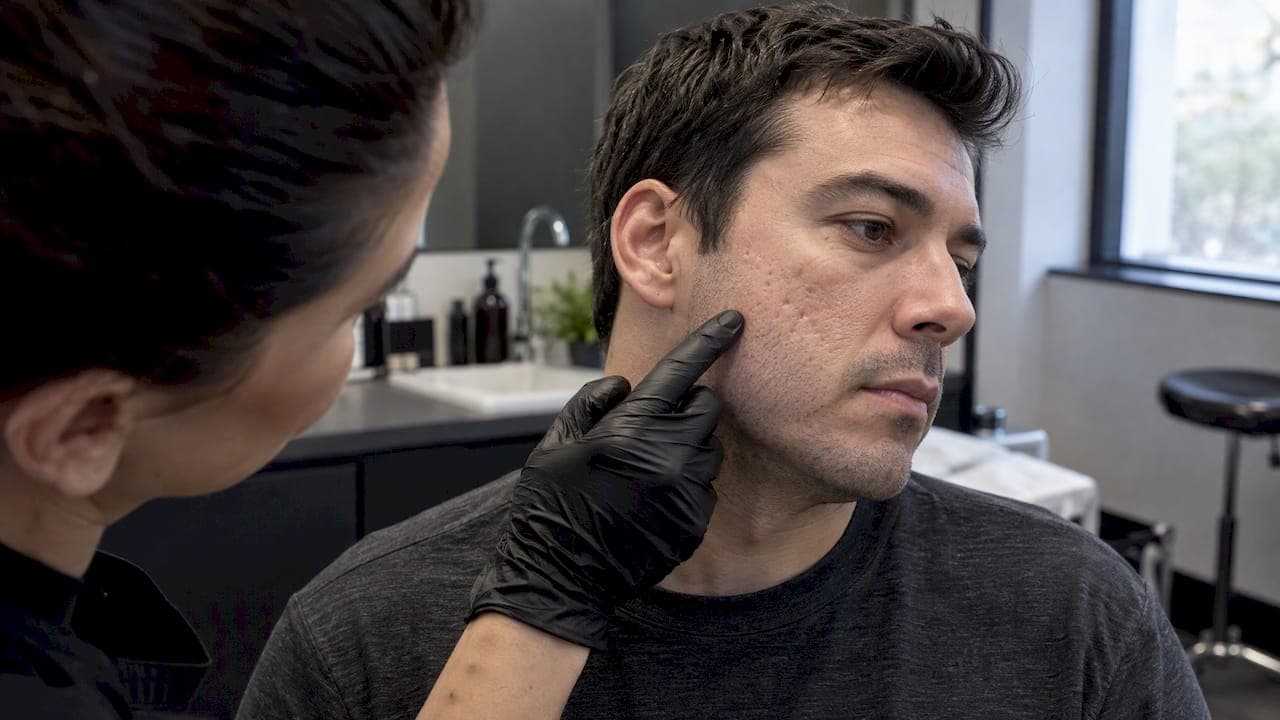
If the marks on your cheeks look round, even and flatten when you pull the skin tight, they are most likely enlarged pores. If they stay indented, you are probably looking at acne scars. The stretch test is the quickest check you can do at home. Retinoids suit pores, TCA CROSS and subcision suit certain scars, and we can assess either at Rivers Edge Skin Studio.
TL;DR:
- Side lighting reveals defined shadows from scar depth; flat red or dark marks sit level with skin and often fade over time.
- Introduce nighttime retinoids gradually, use salicylic acid two or three nights weekly on separate evenings, wear daily sunscreen, and avoid exfoliating just before shaving.
- Clinicians match treatment to scar type: subcision suits rolling scars, punch excision may suit boxcar scars, and deep icepick scars need clinician selection.
- Atrophic scars often respond better to combined methods than one procedure, and treatment usually takes several sessions with recovery time.
- Seek assessment for painful, recurring acne, tethered or deep indentations, or flat marks that persist for months; photos alone can miss tethering.
Table of Contents
- How can you tell pores from acne scars at home?
- Why do pores and scars look so alike?
- What treatments work for enlarged pores and for acne scars?
- What daily routine keeps pores calm and scarring at bay?
- When is self-care not enough?
- What are icepick, boxcar and rolling scars, and how do they differ from pores?
- Does it hit men differently, mentally and socially?
- How do beards and stubble change what you see and what we treat?
- What should you do after treatment, especially with a beard?
- How do you tell scars from folliculitis and ingrown hairs?
- Why we treat male skin as its own case
- Ready to find out what your skin actually needs?
- FAQ
- Sources
How can you tell pores from acne scars at home?
Two checks do most of the work. Neither replaces an in-person assessment, but together they tell you which direction to take.
The stretch test. Stand in good light, place two fingers either side of the area and gently pull the skin taut. Enlarged pores and surface roughness typically flatten out, while true atrophic scars persist. Clinicians use stretching as a reliable first test for exactly this reason.
The directional light test. Hold a torch or phone light at a low angle, to the side of your face, and turn slowly. Scars tend to cast a discrete shadow because they have real depth. Pores and textural irregularities scatter the light instead of casting a defined shadow.
What you are looking at tells you plenty too:
- Pores are round, fairly uniform in size and often contain blackheads or a dark plug.
- Scars are indented, with uneven or sloping edges, and look the same however you stretch the skin.
- Flat dark or red marks that do not dip below the surface are usually something else, covered in the next section.
- Marks that bunch or pull when you move your face may be tethered, which needs a clinician to confirm.
Pro Tip: Photograph the area in the same spot, with the same side-lighting and no flash. Consistent photos make a consultation far more useful.
Be realistic about selfies. A phone camera flattens depth, and tethered scars (where scar tissue anchors the skin to the layer beneath) often cannot be spotted from a picture at all. If a test leaves you unsure, that is a good enough reason to book an assessment.
Why do pores and scars look so alike?
Both create small shadowed dips on the skin, so the eye reads them as the same thing. Underneath, they are very different.
A true scar is a structural change. When a deep spot heals, the body can lay down collagen unevenly and lose volume in the skin below, leaving a permanent dip. The NHS describes this process as a complication of acne, which is why treating breakouts early and leaving spots alone matters so much.
A pore is a natural opening, and it behaves differently:
- Its visible size is influenced by sebaceous gland activity, ageing and sun damage, as DermNet explains.
- Acne can enlarge pores by weakening the follicle opening.
- Oil and debris collect in the opening, which darkens it and changes how it reflects light.
- Nothing is missing from the skin beneath, so the opening can look smaller when oil is controlled or the skin is stretched.
Then there is the mimic: post-inflammatory marks. Flat dark or red patches left after a breakout are often confused with scarring. They typically fade over time, whereas true structural scars are permanent without clinical intervention. If a mark has no dip when you stretch it or catch it in side light, it is probably this.
Many men have a mix of all three: some open pores, some shallow scars and some lingering colour. That is why one treatment rarely does everything, and why we usually plan combinations in stages.
What treatments work for enlarged pores and for acne scars?
Start with what both conditions share. Consistent retinoid use at night, a salicylic acid exfoliant a couple of times a week, oil control and daily sunscreen improve nearly every male face. Retinoids are described by dermatologists as the most effective topical for regulating cell turnover, helping to exfoliate, control oil and smooth texture. Introduce them gradually, because they increase UV sensitivity.
For enlarged pores:
- Topical retinoids and chemical exfoliation to keep follicles clear.
- Professional extraction of stubborn blackheads.
- Non-ablative resurfacing, such as fractional radiofrequency or picosecond lasers.
- Clinician-led microneedling, which we cover in our guide to microneedling for pores.
Be honest with yourself about the outcome. Pores can look smaller and tighter, but they will not close. The aim is a smoother, less shadowed surface, not glass.
For acne scars, the choice depends on the type of scar:
- Treatment for narrow, deep icepick scars should be chosen by a clinician according to scar morphology.
- Subcision, with or without filler, for rolling scars. The NHS notes subcision as a treatment for rolling scars.
- Punch excision for some boxcar scars.
- Microneedling and fractional lasers for general texture.
A narrative review of atrophic scar treatment found that combination treatments generally outperform single methods, covering resurfacing, fillers and surgical techniques together. Because skin type changes both results and risk, a morphology-driven plan is wise, as recent research on scar advances also indicates.
The key finding: Combination treatments commonly produce more benefit than single modalities for atrophic post-acne scars. In practice, that means expecting a staged plan rather than one miracle session.
Most of these approaches need several sessions, spaced out, with some redness or downtime afterwards. Our clinical approach to acne scarring in men walks through what a typical course looks like.
What daily routine keeps pores calm and scarring at bay?
Keep it short enough that you will actually do it. Dermatologists consistently recommend twice-daily cleansing, regular exfoliation and daily sunscreen, and the steps below fit that pattern.
- Morning: cleanse. Use a gel or foaming cleanser suited to oily or combination skin.
- Morning: moisturise. Choose a light, oil-free formula.
- Morning: SPF. Apply it every day, including cloudy ones, as sun damage is one factor behind visible pores.
- Evening: cleanse. Wash off oil, sweat and sunscreen.
- Evening: treat. Apply your retinoid, building up slowly from a couple of nights a week.
- Two or three evenings a week: exfoliate. Use a salicylic acid product on nights you are not using the retinoid on a sensitive area.
Read labels carefully. The American Academy of Dermatology advises oil-free or non-comedogenic products for acne-prone skin and fragrance-free ones for sensitive skin, and warns that "unscented" can simply mean a masking fragrance has been added.
Shaving matters more than most men realise. Exfoliate on a different day from the one you shave, or after rather than immediately before, so you are not dragging a blade over freshly sloughed skin. Our short clinic guide to blackhead removal and timing your shave explains the sequence.
Habits count too. Do not pick or squeeze, as dermatologists stress that picking raises scarring risk. Managing acne early and avoiding picking can help reduce the risk of scarring.
Pro Tip: Introduce one new active at a time before adding another. If your skin stings or flakes, you will know exactly which product caused it.
When is self-care not enough?
Home routines have a ceiling, and it is better to find it early than after months of frustration. Book an assessment when you notice any of these:
- Deep indentations that remain obvious in ordinary daylight.
- Marks that bother you enough to affect confidence or how you groom.
- Flat dark or red marks that have not faded after several months.
- Active nodular or painful acne that keeps producing new marks.
- Scars that appear to pull or bunch when your expression changes.
Persistent or scarring acne in men should prompt a review, and the Cleveland Clinic notes that oilier male skin often tolerates stronger topicals, with isotretinoin an option where appropriate.
At an assessment, we check whether scars are tethered, map which subtypes you have, consider your skin phototype, and ask about any isotretinoin history and infection risk. The usual pathway then runs from assessment to staged, combined treatments, followed by a maintenance plan with a realistic timetable. Our guide to signs men need professional skincare helps if you are still weighing it up.
What are icepick, boxcar and rolling scars, and how do they differ from pores?
Most acne scars are atrophic, meaning they sit below the surface. There are three common types, and DermNet describes them clearly:
- Icepick scars are narrow and deep, like a tiny puncture. They are the type most easily mistaken for a large pore, but they stay visible when you stretch the skin.
- Boxcar scars are wider, with sharply defined edges, like a shallow crater.
- Rolling scars have sloped edges and give the skin a gently wavy look, most visible in side light.
A review of scar improvement methods notes that the three types differ in depth and width, and that treatment should be chosen by morphology. That is the practical difference: a pore responds to oil control and resurfacing, while a scar needs something that rebuilds or releases the tissue beneath.
A quick way to compare icepick scars and pores is to look at the pattern. Pores and scars can be difficult to distinguish by appearance alone, so seek an in-person assessment if you are unsure.

Does it hit men differently, mentally and socially?
Often it does, though not always in the way people expect. Enlarged pores tend to feel like a grooming problem: a nuisance in close-up photos or under bathroom lighting, usually fixable with a better routine. Many men treat them as something to manage rather than something to hide.
Scars carry a different weight. They are a visible record of past breakouts, and because they are permanent without treatment, they can feel like something you are stuck with. Men often tell us they avoid certain lighting, skip photos, or feel self-conscious in meetings and on dates, while rarely raising it with anyone.
Men also tend to wait. Many put up with texture for years before asking for help, partly because skincare is still seen as optional. Waiting rarely makes scars better, and dermatologists note that scars rarely disappear on their own but can be significantly diminished with professional treatment.
The kinder framing is this: wanting smoother skin is a reasonable goal, and seeking an assessment is a practical step, not vanity. Our aim is natural-looking improvement, never an overdone result.
How do beards and stubble change what you see and what we treat?
Facial hair is a natural camouflage. A full beard hides most scarring on the jaw and cheeks, while stubble can make a rough texture look rougher, because short hairs catch light unevenly. That is one reason men with a close shave often notice their pores and scars more than men with a beard.
It also affects how we plan treatment:
- Beards can conceal scars, which can make them look milder than they are.
- Dense hair means some devices need careful technique and a clean, prepared surface.
- Shaving cuts, ingrown hairs and razor irritation can inflame skin that is being treated for pores.
- Scars under a beard are still scars, and can be treated on the same morphology-led basis.
Hair removal is a separate question from scar treatment, and we discuss it at consultation so there are no surprises. We also tailor facials to the face, which is why we offer a Bearded Man Facial at £35 alongside non-bearded options on our services page.
Our advice is to shave or trim a day before a clinic visit, not on the morning of it, so the skin is calm but the area is easy to assess.
What should you do after treatment, especially with a beard?
Aftercare is where good results are protected. The exact advice depends on the procedure, and we give you written guidance, but several principles apply to most men.
- Go gentle with the razor. Ask us how long to wait before shaving. Treated skin is more sensitive, and a blade over inflamed skin invites irritation and ingrown hairs.
- Keep beard products clean. Wash brushes, combs and razors, and avoid heavy oils or balms on treated areas until the skin has settled.
- Cleanse softly. Use a mild, fragrance-free cleanser and avoid scrubs or acid exfoliants until we say otherwise.
- Protect from the sun. Daily SPF is essential, as retinoids and treated skin both increase UV sensitivity.
- Hands off. Do not pick at flaking or scabbing. This is how marks become scars.
- Pause your actives. We will tell you when to restart your retinoid, usually after the skin has calmed.
Clean pillowcases, a fresh towel for your face and avoiding the gym sweat-and-touch routine for a day or two all help. Hygiene matters most in the first few days, when the skin barrier is still recovering.
Redness and mild tightness are common after resurfacing and microneedling, and usually settle over a few days. If you notice spreading redness, pus or significant pain, contact us promptly. Our guide to the benefits of microneedling for men covers what recovery usually looks like.
How do you tell scars from folliculitis and ingrown hairs?
Men shave, and shaving produces its own bumps and marks, which are easy to confuse with scarring. The distinguishing features are depth, timing and what the skin is doing now.
- Folliculitis is inflammation of the hair follicle. It shows up as small red or pus-topped bumps around hairs and is active, tender and changing over days.
- Ingrown hairs appear where a shaved hair curls back into the skin. You can often see the hair under the surface, and the bump may be sore.
- Post-inflammatory marks are flat dark or red patches left behind. They have no dip, and the guidance on acne vulgaris notes they typically fade over time.
- True atrophic scars are indented, stable and unchanging, and stay put when you stretch the skin.
So the practical test is simple: is it new, raised and tender, or old, flat or sunken and quiet? Active bumps are a shaving and hygiene problem. Dips that remain are scars. A mark that is neither raised nor sunken is probably pigment.
Repeated ingrown hairs can themselves cause scarring if picked, so treat the cause: use a clean, sharp blade, shave with the grain, and avoid dry shaving. If a patch keeps flaring in the same place, have it looked at, because inflamed follicles that keep recurring are worth treating before they leave a mark.
Why we treat male skin as its own case
I have seen the same pattern many times: a man arrives convinced his skin is "just bad", when in fact it needs a plan that suits how he lives. Male skin is often oilier, shaving adds daily friction, and many men have never had a routine to begin with. A protocol borrowed from someone else's skin tends to miss all three.
That is why our approach leans toward staged, combined treatments rather than one dramatic procedure. A little resurfacing, a little microneedling and good home care usually beat a single aggressive session, and they keep the result looking like you. We would rather under-promise and let the skin show the difference.
If you are unsure what you are looking at, come and let us look properly. An assessment is a conversation about realistic outcomes, not a sales push, and you can leave with a plan or simply with clarity.
— David
Ready to find out what your skin actually needs?
If you are in Liverpool or the wider Merseyside area, we can assess your skin in person and tell you honestly whether you are dealing with pores, scars or a mix of both. As a men's skin specialist, we build every plan around male skin: oilier, shaved daily and often untreated for years.
Options include our microneedling treatments, starting at £70 for a single Microneedling Facial, or a chemical peel from £60 for a single treatment. A course of four microneedling sessions is £200, and a course of four peels is also £200. You can see everything on our services page.
For context on how clinics describe cosmetic procedures more broadly, Littleover Dental Practice lists its own cosmetic treatments in a similar format.
Book an appointment through our website and bring your photos. We will take it from there.
This article is general information, not a substitute for advice from a qualified doctor. Consult a qualified healthcare professional about your own circumstances before acting on anything here.
FAQ
What are the best treatments for acne scars and pores?
It depends on which you have. Pores respond to retinoids, exfoliation, extractions and gentle resurfacing, while scars need treatment matched to their type, such as TCA CROSS, subcision or microneedling. Research on atrophic scars suggests combining methods tends to work better than relying on one.
What do Koreans do for acne scars?
We cannot speak for any one country's habits, but the underlying approach is the same worldwide: consistent sun protection, gentle exfoliation and professional procedures such as microneedling or lasers for texture. Treatments are chosen by scar type and skin type rather than by trend.
What is the difference between acne marks and scars?
Marks are flat dark or red patches that sit level with the skin and typically fade over time. Scars are indented, permanent without treatment, and persist when you stretch the skin. The American Academy of Dermatology notes that scars rarely fully disappear on their own.
What is the best treatment for boxcar scars?
Boxcar scars have defined edges and are often treated with resurfacing, microneedling or fractional lasers, and sometimes punch excision for deeper ones. A clinician will choose based on depth and your skin type, and several sessions are normal.