
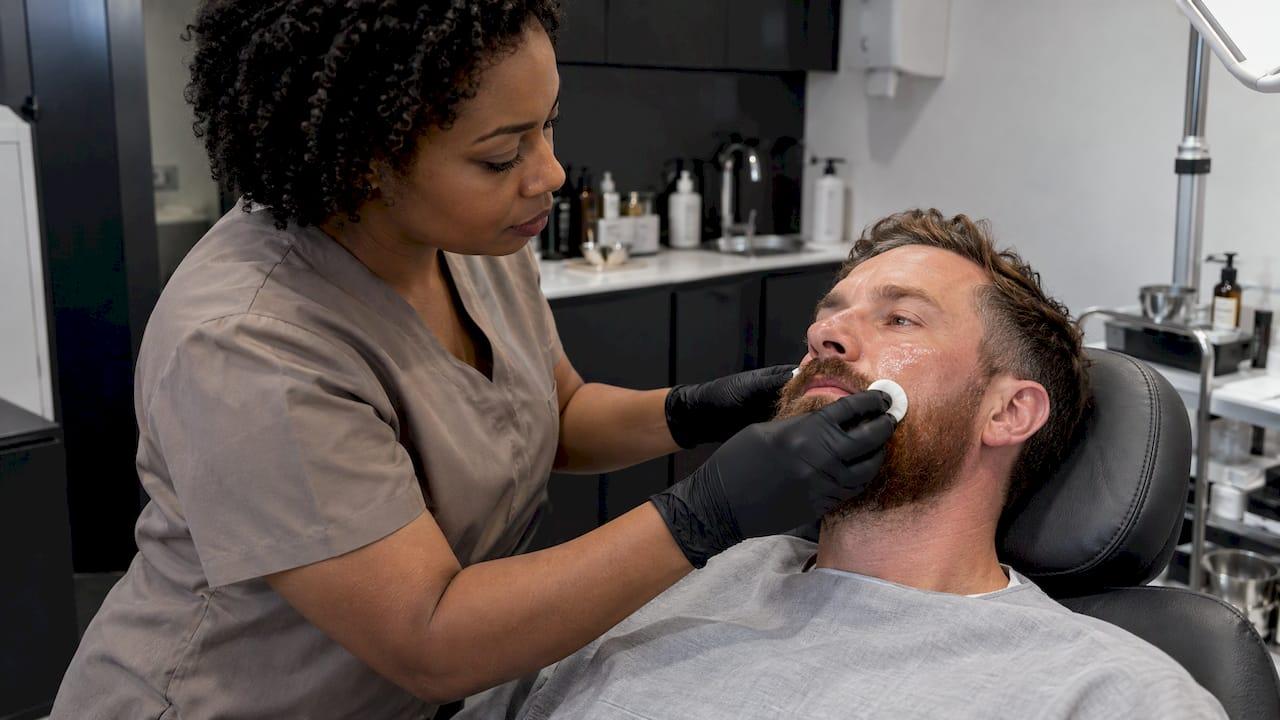
Yes, you can have a chemical peel with a beard. Facial hair does not rule a peel out, but it changes how the peel is planned: the depth, the areas treated and when you shave before and afterwards. At Rivers Edge Skin Studio, our Liverpool clinic for men's skin, we build every peel around your skin and your facial hair, so you are not left guessing.
TL;DR
- A beard does not stop you having a chemical peel. It affects how evenly the solution reaches the skin, so the practitioner plans around it.
- Peels do not stop hair growing or thin your beard. Very fine hair may shed temporarily, according to one summary of peels for men.
- Do not shave straight before your appointment, and do not shave again until your skin has finished peeling. Your aftercare instructions give the date.
- Light (superficial) peels suit most men with beards. Deeper peels need more planning and an experienced practitioner.
- At our studio a single chemical peel is £60, a course of two is £100 and a course of four is £200.
Table of Contents
- Can you have a chemical peel with a beard?
- How a beard changes the way a peel is done
- When to shave before your peel
- What happens during a peel
- Recovery: flaking, stubble and shaving again
- Peel timeline at a glance
- Risks and who should take care
- Which skin concerns a peel helps with
- Peel, facial or microneedling?
- Book a peel with us in Liverpool
- Our view on peels and beards
- FAQ
- Sources
Can you have a chemical peel with a beard?
A chemical peel is a treatment where a controlled acid solution is applied to the face to remove the top layers of skin and encourage new skin to grow. The British Association of Cosmetic Surgeons (BACS) describes it this way and groups peels into three depths: superficial, medium and deep.
A beard is not a barrier to any of that. The practical points are these:
- The practitioner may ask you to trim or shave so the solution touches the skin evenly. The same summary of peels for men says facial hair does not rule out treatment.
- Peels act on skin, not on the hair follicle's growth cycle. They do not reduce beard density or stop hair coming through.
- The longer and denser the beard, the more the peel is concentrated on the exposed skin: forehead, cheeks, nose and neck.
If you wear a short, well-kept beard or stubble, you are an easy candidate for a light peel. If you carry a full beard, a conversation about which areas to treat comes first. That is normal, and it is the reason a consultation matters.
How a beard changes the way a peel is done
Men's skin is different from women's skin in ways that affect a peel. A 2018 review in the Australasian Journal of Dermatology notes that men have thicker, coarser and oilier skin, which makes the way a peeling agent penetrates less predictable. It also points out that men are less likely to use cosmetic camouflage while the skin recovers, so visible flaking matters more to many of them.
A UK guide to peels in male skin adds that beard hair can interfere with even application and healing at medium depth. Its suggested approach is sensible for any man with facial hair: favour superficial depths, test a small area, build depth gradually over several sessions and protect the skin from the sun.
In plain terms, that means three things for you:
- Depth is usually kept light. Superficial peels reach only the outermost layer of skin and need little downtime, as BACS explains. They work well on stubble or a trimmed beard.
- Treatment may be built up over a course. Several light peels are gentler than one aggressive one, and a course also costs less per session at our studio.
- Areas with dense hair may be treated differently. Stronger acids are better applied to hair-free skin, while lighter acids can reach skin under short hair.
If you want the wider picture on depths, our guide to deep versus superficial peels for men goes through them in more detail.
When to shave before your peel
Shaving is the part men ask about most, and advice from clinics varies on the exact timing. Some ask for a clean shave the day before so the solution contacts the skin evenly. Others prefer you not to shave for a day or two so the skin barrier can recover. What is consistent is that you should not shave immediately before the appointment, because shaving is a form of mechanical exfoliation and a peel on top of it can be more irritating than intended.
So the safe routine is:
- Follow the timing you are given when you book, rather than a rule from a forum.
- Do not shave on the morning of your peel.
- If you nick yourself shaving the day before, tell the practitioner. The area can be avoided on the day.
- Do not use scrubs, retinoid products or other exfoliating products in the days beforehand unless you are told to.
Our article on beard facials and when to shave covers the same timing question for facials.
What happens during a peel
A typical appointment runs in a set order. BACS says treatment takes from about 30 minutes to an hour and a half, depending on the peel.
- Consultation and skin history. The practitioner asks about your skin type, medicines you take, cold sores, scarring tendencies and previous treatments. This is also where your beard length and shaving routine are discussed.
- Cleansing. The skin is cleansed so the solution can work evenly.
- Application. The solution is applied in a set order and left for a measured time while the skin is watched for the expected reaction.
- Neutralising and soothing. The peel is stopped, and a moisturiser and sunscreen go on.
- Aftercare. You leave with clear instructions, including when you can shave again.
At our studio, treatment plans are personalised, and we are a men-only clinic, so beards, razor irritation and oilier skin are part of everyday practice rather than an exception. You can see what we offer on our chemical peels for men in Liverpool page.
Recovery: flaking, stubble and shaving again

With a superficial peel, most men feel tightness and see a pink flush in the first days, followed by flaking. BACS says peeling typically begins around day three and can last up to two weeks, and up to three weeks for deeper peels. Flakes can catch in stubble and beard hair, which is the part that bothers most men.
The rules for getting through it are simple:
- Do not pick or pull flakes. Let them come away on their own. Picking risks marks and uneven healing.
- Do not shave until peeling has finished. The same UK guide says you cannot shave until the skin has healed over, because shaving over healing skin risks infection and scarring. The date is set in your aftercare.
- Go gently when you do shave. Use a clean blade or a trimmer, a soft touch and an alcohol-free balm afterwards.
- Moisturise and use sunscreen daily. The British Association of Beauty Therapy and Cosmetology (BABTAC) good practice guide lists a daily SPF 30 as part of aftercare, which is a sensible habit all year in the UK.
- Go easy on heavy exercise for the first few days. Sweat trapped under loosened skin can irritate.
Our step-by-step recovery guide for men lays out the days one by one.
Peel timeline at a glance
| Stage | What to expect | What to do |
|---|---|---|
| Day of peel | Pink flush, mild tightness | Moisturise, use SPF, do not shave |
| Days 1 to 2 | Tight, dry skin | Gentle cleanser and moisturiser |
| Days 3 to 5 | Flaking begins, may catch in stubble | Do not pick; keep skin hydrated |
| Up to about 2 weeks | Peeling finishes | Shave only when your aftercare says so |
| Around 2 weeks | Skin settled | Review the result and plan the next session |
These are typical patterns for lighter peels; yours depends on the peel strength and your skin. The two-week review fits the BABTAC guide, which describes a review about two weeks after a peel as ideal.
Risks and who should take care
Peels are safe in the right hands, and the risks are mostly about depth, skin type and aftercare. BACS lists slow healing, infection during healing (a cold sore flaring up, for example), uneven pigmentation, demarcation lines and less improvement than expected. Scarring and lasting redness are linked to deep peels.
The British Association of Dermatologists says peels should be done by an experienced practitioner, because a poorly done peel can worsen pigmentation, over-lighten skin or scar. It also notes that peels are usually not available on the NHS, so you are looking for a reputable, qualified private provider.
Some situations call for extra planning, and you should say so at the start of your consultation:
- Cold sores. A peel can trigger them, so mention any history.
- Darker skin tones. Dr Ejikeme of Adonia Medical Clinic, speaking to ELLE UK, recommends customised peels with gentler ingredients such as mandelic or azelaic acid to avoid pigment changes.
- Active irritation, open nicks or razor burn. These areas are avoided until they have healed.
- Recent sun exposure or a tan. Tell the practitioner; sun protection matters before and after.
- Medicines and skin conditions. If you take acne medication or have eczema, psoriasis or another skin condition, raise it first. For specific medical questions, speak to your GP or dermatologist.
BABTAC's good practice guide also expects a patch test at least 24 hours before a first peel where the product requires one, signed consent and a record of your medical history. These are the standards a careful provider works to, and they are worth knowing before you book anywhere.
Which skin concerns a peel helps with
Men usually come to a peel for one of a few reasons:
- Dull, uneven or rough skin
- Oiliness and congested pores
- Pigmentation and sun damage
- Razor bumps and rough texture that make shaving uncomfortable
- Acne marks and uneven tone
We go through these in men's skin concerns that chemical peels address, and in more depth for dark marks in our piece on peels for pigmentation in men. If scarring is the concern, our guide to TCA peels for men is the place to start. The full overview is in our complete guide to chemical peels for men's skin.
Peel, facial or microneedling?
The question comes up a lot, so here is a simple comparison of what we offer.
| Treatment | Best for | Price at our studio |
|---|---|---|
| Chemical peel | Tone, texture, pigmentation, oiliness | £60 single, £100 for 2, £200 for 4 |
| Bearded Man Facial | Deep cleansing and care for skin under a beard | £35 |
| Microneedling Facial | Texture, scarring and skin renewal | £70 single, £100 for 2, £200 for 4 |
A facial is a cleansing and care treatment with no downtime. A peel works at a deeper level and brings visible flaking. Microneedling uses fine needles to stimulate the skin to repair itself. Many men do a course of peels and add facials between them. We can tell you which fits at your consultation. Our services page lists every treatment, including microneedling.
Book a peel with us in Liverpool

Rivers Edge Skin Studio is a men-only skin and aesthetics clinic at Unit 6, 10-14 Jamaica St, Liverpool L1 0AF. We are open Monday to Saturday, 10:00 to 17:00, and closed on Sunday.
A single chemical peel is £60. A course of two is £100 and a course of four is £200. Along with peels we offer men's facials, microneedling, skin boosters, anti-wrinkle injections, sweat (hyperhidrosis) injections, polynucleotides, vitamin injections and hair-loss treatments. Injectable treatments are for clients aged 18 and over.

You can book your appointment online or read more on our chemical peels page.
Our view on peels and beards
We are a clinic for men only, and that shapes how we think about a peel with a beard.
Most men who ask us about this worry about the same thing: will my beard get in the way, and will I be left flaking for weeks? Our answer is that a peel can be planned around your facial hair, and a personalised treatment plan is how we do it. The depth, the number of sessions and the timing of shaving all depend on your skin.
We favour a course of lighter peels over one heavy one, because it suits how men's skin behaves and it gives natural-looking results. That is why we price courses of two and four peels below the cost of the same number of single sessions.
Looking after your skin should not be complicated. Tell us about your beard, your shaving routine and what bothers you about your skin, and we will explain the plan in plain terms before we start.
David
FAQ
Can a chemical peel remove facial hair?
No. A peel works on the skin's surface layers and does not stop hair growing or make a beard thinner. Very fine, light hair may shed for a short time as the skin sheds, but it returns. If you want to reduce hair, a peel is not the right treatment.
Do I need to shave my beard before a chemical peel?
Not necessarily. Short beards and stubble can often be treated, and the practitioner will say whether to trim or shave. Avoid shaving immediately before the appointment, and tell us about any nicks or razor burn so those areas can be left alone.
When can I shave after a chemical peel?
Wait until the skin has finished peeling and healed, because shaving over healing skin risks infection and scarring. BACS says peeling can last up to two weeks, so your aftercare instructions give the exact date. Use a clean blade or trimmer and an alcohol-free balm when you do.
Is a chemical peel better than a facial?
They do different jobs. A facial cleanses and cares for the skin with no downtime, while a peel renews the skin's surface and brings visible flaking. Many men alternate the two. Our Bearded Man Facial is £35 and a single peel is £60.
How many peels will I need?
It depends on your skin and your goal. Light peels are usually done as a course, which is why we offer courses of two and four. At your consultation we will recommend a number based on your skin.
Sources
- Chemical Peels | British Association of Cosmetic Surgeons
- Chemical peels: A review of current practice | Australasian Journal of Dermatology
- Melasma | British Association of Dermatologists
- Good Practice Guide | BABTAC
- Chemical peels and resurfacing in male skin | Men's Skin
- Chemical Peels for Men: What's Different | ChemicalPeel.org
- A Guide To Clinical Skincare For Darker Skin | ELLE UK