
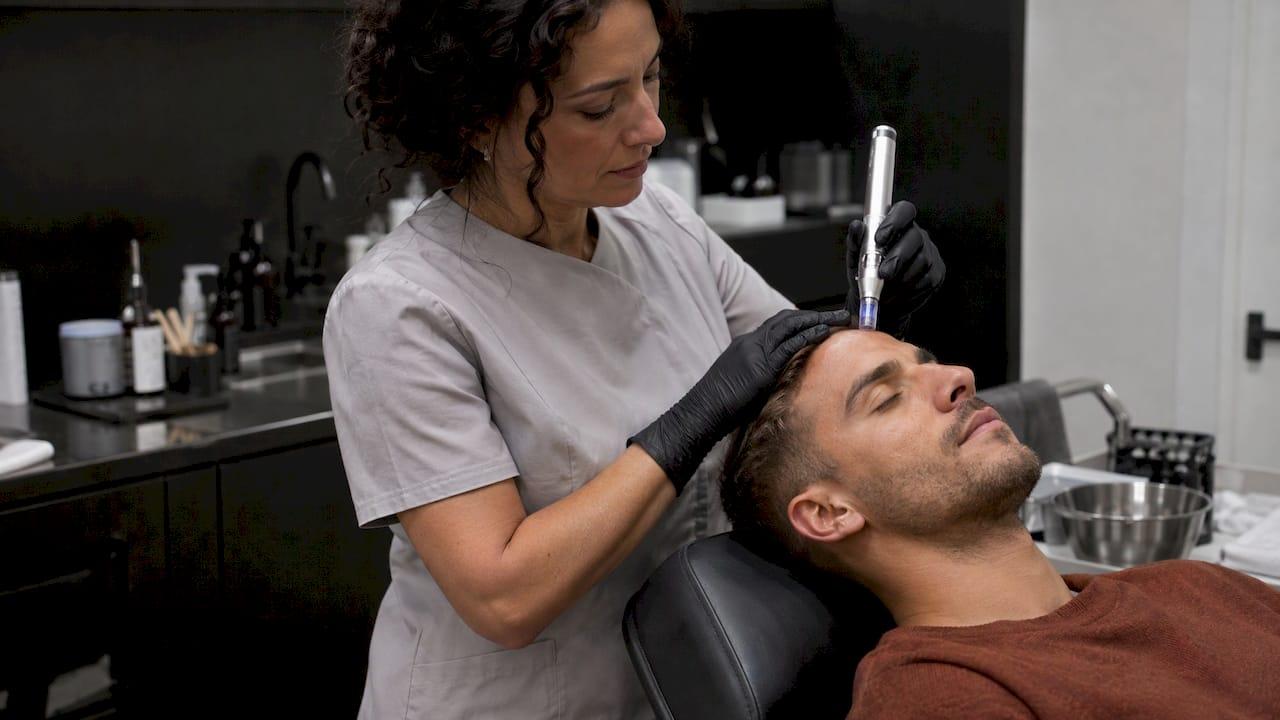
Most men describe professional microneedling as uncomfortable rather than painful. The British College of Aesthetic Medicine takes the same view. You can expect a scratching or prickling sensation, a little more on bony areas like the forehead and jawline, and a tight, warm feel afterwards. This guide explains what each stage feels like, what numbing does, how depth and area change the experience, and who should speak to a doctor before booking.
TL;DR
- Expect discomfort, not real pain: a scratchy, prickling feeling that most men tolerate well, with bony areas feeling sharper.
- Practitioners normally apply a topical anaesthetic, which can take up to 30 minutes to work, and the treatment itself commonly takes 20 to 30 minutes.
- Redness, tightness and mild swelling after treatment usually settle within a few days.
- Active infections, cold sores, keloid scarring, blood-thinning medicines and pregnancy are reasons to get medical advice first.
- At our Liverpool studio, a single microneedling facial costs £70 and a course of 4 costs £200.
Table of Contents
- How painful is microneedling, really?
- What microneedling feels like, step by step
- Does numbing cream work for microneedling?
- Which areas hurt more?
- How needle depth changes the feeling
- What it feels like afterwards
- Who should avoid microneedling or see a doctor first?
- Risks and side effects in context
- How to make your session more comfortable
- Book microneedling for men in Liverpool
- FAQ
- Sources
How painful is microneedling, really?
Pain is personal, so no honest article can give you one number. What we can say is where the evidence sits.
The British College of Aesthetic Medicine says most patients find professional microneedling uncomfortable rather than painful. It also notes that newer vibrating derma pens generally cause less discomfort, because the treatment is delivered quickly.
If you want a figure, the best UK data comes from a 2015 double-blind study from Salford Royal NHS Foundation Trust. Patients rated pain on a 0 to 10 scale after numbing cream. The mean scores were 5.00 with Ametop, 4.38 with EMLA and 3.91 with LMX4. That is a middling score, and it was recorded in a study that used topical anaesthetic on skin being needled.
Two things are worth remembering when you read those numbers:
- They are averages. Some people scored far lower and some higher.
- They describe the treatment moment only. Pain after treatment is a different, milder experience, covered below.
What microneedling feels like, step by step
Knowing the sequence removes most of the worry. Here is a typical appointment, based on how professional microneedling is generally delivered.
Before the needles: consultation and numbing
Your practitioner should ask about your medical history, skin condition and medicines. This matters for safety as much as comfort, and we cover it in the contraindications section. Then a topical anaesthetic goes on. The BCAM says it may take up to 30 minutes to work, so you should expect to sit for a while before treatment starts.

During treatment: pressure, scratching and warmth
The sensation is usually described as light scratching or vibration across the skin. A pen device moves in short passes over each area. Most men notice it most on the forehead, temples, jawline and upper lip, where there is less tissue between skin and bone. The treatment itself commonly takes 20 to 30 minutes.
Straight after: tight, warm and pink
Your skin will feel like mild sunburn: tight, a little tender and warm. StatPearls lists the expected effects as redness, irritation and mild swelling that generally subside over hours to days. Our own guide to what 24 to 72 hours of redness looks like walks through it day by day.
Does numbing cream work for microneedling?
Yes, and it is the standard way to keep treatment comfortable. StatPearls describes pain as minimal when topical anaesthetic is used appropriately.
The Salford study compared three common creams. LMX4 was the one most participants preferred, but none of the three produced a statistically significant pain advantage over the others. In plain terms: the fact that you are numbed matters more than which brand your practitioner uses.
| Topical anaesthetic | Mean pain score (0 to 10) |
|---|---|
| Ametop | 5.00 |
| EMLA | 4.38 |
| LMX4 | 3.91 |
Source: Salford Royal NHS Foundation Trust study, 2015. The differences were not statistically significant.
Practical points on numbing cream:
- Allow the time. Arriving early and letting it work for the full period is the simplest comfort measure you control.
- Tell your practitioner about allergies. The FDA advises people to discuss any allergy or sensitivity to topical anaesthetics with a provider before treatment.
- Ask what is being used. Your practitioner should be able to tell you which product goes on your skin and why.
Which areas hurt more?
For most men, the order is predictable. Fleshy areas such as the cheeks feel milder. Bony areas feel sharper: the forehead, temples, jawline, bridge of the nose and upper lip.

ACE UK says that some facial and body areas are more sensitive, and that reducing needle depth or radiofrequency energy can make treatment more tolerable. The study data fits this. On the face and neck, mean pain scores were 4.1 with EMLA and 4.5 with Ametop and LMX4.
Beard area
Men often ask whether a beard changes things. Hair density does not stop treatment, but the skin under a beard can feel different from the cheek above it. Our first-week timeline for beard microneedling explains what to expect and when you can shave again.
Scalp
The scalp sits close to the skull, so many men find it a more noticeable area. It is the one most often treated for thinning hair, and the sensation is usually described as a prickling pressure. If hair loss is your reason for asking, read our clinic evidence on microneedling and minoxidil and our 72-hour scalp aftercare guidance.
How needle depth changes the feeling
Depth is the main lever on comfort. Shallow treatments for general skin quality are typically gentler. Deeper settings, used for scarring or texture, are more intense and come with more recovery. ACE UK also says the device, handpiece, energy settings and treatment area all affect the experience.
Depth also changes how often you can treat. Our guide to microneedling frequency by depth sets out the gaps that suit each setting. The sensible approach is to start at a depth that suits your skin and build up under a practitioner's guidance, not to chase the deepest setting.
What it feels like afterwards
The treatment moment is short. The aftermath is longer but mild.
- Redness and tenderness. ACE UK says redness, tenderness and swelling can last up to 3 days. The BCAM says redness can remain for a couple of days.
- Stinging. The BCAM notes stinging may occur after treatment.
- Dryness and flaking. DermNet says dryness, scaling, redness and swelling may last several days or longer depending on needle penetration depth. A moisturiser can make the skin more comfortable, according to ACE UK.
Aftercare that keeps you comfortable
The BCAM advises sunscreen, and avoiding heat or cold extremes, sun, saunas, sunbeds and vigorous exercise for 48 hours. That is a sensible gym-free couple of days. Our piece on sun exposure after microneedling for men goes into the detail. If you use retinol, see when to restart it. Many problems come from small slip-ups, which is why we also wrote about common microneedling mistakes.
Who should avoid microneedling or see a doctor first?
Comfort is one question. Safety is the other. Some conditions mean microneedling should wait or be skipped, and your practitioner needs to know about them before the first session.
StatPearls lists these as contraindications or major cautions:
- Active inflammatory acne
- Active herpes or another local infection
- Moderate to severe eczema or psoriasis
- An extreme tendency to keloid scarring
- Immunosuppression, including chemotherapy
The BCAM adds that it advises against treatment with:
- Abnormal scarring such as keloids
- A poorly controlled medical condition
- Local anaesthetic allergy
- Bleeding disorders or autoimmune disease
- Pregnancy or breastfeeding
- Steroid use
- Medicines that affect bleeding, such as aspirin or warfarin
The FDA also advises discussing diabetes, weakened immunity, blood-thinning medicines and clotting problems with a healthcare provider before treatment. Speak to your GP or the specialist who manages the condition if any of these apply to you, and tell your practitioner at consultation.
Cold sores
If you get cold sores around the mouth, say so. ACE UK says microneedling can precipitate an outbreak, and some patients may benefit from preventive antiviral medication. That is a conversation for your GP or a prescriber. Treatment should not go ahead over an active cold sore or infected or inflamed skin.
Hygiene you can check
The FDA recommends confirming that a new cartridge is used for each patient and each session. ACE UK recommends a medical-history assessment, proper disinfection and sealed single-use handpieces. These are reasonable things to expect from any clinic, and a good one will be glad you asked.
Risks and side effects in context
Side effects are usually short-lived. The FDA lists bleeding, bruising, redness, tightness, itching and peeling as common short-term effects that typically resolve without treatment after days or weeks. Less common ones include stinging with products, pigment changes, cold-sore flare-ups, swollen lymph nodes and infection. DermNet adds that bacterial or herpes simplex infection are occasional complications.
The practical lesson is simple: a proper consultation, clean single-use equipment and following aftercare covers most of the risk. Our step-by-step guide to microneedling for men and our explainer on what microneedling treatment is cover the process from the start.
How to make your session more comfortable
You cannot change your pain tolerance, but you can change the conditions around it.
- Share your history. Medicines, allergies, cold sores and skin conditions all affect the plan.
- Arrive on time for numbing. Allow the full period for the anaesthetic to work.
- Tell your practitioner which areas bother you. Forehead, jawline and lip are the usual ones. Depth or technique can be adjusted for them.
- Keep your skin calm beforehand. Avoid sunburn and irritated skin on the day.
- Plan a quiet 48 hours. Skip the sauna, sunbed and heavy gym session, as the BCAM advises.
- Moisturise and use sunscreen. Both help the skin feel better and recover well.
Our view on microneedling and comfort
Most of the men who ask us about pain are not afraid of a little discomfort. They want to know what they are signing up for. That is a fair question, and we think the answer should be given in plain terms.
We treat only men's skin, and that shapes how we plan treatment. Skin on a man's face is often thicker and oilier, and it may sit under a beard. Scalp treatment for thinning hair is a different experience again. We build each plan around the person, the area and the goal, not a standard routine.
Microneedling works best as a course, which is why we price courses lower per session than single visits. Done at a sensible depth with proper aftercare, it is a straightforward way to improve skin texture and support hair treatments. Looking after your skin should not be complicated, and a calm, well-explained appointment is where it starts.
David
Book microneedling for men in Liverpool
If you are ready to try it, we offer microneedling facials and head microneedling at our men's skin studio in Liverpool, with personalised treatment plans and online booking. You can read about the treatment on our microneedling in Liverpool page.

Our published prices:
| Treatment | Price |
|---|---|
| Microneedling Facial (Single Treatment) | £70 |
| Microneedling Facial (Course of 2) | £100 |
| Microneedling Facial (Course of 4) | £200 |
| Head Microneedling | £70 |
For chemical peels and other skin treatments, see our full services and prices.
FAQ
Does microneedling hurt?
Most men feel discomfort rather than pain, usually described as scratching, prickling or vibration. Bony areas such as the forehead and jawline feel sharper than the cheeks. The British College of Aesthetic Medicine describes professional treatment as uncomfortable rather than painful.
Do they numb you before microneedling?
Practitioners normally apply a topical anaesthetic first, and the BCAM says it may take up to 30 minutes to work. In the 2015 Salford study, no cream was shown to be significantly better than the others. Tell your practitioner about any anaesthetic allergy beforehand.
Who should avoid microneedling?
People with active infections or cold sores, active inflammatory acne, moderate to severe eczema or psoriasis, keloid scarring, bleeding disorders or weakened immunity should get medical advice first. The BCAM also lists pregnancy, breastfeeding, steroid use and medicines such as aspirin or warfarin. A consultation should cover all of this before treatment.
How long does soreness last after microneedling?
Redness, tenderness and swelling can last up to 3 days, according to ACE UK, and dryness can follow. Deeper treatment can mean a longer recovery, as DermNet notes. Sunscreen, moisturiser and avoiding heat and heavy exercise for 48 hours help.
Is scalp microneedling more painful than facial microneedling?
Many men find the scalp more noticeable because the skin sits close to the bone, as with the forehead. Depth and technique can be adjusted to suit you. Our scalp aftercare guide explains the first 72 hours.
Sources
- Microneedling | British College of Aesthetic Medicine
- RF-Microneedling | ACE UK
- Comparative Efficacy and Patient Preference of Topical Anaesthetics, 2015
- Microneedling | StatPearls, NCBI Bookshelf
- Skin needling | DermNet
- Microneedling Devices: Getting to the Point on Benefits, Risks and Safety | FDA