
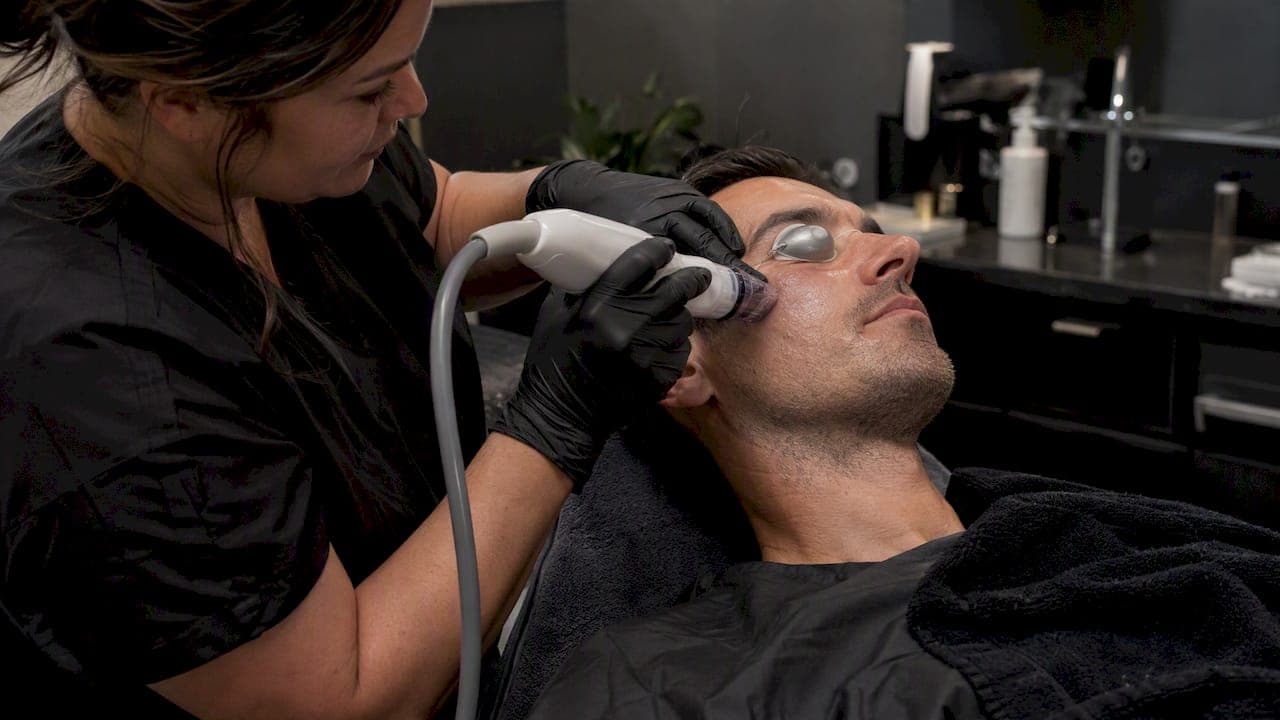
Microneedling under the eyes can soften fine lines and improve skin texture, and it may help some types of dark circles. It will not remove eye bags or fix loose skin. The skin here is the thinnest on your face, so this is a treatment for a trained, registered practitioner, never a home roller. Below we explain what it does, what it cannot do, how it feels, what it costs and how to choose who does it.
TL;DR
- Microneedling stimulates collagen, so it suits fine lines, crepey texture and some dark circles. It does not remove puffiness or sagging.
- Under-eye skin is often thinner than 50 microns, so depth and technique matter more than the device. Do not use a home roller here.
- Expect redness for roughly 24 to 72 hours, and a course of several sessions spaced weeks apart.
- Check your practitioner's registration and training before you book, and tell them about scarring, bleeding disorders and medication.
- Our microneedling facial is £70 for a single treatment, £100 for a course of 2 and £200 for a course of 4.
Table of Contents
- What microneedling does to the skin under your eyes
- Does microneedling work on under-eye wrinkles?
- Can microneedling help dark circles?
- What microneedling cannot fix
- Why the eye area needs a specialist
- What the treatment is like
- Downtime and aftercare
- How many sessions and how long to wait
- Preparing your skin
- How to choose a practitioner in the UK
- Perspective: how we approach the eye area
- Microneedling at Rivers Edge Skin Studio
- Other options for under-eye concerns
- FAQ
- Sources
What microneedling does to the skin under your eyes
Microneedling uses fine, sterile needles to make controlled micro-injuries in the skin. Your body responds by repairing them, and that repair process produces new collagen and elastin. The JCCP information sheet on skin rejuvenation describes the treatment in the same terms: thousands of tiny channels made by repeated puncturing of the skin.
Under the eyes, that matters for three things:
- Fine lines and crinkling. Collagen gives skin its bounce. More of it means shallower, softer lines.
- Texture. Thin, slightly rough or crepey skin tends to look smoother after a course.
- Tone. Some dark circles come from thin skin showing the blood vessels beneath. Thicker, healthier skin can reduce that blue-grey shadow.
If you want the general picture first, our step-by-step guide to microneedling for men and the explainer on what microneedling treatment is cover the basics.
Does microneedling work on under-eye wrinkles?
The best evidence is for fine lines around the eyes, mostly with radiofrequency microneedling (RFMN), which adds heat energy at the needle tip. A 2024 prospective study of 24 participants reported an average 49% drop in wrinkle severity scores after a series of sessions. That is a small, non-randomised trial, so treat it as encouraging rather than conclusive.
Plain, non-radiofrequency microneedling has a thinner evidence base for this area. Dermatology UK says it can soften fine lines and improve skin texture, and that it is a resurfacing treatment, not a filler. That is a fair way to set your expectations: smoother, healthier skin, not a different face.
Deep creases are a different job. Lines caused by muscle movement, such as crow's feet when you squint, often respond better to anti-wrinkle injections, which relax the muscle. Many men do best with a combination. You can read about our anti-wrinkle injections for men in Liverpool if that sounds like your concern.

Can microneedling help dark circles?
Sometimes. It depends entirely on what is causing yours.
| Cause of dark circles | Will microneedling help? |
|---|---|
| Thin skin showing blood vessels (blue or purple tint) | Possibly. Thicker skin hides vessels better. |
| Pigmentation (brown tint) | Possibly, often alongside other treatments such as peels. |
| Hollowing or a tear trough groove (shadow from volume loss) | Limited. The shadow comes from structure, not skin. |
| Puffy fat pads casting a shadow | No. This is a structural issue. |
| Tiredness, allergies, dehydration | Treat the cause first. |
There is clinical research on the subject. A trial of microneedle fractional radiofrequency for infraorbital dark circles and a study of the same approach for periorbital hyperpigmentation both looked at it. Both used radiofrequency devices, so they do not prove that a standard needle device gives the same results. A 2025 systematic review of under-eye treatments is a useful reminder that hollowing, pigmentation, visible vessels and laxity are separate problems with separate solutions.
That is why a proper assessment matters more than the treatment name. Two men with "dark circles" can need completely different things.
What microneedling cannot fix
Be clear on this before you spend money. Microneedling improves texture and fine lines by boosting collagen, but it does not correct prominent fat pads or significant skin laxity. Those usually need surgery, such as lower blepharoplasty. Patients who expect surgical results from microneedling tend to be disappointed.
In practice:
- Eye bags that stick out when you wake up and stay all day: structural. Microneedling will not shrink them.
- Deep hollows under the eye: volume loss. Skin treatments help the surface, not the hollow.
- Hanging, loose lower lids: laxity beyond what collagen stimulation can tighten.
A good practitioner will tell you this at consultation. If anyone promises to remove bags with needling, walk away.
Why the eye area needs a specialist
The skin around the eyes is exceptionally thin, often under 50 microns. Using standard facial settings here risks thermal injury, loss of fat under the skin and prolonged scarring rather than rejuvenation. The same source notes that experienced practitioners adjust needle depth and energy for the periocular area and often use corneal shields near the lash line.
Uncommon complications include burns, fat loss and scarring, and they are more likely with inexperienced providers. A good provider recognises early signs of infection or poor healing and has a plan to deal with them.
There is also a myth that more aggression means better results. Clinical guidance says the opposite: pushing hard on delicate skin can permanently damage the skin barrier, and the right depth depends on your skin thickness and your specific concern.
Why you should not do this at home
Home derma rollers and pens cannot be adjusted by someone who has assessed your skin, and a bent or dirty needle can cause real damage. Dermatology UK points out that at-home devices are not equivalent to clinic treatment for real collagen remodelling. Under the eyes, the risk is not worth the saving. Our piece on common microneedling mistakes lists the others.
What the treatment is like
A typical appointment follows this pattern:
- Consultation. Your practitioner asks about your medical history, medication, skin type and what bothers you. They look at your skin in good light and tell you whether needling is right.
- Cleansing and numbing. The skin is cleansed, and a topical numbing cream may be used.
- Treatment. A sterile, single-use needle head is used, with depth set for the area. Protection is used near the eyes where appropriate.
- Soothing. A calming product is applied, followed by SPF guidance.
Most men describe it as a scratchy, warm, slightly tight feeling rather than real pain. The under-eye area is often quicker and gentler than other zones because shallow settings are used.
Downtime and aftercare
Plan for redness and warmth similar to mild sunburn, which usually settles within 24 to 72 hours. Some men get mild swelling or light flaking around days 3 to 5. Swelling under the eyes can look more obvious than elsewhere because the tissue is loose, so avoid booking before an important event.
Our guide to what to expect in the 24 to 72 hours after microneedling walks through the first days. A few basics apply:
- Do not rub or touch the area, and keep your hands clean.
- Use only the gentle products your practitioner recommends.
- Wear a broad-spectrum SPF daily. Our note on sun exposure after microneedling explains why.
- Skip heavy exercise, saunas and swimming pools for the period your practitioner advises.
See your practitioner promptly, or your GP if you cannot reach them, if you notice spreading redness, pus, increasing pain or any change in your vision.
How many sessions and how long to wait
Practitioners typically recommend 3 to 5 sessions, spaced 3 to 8 weeks apart. Collagen builds slowly, so results appear gradually over weeks and months, not days. For the periocular area, a cautious schedule with shallow depths is usually sensible. Our article on microneedling frequency by depth explains why spacing matters, although it focuses on the scalp.

Preparing your skin
Experts often suggest starting vitamin A and vitamin C topicals for at least a month before treatment, to help collagen formation and prepare the skin to respond. Do not start a strong retinoid on the eye area on your own. Ask your practitioner which product and strength suit you, because retinoids can irritate thin skin and your practitioner may ask you to pause them before treatment.
Also tell your practitioner about:
- Any history of keloid or raised scarring
- Bleeding disorders or blood-thinning medication
- Active infections, cold sores or eczema near the eyes
- Recent sun exposure or sunbed use
- Isotretinoin or other medicines that affect healing
How to choose a practitioner in the UK
Aesthetic clinics in the UK are not regulated as tightly as surgical settings, so the choice of practitioner is your main safety decision. The device brand matters less than their training, experience and hygiene standards.
Use this checklist:
- Look for registration on the JCCP practitioner register, which exists to promote patient safety in non-surgical aesthetics.
- Ask how often they treat the eye area and what depth they use there.
- Expect a proper consultation with a medical history, not a quick sell.
- Ask what happens if something goes wrong and who you contact afterwards.
- Check that needles are single-use and the room is clean.
- Be wary of discounts that push you to book on the spot.
Perspective: how we approach the eye area
We only treat men, and that changes the conversation. Most men who come to us about their eyes are not after a dramatic change. They want to look less tired and less lined without looking "done". That is a reasonable aim, and it is also the one that needs the most restraint.
The first thing we do is work out what is causing the concern. Fine lines, a blue shadow, a hollow and a puffy lid are different problems. Sometimes microneedling is the right step. Sometimes the honest answer is an anti-wrinkle treatment, a peel, polynucleotides or, for a structural bag, a conversation with a surgeon. We would rather tell you that than book you into a treatment that will not deliver.
We have written about polynucleotide injections under the eyes for men who want a different route to the same area. We also believe that looking after your skin should not be complicated: a clear plan, a sensible course, and daily SPF do more than any single appointment.
— David
Microneedling at Rivers Edge Skin Studio
If you are in Liverpool or elsewhere in Merseyside, our microneedling for men in Liverpool page explains how we work. Every treatment starts with a personalised plan. Our current microneedling facial prices are:
| Treatment | Price |
|---|---|
| Microneedling facial, single treatment | £70 |
| Microneedling facial, course of 2 | £100 |
| Microneedling facial, course of 4 | £200 |
If your main concern is surface texture and tone, our chemical peels for men in Liverpool are another option, and you can see every treatment and price on our services page. Tell us about your under-eye concern when you book, and we will advise on what is suitable for you before any treatment goes ahead.
Other options for under-eye concerns
Microneedling sits in the middle of a ladder of options. A treatment ladder for under-eye wrinkles runs from sunscreen and topical retinoids, through in-office procedures such as laser resurfacing, microneedling and muscle-relaxing injections, up to surgery. A rough guide:
- Daily SPF and a gentle moisturiser: the foundation for everything else.
- Topical vitamin A and C: slow, steady improvement in texture.
- Chemical peels: better for surface tone and fine texture.
- Anti-wrinkle injections: best for lines caused by movement.
- Polynucleotides: aimed at skin quality and hydration around the eyes.
- Microneedling: collagen stimulation for texture and fine lines.
- Surgery: for bags and laxity that skin treatments cannot reach.
Start at the bottom and move up only if you need to.
FAQ
Can you do microneedling under the eyes?
Yes, but only with a trained practitioner who adjusts depth for the thin skin there. Home rollers and pens are not a safe substitute. A consultation should confirm that you have no medical reason to avoid it.
Can microneedling get rid of dark circles?
It can improve some of them, particularly where thin skin shows blood vessels or where there is mild pigmentation. It will not fix shadows from hollowing or puffy fat pads. Realistic expectations are a lighter, healthier-looking area, not a complete change.
How often should I have microneedling?
Most plans involve 3 to 5 sessions spaced 3 to 8 weeks apart, then occasional maintenance if you want it. Your practitioner will set the schedule based on your skin and the depth used.
What is the downside of microneedling?
Expect temporary redness, tightness and sometimes mild swelling or flaking for a few days. Rare problems such as infection, burns or scarring are linked mainly to poor technique or aftercare. Choosing a registered practitioner lowers that risk.
What is the best permanent treatment for under-eye bags?
Bags caused by prominent fat pads are structural, and surgery such as lower blepharoplasty is the usual route. Microneedling will not remove them. Speak to a qualified surgeon if bags are your main concern.
Sources
- Microneedling UK: At-Home vs In-Clinic, Costs and Realistic Results, Dermatology UK
- RF Microneedling Around the Eyes, Specialty Vision
- Microneedling With RF-Assisted Skin Penetration Improves Periorbital Wrinkles, nonrandomised clinical trial
- Microneedle fractional radiofrequency system for infraorbital dark circles, prospective trial
- Microneedle fractional radiofrequency in the treatment of periorbital dark circles
- What's New With Under Eye Treatment: a systematic review
- Under-Eye Wrinkles: Evidence-Based Treatment Ladder Guide
- Expert opinion on pre and post procedure care in aesthetic dermatology
- JCCP information sheet: Skin Rejuvenation
- JCCP: Practitioners and Clinics