
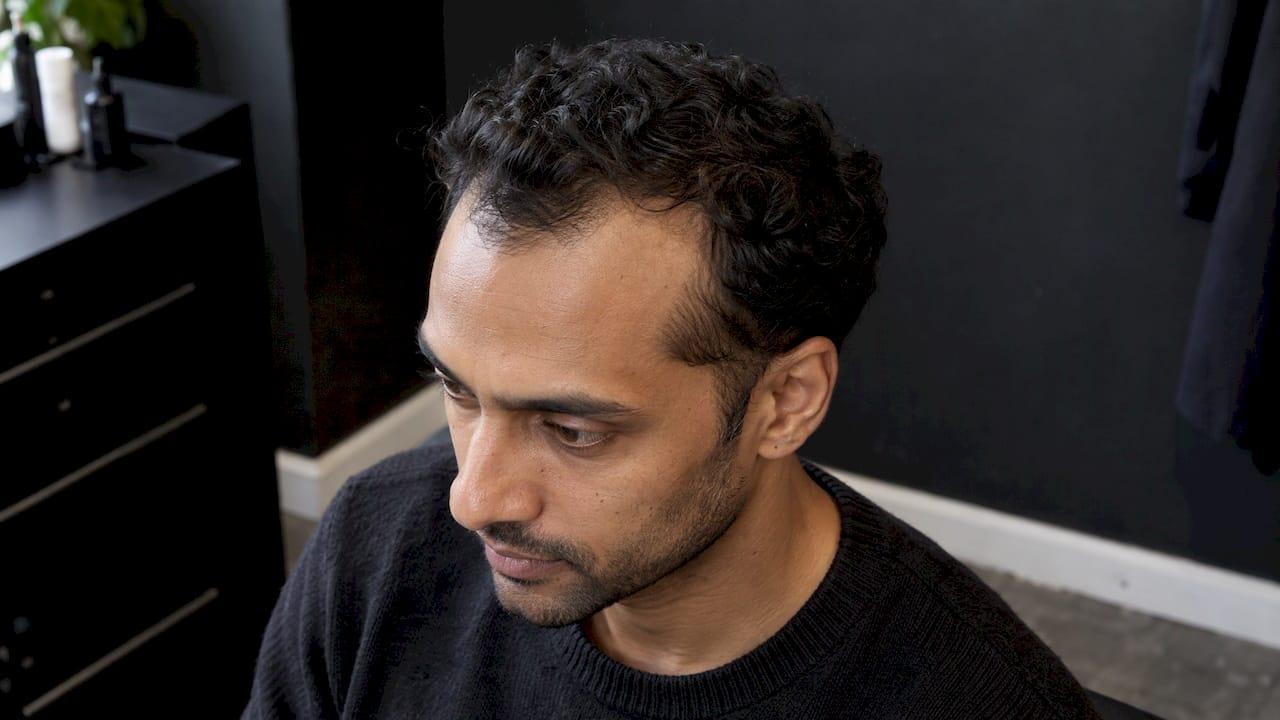
The Norwood scale is the standard way to describe male pattern hair loss. It grades a man's hairline and crown from Stage 1 (no loss) to Stage 7 (only a band of hair round the sides and back). Knowing your stage tells you what is happening, what to expect and when treatment is worth considering. At Rivers Edge Skin Studio in Liverpool we treat hair loss in men with scalp microneedling and polynucleotides, so this guide also shows where each treatment fits.
TL;DR
- The Norwood scale has seven stages. It tracks two zones: the hairline at the temples and the crown.
- Stage 3 is the first stage generally treated as clinically significant balding. Stages 1 and 2 are usually normal variation.
- The scale describes a pattern. It does not diagnose a cause, predict speed or set a treatment plan.
- A set of three photos taken in the same light, repeated months later, shows far more than one look in the mirror.
- Earlier is easier. If you are at Stage 2 to 4, scalp microneedling and polynucleotides are worth discussing with us.
Table of Contents
- What the Norwood scale measures
- The seven stages, one by one
- Reading your own stage from pictures
- What the scale cannot tell you
- How fast does it progress?
- What each stage means for treatment
- Perspective: why we start with the scalp, not the number
- Book a hair-loss consultation in Liverpool
- FAQ
- Sources
What the Norwood scale measures
The scale is a classification system for the extent of hair loss, with seven stages that each describe the severity and pattern of male pattern hair loss. It was built on the observation that two areas tend to change together: the temples and the crown. As loss advances, those two areas widen and can eventually join into one.

The scale comes from Dr O'Tar Norwood's 1975 paper, Male pattern baldness: classification and incidence. He used it to work out how common each pattern is at different ages in 1,000 white adult men. It refined an earlier classification by Dr James Hamilton, which is why you will also see it called the Hamilton-Norwood scale, according to the American Hair Loss Association.
The cause behind the pattern is usually androgenetic alopecia, the inherited sensitivity of hair follicles to hormones. The same association says it accounts for over 95% of hair loss in men. Its figures are American, but they give a sense of scale: by 35, around two thirds of men have some noticeable loss, and by 50 about 85% have significant thinning.
The scale is for men only. Women's pattern hair loss is graded on different scales.
The seven stages, one by one
Here is each stage in plain terms, following the descriptions in the UK Hair Restoration Society's training material.
| Stage | What you see | Usually means |
|---|---|---|
| 1 | Full hairline, no significant loss | Baseline, no balding |
| 2 | Slight recession at the temples | Often a mature adult hairline |
| 3 | Deeper M-, U- or V-shaped recession at the temples | First clinically significant balding |
| 3 vertex | Hairline near stage 2, but clear thinning on the crown | Crown-led pattern |
| 4 | Greater recession, sparse or no hair on the crown, separated by a band of hair | Two distinct balding zones |
| 5 | Larger zones, with the band between them narrower and sparser | Zones close to joining |
| 6 | Temple and crown areas joined, band across the top gone or sparse | One large balding area |
| 7 | Only a band of hair round the sides and back, usually fine | Most advanced stage |
Stages 1 and 2: baseline and the mature hairline
Stage 1 is a full head of hair with no recession. It is not balding. Stage 2 is slight recession at the temples. For many men this is simply the adult hairline settling in during the late teens and twenties, and it stays put.
The difference between a mature hairline and early loss is movement. A hairline that has stopped moving is fine. One that keeps creeping back, with finer and shorter hairs along the edge, is the start of a pattern. You can only tell by comparing photos over time (more on that below).
Stage 3: where balding is generally recognised
Stage 3 is the first stage that the American Hair Loss Association describes as clinically significant male pattern hair loss. The temples recede deeper, giving a clear M, U or V shape. The corners may be thin or bare.
There is also a Stage 3 vertex. Here the hairline stays closer to Stage 2, but the crown is visibly thinner. If this is you, our guide to crown thinning in men covers the early signs. For temple-led loss, see temple thinning in men.
Stages 4 and 5: two zones, one thinning band
At Stage 4 the front recession is more severe and the crown is sparse or bare. A band of hair still runs across the top between the two. At Stage 5 both areas are bigger and that band is narrower and thinner.
This is where many men notice for the first time that something is clearly happening. Some also see a variation, often labelled "A" (for example 4A), where the whole front hairline moves back as one area and there is no separate crown spot.
Stages 6 and 7: the zones merge
At Stage 6 the front and crown areas have joined and the band across the top is gone or very sparse. At Stage 7 only a band of hair remains round the sides and back, and it is usually fine rather than dense.
Reading your own stage from pictures
Norwood scale pictures are useful, but only if you use them properly. A diagram shows an ideal pattern. Your own head will sit between two drawings, and that is normal.
A method that works:
- Take three photos in the same light. Front on, from directly above and in profile. Use the same room, the same time of day and dry, unstyled hair.
- Judge the hairline and crown separately. Match your temples to one stage and your crown to another, then combine them. Mirror checks tend to underplay the crown, because you rarely see it.
- Repeat in three to six months. One photo shows a state, not a direction. Two photos taken months apart show whether anything is changing.
- Keep the files together. Dated photos give you a baseline if you later book a consultation.
If you want to see how different cuts sit on a thinning crown or a higher hairline, a virtual hairstyle try-on tool lets you preview styles on your own photo.
Photos also help with a different problem. Sudden shedding or an overall thinning across the whole scalp is not a Norwood pattern. That is assessed separately, and our guide to diffuse thinning in men explains the causes and tests.
What the scale cannot tell you
The scale is a label, not a diagnosis. The American Hair Loss Association points out that two men at the same stage can have very different hair thickness, follicle miniaturisation and rates of progression. The scale does not predict whether you will move on to the next stage, or when.
That is why a Stage 3 man may stay there for decades while another moves on within a few years. The scale gives you a common language. Your pattern over time, your family history and a proper look at the scalp give you the rest.
How fast does it progress?
Norwood's own survey is the best-known reference. It showed that the share of men at higher stages rises steadily with age, which is why a receding hairline at 25 and a receding hairline at 55 mean different things for the road ahead. The original 1975 study also noted that time keeps having an effect even in later years.
In practice, progress is uneven. Some men have a quick run through two stages and then pause. Others lose slowly and steadily. Stress, illness and general health can change how a pattern looks in the short term, even though the underlying driver is inherited.
The practical point is simple: you cannot assume that your current stage is where you will stay. Tracking it is cheap and easy.
What each stage means for treatment
The NHS names finasteride and minoxidil as the main medicines for male pattern baldness, and notes that they only work for as long as they are used. Both need a conversation with a GP or pharmacist about suitability. Alongside medicines, in-clinic treatments aim to support the scalp and the follicles.
Here is how we think about it by stage.
Stages 1 and 2
At Stage 1 there is usually nothing to treat. At Stage 2, the question is whether it is a settled mature hairline or early loss. Take your photos, wait a few months and compare. If the edge is getting thinner, it is worth acting early rather than waiting for Stage 3.
Stages 3 and 4
This is the window where most men start asking about treatment, and where there is still a lot of hair to support. At Rivers Edge Skin Studio we offer two hair-loss treatments here:
- Scalp microneedling (head microneedling), priced at £70 a session. Fine needles create tiny controlled channels in the scalp. Our guides explain what to expect by 12 to 16 weeks and the 72-hour aftercare.
- Scalp polynucleotides, an injectable skin-booster approach for the scalp. Read what men need to know about polynucleotides for hair loss. Injectable treatments are for clients aged 18 or over.
For a broader look at the options, see what treatment actually works on a receding hairline and our overview of hair regeneration treatments for men.
Stages 5 to 7
Where the zones are close to joining or have joined, there is less hair to work with, and expectations need to be realistic. Treatments are aimed at the hair that remains. A consultation lets us look at your scalp and agree what is sensible for you. Hair transplant surgery is a surgical decision for a specialist surgeon, and the Norwood stage alone should not decide it.
Perspective: why we start with the scalp, not the number
Men usually arrive with a stage in mind. They have matched a photo to a diagram and want to know if the number is right. It is a good starting point, and we are glad when a client has already taken his own photos.
What we care about more is the trend. A Stage 2 hairline that has not moved in five years is a different conversation from a Stage 2 hairline that has thinned since last spring.
We are a men-only clinic, so we talk to men about hair loss every day in plain language, without fuss. Our treatment plans are personal: scalp microneedling, polynucleotides or a combination, set around where you are now and what you want to keep.
The earlier you ask, the more there is to work with.
David
Book a hair-loss consultation in Liverpool
If you have worked out roughly where you sit on the scale, the next step is to have your scalp looked at properly. Rivers Edge Skin Studio is at Unit 6, 10-14 Jamaica St, Liverpool L1 0AF, open Monday to Saturday 10:00 to 17:00 and closed on Sundays. Alongside hair-loss treatments we offer men's facials, chemical peels, microneedling, skin boosters, anti-wrinkle injections, sweat (hyperhidrosis) injections, polynucleotides and vitamin injections. You can see the full list on our services page and book online.

Bring your dated photos if you have them. They make the first appointment far more useful.
FAQ
Is Norwood scale 1 balding?
No. Stage 1 is a full head of hair with no significant recession and is the baseline of the scale. Balding is generally recognised from Stage 3. Stage 1 usually needs no treatment, only occasional photos if you want to track your hairline.
Is a Stage 2 hairline normal?
Often, yes. Slight temple recession is common in adult men and many keep it for life. The thing to watch is change. If photos taken a few months apart show the edge moving back or the hairs there getting finer, it is worth a consultation.
Does the Norwood scale apply to women?
No. It was designed for male pattern baldness only. Women's hair loss follows a different pattern and is graded on other scales. Our clinic treats men only.
Can I move up the scale quickly?
It varies from man to man. Some stay at one stage for many years, while others progress faster. The scale cannot predict your pace, so the most reliable approach is regular photos in the same light and a consultation if you see change.
Sources
- Norwood Scale of Hair Loss, UK Hair Restoration Society
- Male pattern baldness: classification and incidence, PubMed
- Men's Hair Loss, American Hair Loss Association
- Hair loss, NHS
- Virtual hairstyle try-on tool