
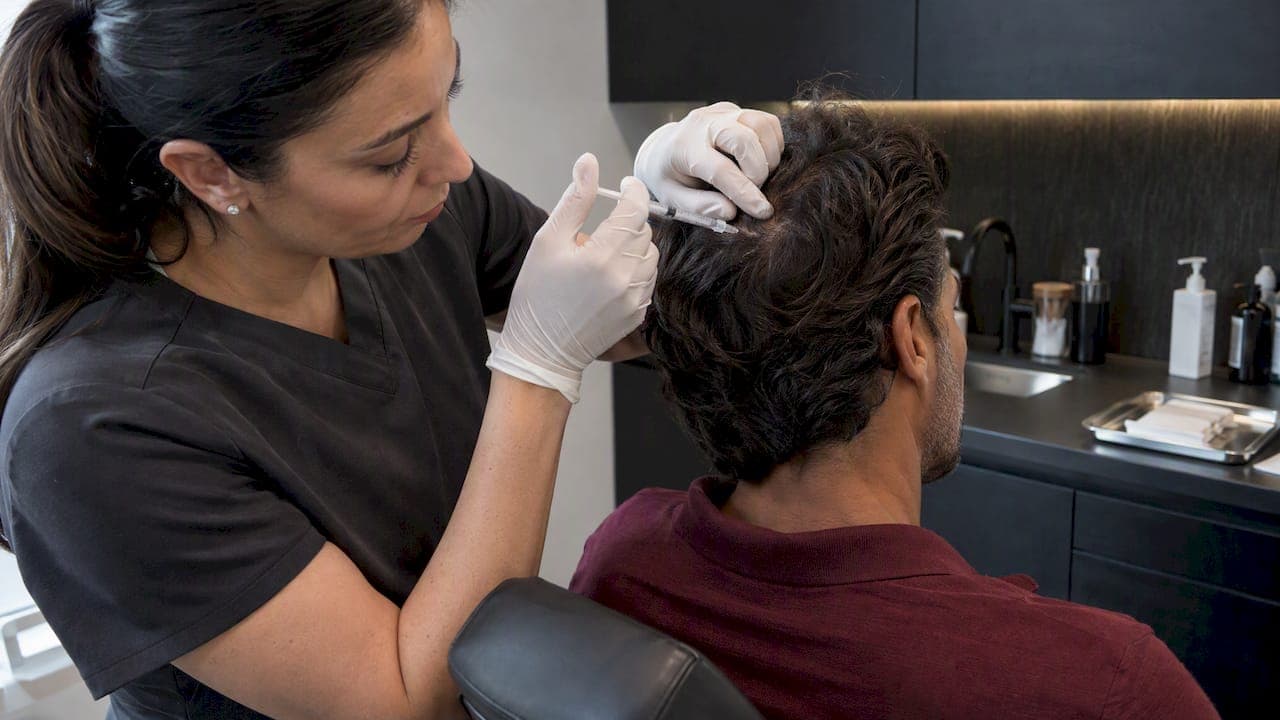
Polynucleotide injections are a scalp treatment that aims to improve the environment around your hair follicles so thinning hair grows thicker. Early studies are encouraging, but the evidence is still small and the treatment is not a cure for male pattern baldness. It suits men with early to moderate thinning, and it works best after the cause of the hair loss has been identified. Here is what the research says, who is a good candidate, and what to expect.
TL;DR
- Polynucleotides are purified DNA fragments injected into the scalp to calm inflammation and support follicle health.
- Small studies report thicker, denser hair, but the authors call for larger trials. Treat it as promising, not proven.
- Men with early to intermediate thinning tend to see the clearest benefit. Advanced baldness and scarring hair loss are poor candidates.
- See your GP first if hair loss is sudden, patchy or unexpected. Finasteride and minoxidil remain the main established treatments.
- At Rivers Edge Skin Studio in Liverpool, Scalp Polynucleotides cost £240 per treatment.
Table of Contents
- What polynucleotides are and how they may help hair
- What the evidence shows
- Who is likely to benefit
- How polynucleotides compare with established treatments
- What a treatment looks like
- Results, side effects and aftercare
- Our perspective
- Scalp treatment at Rivers Edge Skin Studio
- FAQ
- Sources
What polynucleotides are and how they may help hair
Polynucleotides are chains of DNA fragments, usually purified from fish sources such as salmon. In aesthetics they have been used for skin quality for some time. More recently, clinics have started injecting them into the scalp.
The idea is simple. A 2025 study from Thailand describes polynucleotides as stimulating tissue regeneration by reducing inflammation, activating growth factors and speeding up the formation of new blood vessels. All three matter for hair. Inflamed, poorly supplied scalp tissue is a harder place for a follicle to work.
It helps to be clear about what this does not do. In male pattern hair loss, follicles shrink under the influence of hormones and genetics. Polynucleotides do not change your genes or block the hormone involved. They aim to support the follicles you still have.
What the evidence shows
The research is real, but small. Here are the main findings.
| Study | Who and what | Reported result |
|---|---|---|
| 2025, Thailand | 28 patients with androgenetic alopecia, four injection sessions at four-week intervals | Hair diameter and density improved from one month onward, with no serious side effects |
| 2024, Iran | Polynucleotide-based gel injections | Significant increase in hair thickness and a 24.2% rise in terminal hair count at 24 weeks |
| 2015 study | PDRN-only injections, 12 sessions | Mean hair count up 17.9% and thickness up 13.5% |
In the 2025 Thai study, patients rated improvement in 82.1% of cases. That is a self-reported measure, so read it as encouraging rather than decisive.
Why you should stay realistic
The limits are as important as the results. A 2026 report of four patients found the clearest benefit in early to intermediate disease. The advanced case showed only mild improvement, and the authors call the evidence preliminary.
The Journal of Cosmetic Dermatology cautions that trials in this area have small sample sizes, so findings should be treated as exploratory. A 2026 review of non-surgical therapies says much the same: the mechanism is plausible, but larger, adequately powered trials are needed.
So when a clinic says polynucleotides "regrow" hair, be careful. The honest version is that they may thicken and strengthen existing hair, mostly in men who have not lost much yet.
Who is likely to benefit
The best candidate is a man who has noticed thinning at the crown or temples, still has plenty of live follicles, and wants to act early. If that sounds like you, our guides on crown thinning in men and receding hairlines help you judge where you are.
Some men are poor candidates. A clinical overview of polynucleotides in hair loss lists advanced androgenetic alopecia (Norwood VI to VII), scarring alopecias, alopecia areata, and a history of fish or seafood anaphylaxis among them. If you have had a severe reaction to fish, tell us before anything else.
Get the cause checked first
Not all hair loss is male pattern baldness. The NHS advises speaking to a GP to find the cause before paying for a commercial clinic treatment, especially if the hair loss is unexpected.
This matters for a practical reason. The British Association of Dermatologists explains that sudden, diffuse shedding may be telogen effluvium. Common triggers include severe illness or fever, stress, surgery, marked weight loss and medication changes. Assessment can involve a hair-pull test and sometimes blood tests for thyroid disease or iron deficiency.
Male pattern hair loss, by contrast, is usually diagnosed from your history, the pattern at the front and top, and family history. The scalp normally looks healthy.
The European guideline on diagnosing androgenetic alopecia adds that iron deficiency, thyroid problems, inflammatory disease, infection and scarring disorders can mimic or worsen it. It also recommends recording details such as medicines, anabolic steroid use, diet or weight loss, and tight hairstyles before treating. If your shedding is heavy and recent, our guide to diffuse thinning in men covers causes and tests.
How polynucleotides compare with established treatments
The NHS names finasteride and minoxidil as the main treatments for male pattern baldness. It also notes that not all treatments are available on the NHS and they can be expensive if you pay privately. These have far more evidence behind them than polynucleotides.
That shapes how we think about the injections. Polynucleotides are best seen as an addition to a sensible plan, not a replacement for it. If you want a wider look at what is available alongside prescription options, this guide to hair volumizing products backed by evidence is a useful companion for early thinning.
Microneedling is another option that sits well with injections. We explain how it works with minoxidil in our article on microneedling for hair loss, and what to expect in scalp microneedling results. For a broader view, see hair regeneration for men.

What a treatment looks like
A scalp polynucleotide session is a series of small injections across the thinning areas. The studies give a useful reference point: the Thai trial used four sessions at four-week intervals. Other protocols differ, and the right number depends on how much thinning you have and how your scalp responds.
On the day, expect this:
- Consultation. We look at your pattern of loss, ask about family history, medicines and any allergies, and check your scalp.
- Preparation. The scalp is cleaned and, where needed, prepared for comfort.
- Injections. Small amounts are placed across the treatment area.
- Aftercare advice. You leave with clear guidance for the next few days.
We do not publish a fixed session count for everyone, because it should be set at your consultation rather than guessed from a web page.
Results, side effects and aftercare
In the studies above, improvements were measured from about one month in the Thai trial and at 24 weeks in the Iranian study. Hair grows slowly, so judge progress over months, not weeks. Nobody can promise how long results last for you, and maintenance sessions may be discussed once your course ends.
The studies report no serious side effects. Minor reactions at injection sites, such as redness, small bumps, tenderness or occasional bruising, are the usual things to expect. They are typically short-lived. We go into more detail in our guide to polynucleotide side effects.
Contact the clinic or your GP if you develop increasing pain, spreading redness with heat, pus or a fever after treatment. Those are not normal signs.
Our perspective
We work only with men, and hair loss is one of the most common things men raise with us, often quietly and late. Our view is simple. Polynucleotides are worth considering if you are thinning early and want to support your scalp. They are not worth buying on a promise of a full head of hair.

We would rather tell you honestly that your hair loss is too advanced, or that a GP visit comes first, than book you in for a treatment that will disappoint you. When we do treat, we build the plan around you. Scalp polynucleotides can be paired with head microneedling, and some men also ask about biotin injections. We explain what each one can and cannot do so you can decide calmly.
Looking after your skin and scalp should not be complicated. Start with a proper assessment, set realistic expectations, and give the treatment time.
— David
Scalp treatment at Rivers Edge Skin Studio
We are a men's skin clinic in Liverpool, and scalp care is part of what we offer. Scalp Polynucleotides cost £240 per treatment, and Head Microneedling costs £70. You can see the full list on our services page, and you can book online.

If you are not sure which treatment fits, book a consultation and tell us what you have noticed. We will give you a straight answer. You can also read about our microneedling treatments for the face.
FAQ
Do polynucleotides regrow hair in men?
They may thicken and strengthen existing hair, mainly where follicles are still active. Studies report gains in hair density and thickness, but the trials are small and the authors ask for larger ones. They do not reverse advanced baldness.
How long do polynucleotide hair injections take to work?
Some studies measured improvement from one month, while others assessed results at 24 weeks. Hair cycles are slow, so give a course several months before judging it. Your clinician can tell you what is realistic for your pattern of loss.
Are polynucleotide injections safe?
The studies we reviewed reported no serious side effects, and minor injection-site reactions are the usual finding. Men with a history of fish or seafood anaphylaxis should avoid them, as the product is typically fish-derived. Always disclose allergies and medicines at consultation.
Should I see a GP before treatment?
Yes, if your hair loss is sudden, patchy or unexpected. The NHS recommends finding the underlying cause first, and conditions like thyroid problems or iron deficiency can cause shedding. Treatment works best when the diagnosis is clear.
Can I use polynucleotides with finasteride or minoxidil?
Many men use injections alongside established treatments, not instead of them. Tell us what you currently use so we can plan around it. Your GP or prescriber should guide any decision about prescription medicines.
Sources
- Polynucleotides as a novel therapeutic approach in androgenetic alopecia (Springer, 2025)
- Polynucleotide injections and hair diameter and density (PubMed, 2025)
- Polynucleotide-based gel for pattern hair loss (2024)
- PDRN injections study (PubMed, 2015)
- Follicular microenvironment modulation in androgenetic alopecia (2026)
- Polydeoxyribonucleotide in female pattern hair loss (Journal of Cosmetic Dermatology, 2025)
- Minimally invasive non-surgical therapies for androgenetic alopecia (2026)
- PDRN for hair loss: a clinical overview
- Hair loss (NHS)
- Telogen effluvium (British Association of Dermatologists)
- Hair loss, male pattern (British Association of Dermatologists)
- European S1 guideline for androgenetic alopecia
- Hair volumizing products backed by evidence (MyHair)