
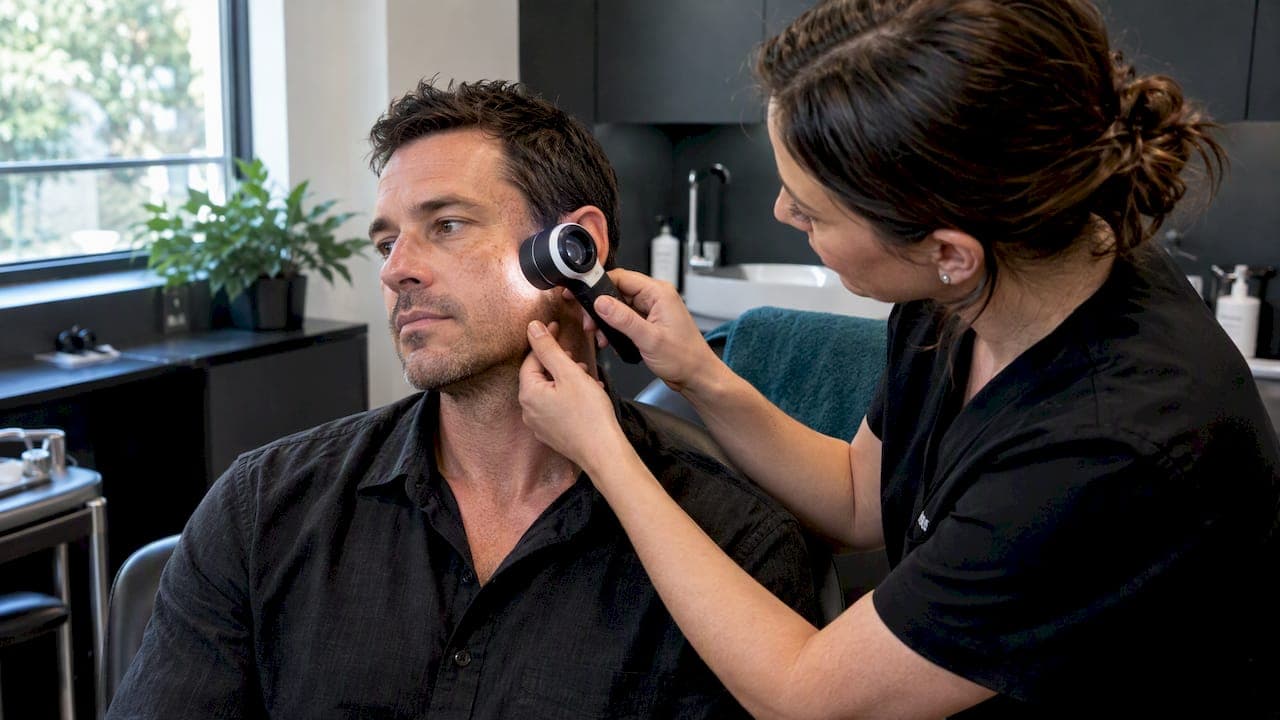
If you have scaly, crusty or changing spots, see a GP or dermatologist before anything else. Otherwise, a combination of prescription topicals, long-term retinoid use and in-clinic procedures such as peels or microneedling gives the most reliable improvement. The right starting point is a proper skin assessment, because medical and cosmetic sun damage need different treatment routes entirely.
TL;DR:
- Most men with sun damage require medical assessment first to confirm actinic keratoses before pursuing cosmetic treatments like peels or microneedling.
- Prescription treatments such as 5-FU, imiquimod, or tirbanibulin depend on lesion number, size, and location, with field therapies for diffuse damage and spot treatments for single patches.
- Professional procedures like chemical peels, microneedling, and laser treatments should be sequenced after medical clearance to avoid masking underlying lesions.
- Post-treatment recovery involves avoiding shaving on treated areas, maintaining strict sun protection, and managing skin sensitivity, especially with facial hair or shaving habits.
- Men’s lifestyles, including outdoor work, smoking, alcohol, and facial hair, influence sun damage development and can hinder treatment outcomes.
Table of Contents
- How sun damage shows up in men: recognising medical vs cosmetic signs
- Topical and prescription treatments: 5-FU, imiquimod, tirbanibulin, diclofenac and retinoids
- Professional procedures: peels, microneedling, lasers and more
- How clinicians choose a treatment: what to ask at consultation
- Home care and prevention: sunscreens, retinoids and daily habits
- Rivers Edge Skin Studio: what to expect from a consultation
- Lifestyle factors common in men affecting sun damage and treatment outcomes
- Post-treatment care and management specific to male skin
- Psychological and social aspects of sun damage treatment in men
- Author's expert view: realistic outcomes and why assessment comes first
- Ready to start: book a skin assessment with us
- FAQ
- Sources
How sun damage shows up in men: recognising medical vs cosmetic signs
Years of cumulative UV exposure change skin in two distinct ways: cosmetic changes that affect how skin looks, and medical changes that affect whether it is healthy. Men often present later than women because skin checks are less habitual, and because facial hair can hide early patches on the cheeks and jawline until they become more obvious.
The cosmetic signs are familiar: fine wrinkling, leathery texture, brown patches called lentigines and a general loss of the skin's bounce as collagen thins. The medical sign to know is the actinic keratosis, a rough, scaly or crusty patch that often feels more obvious to the touch than it looks to the eye. These develop from sun-damaged skin cells and are classed as precancerous, meaning they carry a small but real risk of progressing if left untreated, which is why a clinical pathway exists specifically to grade and manage them.
Certain patterns raise the likelihood of significant sun damage:
- Years of outdoor work, sport or driving with regular sun exposure on the face, scalp, ears, neck and back of the hands.
- A history of sunburns, especially blistering burns in youth.
- Fair or freckle-prone skin that burns rather than tans easily.
- Thinning hair or a shaved head, which leaves the scalp more exposed over time.
A short checklist of red flags should prompt an urgent GP appointment rather than a wait-and-see approach: a spot that is growing, bleeding, ulcerated, newly raised or firm to the touch, or one that looks different from anything else on your skin. Anything that fits that description needs medical eyes on it before any cosmetic plan goes anywhere near it.
Topical and prescription treatments: 5-FU, imiquimod, tirbanibulin, diclofenac and retinoids
Once actinic keratoses are confirmed, treatment choice depends on how many lesions there are, how widespread the affected area is and how a man's skin and lifestyle fit around the regimen. There are two broad approaches: lesion-directed treatment for a single spot, and field therapy for an area with multiple patches or sun damage that is too diffuse to treat spot by spot.
5-fluorouracil (5-FU), sold as Efudix or Tolak, is a topical chemotherapy cream that targets rapidly dividing, sun-damaged cells across a treated area. According to the Royal Marsden's patient factsheet, the cream is expected to cause redness, erosion and crusting, and this reaction is actually a sign the medicine is working rather than a complication to worry about. The reaction typically peaks around the second week of use, with healing continuing for several weeks after the course finishes, and clinicians often treat large areas in stages to keep the inflammation manageable rather than covering everything at once.
Other prescription options used in UK primary and secondary care include:
- Imiquimod, an immune-response cream usually applied a few times a week over several weeks, suited to field therapy on the face or scalp.
- Tirbanibulin, a newer field treatment applied once daily for just five days, appealing for men who want a shorter course.
- Diclofenac gel (Actikerall), a gentler anti-inflammatory option often used for milder, more widespread changes with a longer but less intense course.
Treatment selection genuinely depends on lesion grade and surface area, and the Coventry & Warwickshire formulary pathway sets out cryotherapy as a common first choice for discrete, single lesions, with field therapies reserved for broader change.
Tretinoin and other topical retinoids work differently again: they address photoageing rather than precancerous change, improving fine wrinkling and pigment irregularity when used consistently. A review of topical retinoid evidence found that benefits build over more than six months of regular use, which makes retinoids a maintenance tool rather than a quick fix.
A high-street serum cannot do what a prescription cream does. Many over-the-counter products marketed as repairing sun damage simply do not contain active ingredients at a concentration strong enough to treat actinic keratoses or deep photoageing, so a scaly patch needs a GP, not a chemist's shelf.
Professional procedures: peels, microneedling, lasers and more
Cosmetic procedures address the visible texture and pigment left behind once any medical lesions have been identified and, where needed, treated. Sequencing matters here: a clinician should rule out or manage actinic keratoses before resurfacing the same skin, since treating over an undiagnosed lesion can mask what needs medical attention.
Chemical peels work by removing layers of sun-damaged skin cells to reveal smoother, more evenly pigmented skin underneath. According to DermNet NZ, superficial peels using glycolic or salicylic acid carry low downtime and suit men wanting gradual improvement with minimal disruption, while medium-depth peels using trichloroacetic acid (TCA) at 20 to 35% strength go deeper and produce more noticeable change, but need a trained provider and a longer recovery window. We offer a Chemical Peel as a single treatment or as a course of two or four sessions, which reflects how peels are typically built up gradually rather than done once. Our articles on chemical peels tailored to men's skin and the complete guide to chemical peels for men go into more detail on what to expect before and after a session.
Microneedling creates controlled micro-injuries that trigger the skin's own collagen production, improving texture, fine lines and patchy pigment over a course of sessions. Per DermNet NZ's overview of skin needling, it tends to be well tolerated across a wider range of skin tones than more aggressive resurfacing, with redness and mild swelling the main short-term effects. Our guide to microneedling benefits for men covers suitability in more depth.
Lasers and IPL target pigment or broken blood vessels directly, and are often used for stubborn brown spots or visible redness that peels and microneedling do not fully resolve. Multiple sessions are usually needed, and darker or more sun-exposed skin carries a higher risk of temporary post-inflammatory pigmentation, so these treatments call for a practitioner trained specifically in laser safety on a range of skin types.
Photodynamic therapy and cryotherapy sit closer to the medical side of the spectrum. Cryotherapy, freezing a lesion with liquid nitrogen, is often the first choice for a single discrete actinic keratosis, while photodynamic therapy treats a wider field of sun damage and typically requires referral to secondary care when topical treatments have not worked or are not suitable, as the actinic keratosis pathway sets out.
Pro Tip: Treat any confirmed actinic keratoses first and let the skin fully settle before booking a peel or microneedling session over the same area.
Combining treatments well is less about doing everything at once and more about sequencing: medical clearance first, then a resurfacing plan built around your skin's recovery time, under a clinician's oversight throughout. A man who has a background interest in facial rejuvenation options worth considering in 2026 will find that most effective combinations follow this same order.

How clinicians choose a treatment: what to ask at consultation
A good clinician does not reach for the same treatment for every patch of sun damage. Several factors shape the decision:
- Lesion grade, number and size: a single small patch is treated differently from widespread field change across the forehead or scalp.
- Surface area affected: larger areas usually call for field therapies like 5-FU or imiquimod rather than spot treatment.
- Skin type (Fitzpatrick scale): darker skin tones carry a higher risk of pigment changes from aggressive laser or peel treatments, which shifts the approach.
- Prior treatments and response: what has or has not worked before informs the next step.
- Immunosuppression: men on immunosuppressant medication need closer monitoring, since their skin cancer risk is higher.
- Personal goals and lifestyle: downtime tolerance and how much a man wants to commit to ongoing home care both matter.
Certain findings always need urgent assessment rather than routine review: rapid growth, ulceration, bleeding that does not settle, or a firm, nodular lump. These are not signs to monitor at home.
At a consultation, whether with a GP, dermatologist or aesthetic clinician, it is worth asking:
- What exactly is this lesion or pattern of damage, and how confident is the diagnosis?
- What are the realistic alternatives, including doing nothing for now?
- How much downtime should I expect, and when can I return to normal activities?
- Who will actually be performing the treatment, and what is their training?
- What does follow-up look like, and what does the full course cost?
Pro Tip: Screenshot or write down these five questions before your appointment, since it is easy to forget half of them once you are sitting in the chair.
Home care and prevention: sunscreens, retinoids and daily habits
Clinical treatment only holds if the daily habits around it support it. Sun protection is the non-negotiable foundation: a broad-spectrum SPF of 30 to 50 or higher, reapplied through the day rather than applied once in the morning, used every day of the year rather than only in summer. Physical measures help too: a wide-brimmed hat, UV-rated sunglasses and shade during peak hours all reduce the exposure that sunscreen alone has to work against.

Introducing a retinoid at home needs patience. Start with a low strength two or three nights a week, building up gradually as your skin tolerates it, and expect to wait months rather than weeks before seeing a difference. The retinoid evidence review found visible improvement in fine wrinkling and pigment after more than six months of consistent use, which is a realistic timeline to set expectations against rather than six weeks of hoping.
A few supporting steps round out a sensible routine:
- Add a stable vitamin C serum in the morning to support sun protection and pigment evenness.
- Use a proper moisturiser to repair the skin barrier, particularly while using retinoids or recovering from a peel.
- Pause active ingredients like retinoids and strong acids in the days around any in-clinic procedure, as your clinician advises.
None of this replaces professional treatment for actinic keratoses, but it protects the results once they are achieved and slows further damage from building up.
Rivers Edge Skin Studio: what to expect from a consultation
We work exclusively with men's skin, which means every treatment plan starts from how male skin actually behaves rather than being adapted from a women's protocol. A first visit includes a full skin assessment to map out areas of concern, flag anything that needs medical referral before cosmetic work proceeds, and agree a plan together. From there, we offer Chemical Peels, Microneedling Facials, skin boosters, HydraFacials and anti-wrinkle injections as part of a tailored resurfacing and maintenance plan, with aftercare guidance given at every stage.
Lifestyle factors common in men affecting sun damage and treatment outcomes
Several everyday habits shape how much sun damage builds up and how well it responds to treatment. Outdoor work in trades, driving for a living, or regular sport and running without sun protection all add up to far more cumulative UV exposure than most men register. Shaving regularly can also thin and sensitise facial skin slightly, which sometimes means a gentler introduction to active ingredients than a non-shaving routine would need.
Smoking and heavy alcohol use both affect how well skin repairs itself and recovers after a procedure, since both reduce the skin's capacity to heal efficiently. Men are also statistically less likely to apply sunscreen daily or attend routine skin checks compared with women, which is part of why actinic keratoses and more advanced sun damage are often picked up later rather than early.
Facial hair adds a practical complication of its own: beards can hide early scaly patches on the cheeks and jaw, delaying diagnosis, and they also change how topical treatments are applied, since cream needs to reach the skin rather than sit on hair. None of these factors are reasons to delay treatment, but they do explain why a tailored assessment matters more for men than a generic skincare routine borrowed from elsewhere.
Post-treatment care and management specific to male skin
Recovery after a peel, microneedling session or prescription cream course needs a few adjustments for male skin specifically. Daily shaving over freshly treated or peeling skin can irritate it further, so most clinicians recommend pausing shaving, or switching to a very gentle electric razor, for several days after a procedure until the surface has settled. Facial hair also traps product, so thorough but gentle cleansing becomes more important during any course of topical treatment to stop residue building up against the skin.
Sun protection in the days and weeks after treatment is not optional: freshly treated skin is more vulnerable to further UV damage and pigment change, which can undo the benefit of the procedure itself. A fragrance-free moisturiser to support the healing barrier, combined with strict SPF use, covers most of what post-treatment skin needs. Where a prescription cream like 5-FU is part of the plan, following the clinician's instructions on pausing or continuing around visible reactions matters more than pushing through discomfort alone, since the Royal Marsden factsheet is clear that the inflammatory reaction is expected rather than something to self-manage by stopping early.
Psychological and social aspects of sun damage treatment in men
Visible sun damage, whether that is rough patches, pigmentation or a more weathered overall appearance, can affect how men feel about their skin, particularly when treatment involves a period of redness, peeling or scabbing that is hard to hide. Many men delay booking an appointment because the idea of a visibly reactive face during a work week feels like a bigger barrier than the treatment itself.
Adherence is a genuine issue with longer courses: a five-week imiquimod regimen or a six-month retinoid routine both ask for consistency that is easy to lose motivation for once the initial reaction fades and the skin looks tolerable rather than finished. Being upfront about this at the outset, including planning treatment courses around quieter periods at work or stages of less social contact, tends to improve how well men stick with a plan. A clinician who explains what reaction to expect and when it will settle gives a man a realistic framework to plan around, rather than a vague promise that things will improve eventually.
Author's expert view: realistic outcomes and why assessment comes first
My honest view, having looked closely at the evidence, is that most men treat the cosmetic signs and skip the medical check entirely, which is backwards. Medical clearance for actinic keratoses should come before any resurfacing, not after. Expect retinoids and peels to deliver gradual, maintained improvement rather than a single dramatic fix, and expect any prescription cream reaction to look worse before your skin looks better. If a spot looks different from the rest, get it checked rather than creaming over it.
— David
Ready to start: book a skin assessment with us
We offer a full range of treatments built specifically for men's skin, from Chemical Peels and Microneedling Facials through to skin boosters, HydraFacials and anti-wrinkle injections, all with a tailored plan agreed at your first visit.

Bring a note of any previous treatments or skin concerns to your first appointment, and expect a thorough assessment, skin mapping and a clear plan before anything is booked in. You can see the full list of services and book a consultation directly online.
This article is general information, not a substitute for advice from a qualified doctor. Consult a qualified healthcare professional about your own circumstances before acting on anything here.
FAQ
What does sun keratosis look like?
Actinic keratosis, often called sun keratosis, typically appears as a small, rough, scaly or crusty patch, commonly on the face, scalp, ears or back of the hands. It is often easier to feel than to see, and persistent or suspicious patches should be checked by a GP rather than left alone.
What is the best treatment for sun damage on the skin?
There is no single best treatment, since the right approach depends on whether the damage is precancerous or purely cosmetic. Confirmed actinic keratoses are usually treated with prescription options such as 5-fluorouracil, imiquimod or tirbanibulin, while cosmetic photoageing responds best to a combination of retinoids and procedures like chemical peels or microneedling.
Can the skin recover from sun damage?
Skin can show meaningful improvement in texture, fine lines and pigment with consistent treatment, though it does not fully reverse to undamaged skin. Topical retinoids used for more than six months show measurable improvement in wrinkling and pigment, and professional procedures can speed up and deepen that change.
What treatment is used for sun-damaged skin on the NHS?
For confirmed actinic keratoses, NHS treatment typically includes cryotherapy for single lesions or topical courses such as fluorouracil cream, imiquimod or tirbanibulin for wider field damage, chosen according to lesion grade and area. Purely cosmetic sun damage, such as fine wrinkling or pigment without precancerous lesions, is not routinely treated on the NHS and is typically managed through private skincare or aesthetic clinics.
Sources
- Fluorouracil 5% cream patient factsheet — The Royal Marsden
- Actinic keratosis primary care pathway — Coventry & Warwickshire formulary
- Review: topical retinoids and skin repair (PMC article)
- Chemical peels — DermNet NZ