
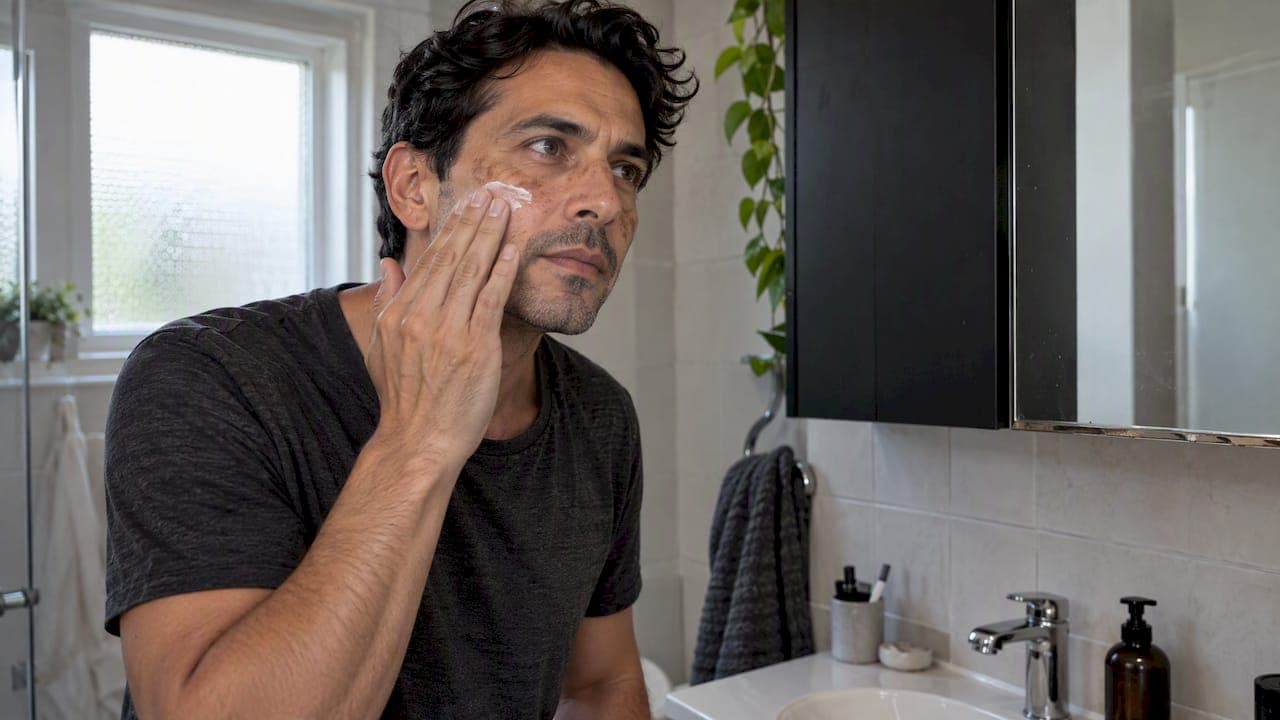
Melasma is a skin condition that causes brown or greyish patches, usually on the face. Men get it too, and it tends to be stubborn. It cannot be cured, but it can be improved and kept under control. The two things that matter most are a correct diagnosis and strict, daily sun protection. Professional treatments such as peels and microneedling can help alongside that, but they never replace it.
This guide explains why men develop melasma, how it differs from other dark patches, what actually works, and what to expect from treatment in the UK.
TL;DR
- Melasma affects men as well as women. In men it is driven mainly by UV exposure and genetics rather than hormones.
- There is no cure. The aim is improvement and long-term maintenance, and it often returns if protection slips.
- Daily broad-spectrum SPF 30+ sunscreen, ideally tinted with iron oxides, is the foundation of every plan.
- Get any new dark patch checked by a GP or dermatologist before you treat it yourself.
- Peels and microneedling are add-ons for suitable skin, not stand-alone fixes. At Rivers Edge Skin Studio in Liverpool, a single peel is £60 and a single microneedling facial is £70.
Table of Contents
- What melasma is, and how common it is in men
- Why men get melasma
- Is it really melasma?
- Perspective: what we see in men's skin
- What actually works: the foundation
- Medical treatments to ask about
- Where peels and microneedling fit
- What results to expect
- Costs at our Liverpool studio
- Book a consultation in Liverpool
- FAQ
- Sources
What melasma is, and how common it is in men
The British Association of Dermatologists (BAD) describes melasma as a common adult skin condition in which brown or greyish patches develop, usually on the face. It is not contagious, not cancerous, and causes no itching or pain. The impact is cosmetic, but that can still weigh on confidence.
It is more common in women and in people with darker skin tones. A review of melasma in men notes it is seen more often in women and in dark-skinned people who live in areas of intense ultraviolet radiation. Men are a minority of cases, but a real one. The BAD notes that melasma accounts for roughly 4% of dermatology clinic attendees, and that men are among them.
Because it is less expected in men, it is often missed or mislabelled as a tan, sun damage or "dirty" skin. A paper in the Medical Journal of Australia calls it a less well recognised entity in males, which is a fair summary of how many men experience it.
Why men get melasma
In women, hormones play a central role: pregnancy, the contraceptive pill and hormone therapy are well known triggers. In men the picture is different.
A study of men with melasma in Clinical and Experimental Dermatology found that hormone levels in affected men generally did not differ much from healthy controls. That points to UV exposure and individual genetic predisposition as the main drivers.
The same literature suggests men more often show a malar pattern, meaning patches across the cheeks. Women more often show a centrofacial pattern across the forehead, cheeks, nose and upper lip. This is covered in Dermatology Times' summary of a male melasma review.
Common triggers for men include:
- Sun and visible light. Men tend to report more daily sun exposure and, historically, less consistent sunscreen use than women, according to the same summary. Outdoor work, cycling, running and golf all add up.
- Family history. If a close relative has melasma, your chances are higher.
- Heat and sweating. Heat is widely discussed as an aggravating factor in melasma, though the evidence is stronger for UV and visible light.
- Irritation. Harsh products, fragrance-heavy aftershaves and some oils can inflame the skin. A clinical profile of 300 men with facial hypermelanosis identified mustard oil on the face as an aggravating factor, so it is worth avoiding oils and strongly scented products if you have noticed patches.
Is it really melasma?
Not every dark patch on a man's face is melasma. Shaving irritation, ingrowing hairs, acne marks, sun spots and freckles can all leave pigmentation. Rarer causes exist too.
Melasma typically looks like roughly symmetrical, irregular-edged brown patches on the forehead, temples, cheeks, upper lip or nose, as the Merck Manual describes. Patches that are lopsided, raised, bleeding, changing shape or growing quickly are a different matter.

See your GP promptly if a patch is new and asymmetrical, has changed in size, shape or colour, itches, bleeds or crusts. Those signs need a medical opinion to rule out skin cancer, and no beauty treatment should be started first.
If the patches are symmetrical and painless, a GP can still confirm the diagnosis and refer you to a dermatologist if needed. Be aware that, as one local NHS guidance page points out, the NHS may not fund treatment for cosmetic reasons alone, though it may help where there is significant distress. Our own research found this stated on a UK aesthetics clinic page, so ask your GP what is available locally.
Perspective: what we see in men's skin
We work only with men's skin, and the pattern is consistent. Men rarely come in saying "I think I have melasma". They say the patches on their cheeks have been there for a couple of years, or that their skin looks uneven after summer and has never quite settled.
Three things shape how we approach it:
- Diagnosis comes first. If we are not confident a patch is simple pigmentation, we ask you to see your GP before any treatment. A skin assessment before peels or lasers matters, particularly with sun-damaged skin.
- Simple beats clever. A man who will not use a ten-step routine will not stick to one. One tinted mineral sunscreen every morning, applied properly, does more than an expensive treatment followed by no protection.
- Honest expectations. Pigmentation of this kind can fade and it can come back. We would rather you start with realistic expectations than a promise nobody can keep.
Treatments are tailored to your skin type, how sensitive it is, and whether you have a beard. We do not offer the prescription creams that are usually first-line for melasma, so those go through a GP or dermatologist. What we can offer is professional skin support alongside that medical route.
— David
What actually works: the foundation
The most important step costs very little. The BAD advises daily sun protection every morning, all year round, as part of your routine. Details from the BAD leaflet and NHS guidance:
- Use a broad-spectrum sunscreen of SPF 30 or higher on all exposed skin: face, neck, ears and a balding scalp.
- Reapply every two hours when outdoors, and use a waterproof version if you are sweating or swimming.
- Choose a formula with iron oxides. These help protect against visible (blue) light, which can trigger pigmentation. A Gloucestershire NHS guidance page also stresses visible-light protection daily regardless of weather, with mineral filters such as zinc, titanium or iron oxide.
A tinted mineral sunscreen is the easiest option for most men. It goes on in the morning with no fuss, and the tint evens out the look of the patches. Dermatology Times makes the same point: men are more likely to stay consistent with easy, multi-benefit products than complicated regimes.
Add a hat when you are outdoors, and keep your shaving routine gentle. Avoid scrubbing or picking at patches, as irritation can darken them.
Medical treatments to ask about
First-line treatment is usually a topical one. The male melasma review summarised by Dermatology Times names triple combination cream as the first-line option, with single or dual therapies being less effective and slower. These are prescription products, so they come from a GP, dermatologist or other prescriber, not from a skincare studio.
The BAD also says clinicians should be clear that there is no cure for melasma. Success means improvement and long-term maintenance through avoiding triggers such as intense UV light and irritating topical products. Procedures such as peels or microneedling are adjuncts, not replacements, for daily photoprotection.
Where peels and microneedling fit
Once the diagnosis is clear and sun protection is in place, some men choose a professional procedure to help the skin along. Two are worth understanding.
Microneedling
Microneedling uses very fine needles to create tiny controlled channels in the skin. In melasma research it is often paired with topical tranexamic acid (TXA). A 2024 meta-analysis of 16 studies found significant reductions in melasma severity scores at 4, 8, 12, 16 and 20 weeks. Common side effects were mild pain (41%) and temporary redness (56%).
That evidence is for microneedling with TXA, a combination, rather than microneedling alone. A systematic review of tranexamic acid and microneedling points the same way. We do not claim our standard microneedling facial is a melasma treatment. We do say it is a recognised skin-rejuvenation procedure that some men use to support skin tone and texture, and we will tell you honestly whether your skin is a good candidate.
If you want to know what a session involves, read our guides on what microneedling treatment is and the step-by-step process for men. Sun exposure afterwards matters a great deal for pigmentation, so also see sun exposure after microneedling.
Chemical peels
Superficial chemical peels are a common part of pigmentation care. The same male melasma review cautions that peels carry a higher risk of post-inflammatory hyperpigmentation in darker skin, meaning the treatment itself can leave new dark marks. Skin type, peel strength and a patch test all matter.
Our article on chemical peels for men's pigmentation covers sessions and expectations, and the complete guide to chemical peels for men goes deeper on how they work. For general tone and brightness, see what skin brightening treatment involves.
What to avoid
- Strong peels or aggressive treatments in summer or just before a holiday.
- Home dermarollers, which can irritate skin and worsen pigmentation if used badly. Our guide to common microneedling mistakes explains why.
- Skin-lightening products from unregulated sources. If a product promises to erase pigmentation quickly, be suspicious.
- Unscented does not always mean gentle, but heavily fragranced products and oils are best left off pigmented areas.
What results to expect
Melasma in men is often more persistent than in women. Women's melasma may ease after pregnancy or when a hormonal trigger stops. The Merck Manual reflects that melasma in men is less likely to fade on its own. Expect a long game.
A realistic plan looks like this:
- Weeks 1 to 4: see your GP, confirm the diagnosis, start daily tinted SPF, and drop irritating products.
- Months 1 to 3: follow any prescribed topical treatment. If suitable, add a course of professional sessions.
- After that: maintain. Keep up the sunscreen, repeat sessions only if advised, and expect that heat and strong sun may bring the patches back.
Recurrence is common. The Gloucestershire NHS guidance says all types of melasma can be difficult to treat and that it often returns in later years. Treat that as normal, not as a failure.
Costs at our Liverpool studio
These are the prices published on our site for the treatments men most often ask about alongside pigmentation concerns:
| Treatment | Price |
|---|---|
| Chemical peel, single | £60 |
| Chemical peel, course of 2 | £100 |
| Chemical peel, course of 4 | £200 |
| Microneedling facial, single | £70 |
| Microneedling facial, course of 2 | £100 |
| Microneedling facial, course of 4 | £200 |
| Deep Cleanse Facial | £35 |
A course is better value than single visits, and skin usually needs more than one session to show change. We will tell you in the consultation whether a course makes sense for your skin.
Book a consultation in Liverpool
If you live in Merseyside and want a straight answer about your skin, we can help. We are a men's skin clinic, so everything is designed around men's skin, including bearded skin. See our peels for men in Liverpool and microneedling for men in Liverpool pages, or browse all our treatments and prices and book online. If your patches look unusual, see your GP first and come to us afterwards.
For a wider view of sun-damaged skin, our article on getting a skin assessment before peels or lasers is a good next read. Follow us on Instagram for recent results and behind-the-scenes content.
FAQ
Can men get melasma?
Yes. It is more common in women, but men make up a real minority of cases, as the BAD notes. In men the main drivers appear to be UV exposure and genetics rather than hormones.
Does melasma go away on its own in men?
Usually not. Male melasma tends to be persistent and often needs ongoing maintenance rather than a quick fix. Daily sunscreen and trigger avoidance are the foundation, and a GP or dermatologist can advise on prescription options.
Why do men get dark patches on the cheeks and upper lip?
In men, melasma often shows on the cheeks, and it can also appear on the upper lip and forehead. Shaving irritation, sun damage and other conditions can look similar, so have the patches checked by a GP or dermatologist if you are unsure what they are.
Can you cure melasma in men?
No. The BAD is clear that there is no cure. Treatment aims to improve the appearance and keep it that way with strict sun protection and by avoiding triggers. Some men see good improvement, but patches can return.
Sources
- British Association of Dermatologists: Melasma
- Melasma in Men: A Review of Clinical, Etiological, and Management Issues
- Melasma in the male: a less well recognised entity, Medical Journal of Australia
- The clinicoaetiological, hormonal and histopathological characteristics of melasma in men
- Melasma in the male patient, Dermatology Times
- Clinical profile of 300 men with facial hypermelanosis
- Hyperpigmentation, Merck Manual Professional Edition
- Melasma bitesize guidance, G-care
- The efficacy and safety of microneedling with topical tranexamic acid, Journal of Cosmetic Dermatology
- The Use of Tranexamic Acid and Microneedling in the Treatment of Melasma: A Systematic Review