
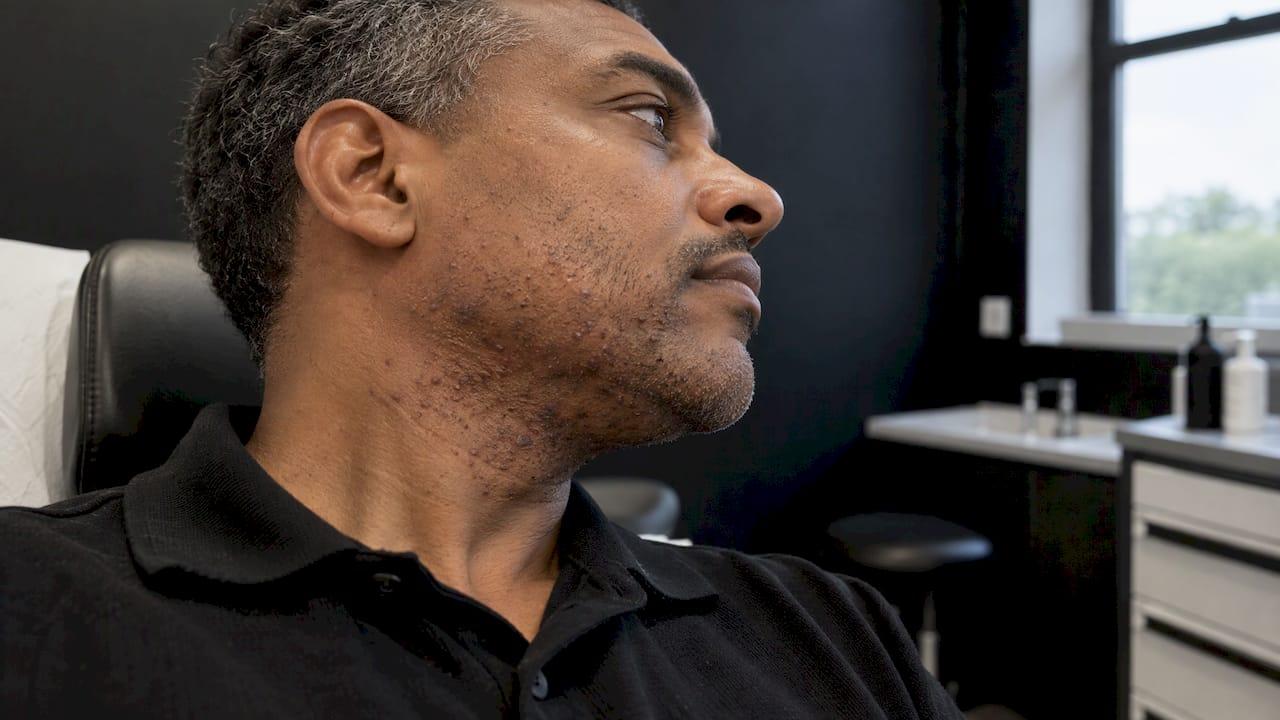
A chemical peel can be a useful part of treating razor bumps. Dermatology reviews report that glycolic and salicylic acid peels have been found useful for the condition, and for the dark marks it leaves behind. A peel works best alongside a change in how you shave. At Rivers Edge Skin Studio, our Liverpool clinic for men's skin, we offer chemical peels as single treatments or as courses, with a plan built around your skin and how you shave.
TL;DR
- Razor bumps (pseudofolliculitis barbae) are hairs that curl back into the skin and inflame the follicle. A peel treats the skin surface, not the shaving habit behind it.
- Reviews report glycolic and salicylic acid peels as useful for razor bumps and for the dark marks they can leave.
- Peels are usually done as a course, not a one-off. Ours cost £60 for a single treatment, £100 for a course of 2 and £200 for a course of 4.
- Sun protection matters after a peel, especially if your skin marks easily.
- We are open Monday to Saturday, 10:00 to 17:00, at Unit 6, 10-14 Jamaica St, Liverpool L1 0AF.
Table of Contents
- What razor bumps actually are
- How a chemical peel helps
- Strengths and courses: what the literature describes
- Why the peel is not the whole answer
- Who needs extra care
- Before and after your peel
- Marks and scars after razor bumps
- What a peel appointment looks like with us
- Book a peel in Liverpool
- Our view
- FAQ
- Sources
What razor bumps actually are
Razor bumps are not a rash from a bad blade. The British Association of Dermatologists describes them as inflammation of hair follicles caused by hairs trapped beneath the skin. It usually happens after hair is cut very short and retracts. Curly hair makes it more likely. The red spots and pustules can leave dark discolouration and scarring.
The medical name is pseudofolliculitis barbae, or PFB. It appears on the face and neck of men who shave. The BAD says it is more common in men of sub-Saharan African lineage, but it affects all ethnicities.
A Journal of Drugs in Dermatology review explains the mechanism. A genetically curved hair, freshly shaved, pierces the skin around the follicle. The body treats it as a foreign object and mounts an inflammatory reaction. That is why the condition has two sides: the shape of your hair, and the way you shave.

Razor bumps or razor burn?
The two get confused. WebMD describes razor bumps as ingrown hairs that curl into the skin as they grow back, looking like pimple-like bumps. Razor burn looks more like streaks or blotches. Both leave skin red and irritated. If the same spots return in the same places every time you shave, you are most likely dealing with razor bumps. For the irritation side, our guide to stopping post-shave irritation is a good start.
How a chemical peel helps
A chemical peel applies a measured acid solution to the skin. It loosens the bonds between dull, surface cells so they shed. For razor bumps, the evidence points to two acids.
Glycolic acid. A 2019 review in Clinical, Cosmetic and Investigational Dermatology reports that glycolic acid peels reduce hair curvature by reducing sulfhydryl bonds in the hair shaft. A straighter hair is less likely to pierce the skin on the way out. Medical News Today makes the same point: glycolic acid is an alpha hydroxy acid that removes old surface cells and lessens the risk of the hair re-entering the skin.
Salicylic acid. USPharmacist describes salicylic acid as anti-inflammatory and keratolytic, meaning it helps break down the dead skin that can plug a follicle.
The marks left behind. The same 2019 review reports that peels have been found useful for post-inflammatory hyperpigmentation (PIH), the brown or dark patches that linger after a bump heals. For many men this is the part that bothers them most. If marks are your main concern, our guide to chemical peels for men's pigmentation goes into it.

Strengths and courses: what the literature describes
You do not need to choose a strength yourself. That decision belongs with the person treating you, based on your skin. But it helps to know what the research describes, so the plan makes sense when you hear it.
- USPharmacist says superficial peels with glycolic acid at 20% to 70%, or salicylic acid at 20% to 30%, may benefit some men with PFB. Both are described as well tolerated, with local burning and stinging the most commonly reported effects.
- A 2024 expert consensus on chemical peels recommends very superficial and superficial peels to keep the risk of PIH low. Its example regimens are glycolic acid at 50% to 68% every 3 weeks for 6 treatments, and salicylic acid at 20% to 30% every 2 weeks for 5 treatments, combined with topical agents for PIH in darker skin.
- The same consensus says redness typically lasts 1 to 3 days after a very superficial peel and 3 to 5 days after a superficial one.
The pattern is clear: gentle peels, repeated. One peel will not change the way your hair grows. A series works with the skin's own turnover. That is why we sell peels both singly and as courses.
| Chemical peel at Rivers Edge | Price |
|---|---|
| Single treatment | £60 |
| Course of 2 | £100 |
| Course of 4 | £200 |
A course of 4 works out at £50 a peel, against £60 for a single session. Because the literature describes repeated, spaced treatments, a course is the sensible way to approach razor bumps.
Why the peel is not the whole answer
The Journal of Drugs in Dermatology review is direct on this. Because PFB is a chronic condition, treatment should aim to stop hairs repeatedly re-entering the skin. The most effective approach combines changes in shaving habits with topical therapies. A peel sits in the second group.
The JAMA Dermatology patient page gives a practical list:
- The best treatment is to avoid shaving where you can.
- If you do shave, a razor designed for sensitive skin, or an electric razor on a high setting, can help. A high setting leaves the hair a little longer.
- Be careful with over-the-counter chemical hair removers. They can be very irritating and can even cause permanent discolouration. Test a small spot first.
- Do not pluck. It increases the chance of the regrown hair entering the skin.
The BAD adds that stopping shaving, waxing or tweezing can let things settle, though inflammation may take 4 to 6 weeks to calm down. If you have been battling bumps for longer than that, that is the point to book a skin consultation. Our guide on razor bumps treatment for men covers what to try first and when to see a clinician.
Who needs extra care
A peel is a controlled irritation of the skin, so it has to be matched to the person.
- Darker or easily marked skin. PIH is the main risk. This is why the consensus favours very superficial and superficial peels, with more sessions and gentler steps. Say at the start if your skin tends to mark or scar.
- Active, angry flare-ups. Skin with open pustules or broken areas needs assessing before anything acidic goes on.
- Sun-exposed skin. The 2019 review advises avoiding photosensitising products in your shave-care routine and using sunscreen as needed.
The common peel effects listed in the consensus are tingling or burning, redness, scaling and crusting. Less often there can be delayed healing, infection, changes in pigmentation, scarring, a temporary acne flare or contact dermatitis. Persistent redness with swelling or weeping raises the risk of PIH and scarring, so contact the clinic that treated you if skin looks that way rather than waiting.
If you take acne medication, use prescription creams or have had a recent cold sore, tell the person treating you before the peel. They will tell you whether to wait.
Before and after your peel
This is where most of the result is won or lost. Your clinician's instructions for your skin come first. These are the general principles.
Before
- Tell us what you currently use on your face, particularly acids, retinoids and scrubs.
- Avoid sunburn and heavy sun exposure beforehand. Burnt skin is not ready for a peel.
- Keep your normal routine simple in the days before. Do not start anything new.
- Ask when to shave before your appointment, so the skin is not freshly irritated on the day.
After
- Be gentle. Cleanse with a mild cleanser and moisturise. Do not pick or scrub flaking skin. Picking is a common route to marks.
- Protect from the sun. Use sunscreen every day on treated skin. The pairing of treatment and sunscreen is explained well in this note on microneedling and sunscreen timing, and the same sun-safe habits suit a peel.
- Wait before you shave. Redness typically lasts 1 to 5 days depending on peel depth, according to the consensus. We advise leaving the skin to settle first and checking with your clinician before the razor goes back on. When you do, use a clean, sharp blade or a clipper, and do not go over the same area repeatedly.
- Skip anything new. Hold off on other acids, scrubs and hair removers until your skin is calm.
Our men's guide to recovering after a chemical peel lays the days out in more detail, and our Merseyside aftercare plan covers what to do if something looks wrong.
Marks and scars after razor bumps
If bumps have already left dark spots or neck scarring, treat those as their own job. Peels address surface pigmentation. Deeper texture changes need a different approach. We cover what is realistic in ingrown hair neck scars in men. Our microneedling treatment is another route to smoother skin texture, at £70 for a single facial, £100 for a course of 2 and £200 for a course of 4. You can read about it on our microneedling page.
For men with a beard, a regular facial keeps the skin underneath clean between treatments. Our Bearded Man Facial is £35.
What a peel appointment looks like with us
We are a men-only skin clinic. That shapes the consultation: we talk about shaving, beard growth, neck skin and how your skin reacts, not a generic routine. Your plan is personalised, so the number of peels and the gap between them follow your skin.
We also offer men's facials, microneedling, skin boosters, anti-wrinkle injections, sweat (hyperhidrosis) injections, polynucleotides, vitamin injections and hair-loss treatments. Injectables are for clients aged 18 and over. If you are in Liverpool or elsewhere in Merseyside, you can see everything on our services page.
Book a peel in Liverpool
Our chemical peels for men are offered at the studio on Jamaica Street, Monday to Saturday, 10:00 to 17:00, and closed on Sunday. A single treatment is £60, with courses of 2 and 4 at £100 and £200. You can book online at our booking page.

If you are not sure which option fits, book the single treatment and we will discuss a course once we have seen your skin.
Our view
Most men who come to us about razor bumps have been told to "just shave differently" and left to get on with it. That advice is right as far as it goes, but it ignores what is already on the skin: the inflamed follicles, the rough surface, the dark marks.
The research supports our approach. Glycolic and salicylic acid peels have been found useful for razor bumps and for the pigmentation they leave, and the sensible way to use them is gently and repeatedly. That is why we set up peels as courses and why we talk about your shaving habits in the same appointment.
Being a men's clinic matters here. Beard growth, neck skin and a daily razor are our everyday subject, not a side note. We want you leaving with a plan you can follow, in a calm and comfortable room, with skin that looks natural and not overdone.
David
FAQ
Can a chemical peel remove facial hair?
No. A peel exfoliates the skin surface and does not remove hair from the follicle. For razor bumps, the aim is smoother skin and straighter regrowth, which lowers the chance of a hair curling back in. Glycolic acid is reported to reduce hair curvature, which is where the benefit comes from.
Can I shave after a chemical peel?
Leave the skin to settle first. Redness typically lasts 1 to 3 days after a very superficial peel and 3 to 5 days after a superficial one. Your clinician will tell you when it is safe to shave again. When you do, use a clean, sharp blade or an electric razor, with light pressure.
How many peels will I need for razor bumps?
The published regimens describe repeated sessions, for example 5 or 6 treatments at 2 to 3 week intervals. We offer single peels and courses of 2 or 4, and the right number depends on your skin. Razor bumps are a long-term condition, so the shaving routine you keep matters as much as the peels.
Are chemical peels safe for darker skin?
Very superficial and superficial peels are recommended to keep the risk of pigmentation changes low. Tell the person treating you about your skin type and any history of dark marks. Daily sunscreen afterwards is part of the plan.
Sources
- British Association of Dermatologists: Pseudofolliculitis
- Journal of Drugs in Dermatology: Pseudofolliculitis Barbae review
- Clinical, Cosmetic and Investigational Dermatology: PFB treatment options
- USPharmacist: PFB prevention and treatment
- International Journal of Dermatology and Venereology: chemical peel consensus
- JAMA Dermatology: Pseudofolliculitis Barbae
- Medical News Today: Razor bumps
- WebMD: Razor burn treatment
- Microneedling and sunscreen timing