
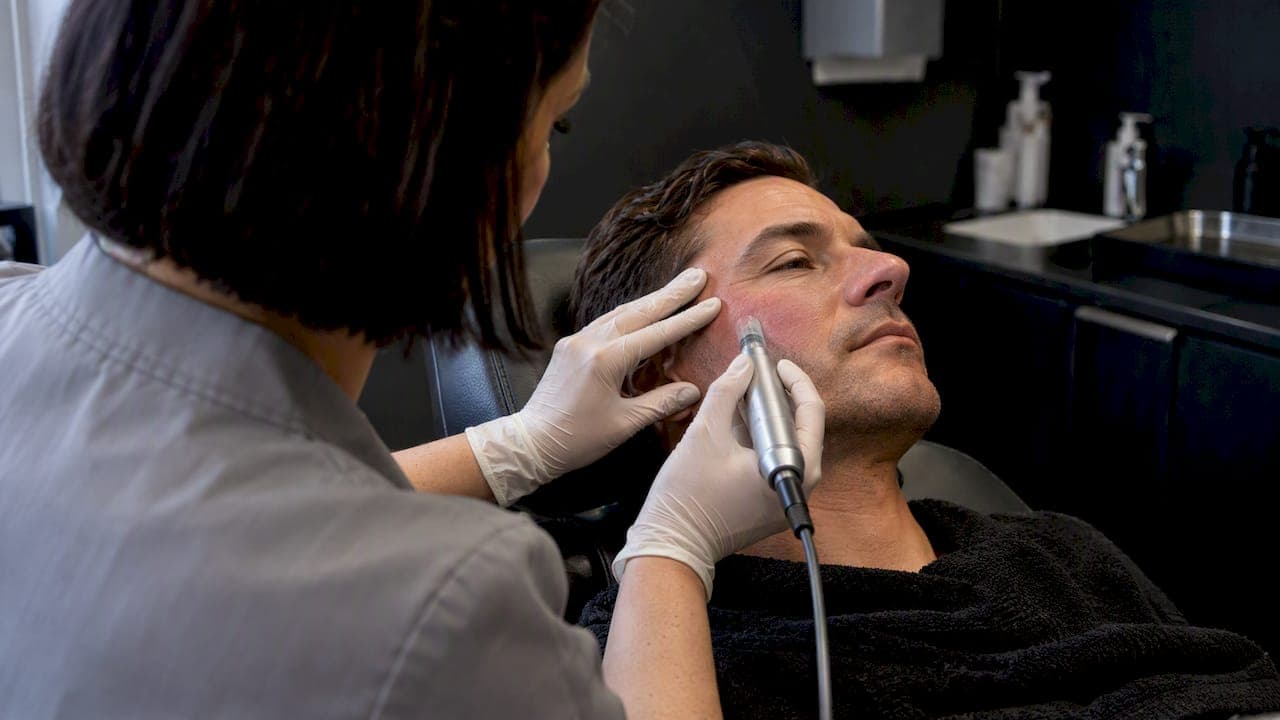
Microneedling results build slowly. You will see redness and a tight, glowing look in the first couple of days, a smoother and fresher finish within a few weeks, and the real change in texture once new collagen has formed, which can take up to three months or more than one session. Below is the timeline we walk our male clients through, with the reasons behind each stage and what you can do to help it along.
TL;DR
- Days 1 to 3: redness and tightness, similar to mild sunburn. This is the healing response starting, not the result.
- Weeks 2 to 4: skin usually looks brighter and feels smoother as the surface settles.
- Weeks 6 to 12: collagen remodelling shows in texture, fine lines and scarring. NHS guidance says improvement can take up to 3 months.
- Most people need a course, commonly three to four sessions about six weeks apart, for a lasting change.
- Aftercare, sun protection and patience decide how good the final result looks.
Table of Contents
- Why microneedling results are not instant
- The microneedling results timeline
- How many sessions do you need?
- Timeline for different concerns
- Why you might not be seeing results yet
- How to get the best microneedling results
- How long do the results last?
- What we think
- Book microneedling in Liverpool
- FAQ
- Sources
Why microneedling results are not instant
Microneedling uses tiny sterile needles to make controlled punctures in the skin. The body treats them as small injuries and starts to repair. According to the British College of Aesthetic Medicine, the body remodels and repairs the damaged tissue and produces collagen and elastin. The same page explains that this happens below the surface, in the dermis, and takes time because new collagen has to form.
That is the whole reason for the wait. What you see on day one is inflammation. What you see at month three is rebuilt skin structure. The two look very different, and the gap between them is where most men lose patience and wonder if the treatment has worked.
NHS guidance for patients is equally direct: results are not immediate, and it may take up to 3 months, or more than one treatment, before you notice an improvement.

The microneedling results timeline
Here is the realistic sequence. Individual skin differs, so treat the weeks as a guide and not a promise.
| Stage | What you will see | What is happening |
|---|---|---|
| Day 0 to 2 | Pink or red skin, tightness, mild swelling | Inflammation after the needling |
| Day 3 to 7 | Dryness, light flaking, skin settling | Surface repair, barrier recovering |
| Weeks 2 to 4 | Brighter, smoother, more even tone | Early repair and increased hydration |
| Weeks 6 to 12 | Finer texture, softer lines, scars less obvious | New collagen and elastin laid down |
| Months 3 to 6 | Full effect of a completed course | Remodelling continues and matures |
Day 0 to 2: redness and tightness
Expect your face to look flushed. NHS trust guidance says redness and swelling should settle over the following 1 to 2 days. Some men find it lasts a little longer, especially after deeper settings. Our guide to how long men stay red after microneedling covers the 24 to 72 hour window in more detail.
If you work in an office or on site, a Friday appointment is a sensible way to get through the worst of it before Monday.
Day 3 to 7: dry, then settled
The redness fades and the skin often feels dry or rough, with some light flaking. This is normal. Moisturise, keep the skin clean and resist picking. If you have a beard, the first week has its own rules about when to shave and what to put on the skin, which we cover in our first week timeline for beard microneedling.
Weeks 2 to 4: the first visible change
This is when many men first notice something. Skin tends to look fresher and more even, and products absorb better. Research supports that last point: a review in the Journal of Drugs in Dermatology notes that microneedling can enhance the delivery of topical products through the skin, which is one reason a good home routine matters.
This early glow is real, but it is not the end point. If you stop here, you miss most of the benefit.
Weeks 6 to 12: texture and scarring
Collagen remodelling is slow and progressive. A 2021 review of radiofrequency microneedling described the remodelling as slow, with improvement continuing even six months after treatment. That study looked at the radiofrequency version of the treatment, but the principle of slow, ongoing rebuilding is the same.
By this stage, enlarged pores, fine lines and shallow acne marks should look softer. Our article on microneedling for pores explains why we plan three to six sessions for that concern.
Months 3 to 6: the finished result
The NHS timeframe of up to three months is where most single sessions reach their peak. After a full course, the change keeps maturing. The same Journal of Drugs in Dermatology review cites a human biopsy study in which collagen type I and elastin were still raised six months after a course of six sessions.
How many sessions do you need?
One session gives you a fresher look. A course gives you a change in the skin. The British College of Aesthetic Medicine says three to four treatments are commonly required, with around six weeks between them. It adds that the practitioner recommends the number needed for your aim, and that scarring such as acne scars or stretch marks may need up to six procedures.
So, is two sessions enough? For general skin quality and a lighter refresh, two can be a reasonable start. For visible scarring or deeper texture, expect more. The honest answer comes from an assessment of your skin, not from a fixed number.
At Rivers Edge Skin Studio, a Microneedling Facial is £70 for a single treatment, £100 for a course of 2 and £200 for a course of 4. A course of four is built around the pattern above: treatments spaced out so the skin can complete each repair cycle before the next one begins.

Why spacing matters
Booking sessions too close together does not speed things up. The skin needs time to finish each round of repair. Going again too soon can mean more irritation and no extra benefit. Gaps of around four to six weeks are standard for facial work, though depth and device change the answer. If you are curious how this works for the scalp, see our guide to microneedling frequency by depth.
Timeline for different concerns
Not every concern moves at the same speed.
Skin tone, texture and fine lines
Most men see a glow within a few weeks and a clearer change in texture across the first three months. Lines respond gradually. This is where a course of four makes the most sense.
Scars and marks
Scars are the slowest to change. NHS patient information makes a point worth remembering: microneedling may not achieve the improvement you hope for in scar texture, tightness or colour, and it will not make a scar disappear. It can soften and improve. Everyone's scars respond differently, so we discuss realistic goals before starting.
Pores and oily skin
Pores tend to look tighter once collagen supports the surrounding skin. That is a multi-session job, which is why we do not promise much after one visit.
Scalp and hair
Hair works on a much longer clock because the hair growth cycle is slow. We cover it in depth in our guides on scalp microneedling results and microneedling with minoxidil. The short version is to plan around months, not weeks, and to judge progress at the 12 to 16 week point.
Why you might not be seeing results yet
If you are three weeks in and see nothing dramatic, that is usually normal. The most common reasons are these.
- It is too early. Collagen takes weeks to build. Up to three months is the NHS guidance.
- One session was not enough. Many concerns need a course.
- Sessions were too far apart. Long gaps let the effect fade before the next one.
- Sun exposure. Unprotected skin undoes progress and raises the risk of pigment change.
- The wrong expectations. Microneedling improves skin. It does not erase deep scars or replace other treatments.
- Home care does not match the treatment. Harsh products or picking at flaking skin slow healing.
Protocols also vary a lot in needle depth, frequency and device type, which is why results from one place are hard to compare with another. A clinician who adjusts depth to the area and your skin is worth more than a number on a menu. Our post on common microneedling mistakes lists the errors we see most often.
How to get the best microneedling results
What you do in the days after treatment affects what you see at week twelve. NHS patient guidance gives a clear baseline:
- Keep the treated area clean.
- Avoid hot water, saunas and swimming for 72 hours, and avoid sweaty exercise for 72 hours or until any swelling has resolved.
- Avoid sun exposure for 7 days and keep using sun block afterwards.
Our own article on sun exposure after microneedling goes through the 48 hour and 7 day question in more detail. For the scalp, there is a separate 72 hour aftercare guide.
A few practical habits help beyond that:
- Use SPF 30 or higher every morning, all year round, including cloudy Merseyside days.
- Use a plain moisturiser and avoid strong acids or retinoids until your clinician says they are fine.
- Do not pick at flaking skin.
- Book the next session in advance so the spacing stays consistent.
- Tell your clinician about any medication, skin condition or cold sore history before treatment, and about anything that changes between visits.
One safety point to know before you book: NHS guidance warns that microneedling may cause temporary or permanent changes in skin pigment, making skin lighter or darker. This is why sun protection and a trained practitioner matter. If you have darker skin, a history of unusual scarring, active acne or an active skin infection, raise it at your consultation so the treatment can be planned around it.
How long do the results last?
Results do not vanish at a set date, but ageing and sun exposure carry on, so skin gradually returns toward its baseline without upkeep. Research gives a sense of the window. The same Journal of Drugs in Dermatology review cites a study reporting 40% thickening of the stratum spinosum lasting up to a year after microneedling combined with topical vitamins A and C. That is a specific study, not a guarantee, but it fits the common pattern of results lasting months after a completed course.
Many men plan a course first, then a top-up session once or twice a year, depending on their goals and how their skin is holding up. Your clinician can set that rhythm after reviewing your progress.
What we think
Most men who ask us about microneedling are really asking one question: when will I look different? The honest answer is that the first sign comes quickly and the real change comes slowly.
We build treatment plans around that. A single session is a good way to start, but the skin changes we are aiming for come from a course, spaced so each repair cycle finishes before the next begins. We adjust depth to the area, whether that is the cheeks, a bearded jaw or the scalp, because men's skin is thicker and oilier and often has facial hair to work around.
We would rather you came back at week six to review your progress than expect a transformation at week one. Photographs at the start and at each visit make the slow changes easier to see, and they stop you judging your skin by one bad morning in the mirror.
Looking after your skin should not be complicated. Book the course, protect your skin from the sun, and let the collagen do its work.
David
Book microneedling in Liverpool
Rivers Edge Skin Studio is a men's skin clinic serving Liverpool and the wider Merseyside area. Our Microneedling Facial is priced at £70 for a single treatment, £100 for a course of 2 and £200 for a course of 4, with a treatment plan tailored to your skin and your goals.

You can read more on our microneedling for men in Liverpool page, see the full price list on our services page, or start with our plain-English guide on what microneedling treatment involves for men. If you are also thinking about scalp work, Head Microneedling is £70 per treatment.
FAQ
When do microneedling results first show?
Most men notice a fresher, smoother look within two to four weeks, after the redness has settled. The deeper changes in texture and lines come later as collagen builds. NHS guidance says it can take up to three months, or more than one treatment, before you notice an improvement.
How long do microneedling results take to peak?
A single session usually reaches its best around the three month mark. After a full course, remodelling can keep improving for around six months. Your clinician can compare your progress photographs to judge when you have reached your best result.
Is two sessions of microneedling enough?
It can be enough for a general refresh, but it is often too few for scarring or deeper texture. Professional guidance says three to four treatments about six weeks apart is common, and scarring may need up to six. We set the number after looking at your skin.
Why am I not seeing results with microneedling?
The usual reasons are checking too early, having only one session, leaving long gaps between sessions, or unprotected sun exposure. Scars are also slower to respond and may not change as much as hoped. If you are past three months after a completed course with no change, go back to your clinician for a review.
Can I do sweaty exercise after microneedling?
Not straight away. NHS patient guidance advises avoiding sweaty exercise, hot water, saunas and swimming for 72 hours, or until any swelling and bleeding have resolved. Check the exact advice with your clinician if you were treated at a deeper setting.
Sources
- Microneedling Post-treatment Information for patients, Chelsea and Westminster NHS Foundation Trust
- Microneedling, British College of Aesthetic Medicine
- Micro-needling patient information, Worcestershire Acute Hospitals NHS Trust
- Microneedling in All Skin Types: A Review, Journal of Drugs in Dermatology
- Radiofrequency Microneedling: A Comprehensive and Critical Review, PubMed