
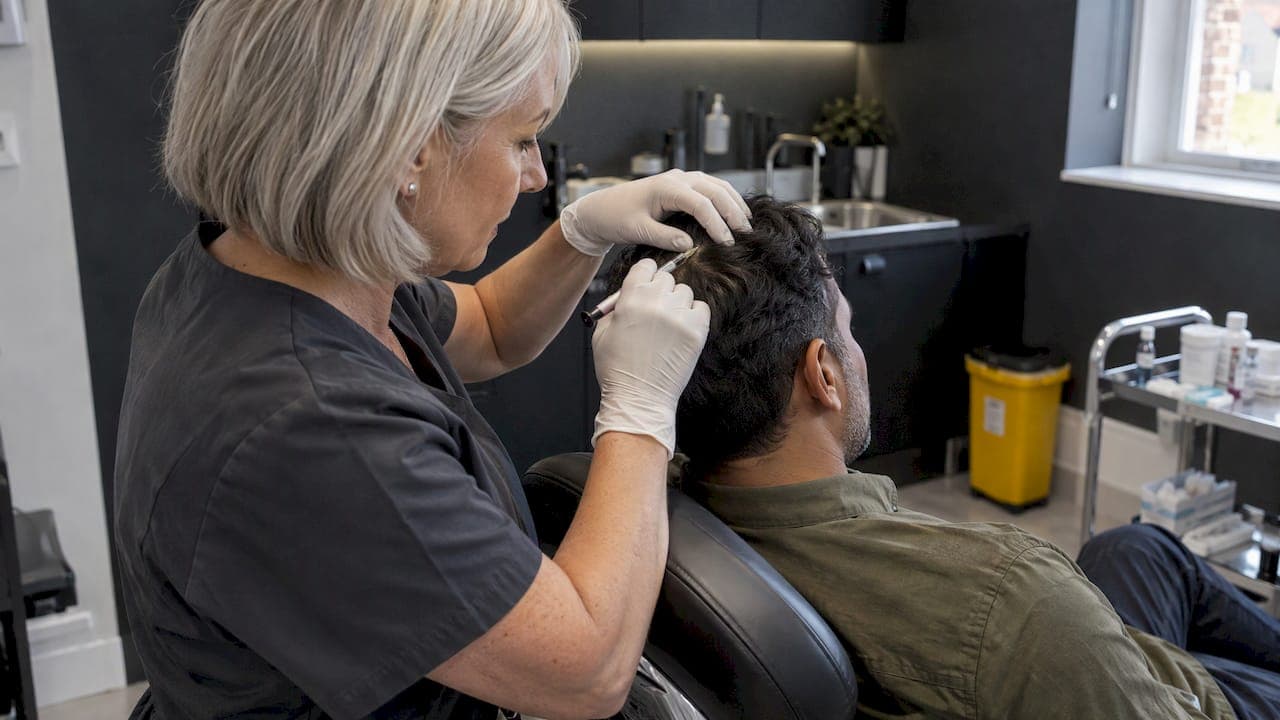
Polynucleotide scalp injections are designed to support hair growth by improving the condition of the skin around your follicles. Tiny amounts of a purified DNA-based gel are placed just under the surface of the scalp, with the aim of waking up weakened follicles and thickening fine, thinning hair. The early studies are encouraging, they work best on thinning rather than bald areas, and they need a course of sessions. At our Liverpool studio, scalp polynucleotides cost £240.
This guide explains how the treatment works, what the research says, how many sessions to expect, what side effects look like and what to check before you book.
TL;DR
- Polynucleotides are purified DNA-based gels injected into the scalp to support follicle activity and the skin around it.
- Small studies report improvements in hair density and thickness, some from about one month after treatment. Larger, longer trials are still needed.
- A typical course is several sessions spaced weeks apart, followed by maintenance. Your plan depends on your pattern of hair loss.
- Side effects reported in the research are mild and short-lived: redness, a burning feeling and the odd small bruise.
- Scalp polynucleotides at Rivers Edge Skin Studio cost £240 per treatment, with head microneedling at £70.
Table of Contents
- What polynucleotides are and how they are meant to help hair
- What the research shows so far
- How the treatment is given and how many sessions to expect
- Side effects and safe use
- What to check before you book
- Our perspective: where polynucleotides fit in a men's hair plan
- Combining treatments for thinning hair
- Book scalp polynucleotides in Liverpool
- FAQ
- Sources
What polynucleotides are and how they are meant to help hair
Polynucleotides are chains of DNA building blocks. The versions used in aesthetic medicine are purified and made into a gel. According to an Italian consensus report, the scalp products use purified trout-derived DNA gels injected into the skin to normalise follicular activity and promote hair growth. You will also see the term PDRN, which stands for polydeoxyribonucleotide. The two are related but not identical, and clinics use the words loosely.
The idea is simple. Hair follicles sit in the skin. If that skin is under strain, from age, hormones, stress or inflammation, the follicles can shrink and produce thinner hair. Polynucleotides are intended to improve that environment. The same consensus report describes the injections as intended to restore the efficiency of the dermal fibrocytes, the cells that maintain the tissue around the follicle, and to normalise the surrounding conditions.
Researchers have also proposed how this could translate into hair. The authors of a 2025 study suggest that regrowth may be linked to increased blood vessel formation and anti-apoptotic effects, meaning follicle cells are less likely to die off early. These are working explanations, not settled science, but they fit with how the treatment is used: as a way of supporting the follicle, not replacing it.
Polynucleotides on the scalp and on the face
The same family of products is used elsewhere in aesthetics. We offer skin boosters with polynucleotides for facial skin quality, and you can read about how they are used under the eyes. The scalp treatment follows the same principle, with a different injection technique and treatment plan suited to hair-bearing skin.
What the research shows so far
The evidence is growing, and it is worth knowing what it does and does not tell you.
A study in men and women with androgenetic alopecia. In a prospective study of 28 patients with androgenetic alopecia (the common pattern hair loss), hair diameter and density improved significantly after four injection sessions at four-week intervals. Improvements were seen from one month after treatment.
A randomised trial in women. A randomised controlled trial of 40 women with female pattern hair loss found mean hair count rose by 17.9% and thickness by 13.5% after 12 weeks of PDRN-only injections. It is a useful result, though it was in women, so it is a guide rather than a direct prediction for male pattern hair loss.

A small Italian report. A preliminary report of four patients combined one micrograft and polynucleotide session with five polynucleotide sessions two weeks apart. At four months, early and intermediate cases showed better apparent density, while the advanced case improved only mildly. That fits what we see in practice: the earlier you start, the more there is to work with.
Reviews of the wider field. A systematic review of nine aesthetic polynucleotide studies covering 219 patients found low to moderate study quality and differing treatment methods, and called for larger studies with longer follow-up. A 2026 preprint reaches a similar view: findings are directionally positive, but adequately powered controlled trials are still needed.
In plain terms, the results so far are promising and consistent in direction. There is no single agreed protocol for product, dose or number of sessions yet. A good practitioner will tell you that and set your expectations around gradual, visible improvement in thickness rather than dramatic regrowth.
Who tends to respond best
A 2026 UK consumer article reports that PDRN tends to work best in early to moderate androgenetic alopecia, in recent diffuse shedding such as after pregnancy, and for regrowth once chemotherapy has finished. For men, the most relevant group is those with thinning at the crown or temples who still have fine hairs in the area. Follicles that are still active have something to respond to. Smooth, shiny areas where hair has been absent for years are a different case, and a consultation is the place to talk through realistic options.

How the treatment is given and how many sessions to expect
The injections are delivered into the skin of the scalp as many small microdroplets using a fine needle. The session is quick and done in clinic. The Italian consensus protocol describes four sessions every 7 or 14 days, followed by four further sessions every 21 to 30 days. Other published studies use four sessions at four-week intervals, as above.
In UK clinics, the same consumer article says four to six scalp sessions about four weeks apart is common, followed by maintenance every two to three months.
These schedules differ because there is no universal standard, so your plan should come from your own assessment. Session planning for any scalp treatment depends on your hair-loss pattern and your skin, which is why Norwood stage and session numbers are worth understanding before you commit to anything. At Rivers Edge Skin Studio we build a personalised treatment plan after looking at your scalp and talking through your goals.
A realistic timeline
| Stage | What to expect |
|---|---|
| Consultation | Scalp assessment, medical history, discussion of goals and your plan |
| First sessions | A course of treatments spaced weeks apart |
| From about one month | Some studies report early gains in hair diameter and density |
| Around three to four months | A fairer point to judge thickness and overall density |
| Afterwards | Maintenance sessions at intervals agreed with your practitioner |
Hair grows slowly, so patience is part of the process. Photos taken under the same lighting at each visit make progress easier to judge than the mirror does.
Side effects and safe use
The Italian consensus report says the most commonly reported complications were redness and a burning feeling around 12 hours after injection, plus occasional small bruises, all minor and quickly passing. For a fuller picture of what to expect after sessions, see our guide to polynucleotide side effects.
Some practical points for safe use:
- Tell your practitioner about any medicines, allergies, skin conditions or recent illness before treatment, and in particular if you have any scalp infection or inflammation.
- Keep your scalp clean and avoid rubbing or picking at the area while it settles.
- Contact the clinic if redness, swelling or pain gets worse rather than better, and see your GP or call NHS 111 if you feel unwell or notice signs of infection such as spreading heat, pus or fever.
- Long-term safety data for scalp use are limited, so ongoing treatment should be reviewed with your practitioner at each visit.
What to check before you book
Aesthetic injections should be given by a qualified professional in a proper clinical setting. ACE UK advises a face-to-face consultation, a medical questionnaire, a skin assessment, informed consent and a cooling-off period before polynucleotide treatment. It also says your practitioner should be registered with a body such as the GMC, GDC, NMC, GPhC or HCPC, and that you can check the register online.
The rules are also moving. The UK Government published a consultation in October 2026 proposing that high-risk cosmetic procedures, including certain injectables, be restricted to specified qualified healthcare professionals in England. Choosing a clinic that already works to a clinical standard puts you on the right side of that direction of travel.
A short checklist:
- Do you get a proper consultation before anything is booked?
- Is the practitioner's professional registration clear, and can you look it up?
- Is the treatment plan explained, including how many sessions and what it costs?
- Are aftercare instructions given in writing?
Our perspective: where polynucleotides fit in a men's hair plan
We see polynucleotides as a way of improving the quality of the scalp, so that the hair you have is as healthy as it can be. Most of the men who ask us about them are in their thirties to fifties, noticing a thinner crown or softer temples, and want a clinical, discreet option that does not feel like a big commitment.
That is why we specialise in men's skin. Male scalp skin is thicker and often oilier, and hair loss usually follows a pattern. We plan treatment around that, not around a generic template. Our scalp polynucleotide treatment is designed to support follicle health, and many men pair it with head microneedling, which has its own following for density gains over 12 to 16 weeks.
We keep the process simple. You come in, we look at your scalp, we agree a plan and we take photographs so you can see change over time. If you want to read more first, our guide to polynucleotides for hair loss goes into the detail.
David
Combining treatments for thinning hair
Hair loss rarely has a single cause, and many men use more than one approach. Our scalp offering is built around three options:
- Scalp polynucleotides, £240: injected into the scalp to support follicle activity and the skin around it.
- Head microneedling, £70: a controlled micro-injury treatment that stimulates the scalp. Our guide to microneedling and minoxidil explains how it can sit alongside a topical routine, and our aftercare guide covers the first 72 hours.
- Biotin injection, £30: part of our wellness injection range. If you are having blood tests, read our note on biotin and false lab results first.
When you book, tell us what you already use, whether that is a prescribed treatment, an over-the-counter foam or supplements. We build around it. Hair-loss medicines have the strongest track record in the literature, and the 2026 preprint notes that oral finasteride and topical minoxidil have established efficacy. Polynucleotides are a scalp-health treatment that men often add to a routine, and your GP or pharmacist is the right person to discuss prescription options. If your hairline is the main worry, our article on what stops a receding hairline is a good starting point.
Setting expectations
A sensible goal is thicker, healthier-looking hair over a few months, not a new hairline. The research reports improvements in diameter and density, which is what you notice as a fuller look when the hair is styled. Results vary from person to person, and nobody can promise a specific outcome. What we can do is plan carefully, use a consistent approach and track your progress so you can decide whether to continue.
Book scalp polynucleotides in Liverpool
Rivers Edge Skin Studio is a men's skin clinic serving Liverpool and the wider Merseyside area. Scalp polynucleotides are £240 per treatment, and head microneedling is £70. We start with a conversation about your hair, your routine and what you want to achieve, then recommend a plan that suits you.

You can see every treatment and price on our services page and book online from there. Prefer to start with your skin? Our microneedling treatments for men are a popular first step.
FAQ
How long before polynucleotides start working on hair?
In a 28-patient study, improvements in hair diameter and density were seen from one month after treatment. Most clinics suggest judging results after a few months, because hair grows slowly. Your practitioner can compare photographs from each visit to show change.
Are there hair injections that can help with hair loss?
Yes. Polynucleotide scalp injections are one option, and research into them is growing. They are intended to support the scalp skin and follicle activity, and are usually given as a course of sessions. A consultation will show whether they suit your pattern of hair loss.
Are polynucleotide scalp injections painful?
The needles are fine and the microdroplets are placed just under the skin surface. Most people describe mild stinging. Redness or a burning feeling can follow for around 12 hours, and a small bruise is occasionally seen according to the published consensus report.
Can polynucleotides be used with other hair treatments?
Many men combine them with scalp microneedling or a topical routine. Tell your practitioner about everything you use, including medicines and supplements, so the plan fits around it. Discuss any prescription hair-loss medicine with your GP or pharmacist.
How much do scalp polynucleotides cost at Rivers Edge Skin Studio?
Scalp polynucleotides cost £240 per treatment. Head microneedling is £70. The services page always shows the current list.
Sources
- Consensus report on the use of PN-HPT (polynucleotides) in aesthetic medicine
- Polynucleotides as a novel therapeutic approach in hair loss (PubMed)
- Polydeoxyribonucleotide in Female Pattern Hair Loss
- Follicular microenvironment modulation in androgenetic alopecia
- The Effectiveness of Polynucleotides in Esthetic Medicine
- Minimally Invasive Non-Surgical Therapies for Androgenetic Alopecia
- Netmums: PDRN skin booster and thinning hair
- ACE UK: Polynucleotides
- GOV.UK: Restrictions on high-risk cosmetic and wellbeing procedures in England
- Norwood stage and session numbers