
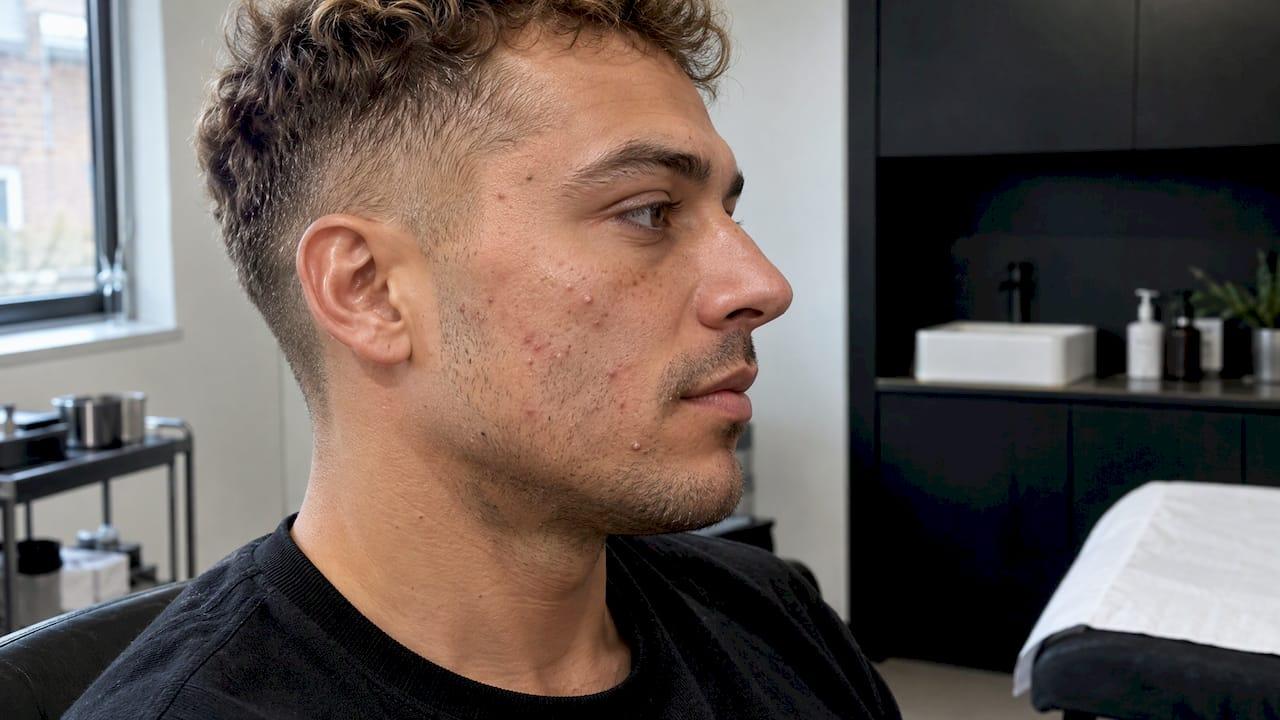
Skin purging is a short, temporary flare of spots that follows starting something that speeds up skin renewal, such as a retinoid or a chemical peel. A breakout is a reaction to something that does not suit your skin, or acne with its own cause, and it keeps going. The quickest tests are timing, location and duration: a purge starts soon after the change, stays in your usual spot areas and settles within about four to six weeks. A breakout appears in new places and does not settle.
If you have just had a peel at our Liverpool studio, or you are about to, this guide shows you what is normal, what is not and what to do in each case.
TL;DR
- A purge starts within days or a couple of weeks of a new exfoliating active or peel, appears where you usually get spots and typically settles in four to six weeks.
- A breakout shows up in new areas, keeps getting worse or comes with burning, itching or worsening redness.
- After a chemical peel, peeling is expected and some spots can follow. Protect your skin with a plain moisturiser and SPF and do not pick.
- If spots last beyond six to eight weeks, turn cystic or hurt, see your GP or a dermatologist.
- Injectable treatments at our studio are for clients aged 18 and over.
Table of Contents
- What skin purging actually is
- What a breakout is
- Purging vs breakout: the side-by-side test
- How long purging lasts
- Purging after a chemical peel
- Microneedling and retinol: a similar pattern
- What to do if you think your skin is purging
- When to see a GP or dermatologist
- Our view: why a men's clinic helps
- Book a men's skin treatment in Liverpool
- FAQ
- Sources
What skin purging actually is
Your skin sheds dead cells and renews itself all the time. Retinoids (vitamin A products), strong acids and professional peels speed that up. Blocked pores that were already forming under the surface get pushed up faster, so spots that would have appeared over the next few weeks arrive all at once.
That is why a purge tends to look like your usual spots, only more of them and for a short time. According to the dermatologist quoted by NBC News, purging usually means smaller spots such as whiteheads and blackheads, though it can look like any type of acne. The key point is that it is tied to a trigger and it improves.
The British Association of Dermatologists makes a similar point about prescribed treatments: some topical treatments such as retinoids can make acne worse for a few weeks before it gets better. It treats this as an expected, temporary stage of treatment, not a sign that the treatment is failing.

What a breakout is
A breakout is a flare of spots with a cause that is not simply faster renewal. It might be a new moisturiser or oil that clogs your pores, a shaving product, sweat under a cap or helmet, stress, hormones or ordinary acne. Because the cause is still there, the spots keep coming.
Typical acne can appear as blackheads, whiteheads, pustules, cysts or nodules without any clear trigger. The same NBC News piece notes that a purge is temporary and tied to starting a new active, while ordinary acne is not.
For men, a few everyday causes are worth checking before you blame a purge:
- Shaving: razor irritation and ingrown hairs look like spots, especially along the jaw and neck.
- Beard care: heavy oils and balms can clog pores under the beard.
- Sweat and friction: caps, helmets and gym kit can trap sweat against skin.
- Hair products: wax and pomade can run onto the forehead and hairline.
Purging vs breakout: the side-by-side test
| What to check | Likely purging | Likely breakout |
|---|---|---|
| Trigger | You started a retinoid, strong exfoliant or peel in the last few weeks | No clear trigger, or a new product that does not exfoliate |
| Timing | Starts within days to a couple of weeks of the change | Can start at any point and may follow a new product after a delay |
| Location | Your usual spot areas, or where the product went | Anywhere, including areas that are normally clear |
| Spot type | Mostly small whiteheads and blackheads, mild redness | Can include deep, painful spots, cysts and nodules |
| How long | Improves within about four to six weeks | Carries on, or gets worse, past six to eight weeks |
| Skin feel | Some dryness or flaking, no burning | Burning, itching, stinging or marked soreness |
Eucerin UK describes the location rule the same way: purging can appear in areas more prone to acne or where the product was applied, and breakouts can occur anywhere, even where you do not normally get spots.
No single row decides it. Use all six together. If three or more point to a breakout, treat it as one.
How long purging lasts
The commonly quoted window is four to six weeks. Eucerin UK says purging typically lasts between four and six weeks after starting a new active product. A US dermatology-sourced guide agrees that purge pimples appear and disappear faster than a normal pimple.
Treat six weeks as the point to stop and think. One dermatologist quoted by NBC News suggests that if spots continue beyond eight weeks, spread to new areas or come with burning, itching or worsening redness, it is more likely irritation or true acne.
Be realistic about acne treatment too. The British Association of Dermatologists says to expect to use treatments for at least 12 weeks before seeing much improvement. A flare in week three is not the verdict. Week twelve is a fairer point to judge.

Purging after a chemical peel
A peel is a controlled exfoliation. A professional applies an acid to the skin so the top layer loosens and sheds. Our chemical peel for men's skin guide explains how that works for male skin, and what a glycolic acid peel does covers one of the most common acids.
What is normal in the days after a peel:
- Tightness, mild redness and flaking.
- Visible peeling. PBL Magazine, a trade title for aesthetic professionals, reports that with superficial peels the surface heals within about three to five days and shedding is expected.
- Some spots in the following weeks. The same article describes breakouts as an acknowledged post-peel effect, managed conservatively.
A flare that begins within days of a strong exfoliant and settles over four to six weeks fits a purge. Per the same source, lesions that persist or escalate beyond that window, cystic flares or significant dermatitis point to something else: intolerance, the wrong strength or a different diagnosis. Those need reassessment.
Irritation is not purging. Burning, scaling and widespread redness suggest the skin barrier has been injured, not that pores are clearing.
What to do in the first week after a peel
- Use a bland, fragrance-free moisturiser and a broad-spectrum SPF. PBL Magazine advises protecting the barrier first.
- Pause home exfoliants for several days, then bring actives back slowly.
- Do not pick or squeeze. The British Association of Dermatologists warns that picking and squeezing aggravates spots and can cause scarring and infection.
- Keep your routine simple. Our peel recovery guide for men sets out the day-by-day detail.
How a course of peels fits in
With a series of peels, a few spots after the first session do not mean the course is not working. Skin that is renewing faster can bring blocked pores up to the surface. That is one reason a course is planned over several visits and not judged on a single week.
At Rivers Edge Skin Studio a single chemical peel is £60, a course of two is £100 and a course of four is £200. If you are choosing between peel types, professional peels for men compared helps you match the peel to your skin concern.
Microneedling and retinol: a similar pattern
Microneedling makes tiny controlled channels in the skin to prompt renewal. Some men notice small spots or a rough patch in the weeks after. If you use retinol at home, restarting it too soon can add irritation on top. Our guide on when to restart retinol after microneedling gives the timing.
A single microneedling facial at the studio is £70, a course of two is £100 and a course of four is £200.
What to do if you think your skin is purging
Keep going, gently
If your spots fit the purge pattern and your skin is not burning or stinging, you usually do not need to stop. You need to be gentle.
- Cut back how often you use the active. The NHS Somerset formulary suggests that to reduce irritation from retinoids or benzoyl peroxide, you start with alternate-day or short-contact application and build up if your skin tolerates it.
- Use a mild cleanser. NICE guidance on acne advises a gentle, skin-pH-neutral or slightly acidic cleanser twice daily, and avoiding oil-based and pore-clogging skincare products.
- Add one new product at a time, so that if something goes wrong you know which one did it.
If you have oily skin and are building a routine, our men's oily skin routine is a sensible starting point.
Stop or pause if you see these signs
If a cream or lotion makes your face red and sore, the British Association of Dermatologists advises you stop it for a few days, then use it less often and build up gradually. Pause exfoliating products and get advice if:
- spots continue past six weeks;
- breakouts appear in new areas;
- your skin feels very dry, tight or flaky;
- you have burning, itching or painful stinging.
Those are the warning signs Eucerin UK lists as reasons to stop or pause exfoliating.
When to see a GP or dermatologist
This is the part not to skip. See your GP if:
- your spots are deep, painful or leaving marks or scars;
- they have not improved after the six to eight week window;
- irritation continues even after you reduce how often you use a product;
- the spots are affecting your mood or confidence.
NICE guidance on acne sets out when people should be referred to a consultant dermatologist-led team: diagnostic uncertainty, acne conglobata or nodulo-cystic acne. Sudden, severe acne with fever or feeling unwell is an emergency (acne fulminans) and needs urgent medical assessment the same day. Acne that causes persistent distress is also a reason for referral, and the NHS Somerset summary of NICE guidance says significant distress should be taken seriously, not waved off as vanity.
Persistent acne and the marks it leaves behind are treatable. If you are left with scarring, our guide to treating acne scarring in men explains the clinical options.
Our view: why a men's clinic helps
Most men who ask us about purging have done the same thing: started a strong product, panicked at week two and either stopped or piled on more products. Both make it harder to read what the skin is doing.
We work only with men's skin. That means we think about beards, shaving irritation, oilier skin and the way men tend to treat their skin: quickly, and with whatever is in the bathroom. Our treatment plans are personalised, so the strength and spacing of a peel or microneedling course are chosen with your skin in mind.
The practical advice is simple. Change one thing at a time, keep aftercare plain, give it four to six weeks and do not pick. A course of treatments, planned over several visits, gives you a clear start point and a clear way to judge results.
David
Book a men's skin treatment in Liverpool
Rivers Edge Skin Studio is a men-only skin and aesthetics clinic at Unit 6, 10-14 Jamaica St, Liverpool L1 0AF. We offer men's facials, chemical peels, microneedling, skin boosters, anti-wrinkle injections, sweat (hyperhidrosis) injections, polynucleotides, vitamin injections and hair-loss treatments. Injectable treatments are for clients aged 18 and over.
If spots, texture or oiliness are your concern, our chemical peels and microneedling are the places to start. Facials are £35 each, including the Bearded Man Facial and the Deep Cleanse Facial. You can see everything on our services page.

We are open Monday to Saturday, 10:00 to 17:00, and closed on Sunday. Book your appointment online. Once your treatment is done, how to maintain results after a facial treatment keeps your skin on track.
FAQ
How do I know if my face is breaking out or purging?
Look at timing, location and duration. A purge begins soon after you start an exfoliating active or have a peel, stays in your usual spot areas and improves within about four to six weeks. A breakout appears in new areas, carries on beyond that window or comes with burning and itching.
How long does purging last after a chemical peel?
The peel itself usually heals on the surface within three to five days, with flaking along the way. Any spots that follow generally settle over four to six weeks. If they are still getting worse after six weeks, or turn deep and painful, see your GP.
Should I stop using my retinol or acid if my skin is purging?
Not necessarily. If your skin is not burning or stinging, you can use the product less often and build up slowly. Stop it for a few days if your skin becomes red and sore, and speak to a healthcare professional if irritation persists.
Can I pick purging spots?
No. Picking and squeezing aggravates spots and can cause scarring and infection. Keep your routine simple with a mild cleanser, a plain moisturiser and SPF, and let the spots run their course.
Is it purging, or is my skin just irritated?
Purging looks like extra spots in your usual areas. Irritation looks and feels different: burning, scaling, tightness and widespread redness. That points to a damaged skin barrier, so pause exfoliants and keep to gentle products.
Sources
- Skin Purging vs. Breakouts: How to Tell the Difference, According to Derms (NBC News)
- Acne (British Association of Dermatologists)
- What Is Skin Purging and How to Manage It (Eucerin UK)
- How to Tell If Your Skin Is Purging or Breaking Out (Healthline)
- Is it normal for skin to purge after a facial? (PBL Magazine)
- Acne vulgaris: management, NG198 (NICE)
- 13.6 Rosacea and acne (Somerset Prescribing Formulary)