
If your forehead and nose turn shiny by lunchtime while your cheeks feel tight, you have combination skin. The routine that suits it is short: a gentle cleanse, a light moisturiser, daily sunscreen, and one carefully chosen treatment step. This guide sets out each step for morning and evening, the ingredients that suit two skin types on one face, and how often to exfoliate. It also shows where a professional treatment at our men's skin clinic in Liverpool fits in once the basics are working.
TL;DR
- Confirm your skin type first: wash, wait 30 minutes with nothing on your face, then see whether only the T-zone (forehead, nose, chin) is oily.
- Keep the routine to three steps: gentle cleanser, lightweight moisturiser, SPF 30 or higher every morning.
- Use one active at a time, and exfoliate gently once or twice a week at most. Never scrub.
- Give any new product several weeks before judging it. See your GP if spots are deep, painful, scarring or affecting your mood.
- Once the basics are in place, facials, chemical peels and microneedling at Rivers Edge Skin Studio can target the areas a home routine struggles with.
Table of Contents
- How to tell if you have combination skin
- Why men's combination skin needs a plan
- The morning routine: three steps
- The evening routine: cleanse, treat, moisturise
- Ingredients that suit two skin types on one face
- Exfoliating without wrecking your skin
- A simple weekly rhythm
- How long until you see a difference
- Where clinic treatments fit in
- Book a men's skin appointment in Liverpool
- Our view on combination skin
- FAQ
- Sources
How to tell if you have combination skin
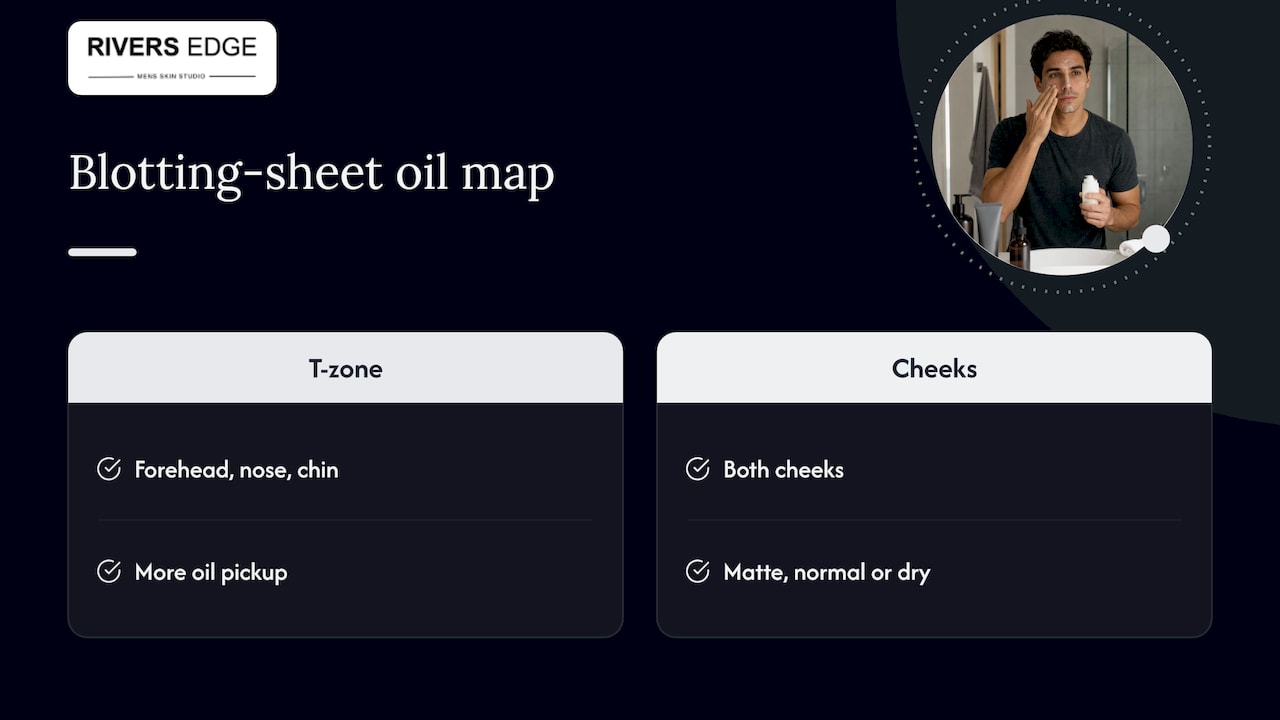
Combination skin means different parts of your face behave differently. The British Skin Foundation's guide by consultant dermatologist Dr Jonathan Kentley gives a simple home test for identifying your skin type. Wash your face and pat it dry. Wait 30 minutes without applying any products. Then look in the mirror. If the T-zone looks oily while the rest of your face looks matte, normal or dry, that is combination skin.
Blotting sheets make this easier. Press one on your forehead, nose, chin and each cheek, and compare how much oil each one picks up. You get a quick map of where your skin produces the most oil.
Two things are worth knowing. The same guide notes that how much oil your skin makes is largely down to genetics, so you are not doing anything wrong if your nose shines. It also says skin type can shift with age and environment, so a routine that worked at 25 may need adjusting at 40, or when you move from summer to winter. Our guide to identifying your skin concerns as a man goes further if you are unsure what you are looking at.
Why men's combination skin needs a plan
Shaving, gym sessions, heating and weather all act on skin that is already uneven. Razors remove surface cells and can leave the cheeks and neck sensitive. Sweat and sunscreen sit on the T-zone and can leave it congested. Meanwhile the cheeks and jawline may feel dry after a hot shower or cold wind.
The American Academy of Dermatology says there is no one-size-fits-all approach to men's skin care, and recommends choosing products by your skin type and concerns. That is the principle behind everything below: keep the routine light, and adjust by area rather than loading the whole face with heavy products or harsh ones.
The morning routine: three steps
Morning is about a clean surface, light hydration and protection. It should take two minutes.
Step 1: Cleanse gently
Use a mild facial cleanser and lukewarm water, not hot. The AAD advises that approach, and washing daily and after exercise. Patient.info's men's routine guide, peer reviewed by Dr Krishna Vakharia, recommends a soap-free face wash rather than soap or shower gel, because those can strip natural oils and dry the skin.
With combination skin, stripping is the trap. Skin that feels squeaky clean is often skin that has lost too much oil, and it can respond by producing more. If your cheeks are dry in the morning, a splash of water on them is enough. Save the full cleanse for the T-zone.
Step 2: Moisturise lightly
Oily areas still need moisture. Choose a lightweight, non-comedogenic moisturiser, meaning one formulated not to block pores. Dr Kentley's guidance says different areas may need different textures: a lotion or gel on the oily parts and a richer cream on dry patches. In practice, one light gel-cream over the whole face is enough for most men, with a second thin layer on any dry cheek.
Step 3: Sunscreen, every day
This is the step that does the most for your skin over the years. UK Men's Health recommends a face sunscreen of at least SPF 30 every day, including in winter. Northumbria Healthcare NHS Foundation Trust advises SPF 30 or higher with at least four UVA stars, and notes the UVA circle logo shows UVA protection.
For combination skin, pick a light, non-greasy face sunscreen, ideally fragrance-free. Men's Health reports that skincare experts prefer a dedicated face product that leaves no residue. If you are outdoors for long, the same NHS page says to reapply about every two hours, and after sweating or towel drying. Cover your face, neck and ears.
A vitamin C serum between cleanser and moisturiser is an optional extra in the morning if you want an antioxidant step. It is not essential to start.
The evening routine: cleanse, treat, moisturise
Evening is where your skin gets cleaned and repaired.
- Cleanse. The aim is to remove sunscreen, sweat, dirt and the day's build-up. If you wear sunscreen daily or have a thick beard, a second pass with the same gentle cleanser helps. Avoid anything harsh or heavily fragranced.
- Treat, if you want to. This is the optional step. Use one active ingredient, not several. We cover choices below.
- Moisturise. A slightly richer moisturiser can go on at night, applied mostly to the drier areas. Leave the T-zone with a thin layer.
If you shave in the evening, do it before cleansing or straight after, and use a gentle aftershave balm instead of an alcohol splash. Our guide on how to start a men's skincare routine covers shaving and routine order for beginners.
Ingredients that suit two skin types on one face
The hard part of combination skin is that what helps one zone can irritate another. The British Skin Foundation guide notes that salicylic acid may suit the T-zone but dry out other areas. It also names three ingredients that may be tolerated across the whole face:
| Ingredient | What it does | Where to use it |
|---|---|---|
| Hyaluronic acid | Adds water to skin without adding oil | Whole face, morning or evening |
| Niacinamide | A versatile ingredient often used for oil control and general skin health | Whole face |
| Azelaic acid | Helps with blemish-prone skin | Whole face, evening |
| Salicylic acid | Works inside pores | T-zone only |
A few label rules help. The AAD advises oil-free or non-comedogenic products for acne-prone skin, and mild fragrance-free products for sensitive skin. It also warns that "unscented" does not always mean fragrance-free, because some products contain a masking fragrance. Check the ingredients list for "parfum".
Introduce one new product at a time, and wait a couple of weeks before adding the next. If something stings or reddens, you will know what caused it.
Exfoliating without wrecking your skin
Most men with combination skin either never exfoliate or scrub too hard. Neither helps. The NHS acne guidance advises against scrubbing, which can irritate skin and make acne worse, and recommends non-comedogenic products.
A better approach is a gentle chemical exfoliant, such as one with lactic acid, once or twice a week, in the evening. Do not combine it on the same night with another strong active. If you use stronger acne products, NHS England's Pharmacy First pathway notes that benzoyl peroxide and retinoids can irritate. It suggests starting on alternate days, or washing the product off after an hour, then increasing as your skin tolerates it.
A simple weekly rhythm
| Day | Morning | Evening |
|---|---|---|
| Most days | Cleanse (T-zone), light moisturiser, SPF 30+ | Cleanse, moisturise |
| Once or twice a week | Same | Cleanse, gentle exfoliant, moisturise |
| After the gym | Rinse and cleanse gently | Normal evening routine |
Gym sweat can clog the T-zone and the hairline. If you get breakouts after training, see our guide to gym acne in men for changes worth making first. In winter, heating and wind dry the cheeks further, and our winter skincare routine for men shows how to adjust.
How long until you see a difference
The British Skin Foundation says that finding the right routine can take time. For acne treatments, NHS England says improvement may take 6 to 8 weeks. Hydration and shine control often feel better sooner, but give any change a few weeks before you judge it. Switching products every few days is the most common reason men feel nothing works. Our piece on why skincare results vary for men explains the factors behind that.
When to see your GP
A routine is for everyday maintenance. Acne that needs clinical assessment is a different matter. The NHS says to see your GP if self-treatment is not improving your acne, or if spots are numerous, deep or painful, leave scarring, show signs of infection, or are affecting your mental health. NHS England adds that you should go to general practice if over-the-counter treatment has not helped after the 6 to 8 weeks, or sooner if the skin is getting worse or severely irritated. A GP can refer you to a dermatologist if needed.
Where clinic treatments fit in
A good home routine keeps combination skin balanced. Professional treatments go after what products at home cannot reach as easily: congested pores in the T-zone, uneven texture, dullness, and the early lines that show around the eyes and forehead. At Rivers Edge Skin Studio in Liverpool we work only with men's skin, and we offer men's facials, chemical peels, microneedling, skin boosters, anti-wrinkle injections, sweat (hyperhidrosis) injections, polynucleotides, vitamin injections and hair-loss treatments, all built around a personalised treatment plan.
For combination skin, these are the usual starting points:
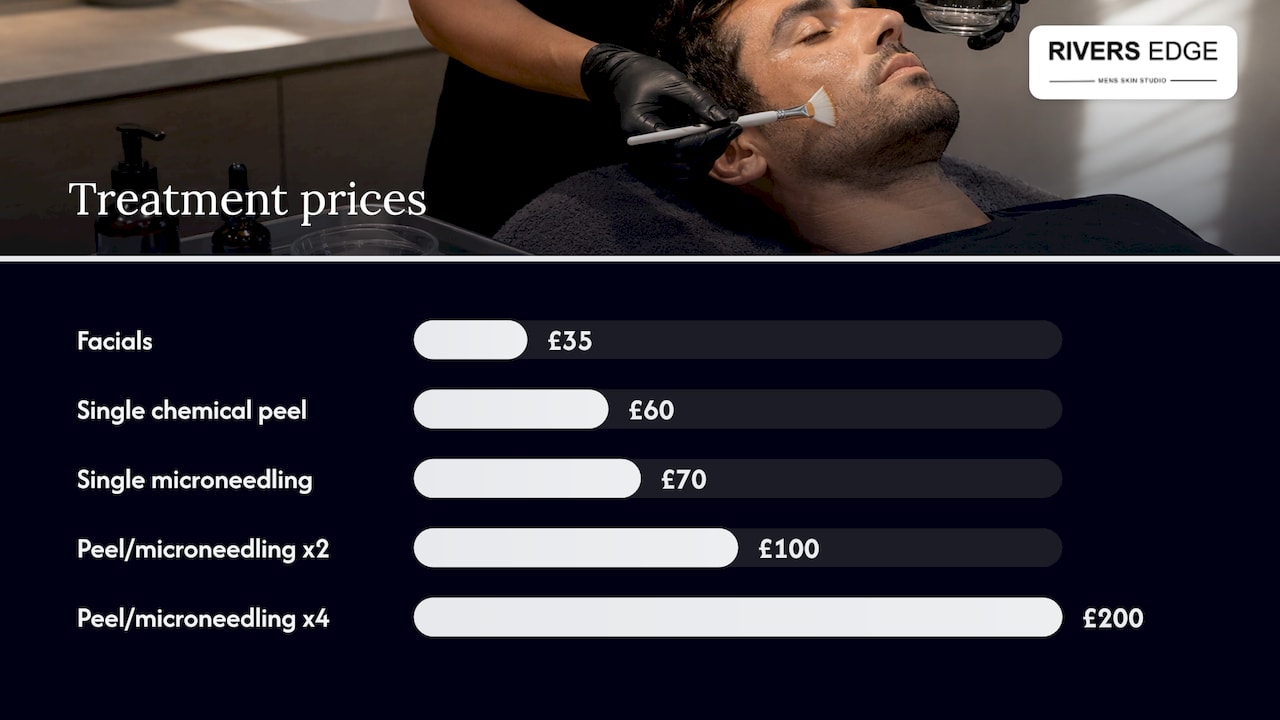
- Facials. Our Deep Cleanse Facial, Bearded Man Facial, Black Tie Facial and Relaxation Facial are each £35. The Deep Cleanse suits a congested T-zone, and the Bearded Man Facial looks after skin under facial hair.
- Chemical peels. A single peel is £60, a course of 2 is £100 and a course of 4 is £200. Peels are used to refine texture and tone, which suits a shiny, uneven T-zone. See our chemical peels in Liverpool page.
- Microneedling. A single facial is £70, a course of 2 is £100 and a course of 4 is £200. It is aimed at texture and visible skin renewal. See microneedling for men in Liverpool.
If you are planning more than one treatment, our guide on combining skincare treatments shows how they are sequenced. After a peel or microneedling, follow the steps in post-treatment skincare for men. If shine is your main frustration, read about clinic treatments that control oily male skin. To keep results going, use these tips on maintaining results after a facial.
If lines are a concern as well, we also offer anti-wrinkle injections. They are for clients aged 18 and over, and the page on anti-wrinkle injections for men in Liverpool explains the treatment.
Book a men's skin appointment in Liverpool
We are at Unit 6, 10-14 Jamaica St, Liverpool L1 0AF, open Monday to Saturday 10:00 to 17:00 and closed on Sunday. You can see every treatment on our services page and book online.

Tell us about your skin type, your routine and what bothers you most, and we will build a plan around it.
Our view on combination skin
Most men come to us having tried a product for a week, seen no change and given up. Combination skin is easy to manage once you stop treating the whole face as one thing.
Keep the home routine short and consistent: gentle cleanse, light moisturiser, sunscreen. That is the foundation. Then use professional treatments where they make the biggest difference, such as a peel for the T-zone or microneedling for texture.
Our clinic is for men only, and our treatments are designed around how men's skin behaves: thicker, more prone to shaving irritation, and often neglected for years. Looking after your skin should not be complicated, and a plan built around your face makes it simpler.
David
FAQ
Should men with combination skin use different products on different areas?
It can help. Dr Kentley's British Skin Foundation guide says different zones may need different products, for example salicylic acid on the T-zone only, and a richer moisturiser on dry patches. If that feels like too much, one light moisturiser and an ingredient such as hyaluronic acid works across the whole face.
Do I need to moisturise if my face is oily?
Yes. Choose a lightweight, non-comedogenic moisturiser. Skin that is oily can still be short of water, and hyaluronic acid is a hydrating ingredient that does not add oil. Skipping moisturiser tends to leave the cheeks tight.
Is SPF necessary in winter?
UK Men's Health recommends SPF 30 or higher every day, including in winter. Choose a light, fragrance-free face sunscreen so it does not sit heavily on the T-zone.
Can I get a facial or peel if I have combination skin?
Yes, and the treatment can be matched to the area: for example, a deep cleanse for a congested T-zone. Tell us about your skin when you book and we will recommend a plan. Our men's facials are £35, and peels and microneedling are priced per session or as courses.
Sources
- Identifying your skin type: a guide by Dr Jonathan Kentley, British Skin Foundation
- Skin care tips for men, American Academy of Dermatology
- Skincare Routine for Men: 3 Easy Steps for Better Skin, Men's Health UK
- The simplest men's skincare routine, Patient.info
- Staying safe in the sun, Northumbria Healthcare NHS Foundation Trust
- Acne, NHS
- Pharmacy First: mild to moderate acne prescribing pathway, NHS England