
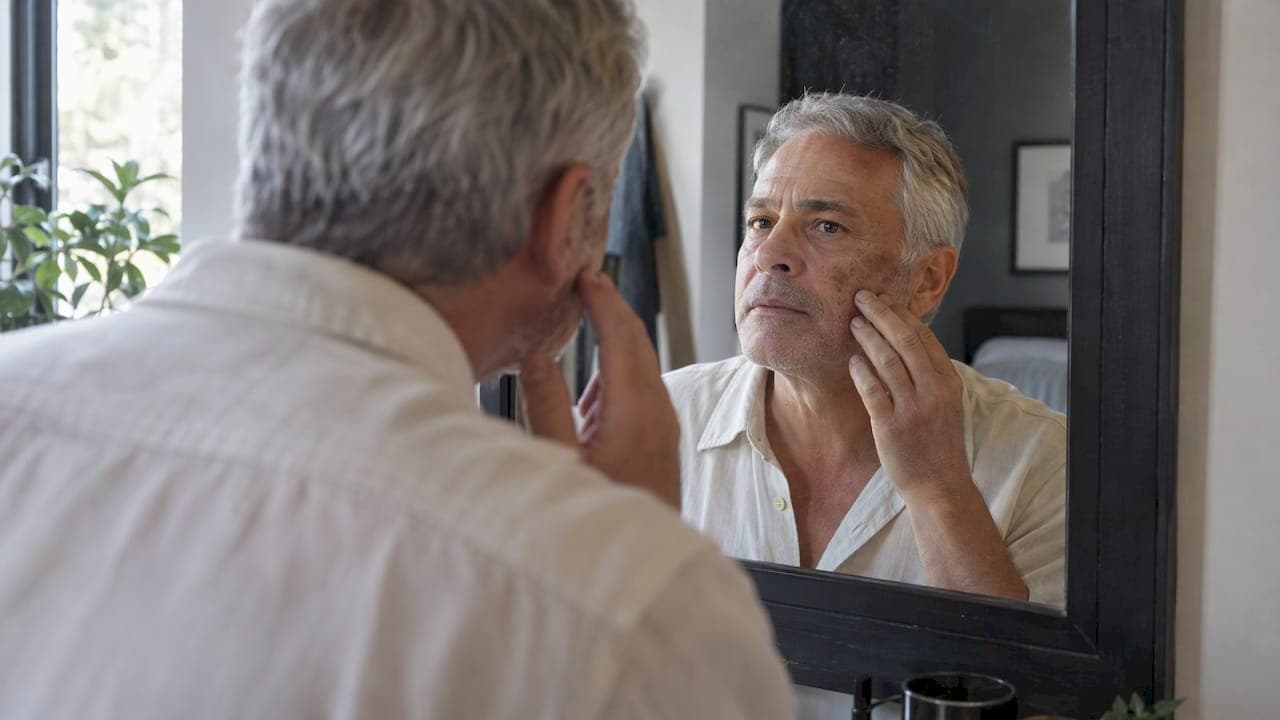
Uneven skin tone in men is usually patchy darkening (hyperpigmentation) from sun exposure, old spots or irritation, sometimes with redness on top. It can be improved, but rarely erased for good. The routine that works combines daily sun protection, a few sensible products and, where needed, professional treatments such as chemical peels or microneedling.
This guide explains what is behind the patches, what you can fix at home, when a clinic makes sense and what to expect on timing and cost.
TL;DR
- Most uneven tone in men comes from sun damage, marks left by spots or shaving irritation, and sometimes melasma.
- Daily SPF is the foundation. Without it, nothing else holds.
- Chemical peels and microneedling are the two professional treatments we use most for tone. Expect 8 to 16 weeks to judge results.
- Not every patch responds: surface pigment usually does, deeper pigment is harder.
- Improvement is management, not a cure. Keep protecting your skin afterwards.
Table of Contents
- What uneven skin tone actually is
- The main causes in men
- Check this before you treat anything
- What you can do at home
- When home care is not enough
- Which treatment suits which problem
- Not all pigment responds the same
- How long it takes
- Our perspective: what we see in men's skin
- What treatment costs at Rivers Edge Skin Studio
- Frequently asked questions
- Sources
What uneven skin tone actually is
Uneven tone means your complexion looks patchy. Some areas are darker, some are red, and the overall finish looks less smooth. The darker areas are hyperpigmentation: localised areas of skin that become darker than the tissue around them.
It is one of the most common grooming concerns men have, and one of the least discussed. Most men notice it in the mirror, in photos or after a summer outdoors, and then do nothing, because it is unclear what to buy or who to ask.
Two things are often mixed up:
- Pigmentation: brown or greyish patches, freckle-like spots, darker marks where a spot used to be.
- Redness: broken capillaries, general flushing, irritated or sensitive skin.
They look similar from a distance but need different handling. A treatment aimed at brown patches will not calm redness, and the reverse is true. Working out which one you have is the first step.
The main causes in men
Sun damage
UV exposure is the biggest driver. Skin that has had years of sun develops more wrinkles and more uneven pigmentation, with small darker and lighter patches. Men who work outdoors, drive a lot, play golf or football, run or cycle often have more of it on the face, ears, neck and the top of the head.
You do not need a holiday for this to build up. The NHS is clear that you can burn in the UK, even when it is cloudy, and that a tan is not protective. Merseyside weather does not get us off the hook.
Marks after spots and irritation
Post-inflammatory hyperpigmentation (PIH) is the dark mark that stays after acne, an ingrown hair, a razor cut or a patch of irritated skin. Men who shave daily, or who pick at spots, tend to see it along the jaw and neck. The spot is gone, the mark is not.
Melasma
Melasma is symmetrical, blotchy brown patches, mainly on the face, and it gets darker after sun. It is more often discussed in women, but men get it too. The British Association of Dermatologists describes it as a common adult condition and notes there is no permanent cure. If your patches are symmetrical and keep returning, a GP or dermatologist is the right first call.
Other contributors
- Dry, dehydrated skin that looks dull and rough.
- Dark circles under the eyes.
- Skin sensitivity from harsh products or aggressive shaving.
- Genetics and skin type.
Check this before you treat anything
Some changes are not cosmetic. A mole or patch that is new, changing shape or colour, itchy, crusty or bleeding needs to be seen by your GP, not treated with a peel. Skin cancer checks come first. If something has changed, book a GP appointment before any cosmetic treatment.
If your patches are widespread, appeared suddenly or came with other symptoms, speak to your GP as well.
What you can do at home
Looking after your skin should not be complicated. For tone, four habits matter more than any single product.
1. Wear sunscreen every day
This is the part everyone skips and the part that decides the result. The BAD says any plan for pigmentation needs consistent, year-round sun protection, because UV can undo progress quickly.
Application matters as much as the product. Most people use far too little, which cuts the protection well below the number on the bottle. The NHS advises using enough to cover the area properly and reapplying every two hours, and straight after sweating, washing or towel drying. For the head and neck, that is roughly a teaspoon. Do not forget ears, the back of the neck and a thinning scalp.
2. Moisturise
Dry skin scatters light and looks patchy. A plain moisturiser applied after washing makes skin look smoother and more even within days, even though it does not change pigment.
3. Use a vitamin C serum in the morning
Vitamin C is an antioxidant that helps skin tone by reducing oxidative stress. A systematic review of 139 patients found vitamin C treated skin looked smoother, less wrinkled and better hydrated. The same literature suggests it works best as an adjunct to physical treatments such as peels, not as a stand-alone fix. Think of it as support.
4. Exfoliate gently
A mild exfoliant once or twice a week clears dead skin and helps the surface look even. More is not better. Over-scrubbing irritates skin, and irritation can leave new dark marks, especially on darker skin tones.
For a wider routine, our guide to men's skin care essentials covers the basics, and our piece on preventing premature skin ageing explains how to slow the damage that causes patches in the first place.
When home care is not enough
If you have used SPF properly for two to three months and the patches have not moved, professional treatment is the next step. The two options we lean on for tone are chemical peels and microneedling.
Chemical peels
A peel applies an acid solution that loosens the top layer of dead, pigmented skin so fresher skin takes its place. It suits sun spots, uneven texture, post-acne marks and dullness. Peels are usually done as a short course rather than one-off, because pigment fades in stages.
Care matters here. Experts note that darker skin types carry a higher risk of post-inflammatory hyperpigmentation if a peel is too strong, so strength has to be matched to your skin. That is why we plan treatment around the individual. You can read more in our guide to chemical peels for men's pigmentation, or see our chemical peels in Liverpool page.
Microneedling
Microneedling uses very fine needles to create tiny controlled channels in the skin. This triggers repair, and it also helps active ingredients reach the skin. For pigmentation, the evidence is strongest when it is paired with topical products. A meta-analysis of microneedling as an adjuvant to topical therapies for melasma found promising but variable results, and a separate review reported significantly greater improvement when microneedling was combined with agents such as vitamin C or tranexamic acid than with topicals alone. Clinical studies have generally reported it as well tolerated, with no serious adverse events commonly seen.
Those studies looked at melasma, which is harder to treat than most sun or acne marks, so they are a cautious guide rather than a promise for your skin. Microneedling is also considered a safer choice for darker skin types, where stronger peels and lasers carry more risk.
If comfort is a worry, there is useful background on numbing options for microneedling. Ask us what is suitable for you at your consultation. Our microneedling page explains the treatment in more detail, and our guide to redness after microneedling covers what the first few days look like.

Combining treatments
A multi-step approach tends to work better than relying on one product or one session. Peels, microneedling and a good home routine can be sequenced, with gaps between sessions. Our guide on how to combine skincare treatments shows how that works in practice. For a broader view of the goal, see what skin brightening treatment involves.
Which treatment suits which problem
| What you see | Likely cause | Where to start |
|---|---|---|
| Freckle-like brown spots on cheeks, nose, forehead, ears | Sun damage | Daily SPF, then a peel course |
| Dark marks along jaw and neck | Post-shaving or ingrown hair irritation | Gentler shaving, SPF, peel or microneedling |
| Flat marks where spots were | Post-acne PIH | Peels or microneedling |
| Symmetrical blotchy patches | Possible melasma | See your GP first, then discuss treatment |
| Dull, rough, patchy look | Dry skin, build-up | Moisturiser, gentle exfoliation, facial |
| Redness and flushing | Sensitivity, capillaries | Calm the skin, see a GP if persistent |
Not all pigment responds the same
Pigment sits at different depths. Epidermal (surface) pigment is generally more responsive to topical therapies and professional treatments like peels or microneedling. Deeper dermal pigment is slower and sometimes does not shift much. A professional examination helps judge which you have and whether treatment is likely to give a visible change.
That is why a straight answer matters. If we think a treatment will not help your type of pigmentation, we will say so before you spend anything.
How long it takes
This is where most men give up too early. Research on combination therapy shows improvements typically become significant from around 8 weeks, with the best results at 12 to 16 weeks. Expect gradual change rather than a transformation after one visit.
A realistic timeline looks like this:
- Weeks 0 to 4: first treatments, skin may look pink or flaky for a short time. Strict SPF from day one.
- Weeks 4 to 8: skin feels smoother. Patches may start to soften.
- Weeks 8 to 16: the point at which to judge results.
- After that: maintenance, plus SPF all year.
After any treatment, follow the aftercare. Our post-treatment skincare steps are simple, and the rule on sun exposure after microneedling is worth reading before you book a holiday.
For sun-damaged skin in particular, a proper check first is sensible. Our article on getting a skin assessment before peels or lasers explains why.
Our perspective: what we see in men's skin
Most men who come to us for tone do not want a long routine. They want to look healthier and more even, and for nobody to be able to tell they had anything done. That is the standard we work to.
We only treat men's skin, and that changes how we plan. Men's skin is typically thicker and oilier, and shaving adds daily irritation. Beards complicate things further. Treatments need to work around all of that, and the plan needs to fit around a working week.
Three things we tell nearly everyone:
- Start with SPF. If you will not wear it, treatment will not last.
- Choose a short course over a single session. Pigment fades in steps, and a course costs less per session.
- Judge results at 8 to 16 weeks, not after one visit.
We would rather set honest expectations than promise a perfect finish. Pigmentation is managed, not cured, and a good plan makes it far less noticeable and easier to keep under control.
— David
What treatment costs at Rivers Edge Skin Studio
The treatments most relevant to uneven tone are below. These are our published prices.
| Treatment | Price |
|---|---|
| Chemical Peel (Single Treatment) | £60 |
| Chemical Peel (Course of 2) | £100 |
| Chemical Peel (Course of 4) | £200 |
| Microneedling Facial (Single Treatment) | £70 |
| Microneedling Facial (Course of 2) | £100 |
| Microneedling Facial (Course of 4) | £200 |
| Deep Cleanse Facial | £35 |
| Bearded Man Facial | £35 |
A course of four peels or four microneedling sessions works out at £50 a session, against £60 or £70 for a single visit. If your skin is dull or congested rather than patchy, a facial at £35 is a simple place to start. The Bearded Man Facial is designed for men with facial hair.
We are a men's clinic serving Liverpool and Merseyside. You can see everything on our services page, and book online when you are ready. We will talk through your skin and agree a plan before any treatment starts.

Frequently asked questions
Is it possible to fix uneven skin tone?
It can usually be improved a lot, but not always cleared completely or permanently. Surface pigment from sun or old spots responds best. Conditions such as melasma tend to return if sun protection slips, so maintenance is part of the plan.
How can I fix uneven skin pigmentation?
Start with daily sunscreen, a moisturiser and a gentle routine. If that is not enough after a couple of months, peels or microneedling are the usual professional options, often as a course. Anything that has changed in size or colour should be checked by your GP first.
Can vitamin C help even skin tone?
Yes, as support. Topical vitamin C is an antioxidant, and reviews show it improves smoothness and hydration. It tends to work best alongside treatments like peels rather than alone, and it does not replace sunscreen.
What is the main cause of uneven skin tone?
In most men it is sun exposure over the years. Marks from acne, ingrown hairs and shaving irritation come next, and melasma is a less common cause. Daily SPF is the single most useful change you can make.
Sources
- Hyperpigmentation of the face and neck, Primary Care Dermatology Society
- Melasma chloasma, Primary Care Dermatology Society
- Melasma, British Association of Dermatologists
- Sunscreen and sun safety, NHS
- Care for skin with sun damage, Cambridge University Hospitals
- Vitamin C systematic review, Journal of Cosmetic Dermatology
- Microneedling as an adjuvant to topical therapies for melasma, JAAD
- Microneedling and topical therapy review, PubMed
- Managing facial hyperpigmentation in skin of colour, PMC